
Theory of Computation Lecture 1 2 3 Book
Theory of Computation Lecture # 1 -2 -3
Book �Introduction to Theory of Computation by Anil Maheshwari Michiel Smid, 2014 �“Introduction to computer theory” by Daniel I. A. Cohen Second Edition �Introduction to the Theory of Computation (second/third edition) by Michael Sipser �Introduction to Languages and Theory of Computation, by J. C. Martin, Mc. Graw Hill Book Co. , 1997, Second Edition
Main contents �RE �NFA �DFA �CFG �PDA �NPDS �TM(The Church-Turing Thesis ) �Decidable and Undecidable Languages �NP Completeness Complexity Theory �Reducibility & Intractability
Language �Natural Languages �English, Chinese, French, Urdu etc �Programming Languages �Basic, Fortran, C, C++, Java etc �Mathematics �State diagram etc
Components of Language �Alphabets �Basic elements �Set of letters or characters �Rules �Grammar �Tells you that words belongs to a language �Syntax �Meaning �Semantics
Definition �Language �Set of strings of characters from the alphabets �Word �A set of characters belongs to the language
English Words �Alphabets �a b c……z A B C ……. Z punctuation marks, blank space etc �Words �All words in standard dictionary �What is on the exam �The quick brown fox jumped over the lazy dog �E. g context-free, regular……
C-Language �Alphabets �ASCII characters �Words �Programs �#include<conio. h> main() {printf(“Hello”); }
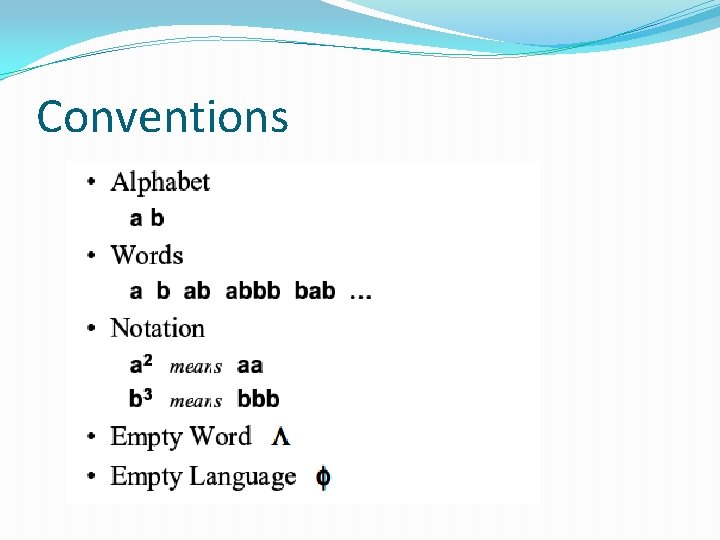
Conventions
What does Theory of automata mean? �The word “Theory” means that this subject is a more mathematical subject and less practical. �Automata is the plural of the word Automaton which means “self-acting” �In general, this subject focuses on theoretical aspects of computer science.
Theory of Automata Applications �This subject plays a major role in: �Defining computer languages �Compiler Construction �Parsing �etc
Types of languages �There are two types of languages �Formal Languages are used as a basis for defining computer languages �A predefined set of symbols and string � Formal language theory studies purely syntactical aspects of a language (e. g. , word abcd) �Informal Languages such as English has many different versions
Basic Element of a Formal Language – Alphabets �Definition: �A finite non-empty set of symbols (letters), is called an alphabet. It is denoted by Greek letter sigma Σ. �Example: �Σ={1, 2, 3} �Σ={0, 1} //Binary digits �Σ={i, j, k}
Example Computer Languages �C Language �C++ �Java �Vb. net �C#. net �etc
What are Strings �A String is formed by combining various symbols from an alphabet. �Example: �If Σ= {1, 0} then some sample strings are � 0, 1, 110011, …. . �Similarly, If Σ= {a, b} then some sample strings are �a, b, abbbbbb, aaaabbbbb, …. .
What is an EMPTY or NULL String �A string with no symbol is denoted by (Small Greek letter Lambda) λ or (Capital Greek letter Lambda) Λ. It is called an empty string or null string. �Please don’t confuse it with logical operator ‘and’.
What are Words �Words are strings that belong to some specific language. �Example: �If Σ= {a} then a language L can be defined as �L={a, aaa, …. } where L is a set of words of the language define by given set of alphabets. Also a, aa, … are the words of L but not ab.
Defining Alphabets – Guidelines �The following are three important rules for defining Alphabets for a language: �Should not contain empty symbol Λ �Should be finite. Thus, the number of symbols are finite �Should not be ambiguous �Example: an alphabet may contain letters consisting of group of symbols for example Σ 1= {A, a. A, bab, d}. �All starting letters are unique
Defining Alphabets – Guidelines �Now consider an alphabet Σ 2= {A, Aa, bab, d} and a string Aabab. A. This string can be factored in two different ways (Aa), (bab), (A), (abab), (A) �Which shows that the second group cannot be identified as a string, defined over Σ = {a, b}. �This is due to ambiguity in the defined alphabet Σ 2 (Because of A and Aa)
Ambiguity Examples �Σ 1= {A, a. A, bab, d} �Σ 2= {A, Aa, bab, d} �Σ 1 is a valid alphabet while Σ 2 is an in-valid alphabet. �Similarly, �Σ 1= {a, ab, ac} �Σ 2= {a, ba, ca} �In this case, Σ 1 is a invalid alphabet while Σ 2 is a valid alphabet.
Length of Strings Definition: �The length of string s, denoted by |s|, is the number of letters/symbols in the string. �Example: �Σ={a, b} �s=aaabb �|s|=5
Word Length Example �Number of words in a string �Example: �Σ= {A, a. A, bab, d} �s=Aa. Abab. Ad �Factoring=(A), (a. A), (bab), (A), (d) �|s|=5 �One important point to note here is that a. A has a length 1 and not 2.
Length of strings over n alphabets �Formula: Number of strings of length ‘m’ defined over alphabet of ‘n’ letters is nm �Examples: �The language of strings of length 2, defined over Σ={a, b}is L={aa, ab, ba, bb} i. e. number of strings = 22 �The language of strings of length 3, defined over Σ={a, b} is L={aaa, aab, aba, baa, abb, bab, bba, bbb} i. e. number of strings = 23
Reverse of a String �The reverse of a string s denoted by Rev(s) or sr, is obtained by writing the letters of s in reverse order. �Example: �If s=abc is a string defined over Σ={a, b, c} then Rev(s) or sr= cba �Σ= {A, a. A, bab, d} �s=Aa. Abab. Ad �Rev(s)=d. Abab. Aa. A
PALINDROME �(Palindrome examples: CIVIC, MADAM, RADAR, STATS, TALLAT, ROTATOR) �The language consisting of Λ and the strings s defined over Σ such that Rev(s)=s. �It is to be denoted that the words of PALINDROME are called palindromes. �Example: �For Σ={a, b} PALINDROME={Λ , a, b, aa, bb, aaa, aba, bab, bbb, . . . }
Even �All strings that contains even number of a’s and even number of b’s �E. g �^, aa, bb, aabb, abab, abba, baab etc
Kleene Star closure �It is denoted by Σ*and represent all collection of strings defined over Σ including Null string. �The language produced by Kleene closure is infinite. It contains infinite words, however each word has finite length.
Kleene Star closure �Examples � If Σ = {x} � Then Σ* = {Λ, x, xxx, xxxx, …. } � If Σ = {0, 1} � Then Σ* = {Λ, 0, 1, 00, 01, 10, 11, …. } � If Σ = {aa. B, c} � Then Σ* = {Λ , aa. B, c, aa. B, aa. Bc, caa. B, cc, …. }
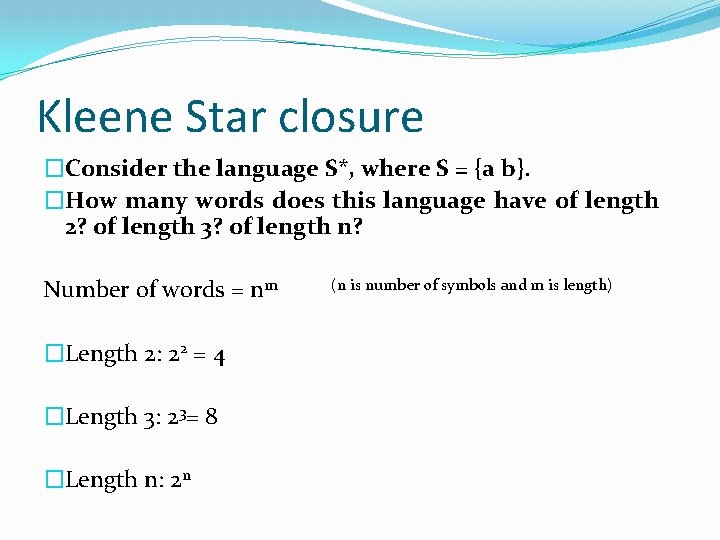
Kleene Star closure �Consider the language S*, where S = {a b}. �How many words does this language have of length 2? of length 3? of length n? Number of words = nm �Length 2: 22 = 4 �Length 3: 23= 8 �Length n: 2 n (n is number of symbols and m is length)
Plus Operation �With Plus Operation, combination of different letters are formed. However, Null String is not part of the generated language.
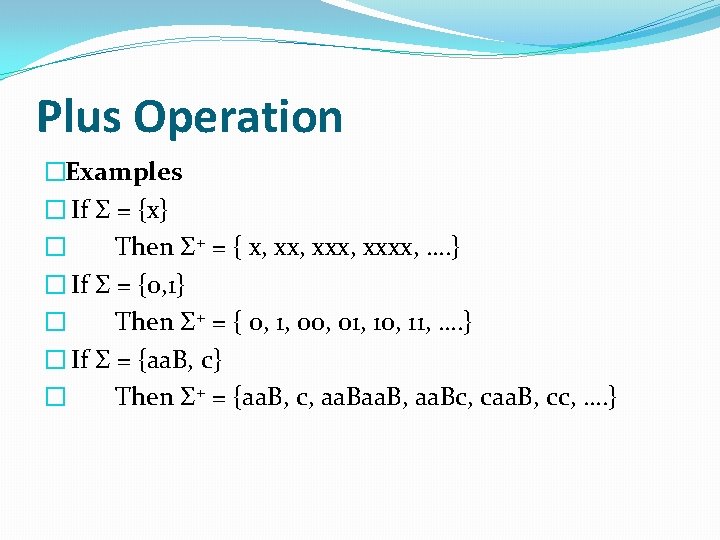
Plus Operation �Examples � If Σ = {x} � Then Σ+ = { x, xxx, xxxx, …. } � If Σ = {0, 1} � Then Σ+ = { 0, 1, 00, 01, 10, 11, …. } � If Σ = {aa. B, c} � Then Σ+ = {aa. B, c, aa. B, aa. Bc, caa. B, cc, …. }
Defining language �Four different ways, in which a language can be defined �There are four ways that we will study in this course: �Descriptive way �Recursive way �Regular Expression �Finite Automata
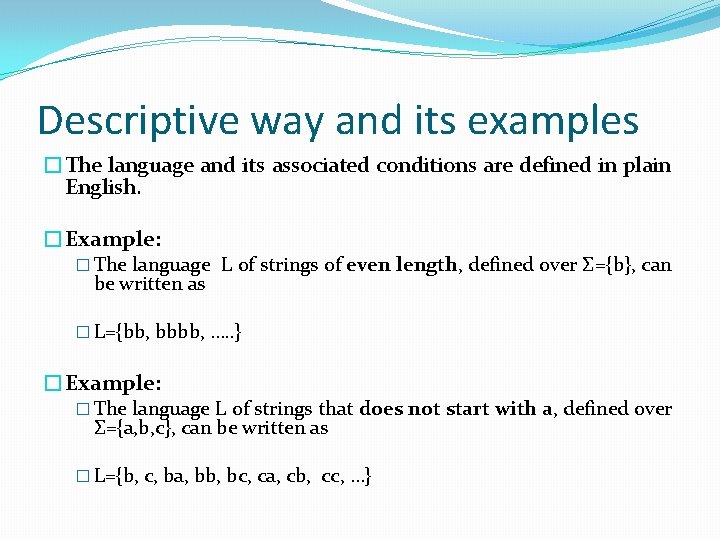
Descriptive way and its examples �The language and its associated conditions are defined in plain English. �Example: � The language L of strings of even length, defined over Σ={b}, can be written as � L={bb, bbbb, …. . } �Example: � The language L of strings that does not start with a, defined over Σ={a, b, c}, can be written as � L={b, c, ba, bb, bc, ca, cb, cc, …}
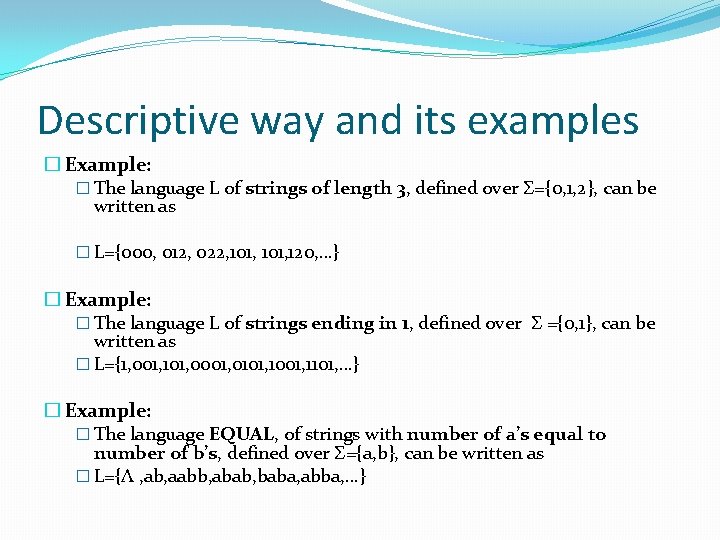
Descriptive way and its examples � Example: � The language L of strings of length 3, defined over Σ={0, 1, 2}, can be written as � L={000, 012, 022, 101, 120, …} � Example: � The language L of strings ending in 1, defined over Σ ={0, 1}, can be written as � L={1, 001, 101, 0001, 0101, 1001, 1101, …} � Example: � The language EQUAL, of strings with number of a’s equal to number of b’s, defined over Σ={a, b}, can be written as � L={Λ , ab, aabb, abab, baba, abba, …}
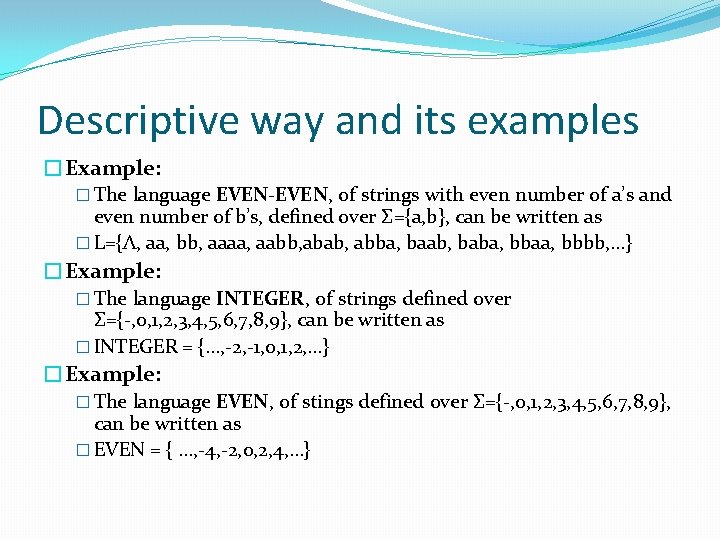
Descriptive way and its examples �Example: � The language EVEN-EVEN, of strings with even number of a’s and even number of b’s, defined over Σ={a, b}, can be written as � L={Λ, aa, bb, aaaa, aabb, abab, abba, baab, baba, bbaa, bbbb, …} �Example: � The language INTEGER, of strings defined over Σ={-, 0, 1, 2, 3, 4, 5, 6, 7, 8, 9}, can be written as � INTEGER = {…, -2, -1, 0, 1, 2, …} �Example: � The language EVEN, of stings defined over Σ={-, 0, 1, 2, 3, 4, 5, 6, 7, 8, 9}, can be written as � EVEN = { …, -4, -2, 0, 2, 4, …}
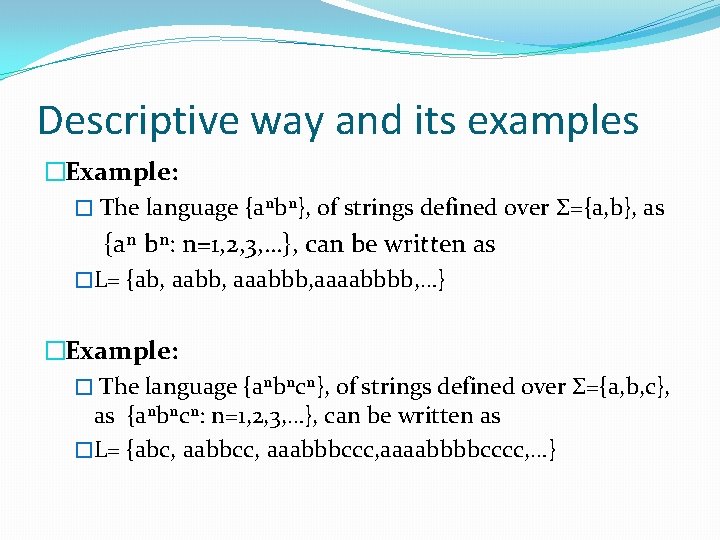
Descriptive way and its examples �Example: � The language {anbn}, of strings defined over Σ={a, b}, as {an bn: n=1, 2, 3, …}, can be written as �L= {ab, aabb, aaabbb, aaaabbbb, …} �Example: � The language {anbncn}, of strings defined over Σ={a, b, c}, as {anbncn: n=1, 2, 3, …}, can be written as �L= {abc, aabbcc, aaabbbccc, aaaabbbbcccc, …}
- Slides: 36