
Theory of Computation Lecture 05 Reduction C SC
![Reducibility (cont. ) • Lemma 3. 2: Let . Then decidable [decidability inherited down]](https://slidetodoc.com/presentation_image_h/2d3b203b4d1bec256fee92c7d47b53ff/image-3.jpg "Reducibility (cont. ) • Lemma 3. 2: Let . Then decidable [decidability inherited down]")
![Unsolvability via Reductions [alternate] • Theorem: The EMPTY-TAPE-ACCEPTANCE problem is c. e. but not](https://slidetodoc.com/presentation_image_h/2d3b203b4d1bec256fee92c7d47b53ff/image-8.jpg "Unsolvability via Reductions [alternate] • Theorem: The EMPTY-TAPE-ACCEPTANCE problem is c. e. but not")
- Slides: 16
Theory of Computation Lecture 05 Reduction C SC 573 Theory of Computation
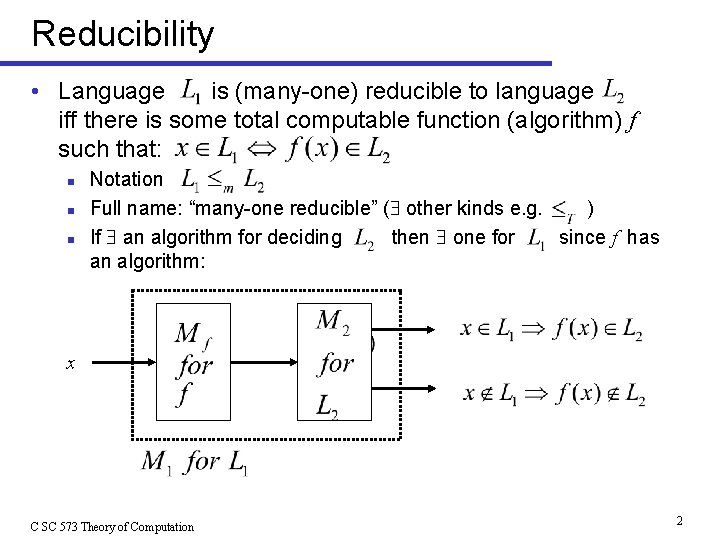
Reducibility • Language is (many-one) reducible to language iff there is some total computable function (algorithm) f such that: n n n Notation Full name: “many-one reducible” ( other kinds e. g. ) If an algorithm for deciding then one for since f has an algorithm: x C SC 573 Theory of Computation 2
Reducibility (cont. ) • Lemma 3. 2: Let . Then decidable [decidability inherited down] undecidable [undecidability inherited up] c. e. [acceptability inherited down] n n n If you want to show a problem P is easier than hardness problem Q then reduce P to Q u P: ? Q If you want to show a problem P is harder than problem Q then reduce Q to P easiness u Q: ? C SC 573 Theory of Computation P 3
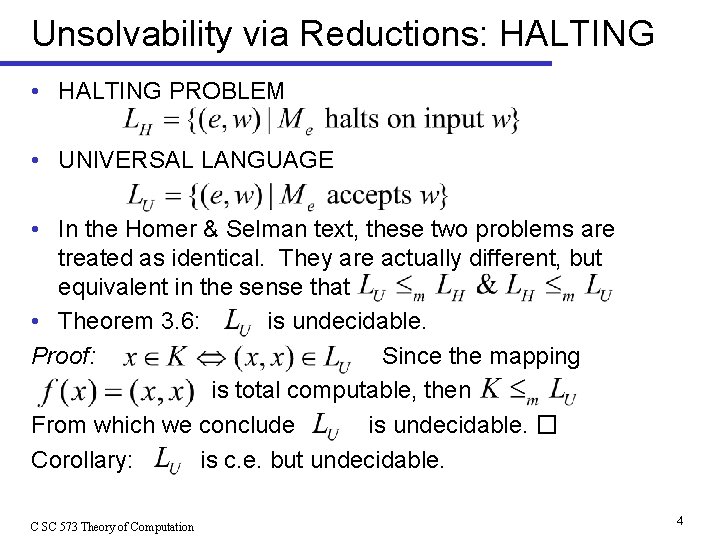
Unsolvability via Reductions: HALTING • HALTING PROBLEM • UNIVERSAL LANGUAGE • In the Homer & Selman text, these two problems are treated as identical. They are actually different, but equivalent in the sense that • Theorem 3. 6: is undecidable. Proof: Since the mapping is total computable, then From which we conclude is undecidable. � Corollary: is c. e. but undecidable. C SC 573 Theory of Computation 4
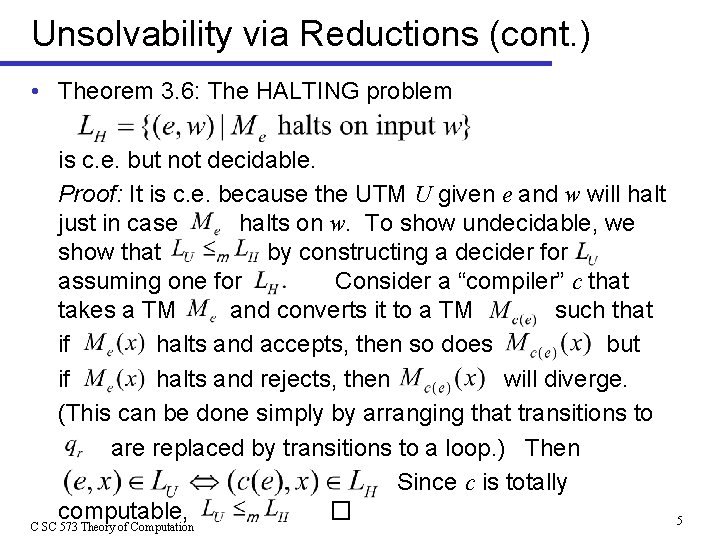
Unsolvability via Reductions (cont. ) • Theorem 3. 6: The HALTING problem is c. e. but not decidable. Proof: It is c. e. because the UTM U given e and w will halt just in case halts on w. To show undecidable, we show that by constructing a decider for assuming one for Consider a “compiler” c that takes a TM and converts it to a TM such that if halts and accepts, then so does but if halts and rejects, then will diverge. (This can be done simply by arranging that transitions to are replaced by transitions to a loop. ) Then Since c is totally computable, � C SC 573 Theory of Computation 5
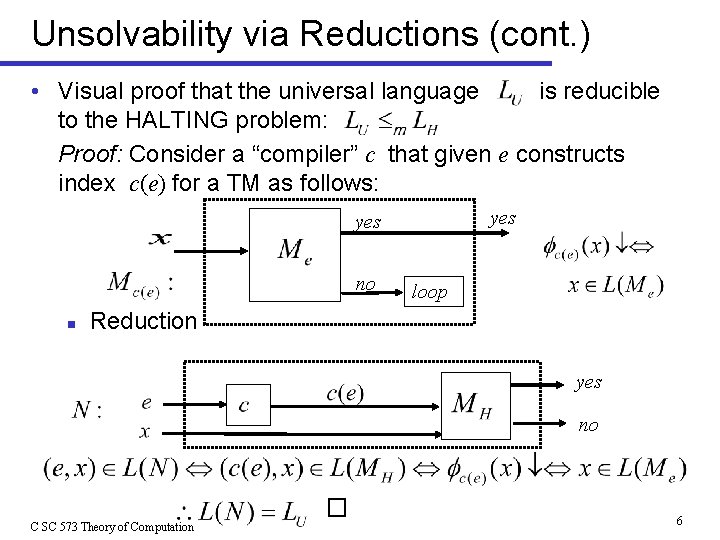
Unsolvability via Reductions (cont. ) • Visual proof that the universal language is reducible to the HALTING problem: Proof: Consider a “compiler” c that given e constructs index c(e) for a TM as follows: yes no n loop Reduction yes no � C SC 573 Theory of Computation 6
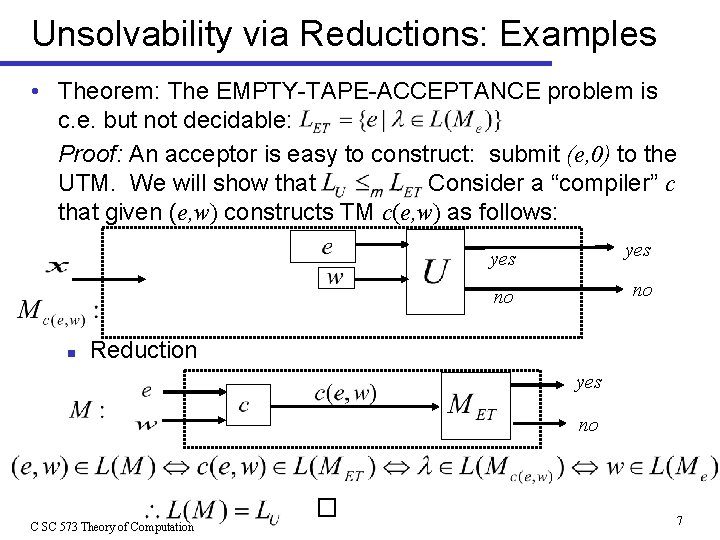
Unsolvability via Reductions: Examples • Theorem: The EMPTY-TAPE-ACCEPTANCE problem is c. e. but not decidable: Proof: An acceptor is easy to construct: submit (e, 0) to the UTM. We will show that. Consider a “compiler” c that given (e, w) constructs TM c(e, w) as follows: n yes no no Reduction yes no � C SC 573 Theory of Computation 7
Unsolvability via Reductions [alternate] • Theorem: The EMPTY-TAPE-ACCEPTANCE problem is c. e. but not decidable: Proof: An acceptor is easy to construct: submit (e, 0) to the UTM. We will show that. Consider a “compiler” c that given (e, w) constructs TM c(e, w): yes { M (w) } no n Reduction yes no � C SC 573 Theory of Computation 8
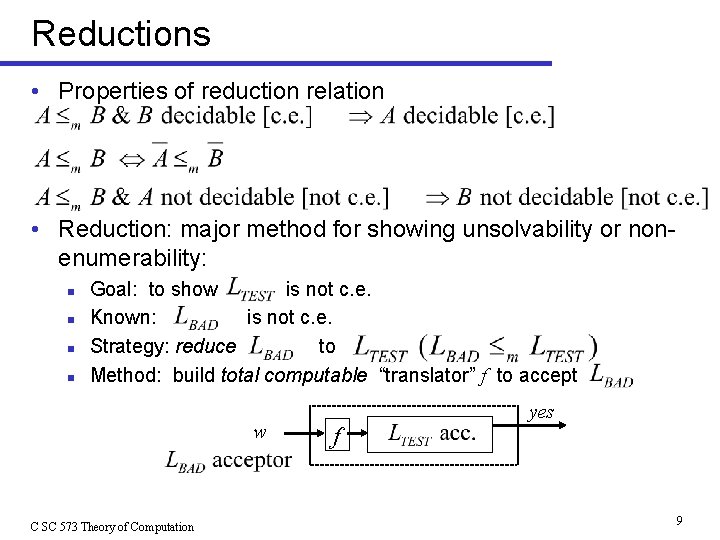
Reductions • Properties of reduction relation • Reduction: major method for showing unsolvability or nonenumerability: n n Goal: to show is not c. e. Known: is not c. e. Strategy: reduce to Method: build total computable “translator” f to accept w C SC 573 Theory of Computation f yes 9
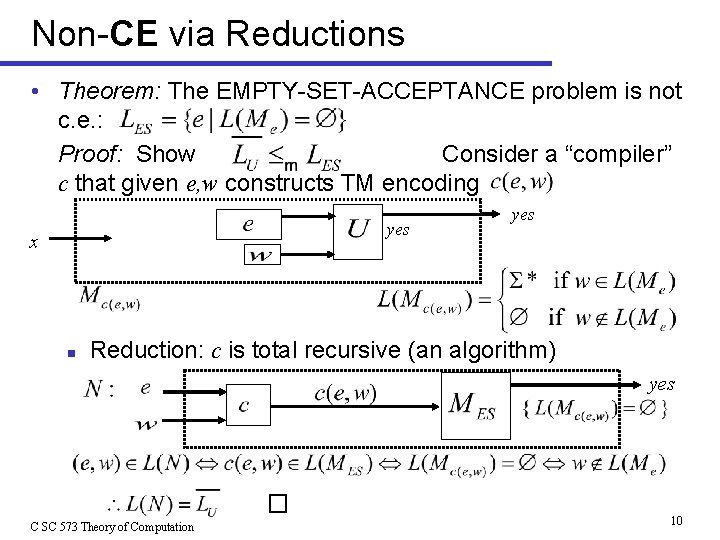
Non-CE via Reductions • Theorem: The EMPTY-SET-ACCEPTANCE problem is not c. e. : Proof: Show Consider a “compiler” c that given e, w constructs TM encoding yes x n yes Reduction: c is total recursive (an algorithm) yes � C SC 573 Theory of Computation 10
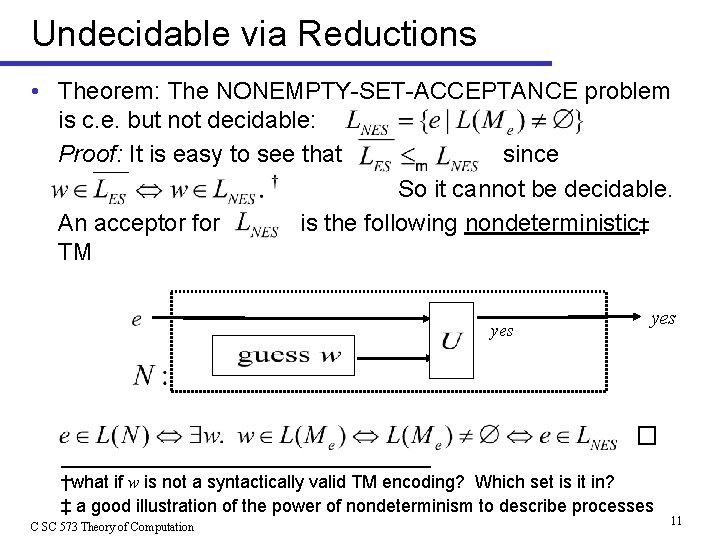
Undecidable via Reductions • Theorem: The NONEMPTY-SET-ACCEPTANCE problem is c. e. but not decidable: Proof: It is easy to see that since So it cannot be decidable. An acceptor for is the following nondeterministic‡ TM yes � ___________________ †what if w is not a syntactically valid TM encoding? Which set is it in? ‡ a good illustration of the power of nondeterminism to describe processes C SC 573 Theory of Computation 11
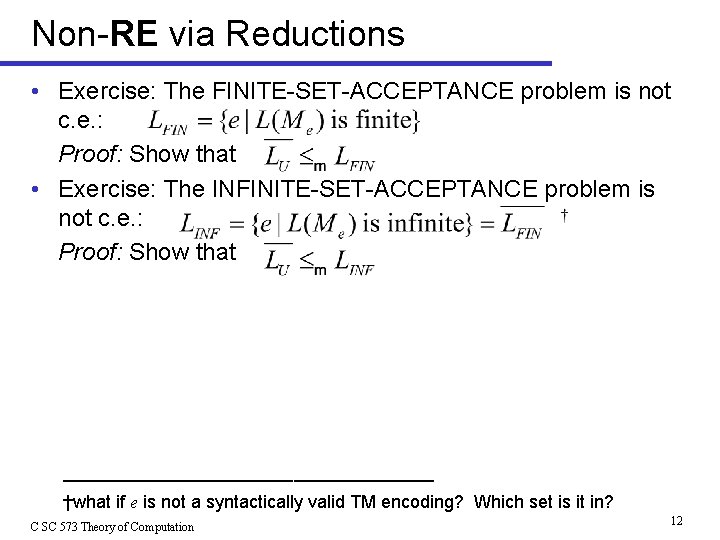
Non-RE via Reductions • Exercise: The FINITE-SET-ACCEPTANCE problem is not c. e. : Proof: Show that • Exercise: The INFINITE-SET-ACCEPTANCE problem is not c. e. : Proof: Show that ___________________ †what if e is not a syntactically valid TM encoding? Which set is it in? C SC 573 Theory of Computation 12
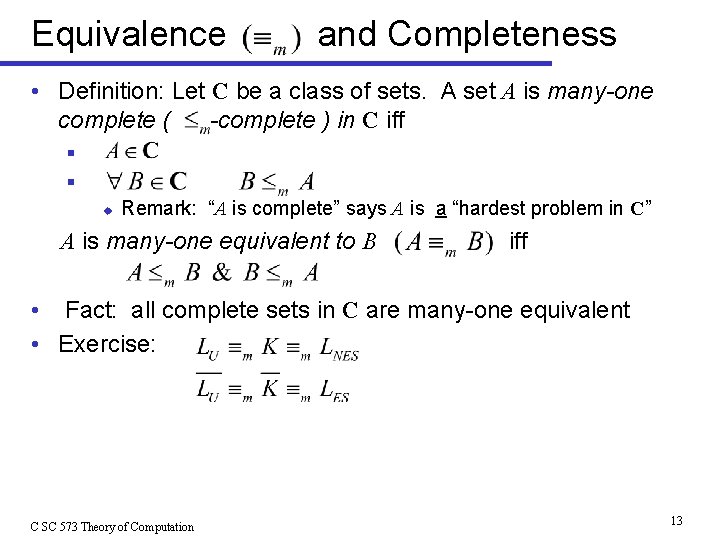
Equivalence and Completeness • Definition: Let C be a class of sets. A set A is many-one complete ( -complete ) in C iff n n u Remark: “A is complete” says A is a “hardest problem in C” A is many-one equivalent to B iff • Fact: all complete sets in C are many-one equivalent • Exercise: C SC 573 Theory of Computation 13
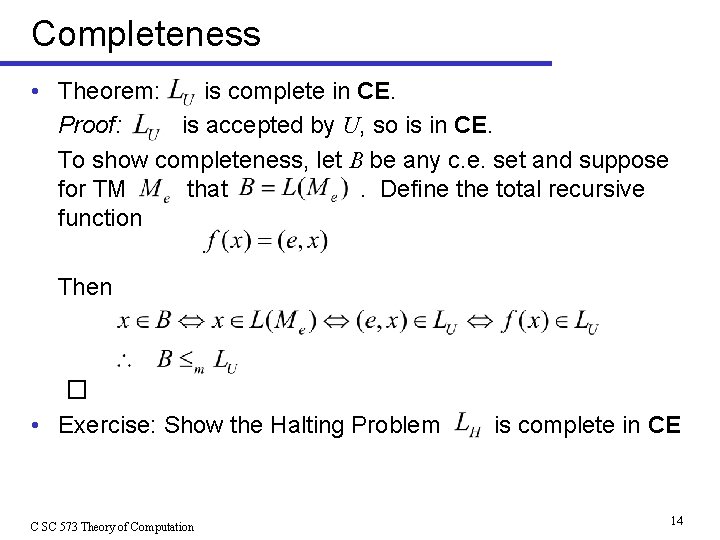
Completeness • Theorem: is complete in CE. Proof: is accepted by U, so is in CE. To show completeness, let B be any c. e. set and suppose for TM that. Define the total recursive function Then � • Exercise: Show the Halting Problem C SC 573 Theory of Computation is complete in CE 14
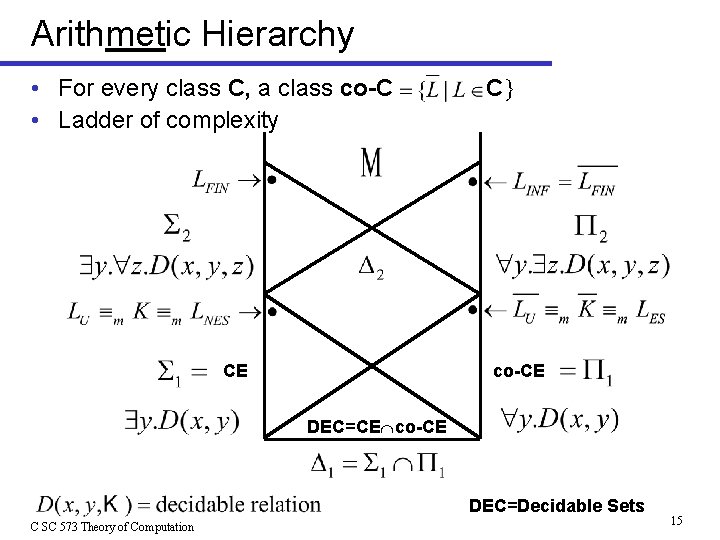
Arithmetic Hierarchy • For every class C, a class co-C • Ladder of complexity CE C} co-CE DEC=CE co-CE DEC=Decidable Sets C SC 573 Theory of Computation 15
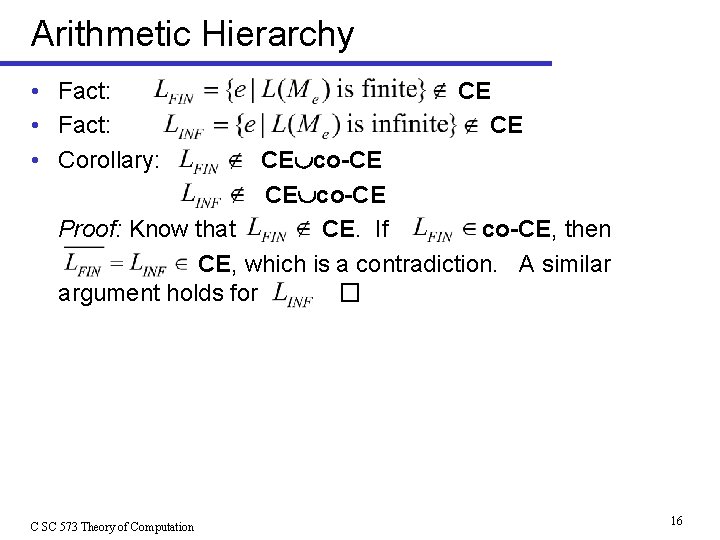
Arithmetic Hierarchy • Fact: • Corollary: CE CE CE co-CE Proof: Know that CE. If co-CE, then CE, which is a contradiction. A similar argument holds for � C SC 573 Theory of Computation 16