
Theory of Colour Theory has two broad types
Theory of Colour Theory has two broad types— q. Colour theory of Pigment q. Colour theory of Light DKTE
Theory of Colour. Pigment DKTE Colour theory of Pigment q Primary colour – There are 3 primary colours Red, Yellow and Blue. As per theory, you can generate any colour mixing these colours. If you add all 3 primary colours in equal quantity we get colour grey near to black. q Secondary colour – Adding any two primary colours in equal ratio get the secondary colour Yellow + Blue = Green Blue + Red = Purple/Voilet Red + Yellow = Orange
Theory of Colour. Pigment DKTE Colour theory of Pigment q Tertiary colour – Adding Primary and secondary colour get the tertiary colours. E. g. Blue (primary) + Green (secondary) = Turquoise Blue (primary) + Purple (secondary) = Blue-Violet Red (primary) + Purple (secondary) = Red-Violet or crimson Red (primary) + Orange (secondary) = Red-Orange Yellow (primary) + Orange (secondary) = Yellow-Orange Yellow (primary) + Green (secondary) = Lime green
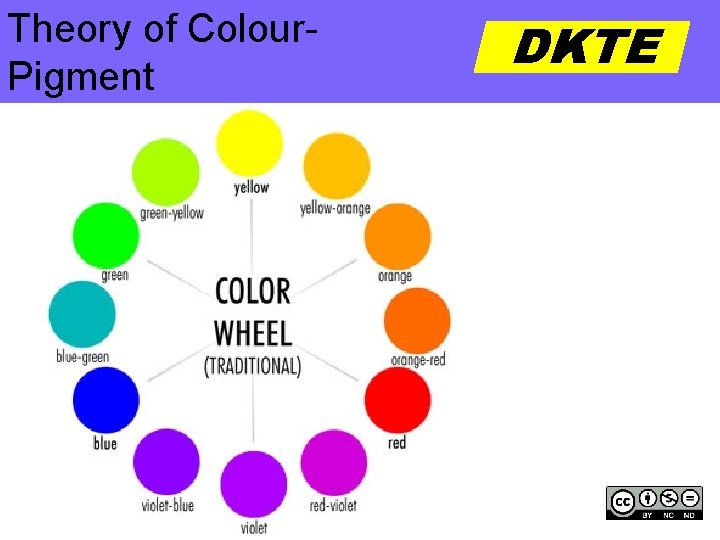
Theory of Colour. Pigment DKTE Drawing a Colour Wheel (Known as Artist colour wheel) q Draw a circle of 6” diameter. q Draw a circle of 1” diameter on every 30 degree angle. i. e 12 small circles. q Fill Primary colours in small circles such that each circle is at angle of 120 deg. (Red, Yellow and Blue) q Mix any two primary colour in equal quantity and fill the circle which is at angle 60 degree between two mixed primary colours. i. e. Secondary colours. q Mix Secondary colour and primary colour in equal quantity and fill the circle between respective colours which is at angle of 30 deg.
Theory of Colour. Pigment DKTE
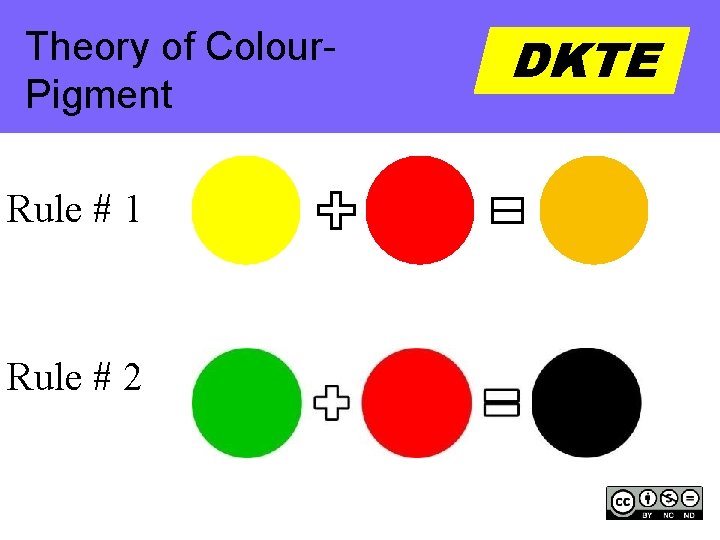
Theory of Colour. Pigment DKTE Rules of mixing colours: q Rule # 1 Adding any 2 colours either from primary, secondary or tertiary levels or adjacent colours from the colour wheel will generate new colour. q Rule # 2 Adding colour and its complimentary colour (opposite colour) from the colour wheel will get neutral colour or near to grey or black colour. q. To show this draw a circle of 1” diameter for colour.
Theory of Colour. Pigment Rule # 1 Rule # 2 DKTE
Theory of Colour. Pigment DKTE Difference between tint, tone and shade of a colours: q Draw a equilateral triangle of 6”. q Divide each side and draw a circle of 1” diameter at each point of triangle and midpoint of sides. q Fill the apex circle with any of the primary colour and on the extreme points on base of triangle fill the circles with white and black colour. q At mid point of base fill the colour made using equal parts of black and white colour i. e. Grey colour.
Theory of Colour. Pigment DKTE Difference between tint, tone and shade of a colours: q Tint is a colour mixed with white colour. It makes colour lighter. q Tone is a colour mixed with grey colour. It will toned down colour. q Shade is a colour mixed with black colour. It makes colour darker.

Theory of Colour. Pigment Tint DKTE Shade Tone
- Slides: 10