
Theory of Climate Change continued Climate Forcing and
- Slides: 24
Theory of Climate Change (continued) Climate Forcing and Physical Climate Responses
Content • Concept of “forcing” • Climate sensitivity – Stefan-Boltzmann response • Feedbacks – Ice-albedo repsonse – Water vapour – Clouds 2
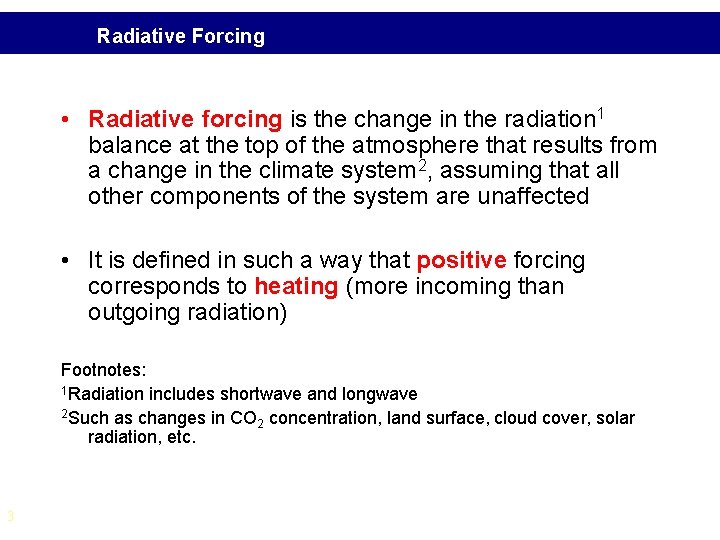
Radiative Forcing • Radiative forcing is the change in the radiation 1 balance at the top of the atmosphere that results from a change in the climate system 2, assuming that all other components of the system are unaffected • It is defined in such a way that positive forcing corresponds to heating (more incoming than outgoing radiation) Footnotes: 1 Radiation includes shortwave and longwave 2 Such as changes in CO concentration, land surface, cloud cover, solar 2 radiation, etc. 3
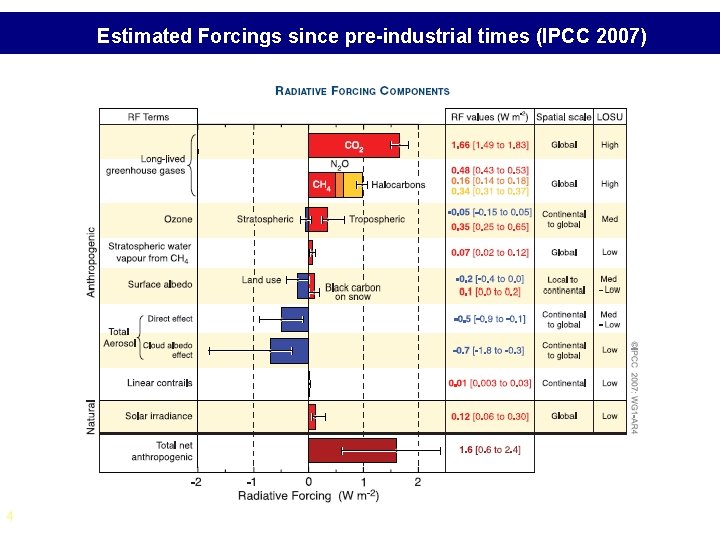
Estimated Forcings since pre-industrial times (IPCC 2007) 4
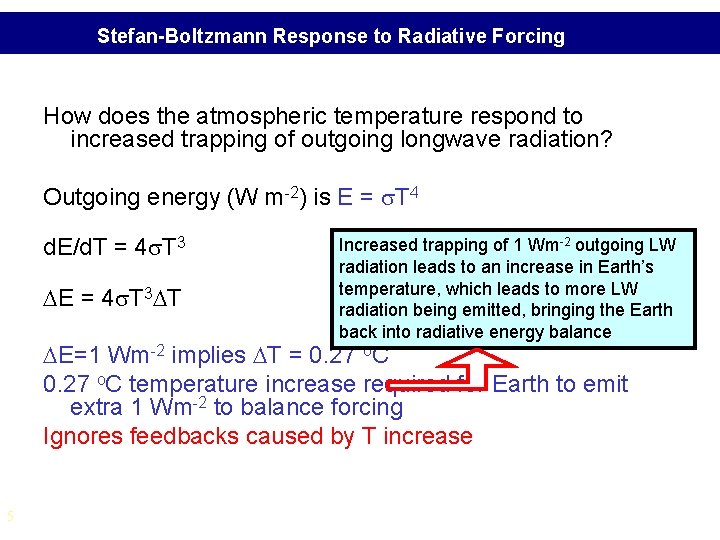
Stefan-Boltzmann Response to Radiative Forcing How does the atmospheric temperature respond to increased trapping of outgoing longwave radiation? Outgoing energy (W m-2) is E = s. T 4 d. E/d. T = 4 s. T 3 DE = 4 s. T 3 DT Increased trapping of 1 Wm-2 outgoing LW radiation leads to an increase in Earth’s temperature, which leads to more LW radiation being emitted, bringing the Earth back into radiative energy balance DE=1 Wm-2 implies DT = 0. 27 o. C temperature increase required for Earth to emit extra 1 Wm-2 to balance forcing Ignores feedbacks caused by T increase 5
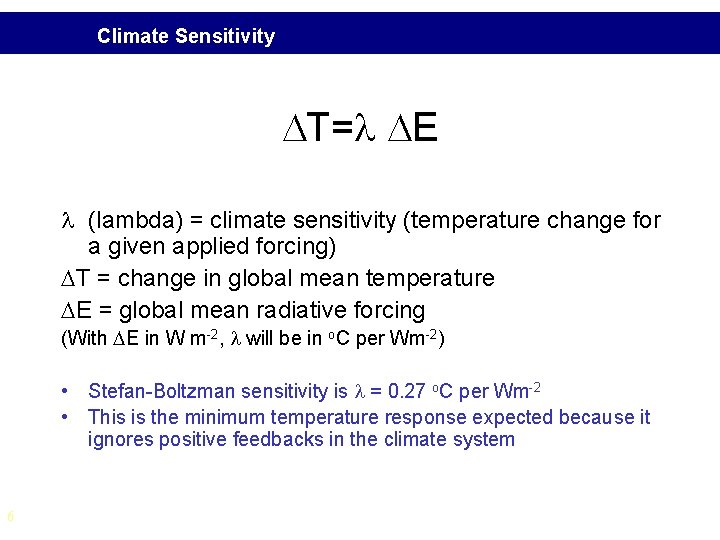
Climate Sensitivity DT=l DE l (lambda) = climate sensitivity (temperature change for a given applied forcing) DT = change in global mean temperature DE = global mean radiative forcing (With DE in W m-2, l will be in o. C per Wm-2) • Stefan-Boltzman sensitivity is l = 0. 27 o. C per Wm-2 • This is the minimum temperature response expected because it ignores positive feedbacks in the climate system 6
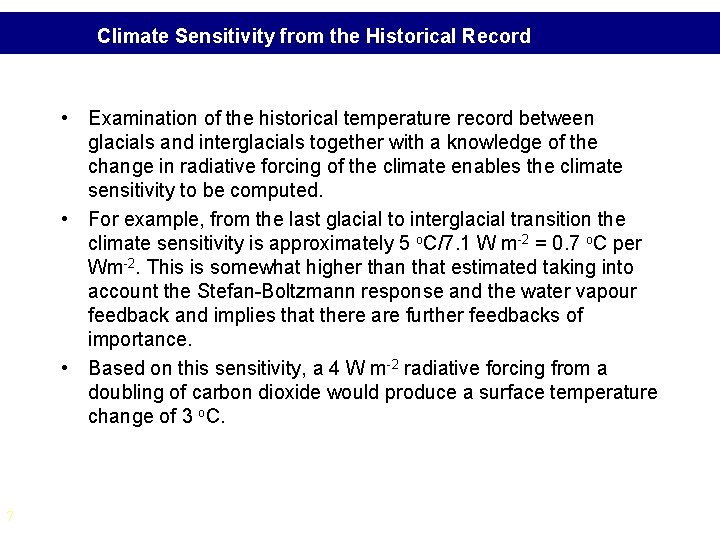
Climate Sensitivity from the Historical Record • Examination of the historical temperature record between glacials and interglacials together with a knowledge of the change in radiative forcing of the climate enables the climate sensitivity to be computed. • For example, from the last glacial to interglacial transition the climate sensitivity is approximately 5 o. C/7. 1 W m-2 = 0. 7 o. C per Wm-2. This is somewhat higher than that estimated taking into account the Stefan-Boltzmann response and the water vapour feedback and implies that there are further feedbacks of importance. • Based on this sensitivity, a 4 W m-2 radiative forcing from a doubling of carbon dioxide would produce a surface temperature change of 3 o. C. 7
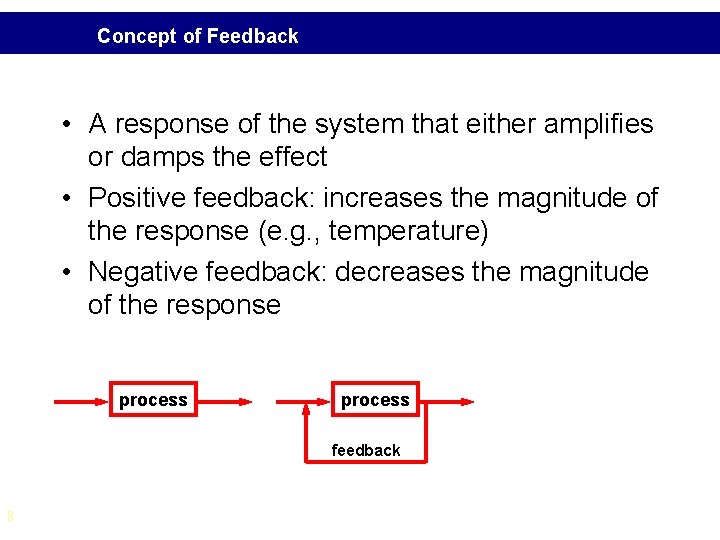
Concept of Feedback • A response of the system that either amplifies or damps the effect • Positive feedback: increases the magnitude of the response (e. g. , temperature) • Negative feedback: decreases the magnitude of the response process feedback 8
Climate Feedback Factor • The climate feedback factor is the ratio of temperature change including feedbacks to the temperature change with no feedbacks • Approx 1. 2 to 3. 75 for Earth based on climate models and observations 9
“Response” and “Feedback” • Response is a change in the climate system due to an imposed forcing • Feedback is a response that amplifies or damps the effect of the original forcing 10
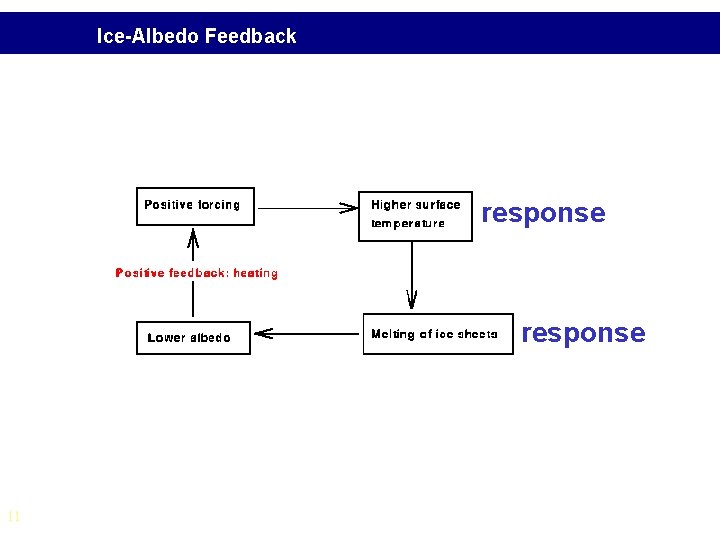
Ice-Albedo Feedback response 11
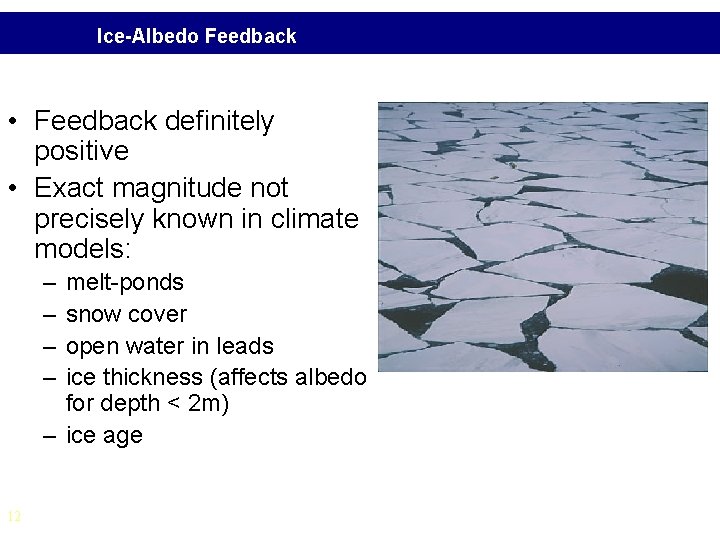
Ice-Albedo Feedback • Feedback definitely positive • Exact magnitude not precisely known in climate models: – – melt-ponds snow cover open water in leads ice thickness (affects albedo for depth < 2 m) – ice age 12
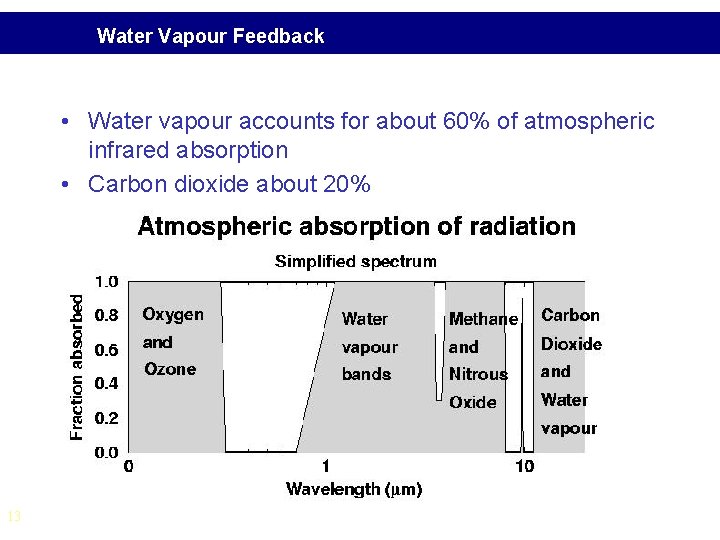
Water Vapour Feedback • Water vapour accounts for about 60% of atmospheric infrared absorption • Carbon dioxide about 20% 13
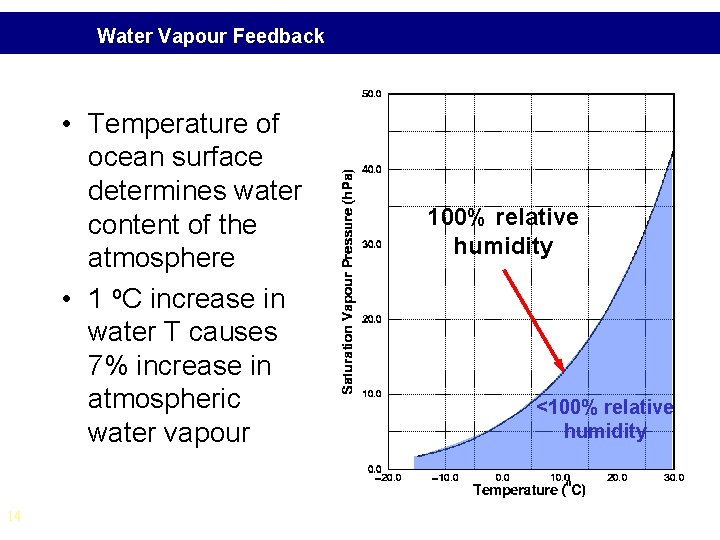
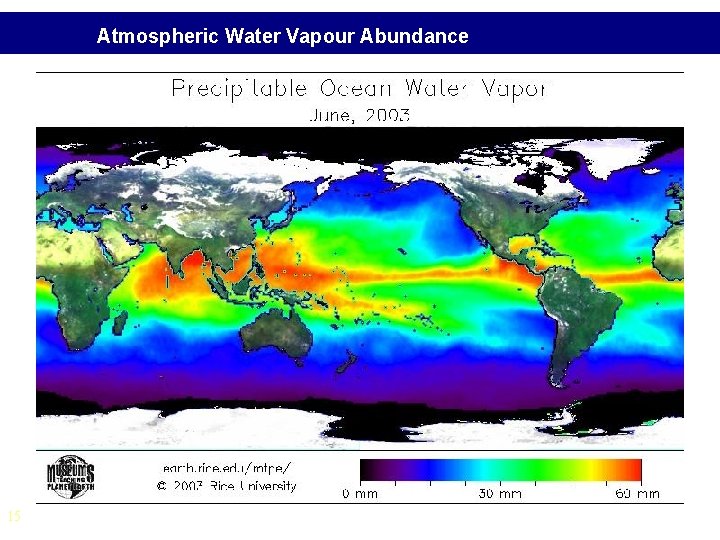
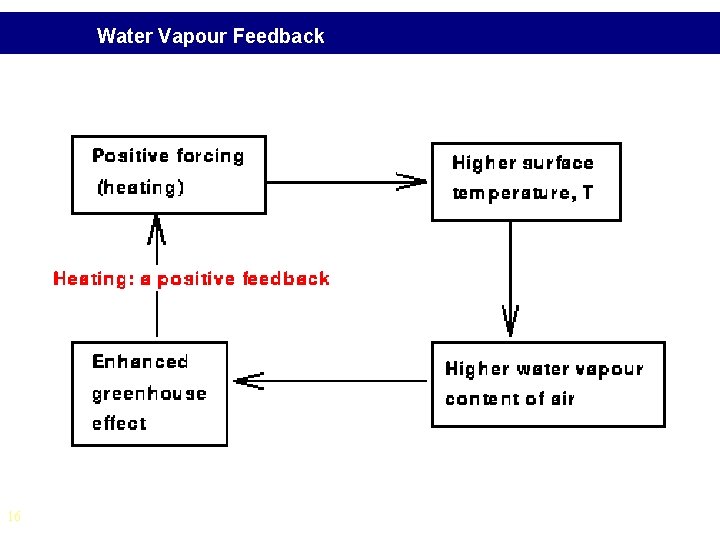
Water Vapour Feedback • Temperature of ocean surface determines water content of the atmosphere • 1 o. C increase in water T causes 7% increase in atmospheric water vapour 14 100% relative humidity <100% relative humidity
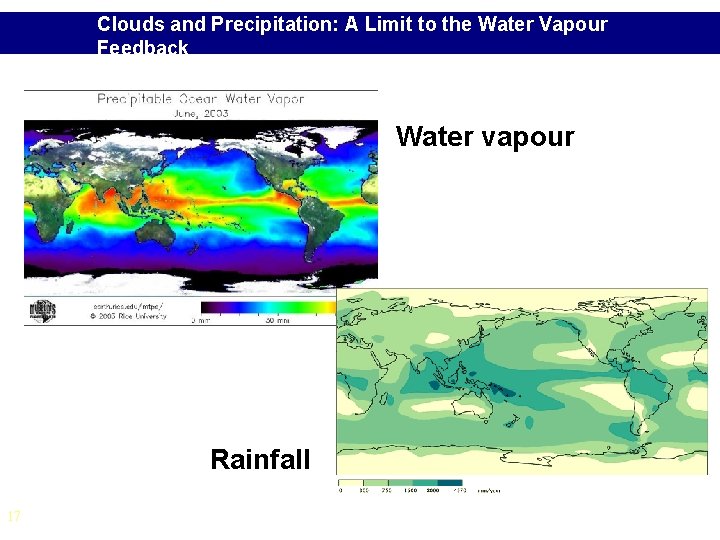
Atmospheric Water Vapour Abundance 15
Water Vapour Feedback 16
Clouds and Precipitation: A Limit to the Water Vapour Feedback Water vapour Rainfall 17
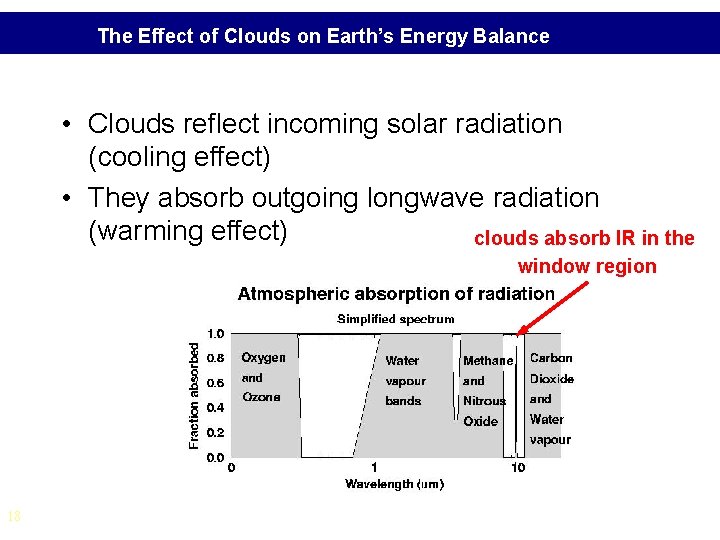
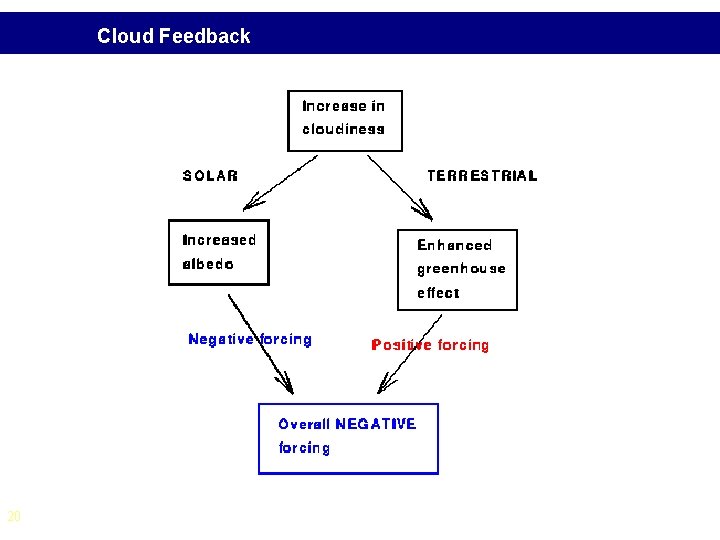
The Effect of Clouds on Earth’s Energy Balance • Clouds reflect incoming solar radiation (cooling effect) • They absorb outgoing longwave radiation (warming effect) clouds absorb IR in the window region 18
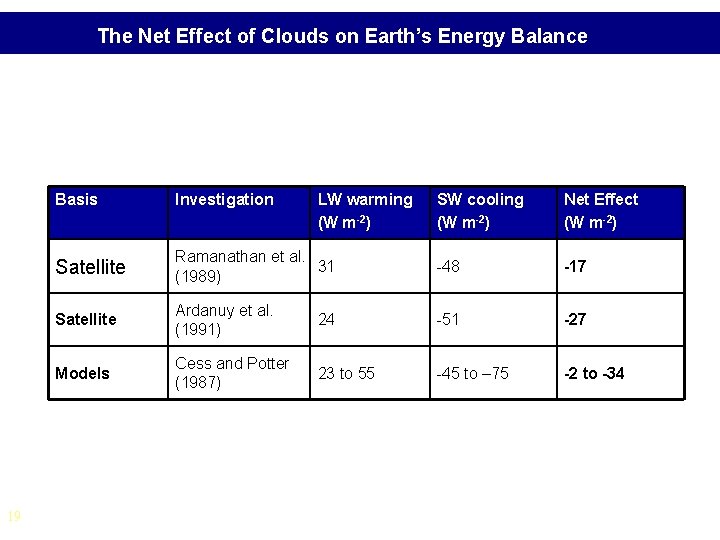
The Net Effect of Clouds on Earth’s Energy Balance 19 Basis Investigation Satellite LW warming (W m-2) SW cooling (W m-2) Net Effect (W m-2) Ramanathan et al. 31 (1989) -48 -17 Satellite Ardanuy et al. (1991) 24 -51 -27 Models Cess and Potter (1987) 23 to 55 -45 to – 75 -2 to -34
Cloud Feedback 20
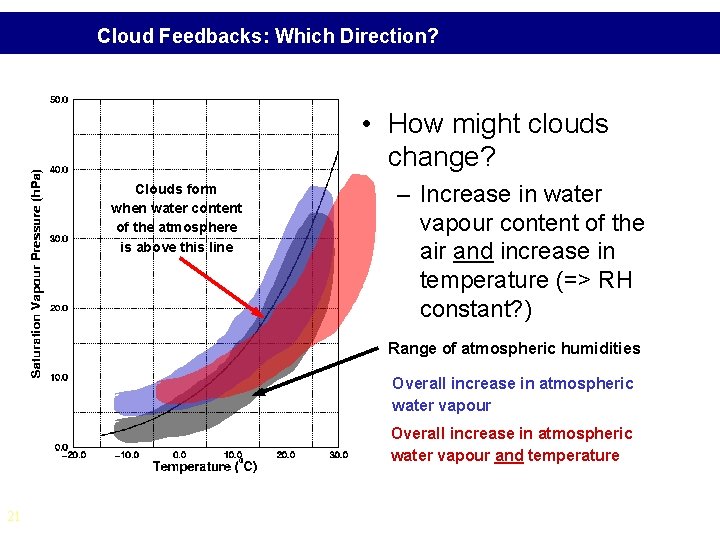
Cloud Feedbacks: Which Direction? • How might clouds change? Clouds form when water content of the atmosphere is above this line – Increase in water vapour content of the air and increase in temperature (=> RH constant? ) Range of atmospheric humidities Overall increase in atmospheric water vapour and temperature 21
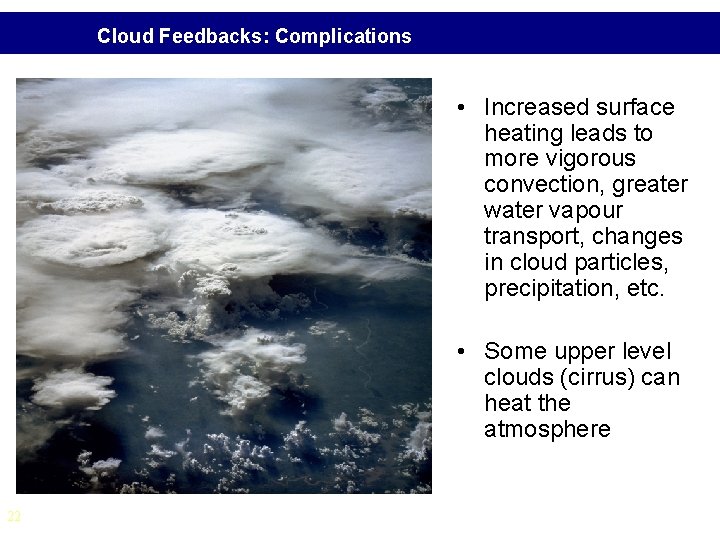
Cloud Feedbacks: Complications • Increased surface heating leads to more vigorous convection, greater water vapour transport, changes in cloud particles, precipitation, etc. • Some upper level clouds (cirrus) can heat the atmosphere 22
Climate Model Simulations of Cloud Changes • Very uncertain model prediction – large spread between models • Double CO 2: roughly 50 -50% spread between models of positive and negative feedback • Large uncertainties regarding boundary layer and deep convective clouds • Remain largest source of uncertainty in feedback calculations 23
Further Reading • Climate sensitivity • http: //en. wikipedia. org/wiki/Climate_sensitivity • Some advanced further reading. A review of current state of knowledge • http: //www. atmos. ucla. edu/csrl/publications/Hall/Bony_et_al_2006. pdf • Discussion of snow-albedo feedback • 24 http: //www. atmos. ucla. edu/csrl/global. html