
Theory of Change Template Instructions on Completion Complete
- Slides: 3
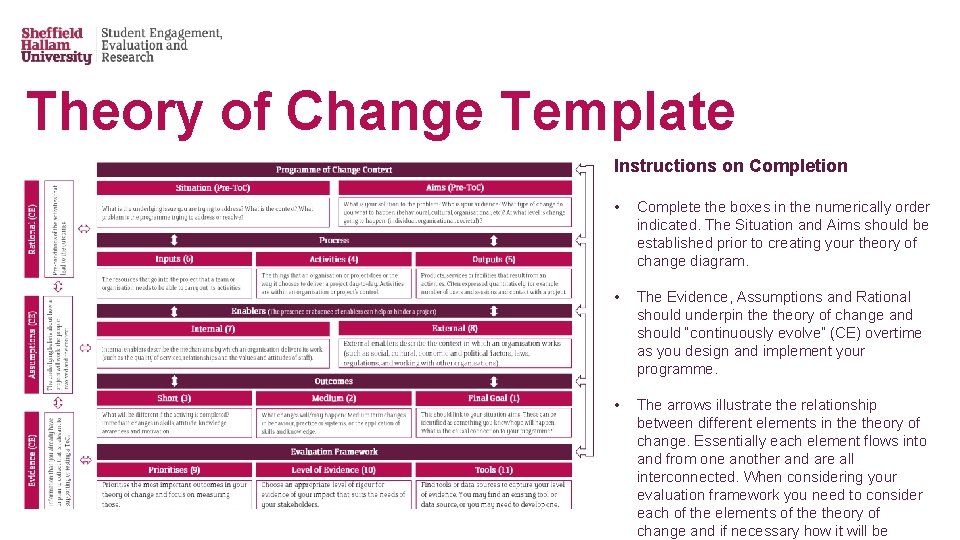
Theory of Change Template Instructions on Completion • Complete the boxes in the numerically order indicated. The Situation and Aims should be established prior to creating your theory of change diagram. • The Evidence, Assumptions and Rational should underpin theory of change and should “continuously evolve” (CE) overtime as you design and implement your programme. • The arrows illustrate the relationship between different elements in theory of change. Essentially each element flows into and from one another and are all interconnected. When considering your evaluation framework you need to consider each of the elements of theory of change and if necessary how it will be
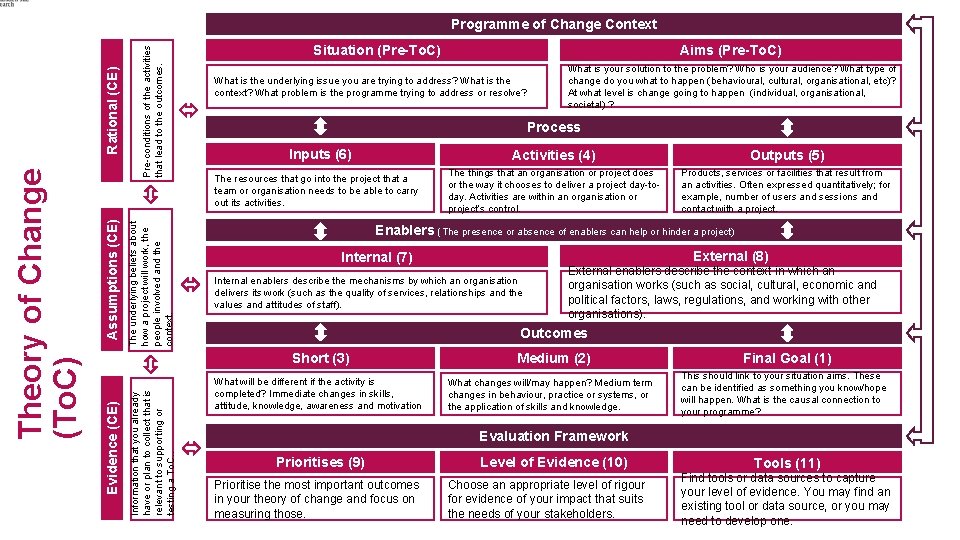
Pre-conditions of the activities that lead to the outcomes. The underlying beliefs about how a project will work, the people involved and the context. Assumptions (CE) Information that you already have or plan to collect that is relevant to supporting or testing a To. C. . Aims (Pre-To. C) Situation (Pre-To. C) What is the underlying issue you are trying to address? What is the context? What problem is the programme trying to address or resolve? What is your solution to the problem? Who is your audience? What type of change do you what to happen (behavioural, cultural, organisational, etc)? At what level is change going to happen (individual, organisational, societal) ? Process Inputs (6) The resources that go into the project that a team or organisation needs to be able to carry out its activities. Activities (4) Outputs (5) The things that an organisation or project does or the way it chooses to deliver a project day-today. Activities are within an organisation or project’s control. Products, services or facilities that result from an activities. Often expressed quantitatively; for example, number of users and sessions and contact with a project. Enablers (The presence or absence of enablers can help or hinder a project) External (8) Internal (7) Internal enablers describe the mechanisms by which an organisation delivers its work (such as the quality of services, relationships and the values and attitudes of staff). External enablers describe the context in which an organisation works (such as social, cultural, economic and political factors, laws, regulations, and working with other organisations). Outcomes Short (3) Evidence (CE) Theory of Change (To. C) Rational (CE) Programme of Change Context What will be different if the activity is completed? Immediate changes in skills, attitude, knowledge, awareness and motivation Medium (2) What changes will/may happen? Medium term changes in behaviour, practice or systems, or the application of skills and knowledge. Final Goal (1) This should link to your situation aims. These can be identified as something you know/hope will happen. What is the causal connection to your programme? Evaluation Framework Prioritises (9) Prioritise the most important outcomes in your theory of change and focus on measuring those. Level of Evidence (10) Choose an appropriate level of rigour for evidence of your impact that suits the needs of your stakeholders. Tools (11) Find tools or data sources to capture your level of evidence. You may find an existing tool or data source, or you may need to develop one.
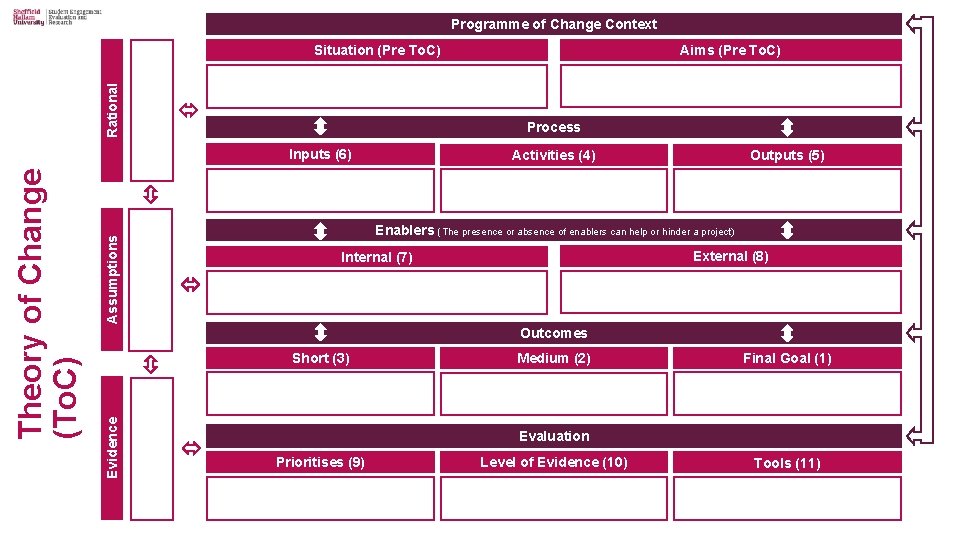
Programme of Change Context Aims (Pre To. C) Rational Situation (Pre To. C) Process Assumptions Activities (4) Outputs (5) Enablers (The presence or absence of enablers can help or hinder a project) External (8) Internal (7) Outcomes Short (3) Evidence Theory of Change (To. C) Inputs (6) Medium (2) Final Goal (1) Evaluation Prioritises (9) Level of Evidence (10) Tools (11)