
THEORY OF CHANGE In an ideal world social


- Slides: 40
THEORY OF CHANGE In an ideal world, social problems could be solved with neat, simple solutions. Reality, however, is often quite a different story. Debbi D. Brock, Wingate University Kudos to Georgetown Social Enterprise Initiative, Ben Simmons-Telep & Araba Sapara-Grant, Theory of Change Carol Weiss, Theoryof. Change. org,
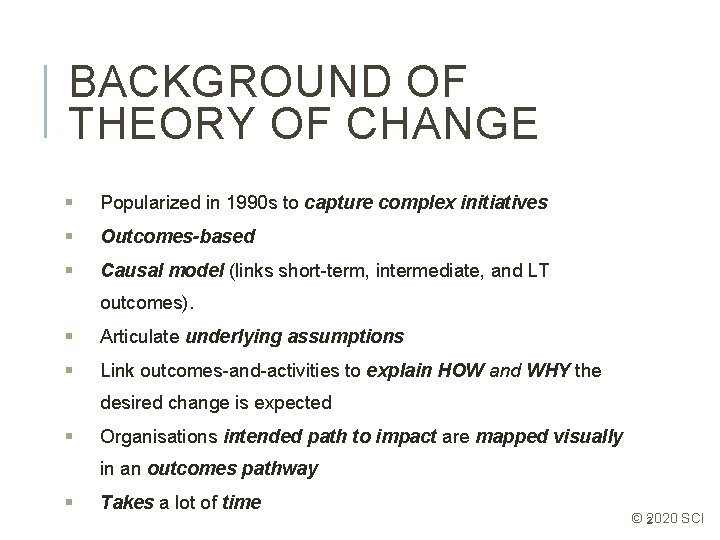
BACKGROUND OF THEORY OF CHANGE § Popularized in 1990 s to capture complex initiatives § Outcomes-based § Causal model (links short-term, intermediate, and LT outcomes). § Articulate underlying assumptions § Link outcomes-and-activities to explain HOW and WHY the desired change is expected § Organisations intended path to impact are mapped visually in an outcomes pathway § Takes a lot of time © 2020 SCI 2
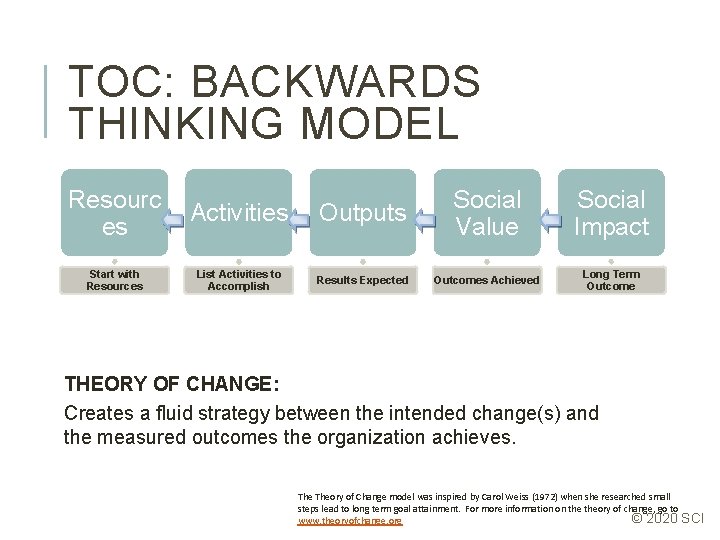
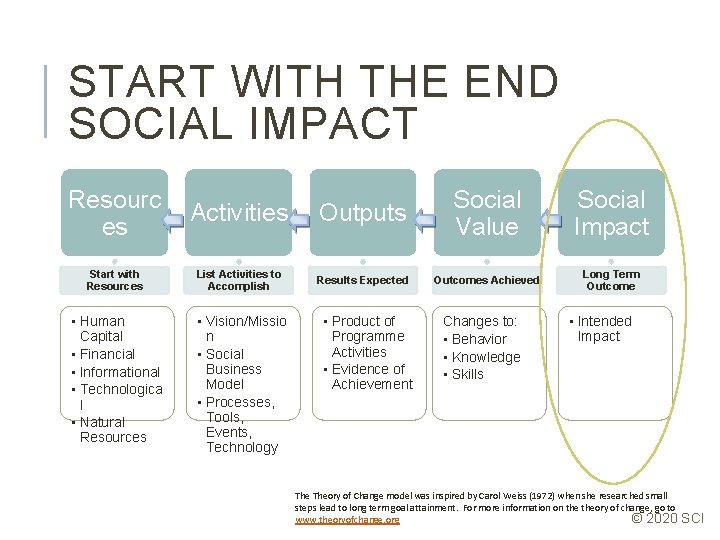
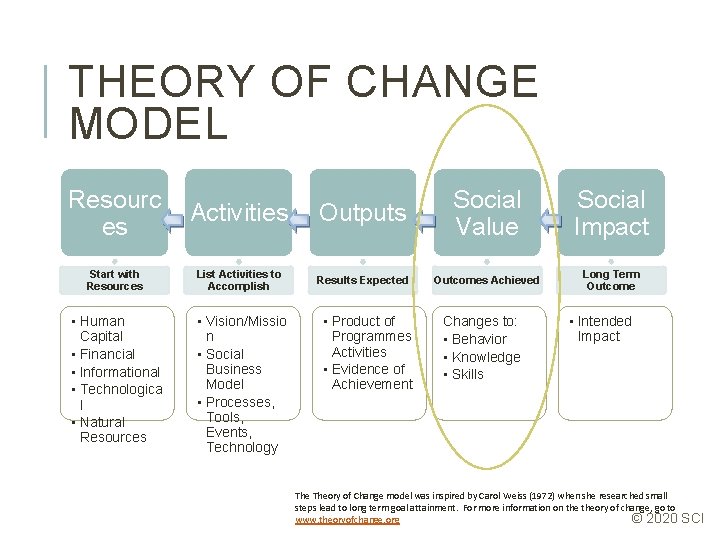
TOC: BACKWARDS THINKING MODEL Resourc es Activities Start with Resources List Activities to Accomplish Outputs Social Value Social Impact Results Expected Outcomes Achieved Long Term Outcome THEORY OF CHANGE: Creates a fluid strategy between the intended change(s) and the measured outcomes the organization achieves. Theory of Change model was inspired by Carol Weiss (1972) when she researched small steps lead to long term goal attainment. For more information on theory of change, go to © 2020 SCI www. theoryofchange. org
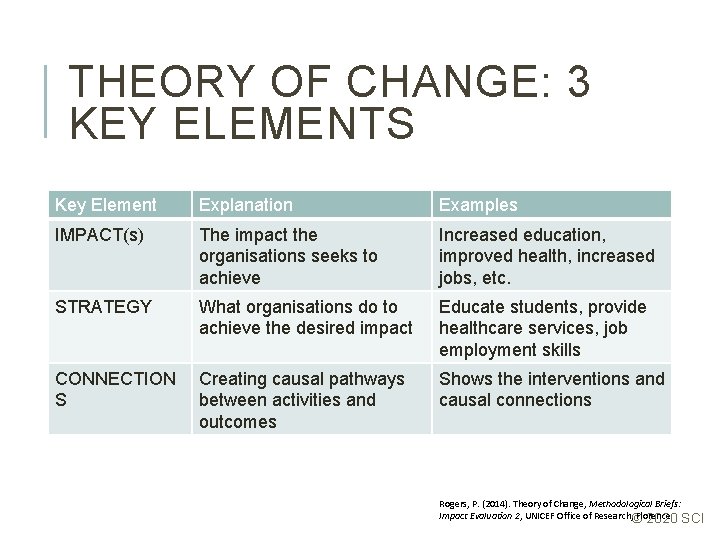
THEORY OF CHANGE: 3 KEY ELEMENTS Key Element Explanation Examples IMPACT(s) The impact the organisations seeks to achieve Increased education, improved health, increased jobs, etc. STRATEGY What organisations do to achieve the desired impact Educate students, provide healthcare services, job employment skills CONNECTION S Creating causal pathways between activities and outcomes Shows the interventions and causal connections Rogers, P. (2014). Theory of Change, Methodological Briefs: Impact Evaluation 2, UNICEF Office of Research, © Florence 2020 SCI
THEORY OF CHANGE OVERVIEW
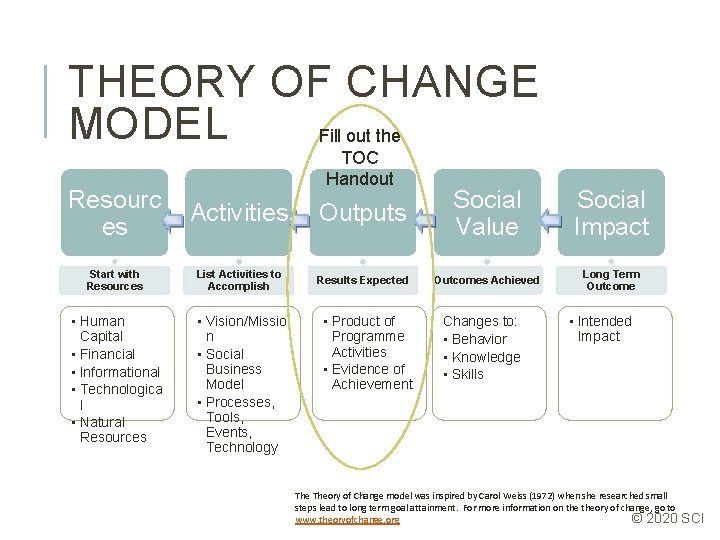
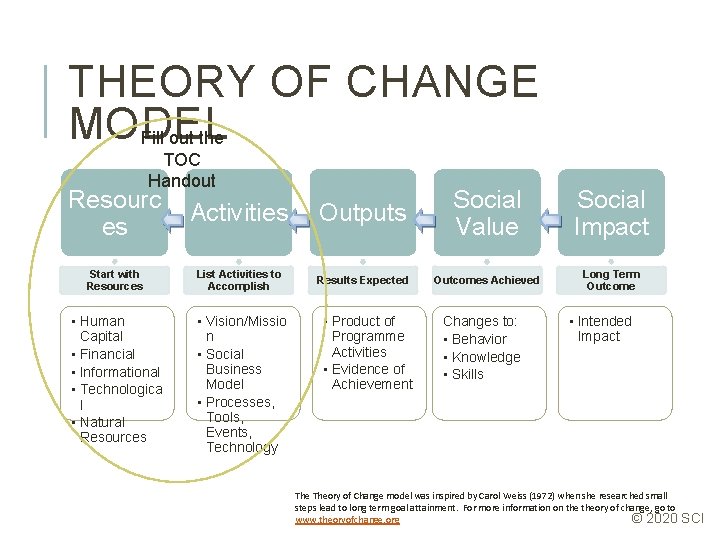
START WITH THE END SOCIAL IMPACT Resourc es Activities Start with Resources List Activities to Accomplish • Human Capital • Financial • Informational • Technologica l • Natural Resources • Vision/Missio n • Social Business Model • Processes, Tools, Events, Technology Outputs Social Value Social Impact Results Expected Outcomes Achieved Long Term Outcome • Product of Programme Activities • Evidence of Achievement Changes to: • Behavior • Knowledge • Skills • Intended Impact Theory of Change model was inspired by Carol Weiss (1972) when she researched small steps lead to long term goal attainment. For more information on theory of change, go to © 2020 www. theoryofchange. org SCI
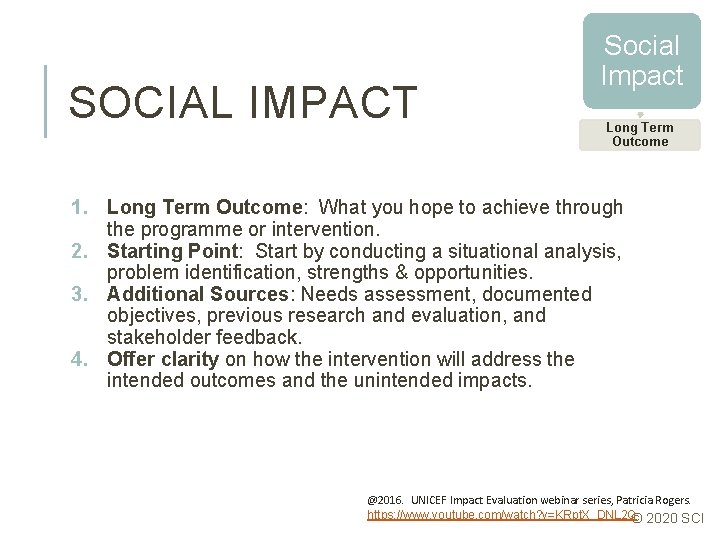
SOCIAL IMPACT Social Impact Long Term Outcome 1. Long Term Outcome: What you hope to achieve through the programme or intervention. 2. Starting Point: Start by conducting a situational analysis, problem identification, strengths & opportunities. 3. Additional Sources: Needs assessment, documented objectives, previous research and evaluation, and stakeholder feedback. 4. Offer clarity on how the intervention will address the intended outcomes and the unintended impacts. @2016. UNICEF Impact Evaluation webinar series, Patricia Rogers. https: //www. youtube. com/watch? v=KRpt. X_DNL 2 Q© 2020 SCI
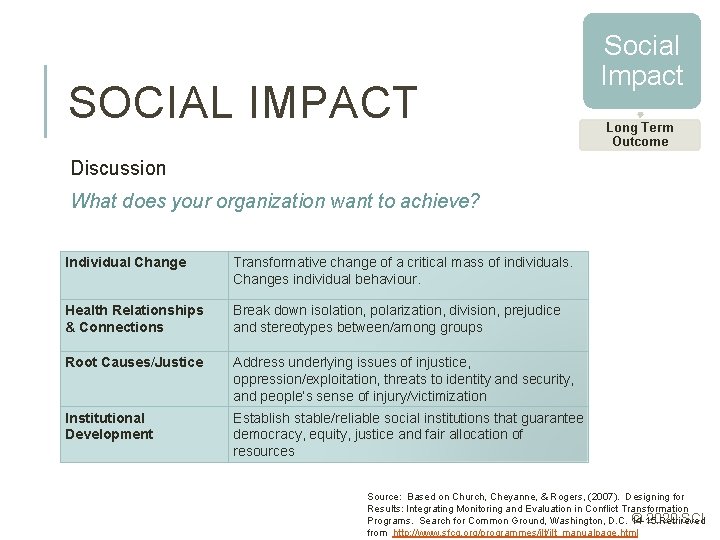
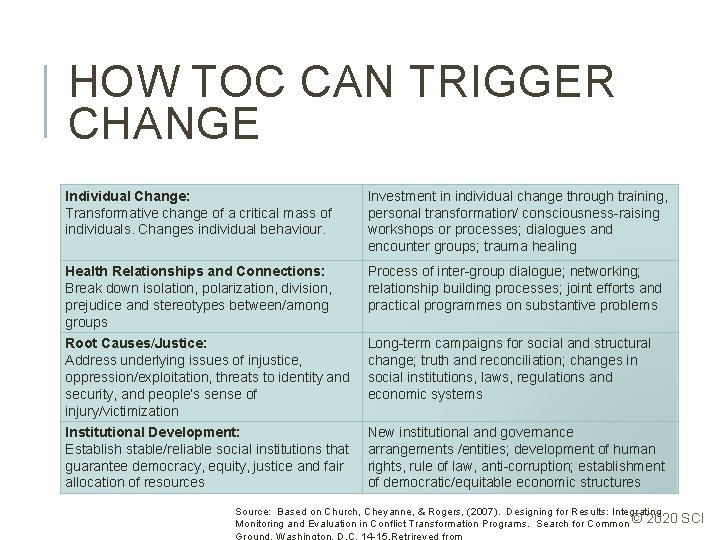
SOCIAL IMPACT Social Impact Long Term Outcome Discussion What does your organization want to achieve? Individual Change Transformative change of a critical mass of individuals. Changes individual behaviour. Health Relationships & Connections Break down isolation, polarization, division, prejudice and stereotypes between/among groups Root Causes/Justice Address underlying issues of injustice, oppression/exploitation, threats to identity and security, and people’s sense of injury/victimization Institutional Development Establish stable/reliable social institutions that guarantee democracy, equity, justice and fair allocation of resources Source: Based on Church, Cheyanne, & Rogers, (2007). Designing for Results: Integrating Monitoring and Evaluation in Conflict Transformation © 2020 SCI Programs. Search for Common Ground, Washington, D. C. 14 -15. Retrireved from http: //www. sfcg. org/programmes/ilt_manualpage. html
HOW TOC CAN TRIGGER CHANGE Individual Change: Transformative change of a critical mass of individuals. Changes individual behaviour. Investment in individual change through training, personal transformation/ consciousness-raising workshops or processes; dialogues and encounter groups; trauma healing Health Relationships and Connections: Break down isolation, polarization, division, prejudice and stereotypes between/among groups Process of inter-group dialogue; networking; relationship building processes; joint efforts and practical programmes on substantive problems Root Causes/Justice: Address underlying issues of injustice, oppression/exploitation, threats to identity and security, and people’s sense of injury/victimization Long-term campaigns for social and structural change; truth and reconciliation; changes in social institutions, laws, regulations and economic systems Institutional Development: Establish stable/reliable social institutions that guarantee democracy, equity, justice and fair allocation of resources New institutional and governance arrangements /entities; development of human rights, rule of law, anti-corruption; establishment of democratic/equitable economic structures Source: Based on Church, Cheyanne, & Rogers, (2007). Designing for Results: Integrating Monitoring and Evaluation in Conflict Transformation Programs. Search for Common © 2020 Ground, Washington, D. C. 14 -15. Retrireved from SCI
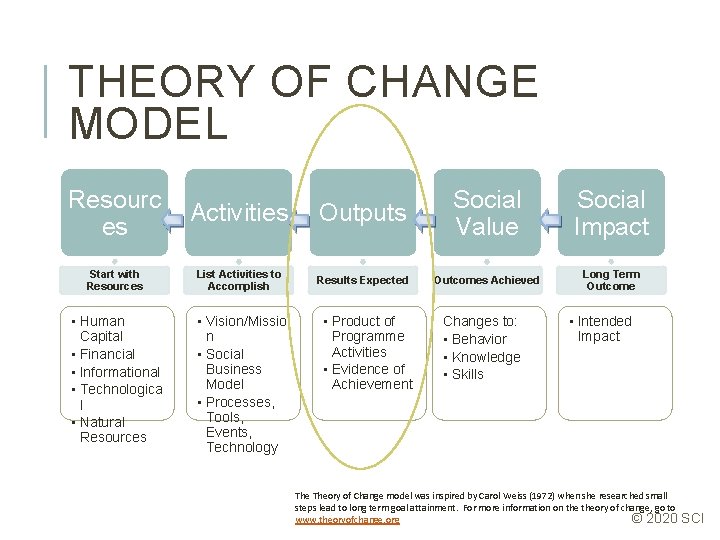
THEORY OF CHANGE MODEL Resourc es Activities Start with Resources List Activities to Accomplish • Human Capital • Financial • Informational • Technologica l • Natural Resources • Vision/Missio n • Social Business Model • Processes, Tools, Events, Technology Outputs Social Value Social Impact Results Expected Outcomes Achieved Long Term Outcome • Product of Programmes Activities • Evidence of Achievement Changes to: • Behavior • Knowledge • Skills • Intended Impact Theory of Change model was inspired by Carol Weiss (1972) when she researched small steps lead to long term goal attainment. For more information on theory of change, go to © 2020 www. theoryofchange. org SCI
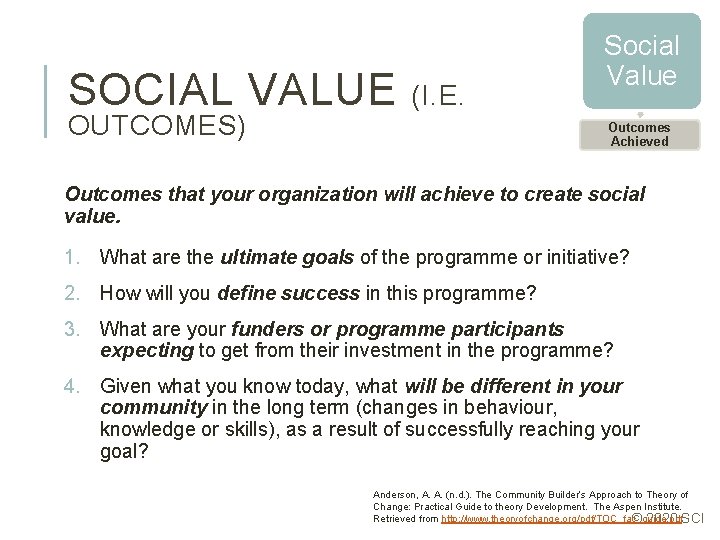
SOCIAL VALUE OUTCOMES) (I. E. Social Value Outcomes Achieved Outcomes that your organization will achieve to create social value. 1. What are the ultimate goals of the programme or initiative? 2. How will you define success in this programme? 3. What are your funders or programme participants expecting to get from their investment in the programme? 4. Given what you know today, what will be different in your community in the long term (changes in behaviour, knowledge or skills), as a result of successfully reaching your goal? Anderson, A. A. (n. d. ). The Community Builder’s Approach to Theory of Change: Practical Guide to theory Development. The Aspen Institute. Retrieved from http: //www. theoryofchange. org/pdf/TOC_fac_guide. pdf © 2020 SCI
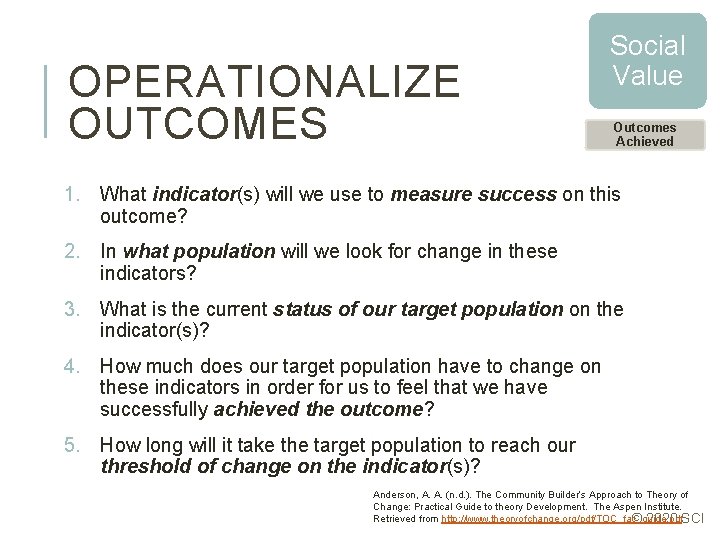
OPERATIONALIZE OUTCOMES Social Value Outcomes Achieved 1. What indicator(s) will we use to measure success on this outcome? 2. In what population will we look for change in these indicators? 3. What is the current status of our target population on the indicator(s)? 4. How much does our target population have to change on these indicators in order for us to feel that we have successfully achieved the outcome? 5. How long will it take the target population to reach our threshold of change on the indicator(s)? Anderson, A. A. (n. d. ). The Community Builder’s Approach to Theory of Change: Practical Guide to theory Development. The Aspen Institute. Retrieved from http: //www. theoryofchange. org/pdf/TOC_fac_guide. pdf © 2020 SCI
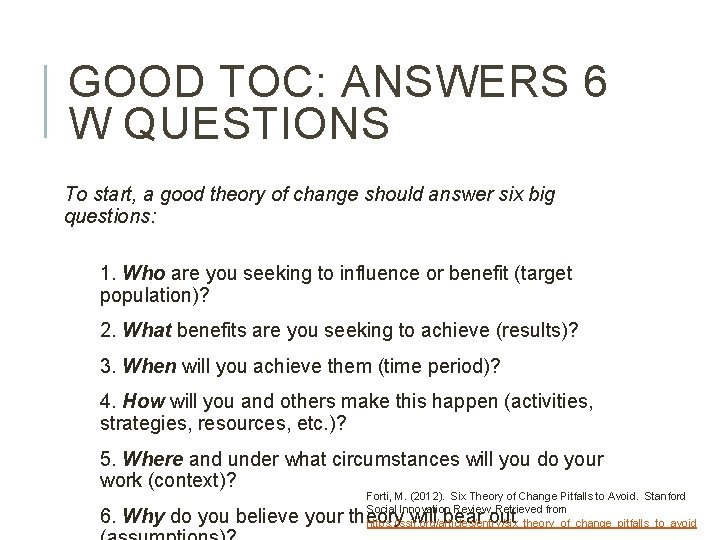
GOOD TOC: ANSWERS 6 W QUESTIONS To start, a good theory of change should answer six big questions: 1. Who are you seeking to influence or benefit (target population)? 2. What benefits are you seeking to achieve (results)? 3. When will you achieve them (time period)? 4. How will you and others make this happen (activities, strategies, resources, etc. )? 5. Where and under what circumstances will you do your work (context)? Forti, M. (2012). Six Theory of Change Pitfalls to Avoid. Stanford Social Innovation Review. Retrieved from https: //ssir. org/articles/entry/six_theory_of_change_pitfalls_to_avoid 6. Why do you believe your theory will bear out
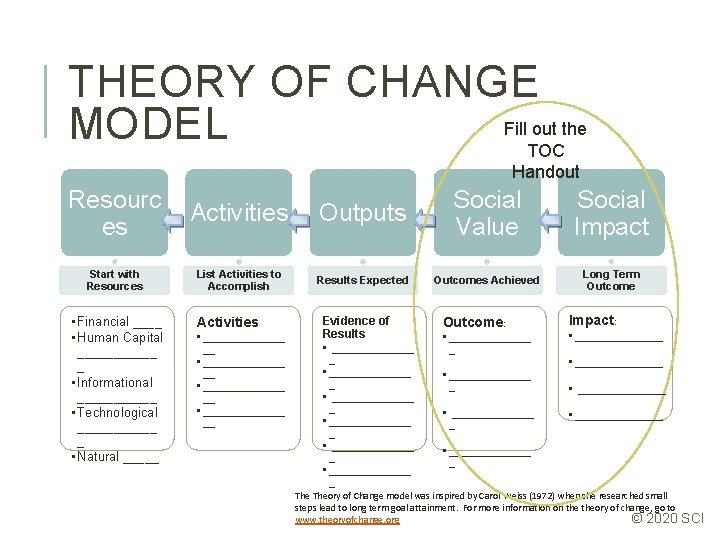
THEORY OF CHANGE Fill out the MODEL TOC Handout Resourc es Activities Start with Resources List Activities to Accomplish • Financial ____ • Human Capital ______ _ • Informational ______ • Technological ______ _ • Natural _____ Activities • ______________ __ Outputs Social Value Social Impact Results Expected Outcomes Achieved Long Term Outcome Evidence of Results • ______________ _ • ______________ _ Outcome: Impact: • ______________ _ • _______________ • ______________ _ Theory of Change model was inspired by Carol Weiss (1972) when she researched small steps lead to long term goal attainment. For more information on theory of change, go to © 2020 www. theoryofchange. org SCI
THEORY OF CHANGE MODEL Resourc es Activities Start with Resources List Activities to Accomplish • Human Capital • Financial • Informational • Technologica l • Natural Resources • Vision/Missio n • Social Business Model • Processes, Tools, Events, Technology Outputs Social Value Social Impact Results Expected Outcomes Achieved Long Term Outcome • Product of Programme Activities • Evidence of Achievement Changes to: • Behavior • Knowledge • Skills • Intended Impact Theory of Change model was inspired by Carol Weiss (1972) when she researched small steps lead to long term goal attainment. For more information on theory of change, go to © 2020 www. theoryofchange. org SCI
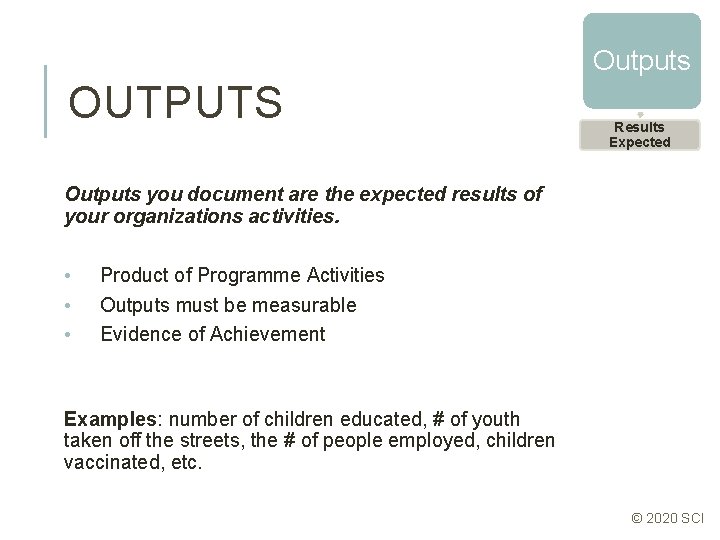
Outputs OUTPUTS Results Expected Outputs you document are the expected results of your organizations activities. • • • Product of Programme Activities Outputs must be measurable Evidence of Achievement Examples: number of children educated, # of youth taken off the streets, the # of people employed, children vaccinated, etc. © 2020 SCI
THEORY OF CHANGE MODEL Fill out the TOC Handout Resourc es Activities Start with Resources List Activities to Accomplish • Human Capital • Financial • Informational • Technologica l • Natural Resources • Vision/Missio n • Social Business Model • Processes, Tools, Events, Technology Outputs Social Value Social Impact Results Expected Outcomes Achieved Long Term Outcome • Product of Programme Activities • Evidence of Achievement Changes to: • Behavior • Knowledge • Skills • Intended Impact Theory of Change model was inspired by Carol Weiss (1972) when she researched small steps lead to long term goal attainment. For more information on theory of change, go to © 2020 www. theoryofchange. org SCI
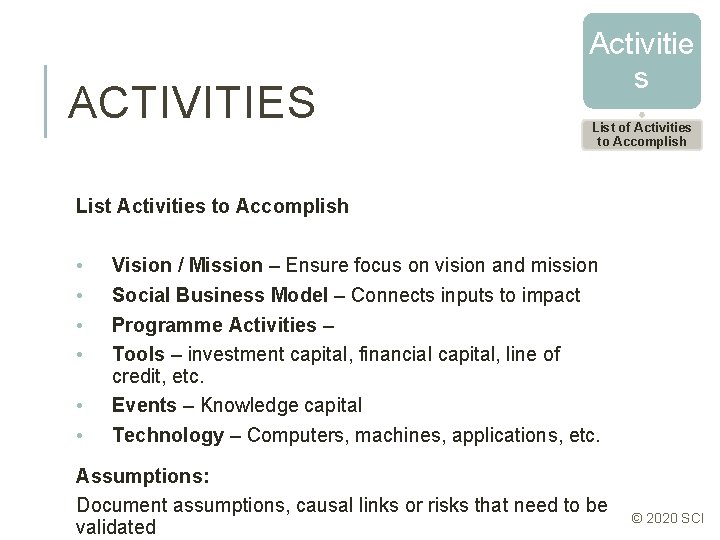
ACTIVITIES Activitie s List of Activities to Accomplish List Activities to Accomplish • • • Vision / Mission – Ensure focus on vision and mission Social Business Model – Connects inputs to impact Programme Activities – Tools – investment capital, financial capital, line of credit, etc. Events – Knowledge capital Technology – Computers, machines, applications, etc. Assumptions: Document assumptions, causal links or risks that need to be validated © 2020 SCI
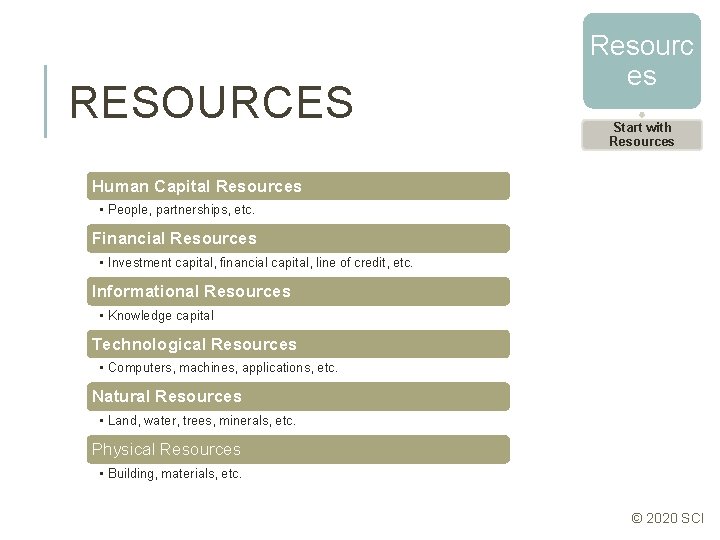
RESOURCES Resourc es Start with Resources Human Capital Resources • People, partnerships, etc. Financial Resources • Investment capital, financial capital, line of credit, etc. Informational Resources • Knowledge capital Technological Resources • Computers, machines, applications, etc. Natural Resources • Land, water, trees, minerals, etc. Physical Resources • Building, materials, etc. © 2020 SCI
THEORY OF CHANGE MODEL Fill out the TOC Handout Resourc es Activities Start with Resources List Activities to Accomplish • Human Capital • Financial • Informational • Technologica l • Natural Resources • Vision/Missio n • Social Business Model • Processes, Tools, Events, Technology Outputs Social Value Social Impact Results Expected Outcomes Achieved Long Term Outcome • Product of Programme Activities • Evidence of Achievement Changes to: • Behavior • Knowledge • Skills • Intended Impact Theory of Change model was inspired by Carol Weiss (1972) when she researched small steps lead to long term goal attainment. For more information on theory of change, go to © 2020 www. theoryofchange. org SCI
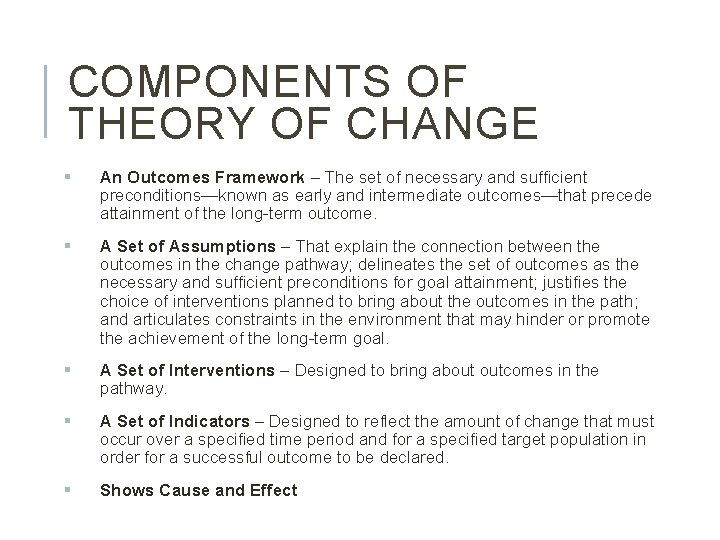
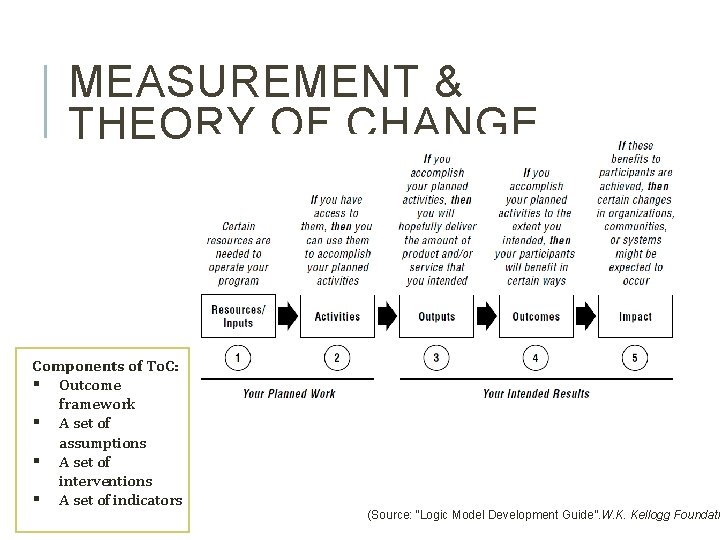
COMPONENTS OF THEORY OF CHANGE § An Outcomes Framework – The set of necessary and sufficient preconditions—known as early and intermediate outcomes—that precede attainment of the long-term outcome. § A Set of Assumptions – That explain the connection between the outcomes in the change pathway; delineates the set of outcomes as the necessary and sufficient preconditions for goal attainment; justifies the choice of interventions planned to bring about the outcomes in the path; and articulates constraints in the environment that may hinder or promote the achievement of the long-term goal. § A Set of Interventions – Designed to bring about outcomes in the pathway. § A Set of Indicators – Designed to reflect the amount of change that must occur over a specified time period and for a specified target population in order for a successful outcome to be declared. § Shows Cause and Effect
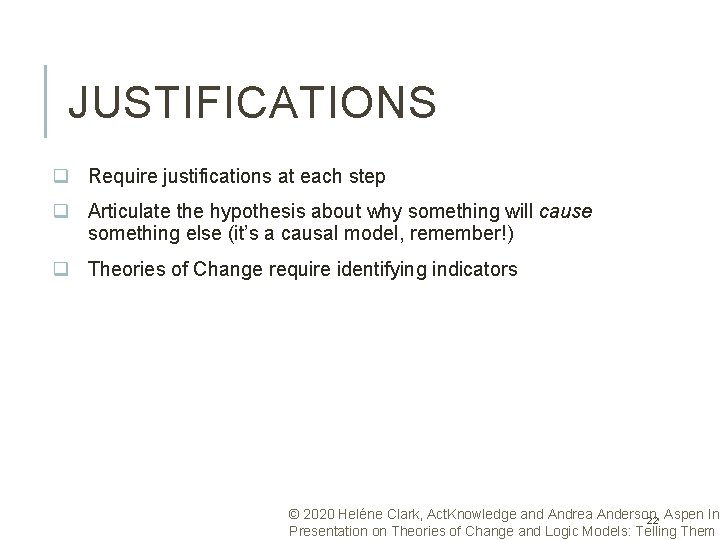
JUSTIFICATIONS q Require justifications at each step q Articulate the hypothesis about why something will cause something else (it’s a causal model, remember!) q Theories of Change require identifying indicators © 2020 Heléne Clark, Act. Knowledge and Andrea Anderson, 22 Aspen Ins Presentation on Theories of Change and Logic Models: Telling Them
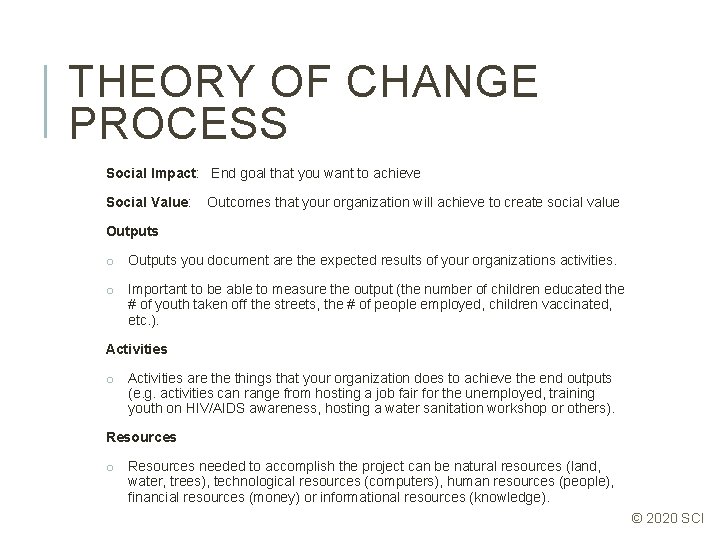
THEORY OF CHANGE PROCESS Social Impact: End goal that you want to achieve Social Value: Outcomes that your organization will achieve to create social value Outputs o Outputs you document are the expected results of your organizations activities. o Important to be able to measure the output (the number of children educated the # of youth taken off the streets, the # of people employed, children vaccinated, etc. ). Activities o Activities are things that your organization does to achieve the end outputs (e. g. activities can range from hosting a job fair for the unemployed, training youth on HIV/AIDS awareness, hosting a water sanitation workshop or others). Resources o Resources needed to accomplish the project can be natural resources (land, water, trees), technological resources (computers), human resources (people), financial resources (money) or informational resources (knowledge). © 2020 SCI
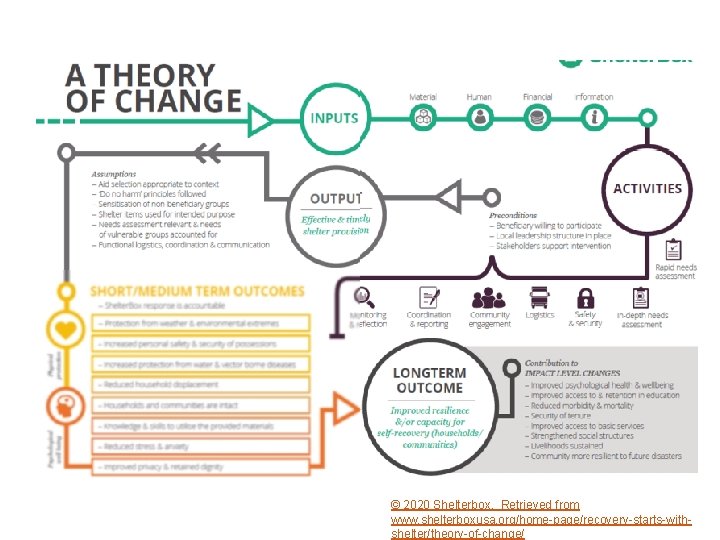
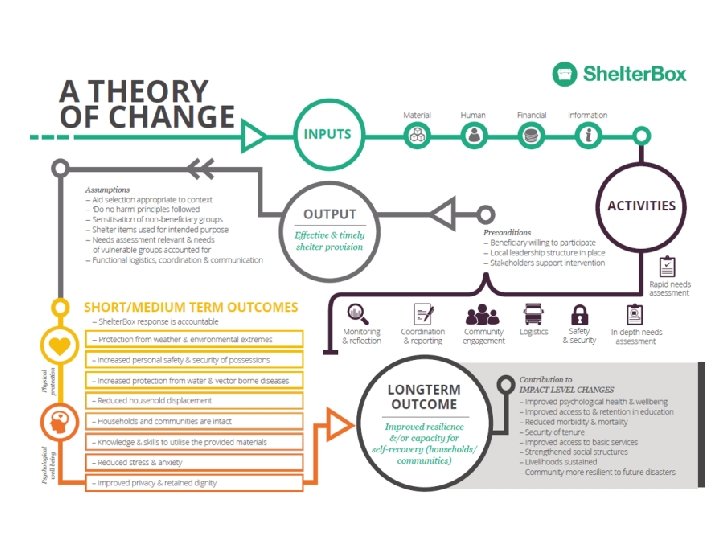
© 2020 Shelterbox. Retrieved from www. shelterboxusa. org/home-page/recovery-starts-withshelter/theory-of-change/
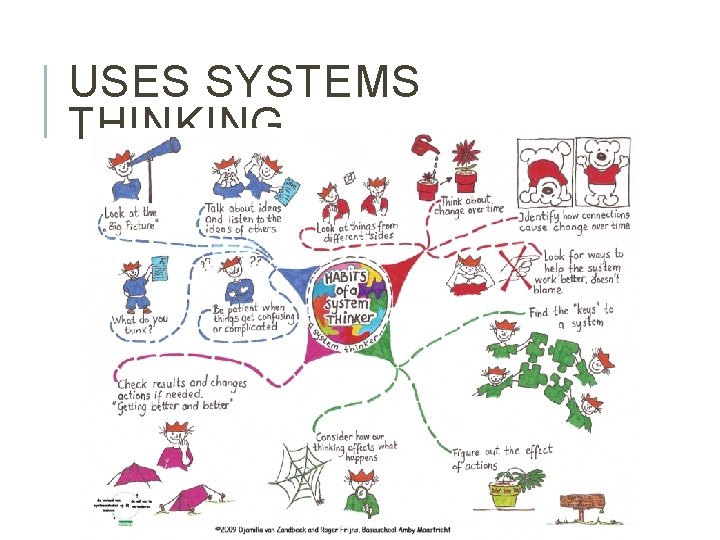
USES SYSTEMS THINKING
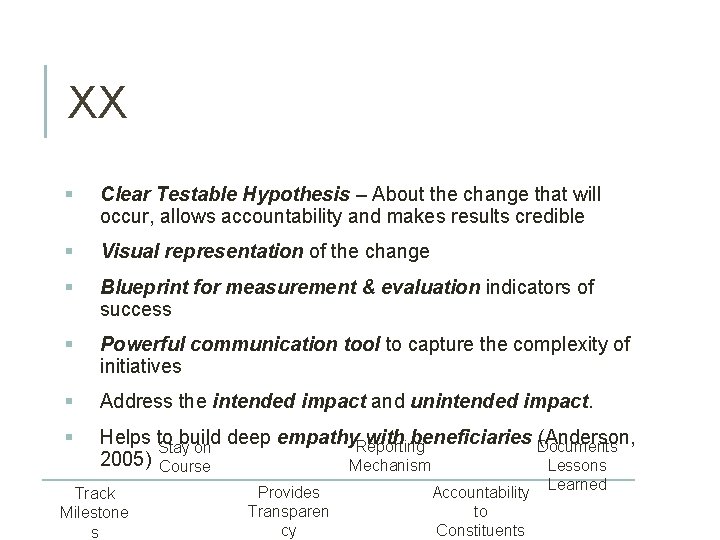
XX § Clear Testable Hypothesis – About the change that will occur, allows accountability and makes results credible § Visual representation of the change § Blueprint for measurement & evaluation indicators of success § Powerful communication tool to capture the complexity of initiatives § Address the intended impact and unintended impact. § Helps to build deep empathy. Reporting with beneficiaries Documents (Anderson, Stay on 2005) Course Mechanism Lessons Track Milestone s Provides Transparen cy Accountability to Constituents Learned
6 PITFALLS OF THEORY OF CHANGE 1. Confusing accountability with hope. A theory of change must clarify what results an organisation will hold itself accountable for achieving; in other words, what results must it deliver to be successful. 2. Creating a mirror instead of a target. A good TOC doesn’t simply reflect what an organisation is already doing; rather, it articulates what the organisation wants to be held accountable for, and works backward to identify necessary activities, strategies, resources, capabilities, culture, and so on. 3. Failing to take the external context into account. The best theories of change explicitly integrate the anticipated actions of regulators, the work of peer organizations, expected changes in the economic climate, and other factors. A deep understanding of the external context will help you create a more realistic TOC. 4. Not confirming the plausibility of your theory. While internal dialogue is a common starting point for theory of change development, the process should not conclude without a concerted effort to verify whether your “theory” is plausible. Though these efforts took time, they helped FIRST perfect their programme model and programme delivery practices in advance of implementing changes. 5. Creating a theory that isn’t measurable. To be able to test, refine, and improve your TOC over time, you need to be able to measure its key elements. Articulate the input, output, and outcome indicators the TOC suggests you should track. Forti, M. (2012). Six Theory of Change Pitfalls to Avoid. Stanford 6. Assuming you’ve figured it all out. To get the most out of. Review. your TOC, youfrom need to recognize Social Innovation Retrieved and explicitly account for the uncertainties that underlie your plan. Learning organizations carefully https: //ssir. org/articles/entry/six_theory_of_change_pitfalls_to_avoid
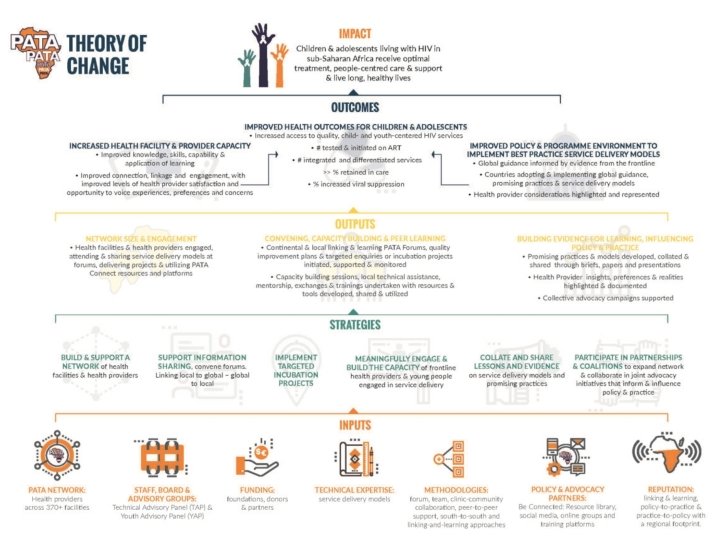
THEORY OF CHANGE EXAMPLES "It is only when your organisations has a "true north" compass point about the change you make that you will be able to credibly evaluate your organisations impact on the community you serve. - Mark Fulop
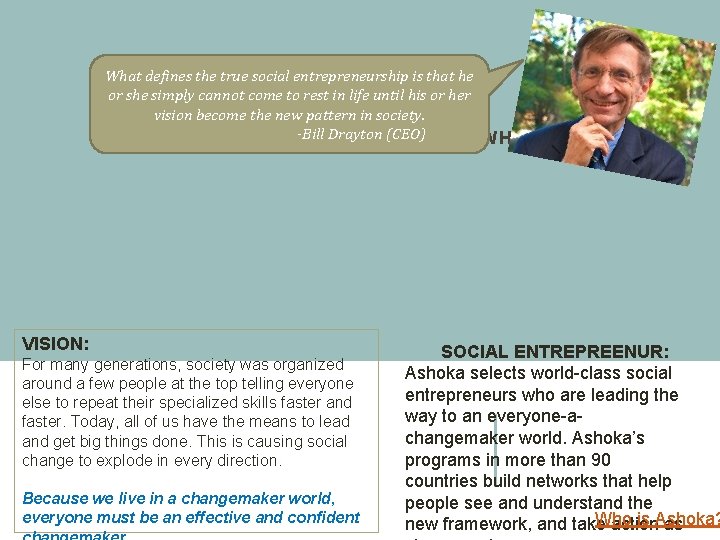
What defines the true social entrepreneurship is that he or she simply cannot come to rest in life until his or her vision become the new pattern in society. -Bill Drayton (CEO) WHAT IS ASHOKA? VISION: For many generations, society was organized around a few people at the top telling everyone else to repeat their specialized skills faster and faster. Today, all of us have the means to lead and get big things done. This is causing social change to explode in every direction. Because we live in a changemaker world, everyone must be an effective and confident SOCIAL ENTREPREENUR: Ashoka selects world-class social entrepreneurs who are leading the way to an everyone-achangemaker world. Ashoka’s programs in more than 90 countries build networks that help people see and understand the Who is Ashoka? new framework, and take action as
MEASUREMEN T & THEORY OF CHANGE
MEASUREMENT & THEORY OF CHANGE Components of To. C: § Outcome framework § A set of assumptions § A set of interventions § A set of indicators (Source: “Logic Model Development Guide”. W. K. Kellogg Foundatio
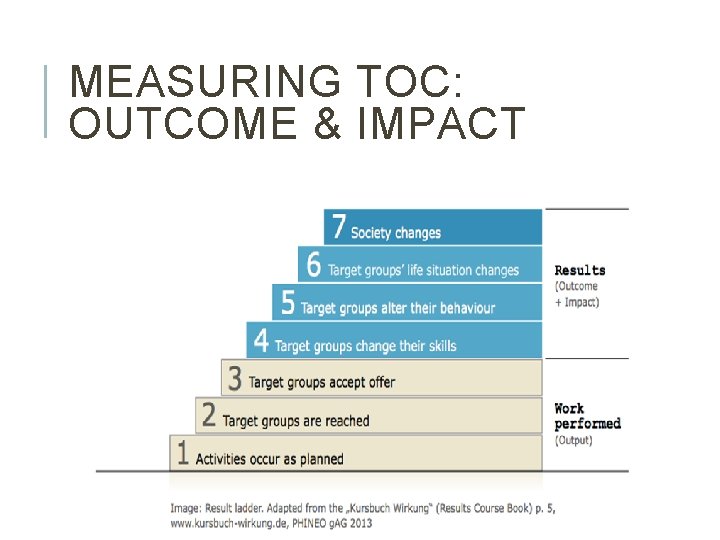
MEASURING TOC: OUTCOME & IMPACT
CONCLUSION
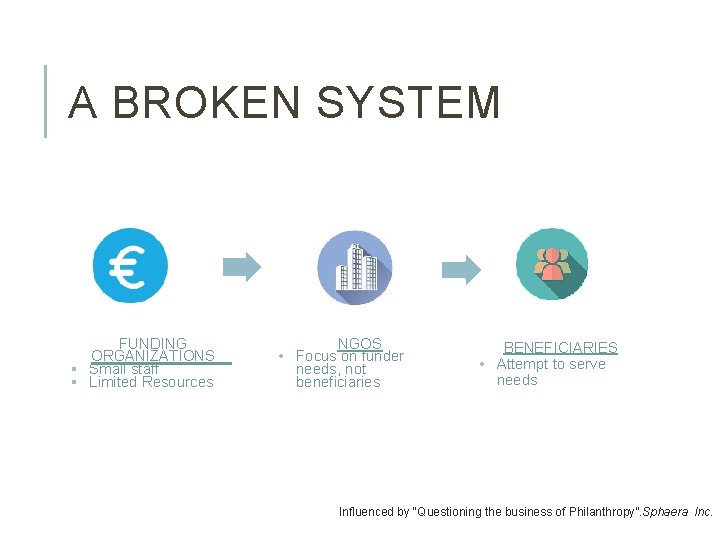
A BROKEN SYSTEM FUNDING ORGANIZATIONS § Small staff § Limited Resources NGOS • Focus on funder needs, not beneficiaries BENEFICIARIES • Attempt to serve needs Influenced by “Questioning the business of Philanthropy”. Sphaera Inc.
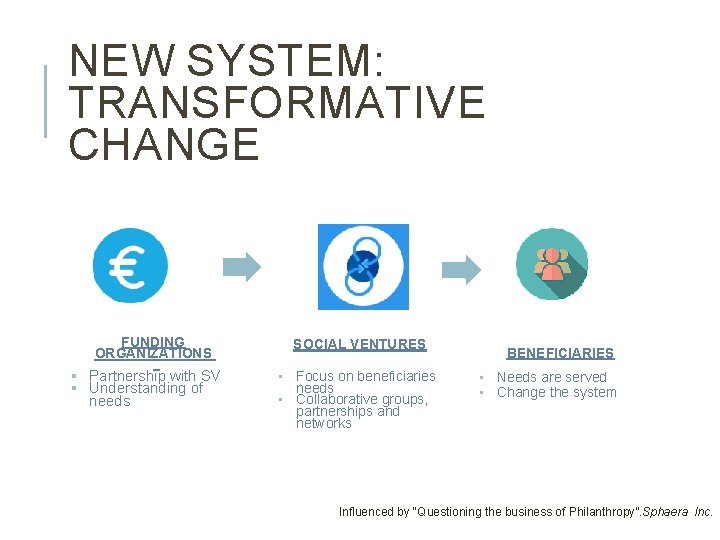
NEW SYSTEM: TRANSFORMATIVE CHANGE FUNDING ORGANIZATIONS § Partnership with SV § Understanding of needs SOCIAL VENTURES • Focus on beneficiaries needs • Collaborative groups, partnerships and networks BENEFICIARIES • Needs are served • Change the system Influenced by “Questioning the business of Philanthropy”. Sphaera Inc.
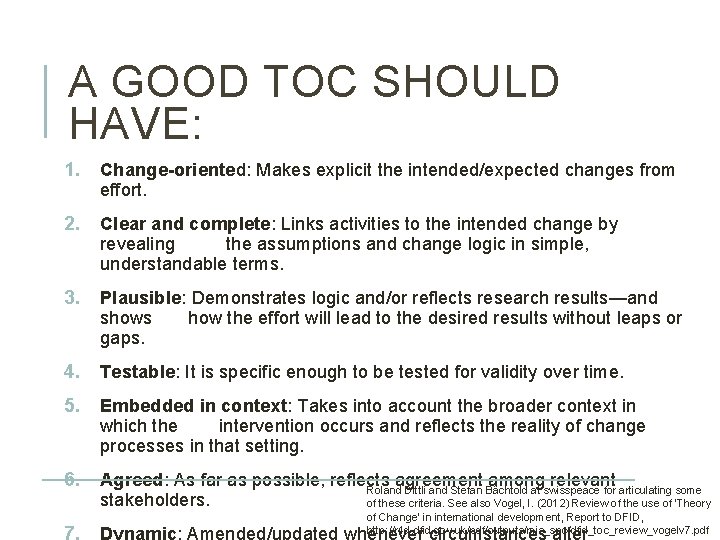
A GOOD TOC SHOULD HAVE: 1. Change-oriented: Makes explicit the intended/expected changes from effort. 2. Clear and complete: Links activities to the intended change by revealing the assumptions and change logic in simple, understandable terms. 3. Plausible: Demonstrates logic and/or reflects research results—and shows how the effort will lead to the desired results without leaps or gaps. 4. Testable: It is specific enough to be tested for validity over time. 5. Embedded in context: Takes into account the broader context in which the intervention occurs and reflects the reality of change processes in that setting. 6. Agreed: As far as possible, reflects agreement among relevant Roland Dittli and Stefan Bächtold at swisspeace for articulating some stakeholders. of these criteria. See also Vogel, I. (2012) Review of the use of ‘Theory 7. of Change’ in international development, Report to DFID, http: //r 4 d. dfid. gov. uk/pdf/outputs/mis_spc/dfid_toc_review_vogelv 7. pdf Dynamic: Amended/updated whenever circumstances alter
EXERCISE
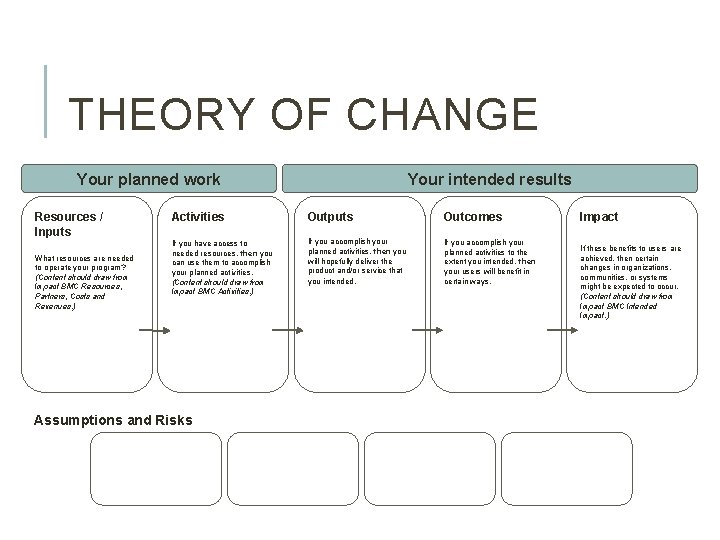
THEORY OF CHANGE Your planned work Resources / Inputs What resources are needed to operate your program? (Content should draw from Impact BMC Resources, Partners, Costs and Revenues. ) Your intended results Activities Outputs Outcomes If you have access to needed resources, then you can use them to accomplish your planned activities. (Content should draw from Impact BMC Activities. ) If you accomplish your planned activities, then you will hopefully deliver the product and/or service that you intended. If you accomplish your planned activities to the extent you intended, then your users will benefit in certain ways. Assumptions and Risks Impact If these benefits to users are achieved, then certain changes in organizations, communities, or systems might be expected to occur. (Content should draw from Impact BMC Intended Impact. )