
THEORY IN ANTHROPOLOGY Learning Objectives 1 2 3
THEORY IN ANTHROPOLOGY

Learning Objectives 1) 2) 3) 4) 5) Develop a timeline for anthropological theory Recognize the early influence of European scholars on American anthropological theory Discriminate between the various anthropological theoretical schools of thought Explain the main contributes of each scholar to anthropological theory Distinguish between early ideas of cultural and biological variation and current understanding of such processes.
Unlinear Evolutionism • ‘Armchair’ Anthropologists • [Note: As emphasis on scientific methodology grew, both methods and ‘theories’ were challenged]

Unlinear Evolutionism • Result of ‘Armchair’ Anthropology = Unilinear Evolutionism • All human ways of life pass through a __________________________ • Cultures evolve in a ________________ • Cultural traits have a ___________
Unlinear Evolutionism • Louis Henjry Morgan • _______ development, with subdivisions: _______ _____ • Problem(s) with Morgan’s scheme • ________________
Unlinear Evolutionism • E. B. Tylor • Anthropology of __________ _________ • Different starting points & speeds along the unilinear continuum • Viewed some cultures as _________ • Checkpoint: What does ‘living fossils’ mean?
Unlinear Evolutionism Unilineal Evolutionism Summary • Negative • Positive
Historical Particularism • Emphasized that each culture has its own unique ________ • Cultures should be understood based _______________________ • Methods of cultural analysis = _________ • Rejected _________
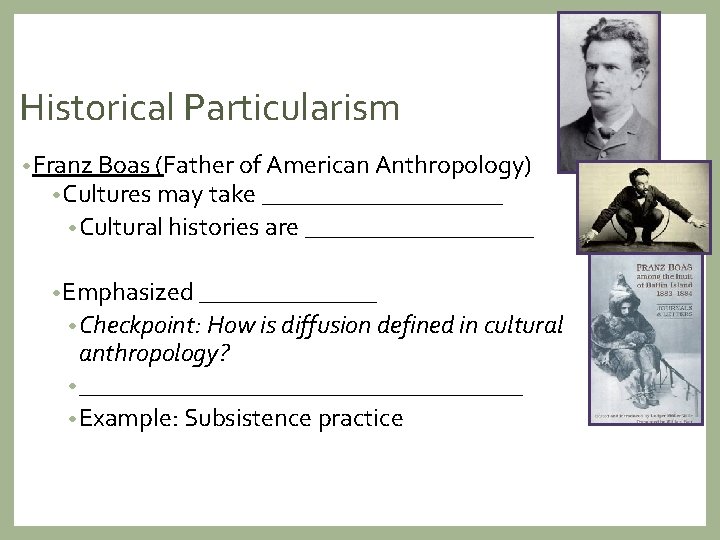
Historical Particularism • Franz Boas (Father of American Anthropology) • Cultures may take __________ • Cultural histories are _________ • Emphasized _______ • Checkpoint: How is diffusion defined in cultural anthropology? • __________________ • Example: Subsistence practice

Historical Particularism Summary • Negative • Positive
Functionalism • Emphasizes the role (function) of________ • Challenged both _______________ • Important scholars: • Malinowski (Father of Ethnography) • Radcliffe-Brown
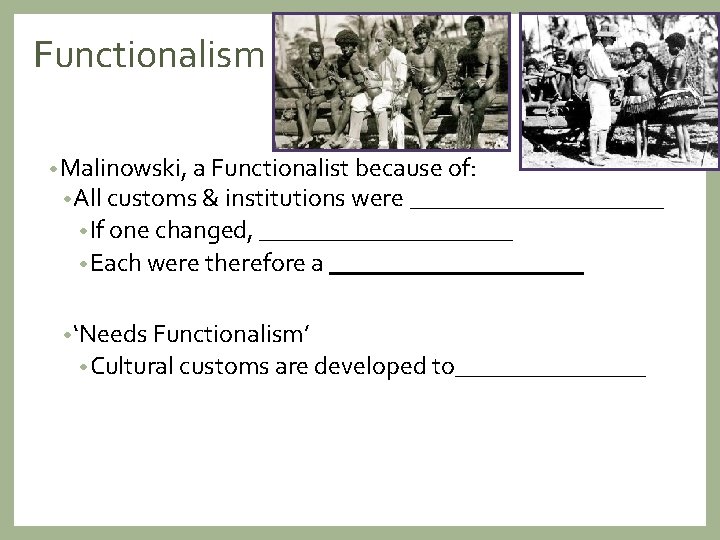
Functionalism • Malinowski, a Functionalist because of: • All customs & institutions were __________ • If one changed, __________ • Each were therefore a __________ • ‘Needs Functionalism’ • Cultural customs are developed to________
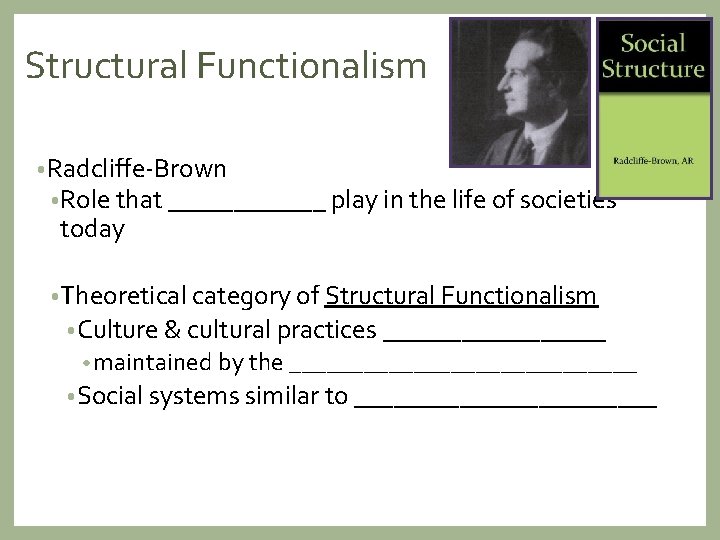
Structural Functionalism • Radcliffe-Brown • Role that ______ play in the life of societies today • Theoretical category of Structural Functionalism • Culture & cultural practices _________ • maintained by the ______________ • Social systems similar to ____________
Functionalism • Functionalism – Still Present in Anthropology • Despite challenges to the general theme, a form of functionalism is still a very active perspective in anthropology

Configurationalism • Culture viewed as ___________ • Pulled from both ______________ • Diffusion is ___________ • _______ barriers and/or _____ barriers • Considered to be part of psychological anthropology • Scholars: Ruth Benedict and Margaret Mead
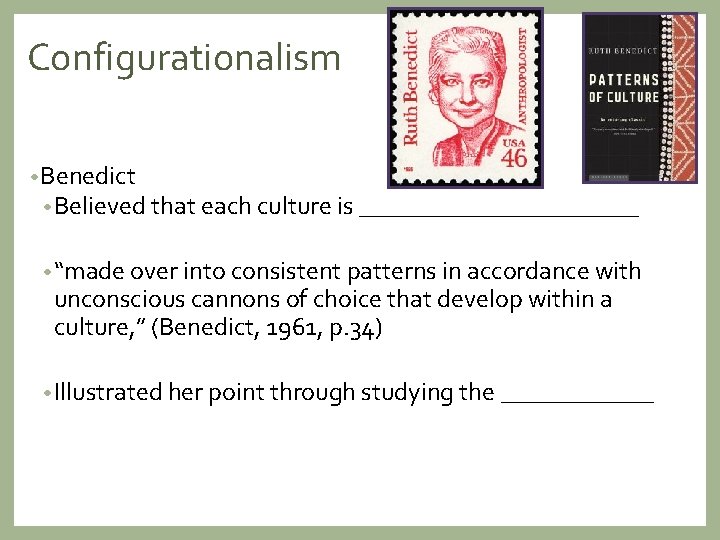
Configurationalism • Benedict • Believed that each culture is ___________ • “made over into consistent patterns in accordance with unconscious cannons of choice that develop within a culture, ” (Benedict, 1961, p. 34) • Illustrated her point through studying the ______
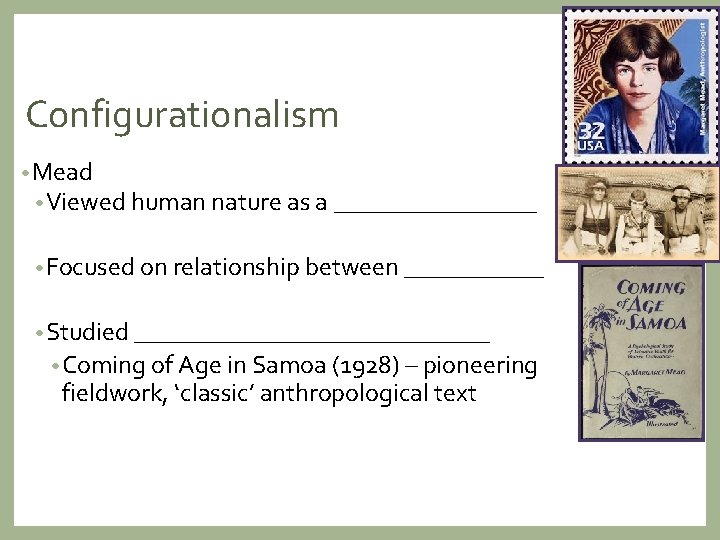
Configurationalism • Mead • Viewed human nature as a ________ • Focused on relationship between ______ • Studied ______________ • Coming of Age in Samoa (1928) – pioneering fieldwork, ‘classic’ anthropological text
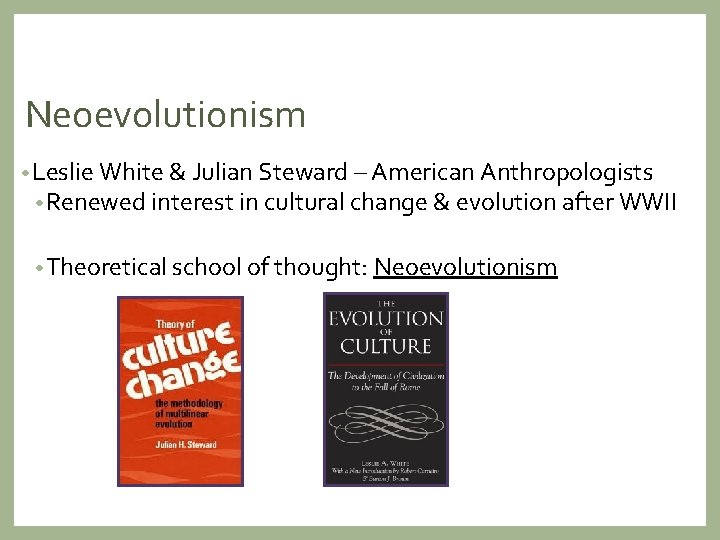
Neoevolutionism • Leslie White & Julian Steward – American Anthropologists • Renewed interest in cultural change & evolution after WWII • Theoretical school of thought: Neoevolutionism
Neoevolutionism • Leslie White • Foundation of _________________ • ______= unit of measurement & cause of cultural change • Rejected __________
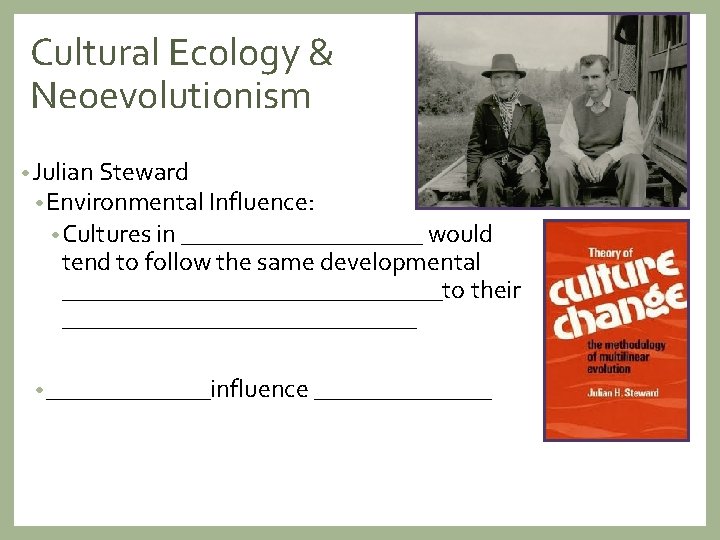
Cultural Ecology & Neoevolutionism • Julian Steward • Environmental Influence: • Cultures in __________ would tend to follow the same developmental _______________to their ______________ • _______influence _______
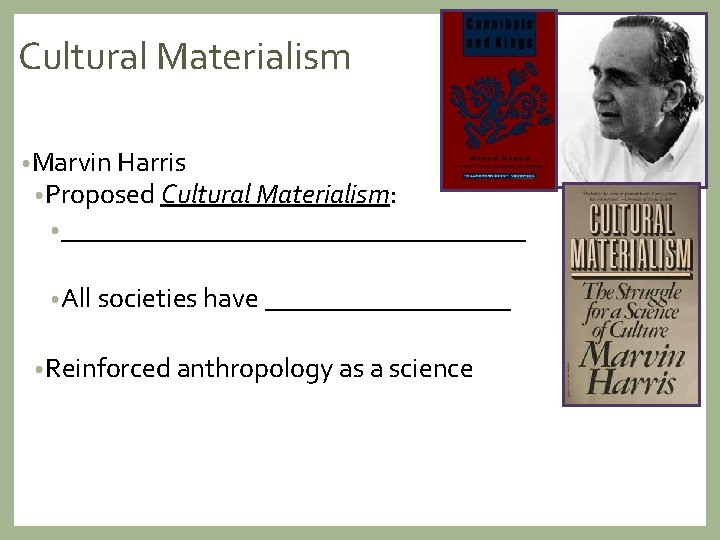
Cultural Materialism • Marvin Harris • Proposed Cultural Materialism: • _________________ • All societies have _________ • Reinforced anthropology as a science
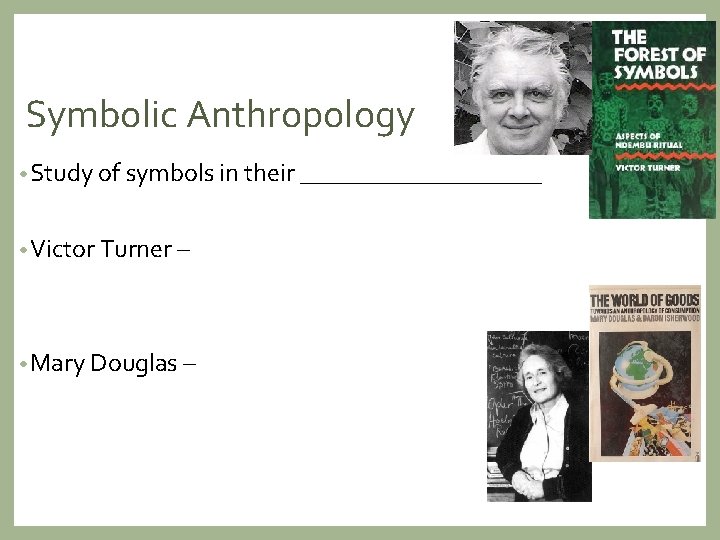
Symbolic Anthropology • Study of symbols in their __________ • Victor Turner – • Mary Douglas –
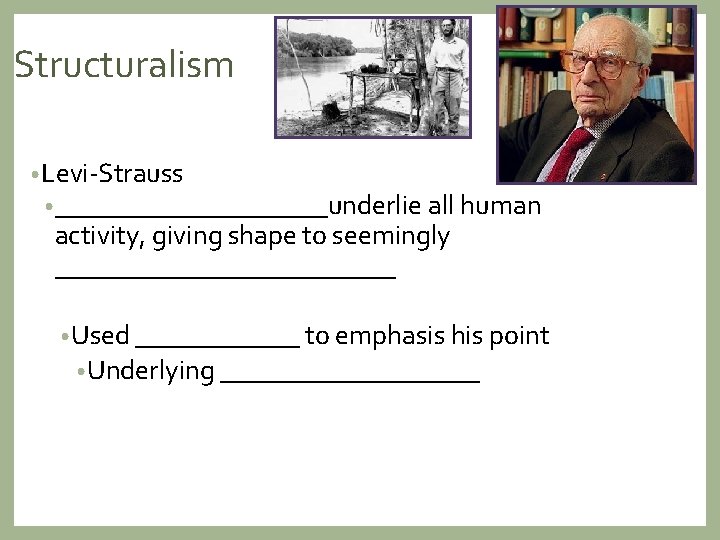
Structuralism • Levi-Strauss • __________underlie all human activity, giving shape to seemingly _____________ • Used ______ to emphasis his point • Underlying __________

When we get to Globalization… We will cover: • Processual Approches • World System Theory • Political Economy

Anthropology Today • Increase specialization • Specializations of Cultural Anthropology: Economic Anthropology Urban Anthropology of Migration Medical Anthropology of Religion Educational Anthropology Psychological Anthropology • Four-field approach continues to be present among Anthropologists
Summary • Become comfortable with: • Scholars outlined on previous slide • Theoretical school of thought • Main contribution • Example: Leslie White’s idea that energy capture propelled cultures forward & his rejection of unilinear evolutionism
- Slides: 26