
THEORY CONSTRUCTION 9 The interpretive approach 1 What




- Slides: 63
THEORY CONSTRUCTION 9. The interpretive approach 1
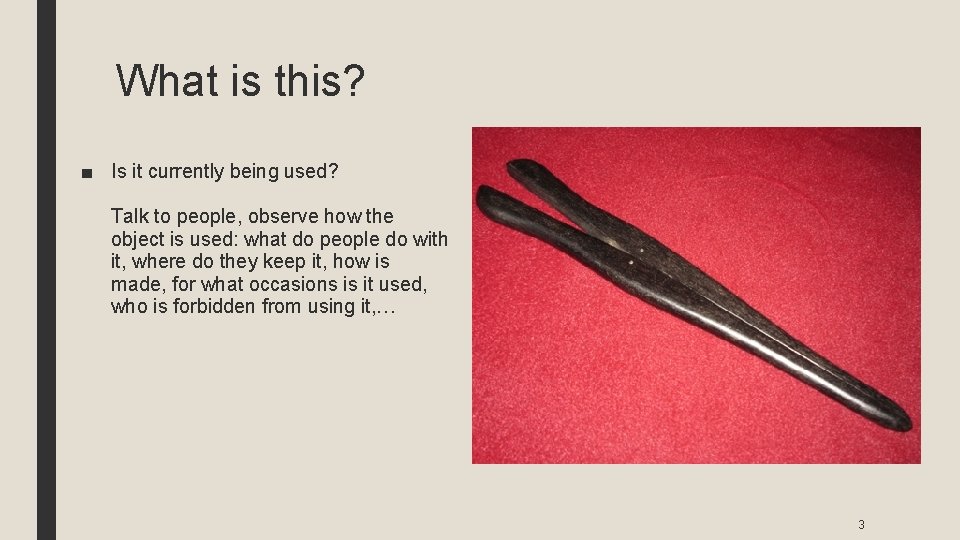
What is this? ■ Photograph: where did you find the picture? What era and where? Can you find photographs of similar objects? ■ Material object: where did it emerge from? A farmer? Your granny’s attic? Excavations? 2
What is this? ■ Is it currently being used? Talk to people, observe how the object is used: what do people do with it, where do they keep it, how is made, for what occasions is it used, who is forbidden from using it, … 3
The positivist perspective ■ You start by formulating definitions of concepts (conceptualization), operationalize those concepts so that you can develop specific hypotheses that you can test. “this object is X. It’s main use is Y. It is sold and bought mostly by those kind of people, there and then. ” ■ You have to know in advance what it is, so that you can ask specific questions about the object… – e. g. you could inquire into consumption, production, what type of people possess or buy this type of object (e. g. class, profession, city/countryside), where do they buy this object, how much is it worth, how have the prices fluctuated over time, … 4
The interpretive perspective ■ Interpretive researchers: do not go to the field with their concepts and perspectives ready to be applied. ■ Rather: they want to understand how these concepts, roles, objects, meanings are used in the field. ■ “In interpretive research, we seek to understand what a thing “is” by learning what it does, how particular people use it, in particular contexts. That is, interpretive research focuses on context-specific meanings, rather than seeking generalized meaning abstracted from particular contexts. ” (SS&Y) 5
The interpretive perspective ■ Same thing with learning a new language: you’ll have to ask people what particular words mean (“sowieso”, “yallla”), find out how these words are used… ■ Similar to other interpretive questions: – What does “integration” mean to different people? – Solidarity, success, status, independency, self-expression, equality, … 6
So… What is this? ■ “Glove “stretchers. ” ■ They were used by the British in Victorian times to stretch the fingers of gloves, making it easier to get the glove on. ■ At the time it was fashionable to wear gloves a size smaller than your hand: beauty ideals of small, delicate hands. 7
Glove stretchers ■ How a word, an object, a ritual, a ceremony or an act is used in particular contexts, reveals assumed, unspoken, or taken-for-granted ideas about a range of values, beliefs and/or feelings. ■ The glove stretcher: values of modesty, dignity, respectability, beliefs about what constitutes “proper” dress, and what it means to cover your hands with gloves in terms of status, class, femininity and so on. 8
Glove stretchers ■ Understanding what an object is can tell us a lot about the world of which it is a part. ■ This holds for all kinds of social elements: words, phrases, images, objects, feelings, thoughts, actions, … ■ In other words: the interpretive approach starts from a strong focus on context and on the “native” perspective: what does it mean to particular people? 9
Overview ■ Contextuality – Context – Concepts – Constitutive causality ■ Trustworthiness ■ Evidence ■ Getting going with interpretive research 10
Overview ■ Schwartz-Shea, P. & Yanow, D. (2012) Interpretive research design. Concepts and processes. New York: Routledge, pp 45 -54 (ch. 3). ■ Schwartz-Shea, P. & Yanow, D. (2012) Interpretive research design. Concepts and processes. New York: Routledge, pp 78 -90 (ch 5). ■ Schwartz-Shea, P. & Yanow, D. (2012) Interpretive research design. Concepts and processes. New York: Routledge, pp 91 -114 (ch 6). 11
Context ■ Schwartz-Shea, P. & Yanow, D. (2012) Interpretive research design. Concepts and processes. New York: Routledge, pp 45 -54 (ch. 3). ■ Explore why things take particular forms, rather than others… ■ Two dimensions of interpretive sociological research 1. You look at how individuals actively construct realities – What strategies do they use. What are their intentions and motivations? How do they think and feel? – Focus on their agency – Approaching people as subjects, rather than objects. – This is what makes it essentially interpretive. 12
Context 2. Concentrate on inter-subjectively shared meanings and their consequences – Social scripts (Goffman), imaginaries (Taylor), cultural systems (Malinowksi, Douglas, Parsons), cultural repertoires (Swidler), webs of meaning (Weber/Geertz) – Make sure to examine the (intended and unintended) consequences of social meaningmaking (e. g. “If men define situations as real, they are real in their consequences”) – These two elements make interpretive research sociological 13
What about generalisation? ■ Positivism: generalization takes center stage. – Showing that your findings can be generalized (that they can be applied across different contexts) is the responsibility of the researcher. – Researcher needs to recognize the “limits” of his/her own research. Why and how it might only apply for a particular case. ■ Interpretivism: “Is the research sufficiently contextualized so that the interpretations are embedded in, rather than abstracted from, the settings of the actors studied? ” – “Contextuality” serves as a main criterion for scientific relevance, rather than “generalisability” – Applying this interpretation to other cases is the responsibility of the reader / other researchers… 14
Concepts ■ Etic or experience-distant (positivist) – Needs to be precise, accurate, clear – Contributing to the literature, so the concepts need to engage with existing studies. And you need to have it ready before you analyse your data (a priori) – Allows to estimate correlations and causes across cases ■ Emic or experience-near (interpretive) – Entry to “local knowledge”: adequately reflects lived experiences – Developing insights throughout the research – “emic” 15
Concepts ■ E. g. Migration to Europe: – Hooghe et al 2008: GDP, unemployment rates, social welfare arrangements. Abstract, decontextualised, objective. – Belloni: refugees as gamblers. Using words and metaphors that are used by her respondents as well. Building her theory from those metaphors. ■ E. g. “Social cohesion” – Social trust in one’s neighbourhood and in people more generally – Frequency and quality of contact with others 16
Sensitizing concepts ■ Blumer, H. (1954). “What is wrong with social theory? ” American sociological review, 19(1), pp 7 -10. ■ Definitive concepts: “refers precisely to what is common to a class of objects, by the aid of a clear definition in terms of attributes or fixed benchmarks. – Definitive concepts: “provide prescriptions of what to see” ■ Sensitizing concepts: “lacks such specification of attributes or benchmarks and consequently it does not enable the user to move directly to the instance and its relevant content. Instead, it gives the user a general sense of reference and guidance in approaching empirical instances. ” – Sensitizing concepts: “merely suggest directions along which to look. ” ■ According to Blumer, most sociological concepts are sensitising: culture, institutions, social structures, morality, persaonlity, … – They lack precise reference – They rest on a general sense of what is relevant 17
Sensitizing concepts ■ Sensitising concepts are not just a sign of immaturity and a lack of scientific sophistication ■ What we study is always situated in a distinctive context, hence we cannot simply apply abstract concepts to empirical reality. ■ Instead, we need to use these concepts so that they help express the distinct character of what we’re studying. – E. g. comparing “assimilation” for Jewish Rabbi’s in Poland vs Mexican peasants in the US – E. g. comparing social structures in a Chinese village or in an American labour union… 18
Sensitizing concepts ■ “One moves out from the concept to the concrete distinctiveness of the instance instead of embracing the instance in the abstract framework of the concept. ” (Blumer) ■ E. g. what does social cohesion mean in each country ■ E. g. what does “integration” mean in Germany and in New York? 19
Sensitizing concepts ■ Successful use of such concepts depends less on clear-cut definitions that can be operationalized and tested across a wide range of case. And more on a “patient, careful and imaginative” attitude towards what you’re studying – “remaining in close and continuing relations with the natural social world” – Awareness of what your concept (does not) mean in this particular context ■ Concepts may help you gain insights in what things mean to people in a specific context. They render you “sensible” for, or “attentive” to particular perspectives 20
Overview ■ Contextuality – Context – Concepts – Constitutive causality ■ Trustworthiness ■ Evidence ■ Getting going with interpretive research 21
Causality ■ Quid causality if you’re not analysing objective relationships between variables? How to explain social phenomena in an interpretive approach? ■ “Constitutive causality”: explain through embedded meanings 22
Causality: two sources 1. Individual intentions. ■ Weber: what motivates people? ■ Methodological individualism: you look at how individuals use particular scripts, and how their conception of ideals and values feed into particular types of actions and consequences ■ For example: – The meanings of sports cars for (some) young people, and how this feeds into social actions – Analysing individuals’ strategies for acquiring status, a better position at the labor market, … 23
Causality 2. Contextual explanations ■ Understand actors in and through the context in which they live ■ For example: – Analyzing a neighborhood: how urban identities, socio-economic and spatial composition of different urban areas influences the way people behave in particular streets, and how they talk about their neighborhood – Historical, power-infused settings (do not) co-create a collective refugee identity 24
Overview ■ Contextuality ■ Trustworthiness – Criteria of good research – Where do data come from – Checking for trustworthiness ■ Evidence ■ Getting going with interpretive research 25
Criteria of good research ■ Recall: Positivist criteria (validity, reliability, replicability) all rest on removing the researcher from the scene. ■ Analyzing reality from an external point of view (“objectively”) requires a certain physical, social and emotional distance from that reality ■ “Bias” = when this distance is breached – E. g. training interviewers so that they apply the same codes, ask the same questions… 26
Bias in positivist research ■ Emotionally too close – Identifying with or against respondents (e. g. racists, elite, prostitutes, …) – No neutral assessment of the evidence ■ Cognitively too close – Confirmation basis – Laboratory: double-blind procedures ■ Physical presence – The presence of the researcher affect the answers of the interviewers. 27
Bias in Interpretive research ■ These criteria and assumptions do not fit well with interpretivists’ attention to context, local knowledge and constitutional causality ■ Interpretive researchers assume that social phenomena are: – Dynamic, fluid, historical (reality is not stable) – Co-produced, embodied, situated (you don’t collect data) ■ Interpretivism: ideal researcher is the instrument him/herself (rather than a nuisance whose impact needs to be limited by procedures and controls) 28
Bias vs partiality ■ “Bias” is a problematic notion in interpretive research ■ Interpretive researchers try to understand meaning-making in actors’ own settings, without artificial controls ■ Researchers enter settings knowing that “their embodied selves constitute the primary instrument for accessing and making sense of those individual and community meaning-making processes. ” – Researchers are never interchangeable – Always embodied – Always a partial perspective 29
Criteria of good research ■ Interpretive researchers have other ways of making their research “trustworthy”, besides validity, reliability, replicability, … ■ “These practices begin from the position that there is no place to stand outside of the social world that allows a view of truth unmediated by human language and embeddedness in circumstance. ” (SS&Y) ■ “The search for knowledge… begins wherever the scientist initially finds her- or himself…” (SS&Y) 30
Overview ■ Contextuality ■ Trustworthiness – Criteria of good research – Where do data come from – Checking for trustworthiness ■ Evidence ■ Getting going with interpretive research 31
Where do data come from? ■ Positivism: data (“what is given”) is to be collected by the researcher. You assume a distinction between researcher and reality. ■ Interpretivism: world and researcher are entwined. Data do not already exist, they are not out there, but co-generated, co-created by the researcher and his/her respondents. – E. g. interpretive epistemology: strictly speaking there is no objective reality that can be seen from an external point of view. There are only active, partial constructions of reality. 32
Where do data come from? ■ Respondents interpret reality themselves ■ Key role of informants – e. g. Beloni: important role of her key informants. – Sometimes key-informants become co-authors (e. g. refugee studies) ■ Developing emic concepts – E. g. “gambling” – E. g. being “hospitable” ■ Intrusion/change can help you learn something – E. g. Garfinkel’s ethnomethodology 33
Who the researcher is, matters ■ Everyone (and not only researcher) has unique prior knowledge ■ Different (intellectual, social, emotional) resources harbor (slightly) different results, as researchers will emphasize other aspects of a social phenomenon. ■ Participants also “read” the researcher: they interpret who (s)he is, what (s)he wants, what (s)he is doing… 34
Who the researcher is, matters ■ E. g. interviewing Syrian men and women… – <-> intercoder realibility in positivist approaches: should be precisely the same – Different researcher with particular skills and identity – Not so much true/untrue – More relevant: revealing intersection between gender, power and religion – Continuous “reflexivity”: reflecting about your own identity, actions and expectations 35
Who the researcher is, matters ■ In advance: reflect how your persona might have an impact on your research, on the setting, people, actions… ■ e. g. doing research with homeless youngsters: you need particular street skills, social skills, listening skills to become credible, to gain their trust, to understand them. These are skills you don’t need when you stay behind your desk conducting regression analyses. 36
What about lies, then? ■ “It is not that researcher cannot detect lies, but that lies, rumors, inventions, denials, evasions and silences are themselves potentially data that are relevant to the unfolding analysis. ” (SS&Y) ■ Interpretive researchers are as interested in the frontstage as in the backstage: they are interested in symbolic boundary work, strategies of the self, performances, … – E. g. Gofmann, Stigma, The presentation of self in everyday life – E. g. Lamont, Money, Morals and Manners 37
What about lies, then? ■ E. g. Syrian refugees: socially desirable answers about working aspirations? – understanding the context in which they act – understanding their intentions (why are they here, how do they want to appear? ) – Observe their statements and actions in different settings 38
Overview ■ Contextuality ■ Trustworthiness – Criteria of good research – Where do data come from – Checking for trustworthiness ■ Evidence ■ Getting going with interpretive research 39
Checking for “trustworthiness” ■ Criteria for assessing whether interpretive research is trustworthy or not… 1. Reflexivity… 2. Strategies for data analysis 3. “Member checking” ■ Schwartz-Shea, P. & Yanow, D. (2012) Interpretive research design. Concepts and processes. New York: Routledge, pp 91 -114 (ch 6). 40
1. Reflexivity ■ “a researcher’s active consideration of and engagement with the ways in which his own sense-making and the particular circumstances that might have affected it, throughout all phases of the research process, relate to the knowledge claims he ultimately advances in written form. ” ■ “transparancy of knowledge generation”: where do your interpretations come from? ■ Ethical reflexivity: by maintaining a close proximity to research participants, your personal sense of responsibility is strengthened – You often have more intimate knowledges of their lives – Only strangers can remain neutral 41
1. Reflexivity ■ At the design stage, reflect systematically about: – Researcher’s characteristics (demographic, socially, emotionally, …) – Physical locations in the field setting: access to persons and ideas, vulnerabilities… ■ Writing stage – Continuous self-reflection on your interpretations, theories, how you respond emotionally to events, people, sites, documents… Trace how your insights emerged: where did you get this interpretation from? How did the context impact that interpretation? – Reflect on the impact of your research community (e. g. Hochschild, Lamont, …) 42
2. Strategies for data analysis ■ Don’t focus on “getting the facts right”, but on understanding the nuances of various experiences more fully – Can only be learned over time – Hence you need to suspend your judgment: avoid rising too quickly on a pattern, answer or interpretation – Instead: ■ “Following up surprises” ■ Search for tensions in your explanations and/or negative cases (to which cases do you struggle to apply your initial interpretation? ) ■ Search for evidence that will force you to challenge your initial impressions, pet theories or favored explanations 43
3. Member-checking ■ “Sending or bringing written material involving the people studied back to them. ” ■ Do your interpretations clarify or make explicit what they implicitly assume? Can they recognize themselves in your descriptions? How do they respond? ■ How do different respondents react to the same interpretation? What does that tell you? ■ Almost impossible to get it right for everyone ■ You can include some of these comments in your research (appendix, during your interpretations, …) ■ Not always appropriate – Anonymity or confidentiality… – Politically or economically sensitive – Sometimes e-mail or mail may not be appropriate 44
Overview ■ Contextuality ■ Trustworthiness – Criteria of good research – Where do data come from – Checking for trustworthiness ■ Evidence ■ Getting going with interpretive research 45
Evidence ■ Usually associated with positivism: hard evidence, evidence-based policies, … ■ Often seen as problematic in interpretative research: “merely subjective”, difficult to convince others, … ■ Yet there are strategies for providing evidence, and criteria for judging whether these interpretations are adequate… 46
How to build up evidence for an interpretation ■ Concentrate on variety in your data: a fit between your interpretations and a wide range of actions, settings, discourses, persons, temporalities, … ■ “Terms gain their meaning from their place within an extensive network, and in order to understand these terms, [reseachers] must be fully trace the entire network. ” (Brandwein in SS&Y, p 86). 47
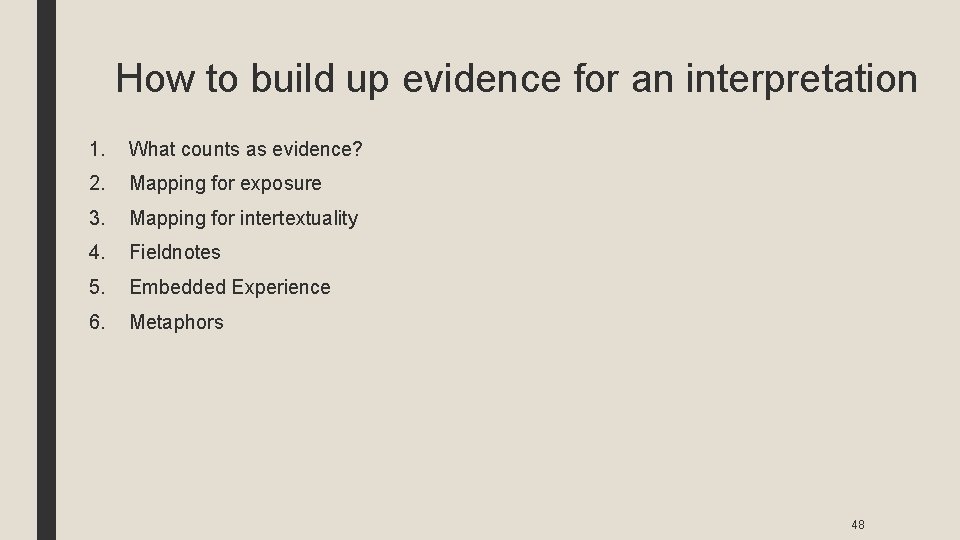
How to build up evidence for an interpretation 1. What counts as evidence? 2. Mapping for exposure 3. Mapping for intertextuality 4. Fieldnotes 5. Embedded Experience 6. Metaphors 48
1. What counts as evidence? ■ Evidence can be anything, depending on the puzzle you’re tracing ■ For example: – Change in media perspectives on minorities after 9/11: quantitative and qualitative analysis, interviews with journalists, focus groups with audience members, social media analyses, … – Stories on mental hospitals in the 1950 s: can emerge from oral histories, administrative archives, photographs, reports, … – Experience of a neighborhood: analyzing buildings, designs of the streets, interactions, police patrols, parties, … 49
1. What counts as evidence? ■ You need a fit between your research topic and the right type of data – e. g. if you’re interested in interactions between doctors and patients: you cannot limit yourself to in-depth interviews with doctors or with patients, or read statistical reports on the number and types of consultations. You will need to conduct some form of observation of these interactions. – e. g. interviewing war journalists about their practices and experiences in and around Syria: interviews with fixers, content analysis, autobiographical documents, knowledge of the Syrian conflict, … 50
2. Mapping for exposure ■ Expose yourself to a variety of meanings and positions – e. g. different neighbourhood(s) in a city, or different streets in a neighbourhood – e. g. positions within an organisation (coordinator, internship, street-level social worker, …) – e. g. positions in a certain field (shelter for homeless people: different organisations working in that sector) ■ Locating documents that enable you to map different, perhaps contentious views: it may lead you to documents or archives that you could not plan for in the initial research design 51
2. Mapping for exposure ■ Finding out where relevant data can be found – initial meetings with different actors involved – media reports & google – visiting the setting – shadowing individuals – Prior knowledge that you continuously revise (p 88) ■ This actually represents a large share of interpretive research work: continuously looking for relevant data – In contrast to positivist research: one survey, one database that is usually already at your disposal… 52
3. Mapping for intertextuality ■ “Intertextuality” comes from literary analysis (Kristeva, Bakhtin) – Traditionally: references to other texts – E. g. It rained “for forty days and forty nights” refers to Noah’s arch – E. g. building a Christmas crib for refugees – E. g. many NASA spaceships are named after Star Trek vehicles, on request ■ In interpretive social sciences: the researcher sees links between different “texts”, between different types of data – E. g. comparing what Rwandan genocide perpetrators said in interviews with what was noted in official letters of confession: understanding coping mechanisms and discursive rationalizations… (Fuji 2008) 53
3. Mapping for intertextuality – Positivism: finding patterns across a large amount of (similar) observations – Interpretivism: building evidence through a wide range of elements (cases, instances, actors, words, feelings, situations, spaces, temporalities, …). – Hence you have to demonstrate that your interpretation makes sense across a wide range of concrete situations. 54
4. Fieldnotes ■ Write down as much as you can, a voice recorder can also work. Either can sometimes be difficult though… ■ Not only in participant observation: in any kind of data collection. – Interviews, focus groups, informal conversations, staff meetings, workshops, when you read particular media stories, … always note down a thick description of the context of your encounters and reflections. 55
5. Embodied experiences ■ Being there, seeing, smelling, hearing reality as people you are studying do. ■ You will probably get closer to what things mean to people by fully using your senses, than by handing out questionnaires. 56
6. Metaphors ■ Goal is to understand respondents’ experiences most adequately. Hence metaphors or allegories can work particularly well, as long as they fit logically with your interpretation, and practically with your phenomenon ■ Go back to your respondents, check if the metaphors express how they experience things… 57
Overview ■ Contextuality ■ Trustworthiness – Criteria of good research – Where do data come from – Checking for trustworthiness ■ Evidence ■ Getting going with interpretive research 58
Getting going… ■ Positivist approach: planning & timing – Linear process from theory to data to writing up results – Clear separation between data collection and analysis ■ Interpretive research: flexibility & adaptability – Abduction, hermeneutical circle: data collection, analysis, reading and writing as an iterative, recursive process – You start with “some sense of a research question” (SS&Y, p 54) – Continuously looking for relevant data: actors, places, objects, temporalities, words, feelings, figures of speech, … 59
Getting going… ■ However: you do need some preparation… ■ Three particular issues are crucial in reflecting on your interpretive research – Access to and choice of settings, actors, events, archives, materials, … – Positionality: relation with respondents 60
Where & When? ■ Where to meet respondents: – E. g. : refugees: at their homes, reception centres, at university, my home, public bar, … – E. g. Walby (2010): background noise of coffee shops, park benches: urban anonymity – E. g. Anthropologists in coffee shops, squats, ghettos, … ■ When: – Office hours, evenings, weekends, … – Flexible, open planning 61
Access ■ Formal access: permission from superiors – Sometimes: officially apply for permission – Convincing superiors: confidentiality, mutual benefits, … – Helps if you were or are an insider (e. g. journalists) – E. g. refugees: Fedasil, social organizations, … – Social access: whether or not people let you into their lives ■ You have to build up relations (“rapports”) with people ■ This can happen gradually or suddenly 62
Building up relations ■ Positivism: distance – The professional/expert researches the passive subject – Their interactions are clearly bounded in time – And often regulated through contracts, consent forms, … ■ Interpretive: proximity – Informants are crucial not only in providing information but in opening doors – Keeping in touch over a longer period of time – Stay in touch with a wider range of actors in the setting you’re going to research, not only the key respondents (e. g. archive, teachers, social workers, policy-makers, party members, neighbors, …) 63