
THEORY CONSTRUCTION 8 Causal Models Dina Abdelhafez Causal

THEORY CONSTRUCTION 8. Causal Models Dina Abdelhafez
Causal models ■ Models are how most positivist scientists deal with theory ■ Schematic representations of relations between variables ■ This lecture will cover: – 1. Types of causal relationships – 2. Constructing a causal model 2

1. Types of causal relationships 1. Direct causal relationship 2. Indirect causal relationship 3. Spurious relationship 4. Bidirectional causal relationship 5. Unanalysed relationship 6. Moderated causal relationship 3
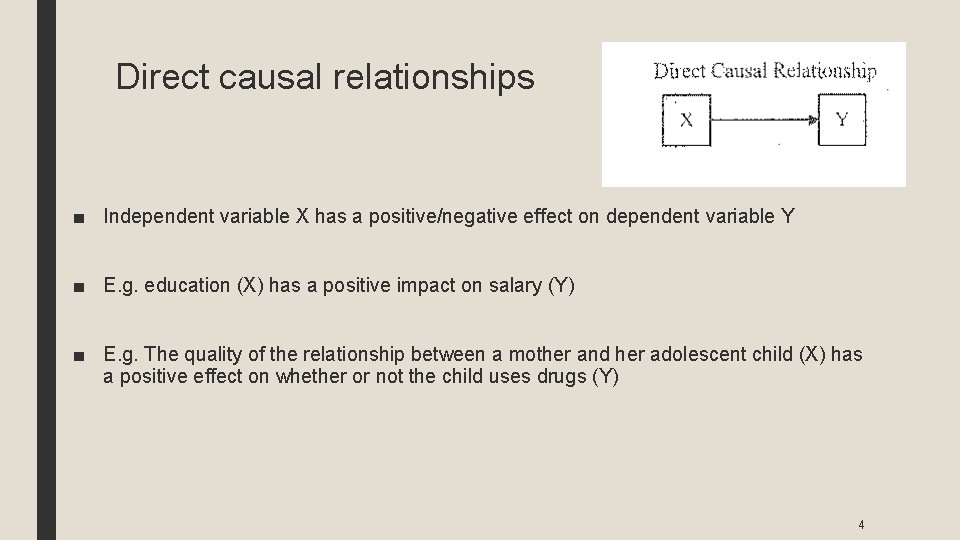
Direct causal relationships ■ Independent variable X has a positive/negative effect on dependent variable Y ■ E. g. education (X) has a positive impact on salary (Y) ■ E. g. The quality of the relationship between a mother and her adolescent child (X) has a positive effect on whether or not the child uses drugs (Y) 4
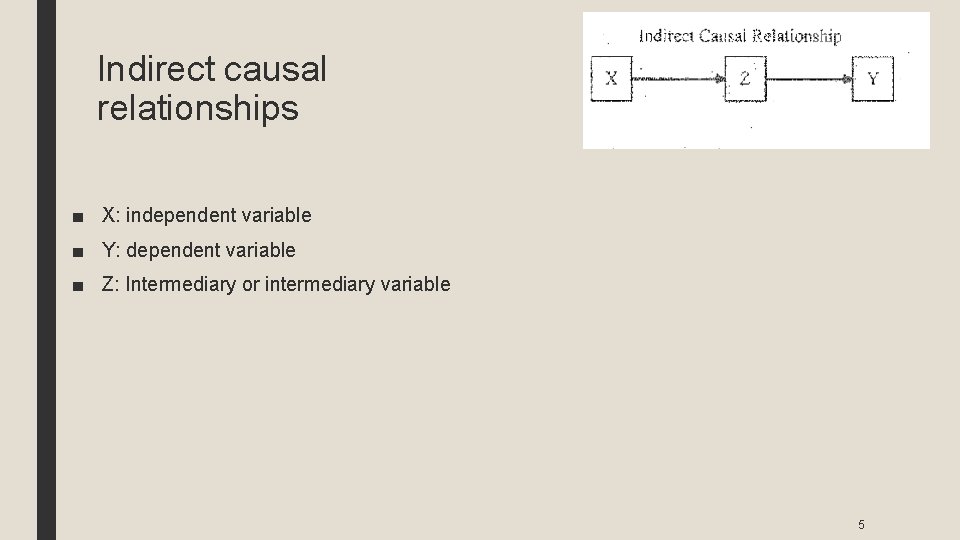
Indirect causal relationships ■ X: independent variable ■ Y: dependent variable ■ Z: Intermediary or intermediary variable 5
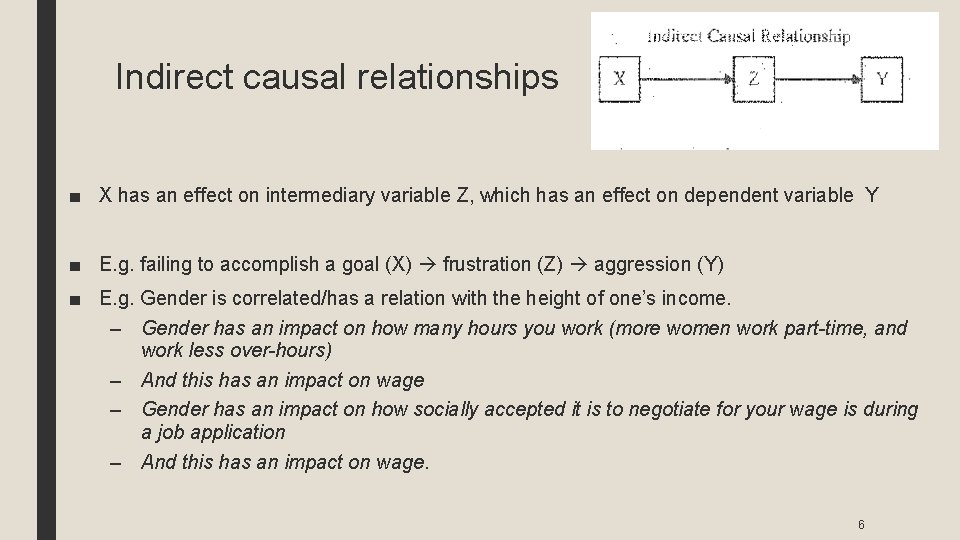
Indirect causal relationships ■ X has an effect on intermediary variable Z, which has an effect on dependent variable Y ■ E. g. failing to accomplish a goal (X) frustration (Z) aggression (Y) ■ E. g. Gender is correlated/has a relation with the height of one’s income. – Gender has an impact on how many hours you work (more women work part-time, and work less over-hours) – And this has an impact on wage – Gender has an impact on how socially accepted it is to negotiate for your wage is during a job application – And this has an impact on wage. 6
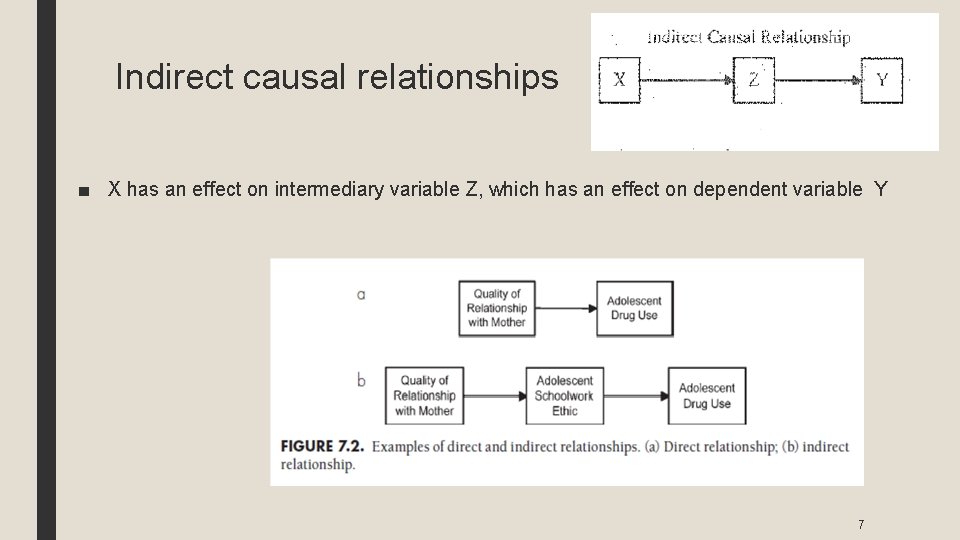
Indirect causal relationships ■ X has an effect on intermediary variable Z, which has an effect on dependent variable Y 7
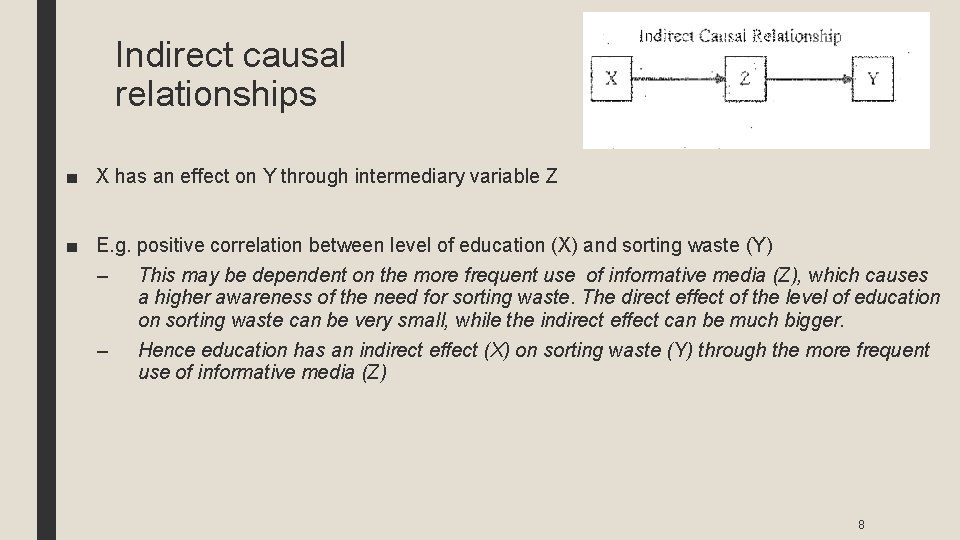
Indirect causal relationships ■ X has an effect on Y through intermediary variable Z ■ E. g. positive correlation between level of education (X) and sorting waste (Y) – This may be dependent on the more frequent use of informative media (Z), which causes a higher awareness of the need for sorting waste. The direct effect of the level of education on sorting waste can be very small, while the indirect effect can be much bigger. – Hence education has an indirect effect (X) on sorting waste (Y) through the more frequent use of informative media (Z) 8
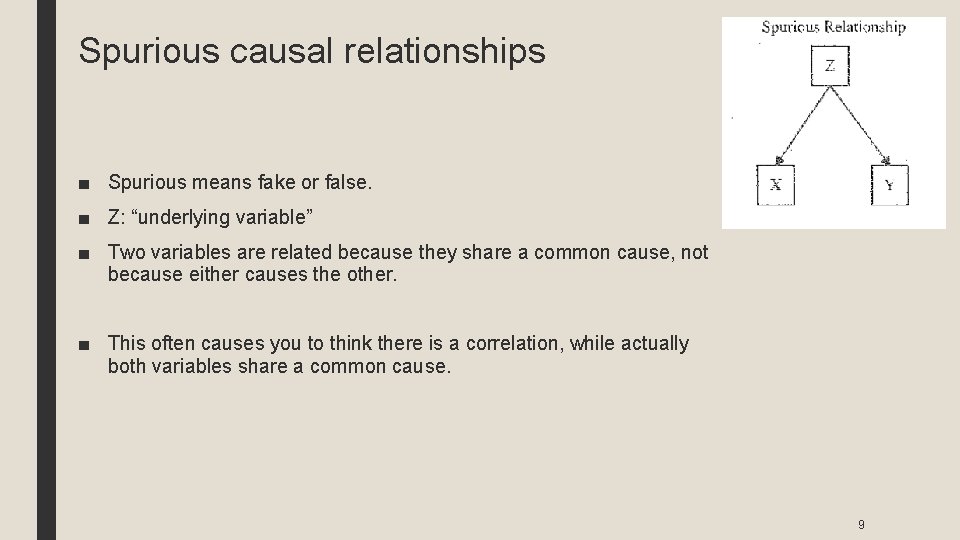
Spurious causal relationships ■ Spurious means fake or false. ■ Z: “underlying variable” ■ Two variables are related because they share a common cause, not because either causes the other. ■ This often causes you to think there is a correlation, while actually both variables share a common cause. 9
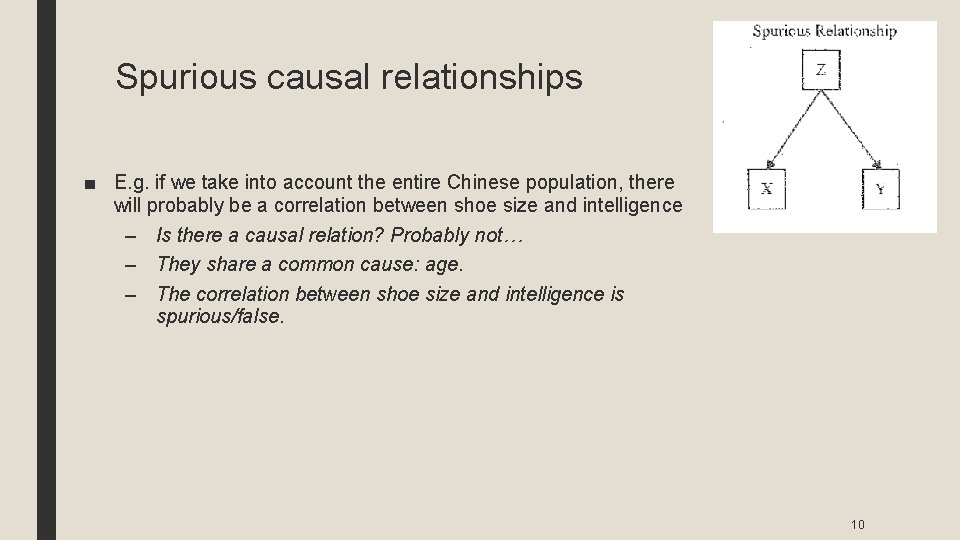
Spurious causal relationships ■ E. g. if we take into account the entire Chinese population, there will probably be a correlation between shoe size and intelligence – Is there a causal relation? Probably not… – They share a common cause: age. – The correlation between shoe size and intelligence is spurious/false. 10
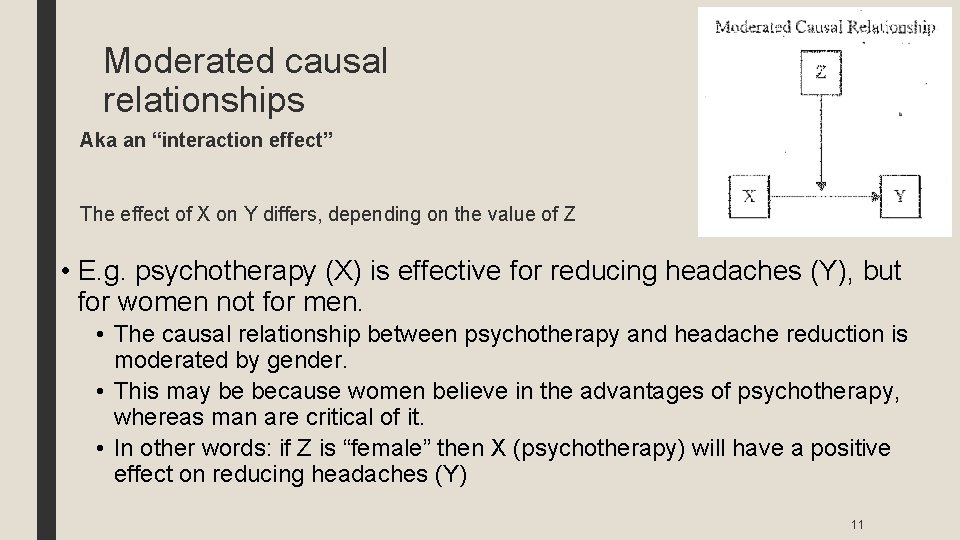
Moderated causal relationships Aka an “interaction effect” The effect of X on Y differs, depending on the value of Z • E. g. psychotherapy (X) is effective for reducing headaches (Y), but for women not for men. • The causal relationship between psychotherapy and headache reduction is moderated by gender. • This may be because women believe in the advantages of psychotherapy, whereas man are critical of it. • In other words: if Z is “female” then X (psychotherapy) will have a positive effect on reducing headaches (Y) 11
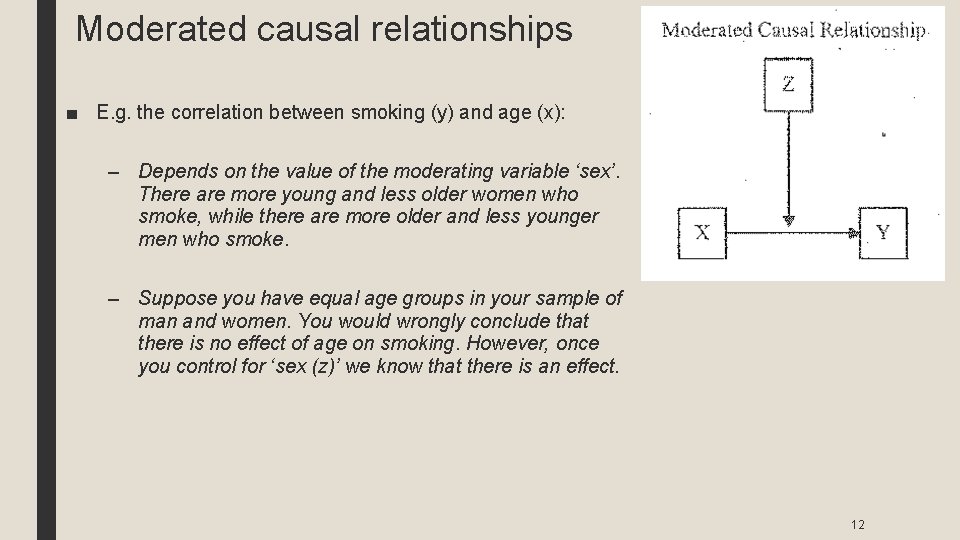
Moderated causal relationships ■ E. g. the correlation between smoking (y) and age (x): – Depends on the value of the moderating variable ‘sex’. There are more young and less older women who smoke, while there are more older and less younger men who smoke. – Suppose you have equal age groups in your sample of man and women. You would wrongly conclude that there is no effect of age on smoking. However, once you control for ‘sex (z)’ we know that there is an effect. 12
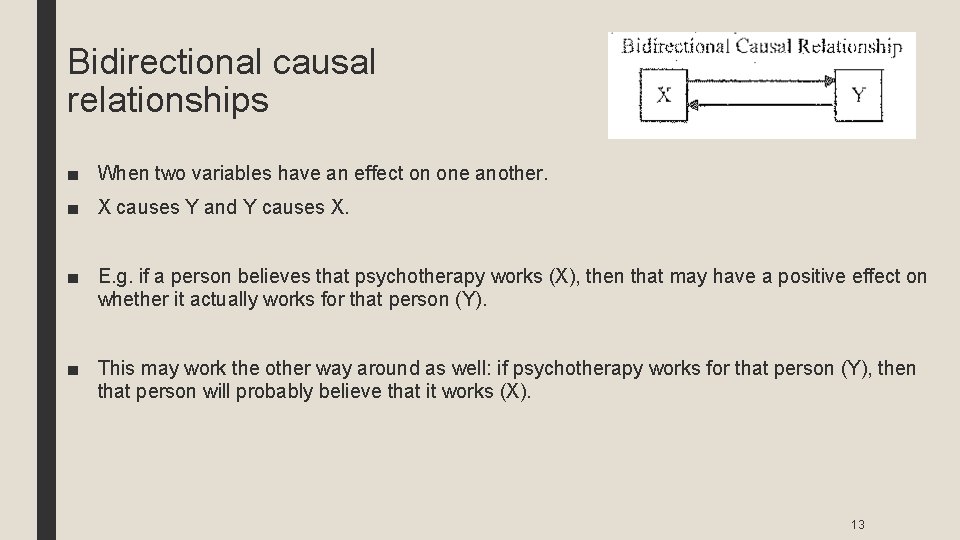
Bidirectional causal relationships ■ When two variables have an effect on one another. ■ X causes Y and Y causes X. ■ E. g. if a person believes that psychotherapy works (X), then that may have a positive effect on whether it actually works for that person (Y). ■ This may work the other way around as well: if psychotherapy works for that person (Y), then that person will probably believe that it works (X). 13
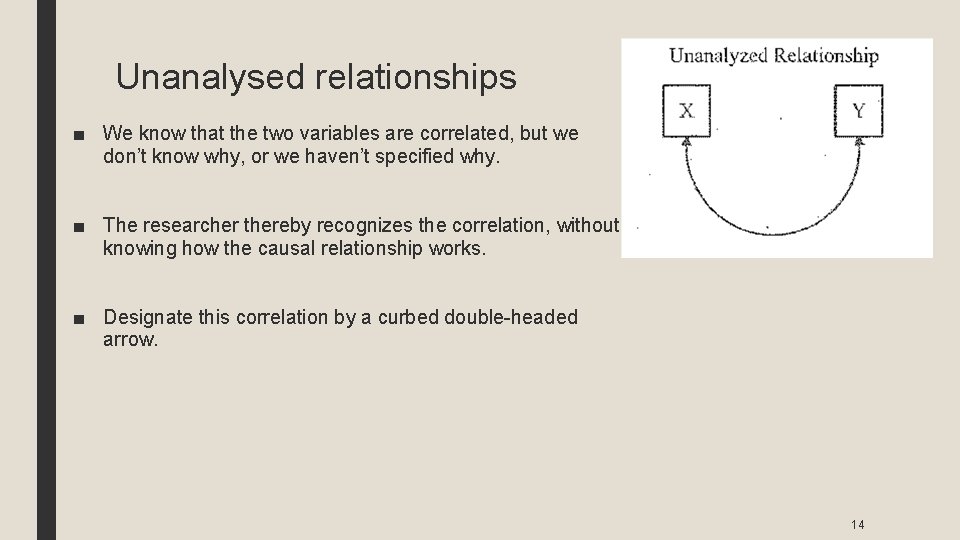
Unanalysed relationships ■ We know that the two variables are correlated, but we don’t know why, or we haven’t specified why. ■ The researcher thereby recognizes the correlation, without knowing how the causal relationship works. ■ Designate this correlation by a curbed double-headed arrow. 14
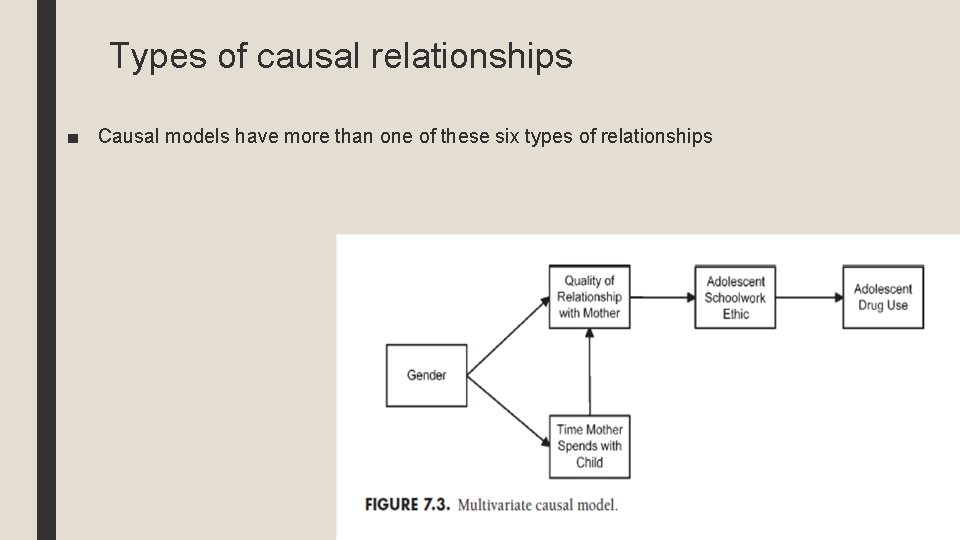
Types of causal relationships ■ Causal models have more than one of these six types of relationships 15
2. Constructing a causal model 1. Choose dependent and independent variables 2. Identify possible direct causes 3. Indirect causal relationships 4. Moderated causal relationships 5. Reciprocal or bidirectional causality 6. Spurious relationship 7. Unanalyzed relationships 8. Expanding theory
1. Choose dependent and independent variables ■ Usually you start from a dependent variable that you want to explain – E. g. differences in employment between different regions? – E. g. differences in people’s social trust in others? ■ Sometimes: you want to research what the effects are of an independent variable – E. g. the effects of long-term unemployment on… psychological well-being, chances of finding work, . . . – E. g. the effects of social trust on voting behavior, attitude towards foreigners, …
2. Identify possible (direct) causal relationships ■ E. g. differences in employment between different regions because of: – Education level, age, gender, ethnicity – Labor market demands – Institutional racism ■ E. g. differences in people’s social trust in others because of: – Education level, age, gender – Media consumption – Neighborhood – Experiences of crime
2. Identify possible (direct) causal relationships ■ E. g. the effects of long-term unemployment on: – Psychological well-being – Divorce rates – Alcohol abuse – Chances of finding work ■ E. g. the effects of social trust on: – Voting behavior – Attitude towards foreigners – Contact with neighbors
2. Identify possible (direct) causal relationships ■ It’s best to limit yourself, initially, to just a few causal variables – Otherwise your model will become too complex too soon. – Excluding the typical social variables (age, education, gender, occupation, ethnicity, …) ■ By drawing on the existing literature – Identifying gaps – Addressing new (sub)populations or sub-variables ■ Creative heuristics – To explore new, unexpected correlations and causes
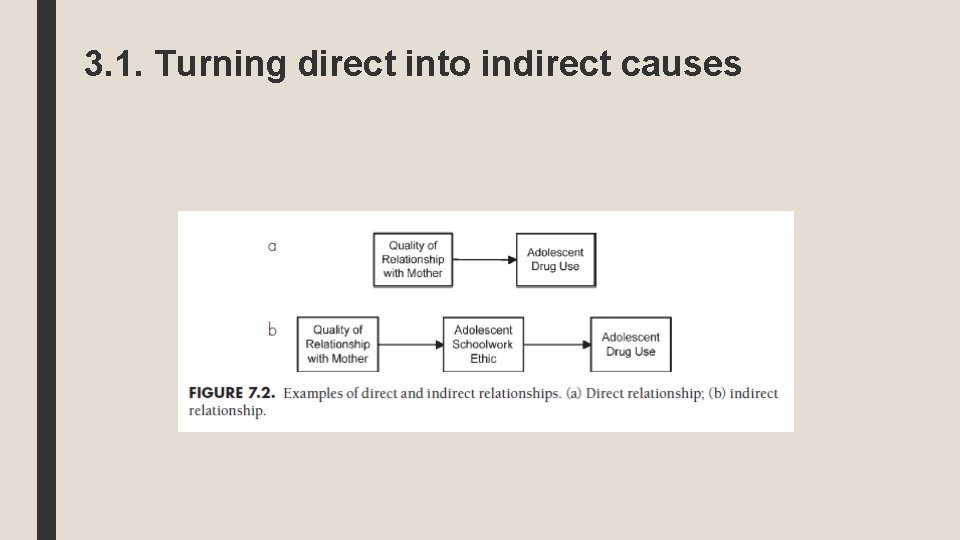
3. Indirect causal relationships 3. 1 Turning direct into indirect causes ■ Identify mediating variables and insert them in the model. ■ e. g. impact of the quality of the relationship with the mother (X) on drug use (Y) ■ Ask yourself: why do you think the quality of relationship impacts drug use?
3. 1. Turning direct into indirect causes
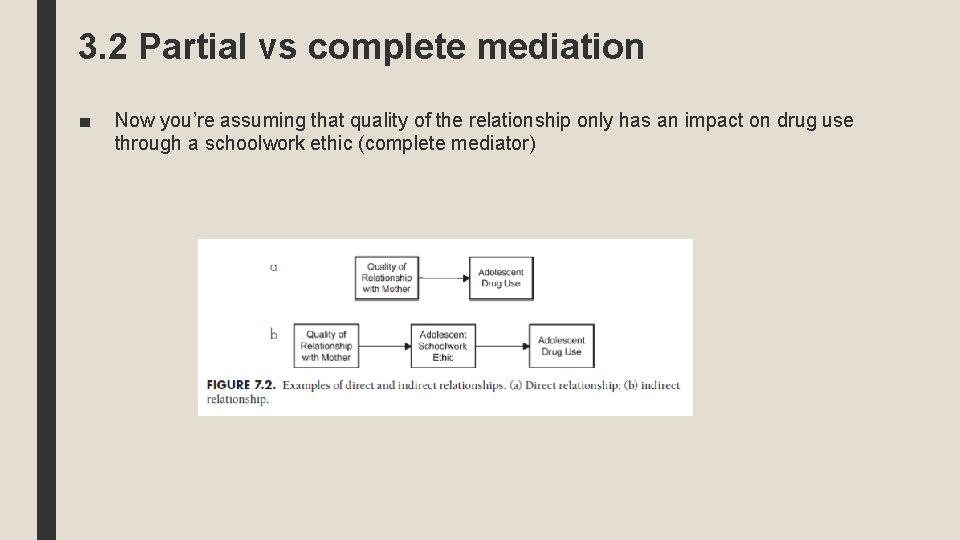
3. 2 Partial vs complete mediation ■ Now you’re assuming that quality of the relationship only has an impact on drug use through a schoolwork ethic (complete mediator)
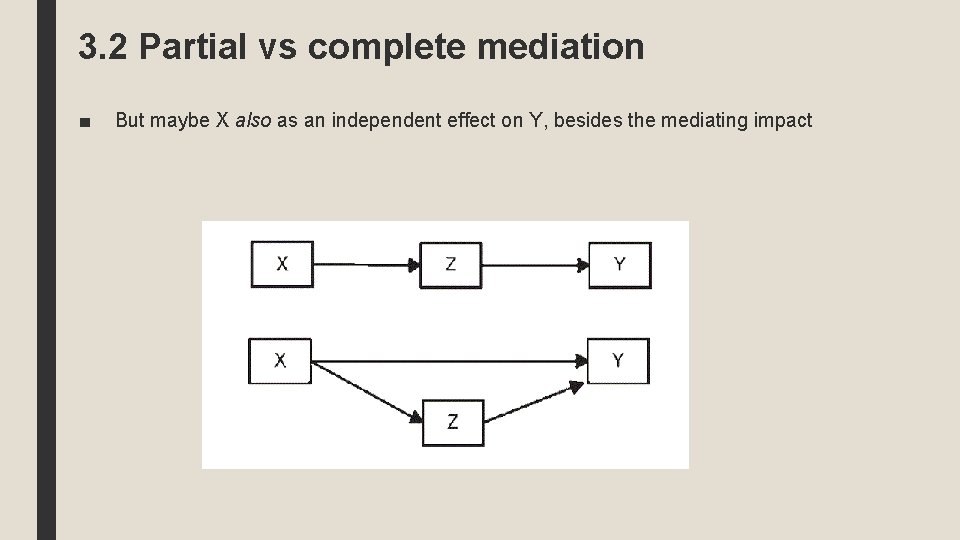
3. 2 Partial vs complete mediation ■ But maybe X also as an independent effect on Y, besides the mediating impact
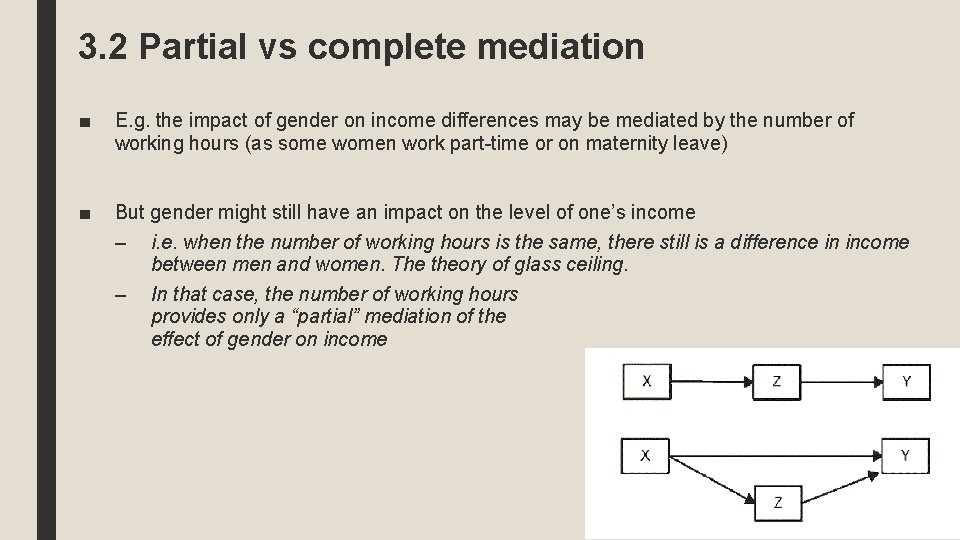
3. 2 Partial vs complete mediation ■ E. g. the impact of gender on income differences may be mediated by the number of working hours (as some women work part-time or on maternity leave) ■ But gender might still have an impact on the level of one’s income – i. e. when the number of working hours is the same, there still is a difference in income between men and women. The theory of glass ceiling. – In that case, the number of working hours provides only a “partial” mediation of the effect of gender on income
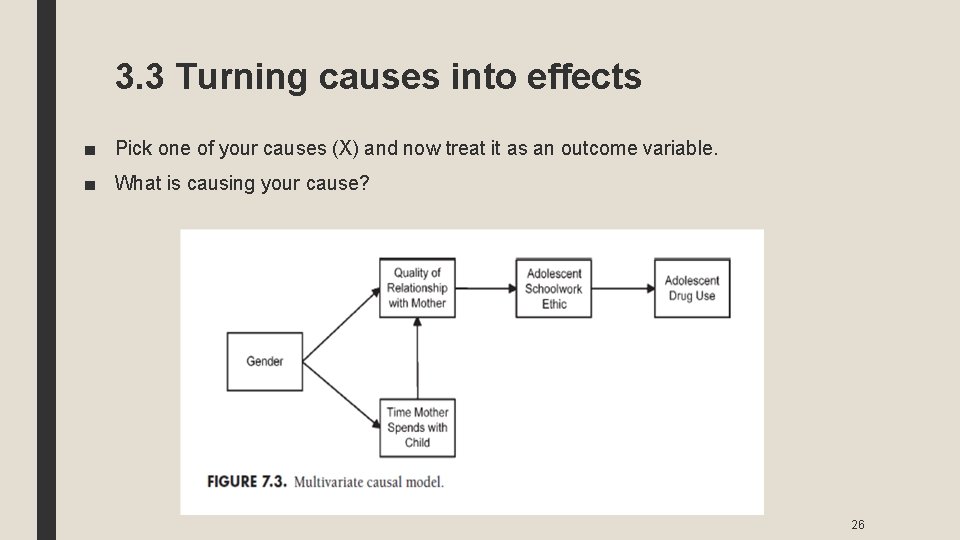
3. 3 Turning causes into effects ■ Pick one of your causes (X) and now treat it as an outcome variable. ■ What is causing your cause? 26
3. 3 Turning causes into effects ■ E. g. long cancer can be partly explained by a particular lifestyle (smoking and drinking) ■ But this particular lifestyle can be explained by class, education, age, gender, … 27
4. Moderated Causal relationships ■ Consider adding moderated causal relationships. Is the relationship between X and Y moderated by Z? ■ Ask yourself: “will the impact of X on Z be higher for some individuals than for others? ” ■ E. g. the effectiveness of psychotherapy may be moderated by gender. ■ E. g. the effects of alcohol on one’s health may be bigger for individuals who do not engages in sports. 28
4. Moderated Causal relationships ■ Or ask yourself: “Are there some circumstances where the impact of X on Y will be stronger than in other circumstances? ” ■ E. g. what could moderate the effect of long-term unemployment on psychological wellbeing? – Financial security due to the income of a partner or property ownership? – Intensive volunteering? – Children in need of care? 29
5. Reciprocal or bidirectional causality ■ Try to reverse the sign of your arrows: is causality also possible in the opposite direction? ■ And is it possible to think of a feedback loop between these two variables? ■ E. g. performance in school effects drug use and vice versa… ■ E. g. media consumption effects voting behavior and vice versa… 30
5. Reciprocal or bidirectional causality ■ You might want to include a feedback loop through a mediator variable ■ E. g. How satisfied supervisors are with their employees (X) may impact how satisfied employees are with their jobs (Z). ■ Employee satisfaction (Z) may in turn influence the productivity of employers (Y). ■ Which may have a positive (feed back) effect on how satisfied supervisors are with their employees (X) 31
6. Adding variables 6. 1 Add additional outcome variables ■ e. g. the impact of participating in a youth movement on unemployment ■ What other (socio-economic) effects might participating in a youth movement have? – Finding particular jobs? (manual labor, white collar, management, teaching, social-cultural work, …) – The level of your income? 32
6. 2 Turn your effect into a cause ■ Think of the original outcome variable as a cause of a new variable ■ E. g. “what is the impact of long-term unemployment on psychological well-being” ■ You can add: “in the condition of long-term unemployment”, what is the impact of psychological well-being on people’s labour market strategies? 33

6. 3 Specify causal relationships between existing variables ■ Between different independent variables – E. g. between educational level and income – E. g. between gender and social values ■ And between independent, mediating, moderating and dependent variables 34
7. Add unanalysed relationships ■ You can do this to make sure you have not forgotten any important causal relationships in your model, and to recognize that there are correlations between these variables (even though they may not be meaningful) ■ But it is often not included in the final model, that is published in a thesis or article 35
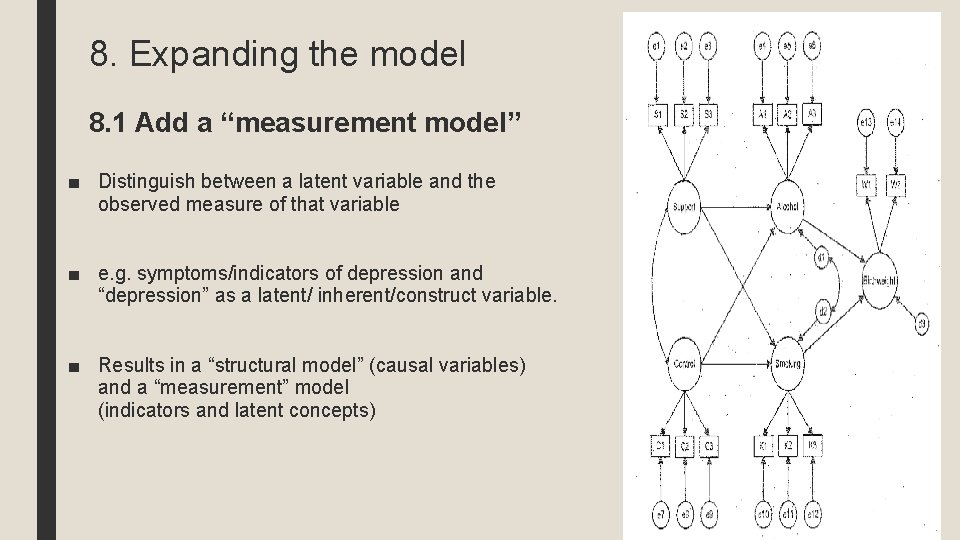
8. Expanding the model 8. 1 Add a “measurement model” ■ Distinguish between a latent variable and the observed measure of that variable ■ e. g. symptoms/indicators of depression and “depression” as a latent/ inherent/construct variable. ■ Results in a “structural model” (causal variables) and a “measurement” model (indicators and latent concepts) 36
8. 2 Revisiting your literature review ■ Revisit the scientific literature on your (in)dependent variables ■ Which variables or relationships are occurring in the literature that are missing from your model? ■ Which variables have you included that are lacking in the literature? 37
8. 3 Translate the model into propositions ■ Every causal relationships can be translated into a “proposition” ■ You can add these propositions throughout the paper, and/or at the end of your theoretical framework, and at the end of your findings section. 38
8. 3 Translate the model into propositions For example ■ Proposition 1: “Social values have an impact on the amount of domestic and childcaring work women are expected to do within their household. ” ■ Proposition 2: “The amount of domestic and childcaring work individuals have to do has a negative impact on the amount of extra hours they can work outside their homes. ” ■ Proposition 3: “The amount of extra hours an individual can work outside their homes, has a positive impact on the height of her income (ceteris paribus). 39

Announcements ■ Assignment Deadline is 25 th November. ■ The lecture will be an interactive seminar for each student topic a 20 min discussion. ■ The list of reading material for the exam is available now on Moodle ■ The exams time is between 10: 30 -1: 00 pm on these days: – On 13 th of January 2020 will be in room 2019. – On 20 th of January 2020 will be in office 3012. – On 27 th of January 2020 will be in room 2019. ■ All your student will be able to sign in for this examination from Jan 1 st, 2020. 40
- Slides: 40