
THEORY COMPARISON PRESENTATION BOWEN FAMILY SYSTEMS THERAPY AND
THEORY COMPARISON PRESENTATION BOWEN FAMILY SYSTEMS THERAPY AND STRUCTURAL FAMILY THERAPY Amber D. Yeager August 12, 2014

BOWEN FAMILY SYSTEMS THERAPY The main goal of Bowenian therapy is to reduce chronic anxiety by: 1. Facilitating awareness of how the emotional system functions 2. Increasing levels of differentiation, where the focus is on making changes for the self rather than on trying to change others Concepts: 1. Emotional Fusion and Differentiation of Self 2. Triangles 3. Nuclear Family Emotional System 4. Family Projection Process 5. Emotion Cutoff 6. Multi-generational Transmission Process 7. Siblings Positions 2

STRUCTURAL FAMILY THERAPY Concepts: 1. Focuses on the present and future. 2. Humans are social creatures. 3. Environmental factors more important than hereditary factors. 4. Systemic causality. 5. Process more important than content. 6. Family is microcosm of the social milieu. 7. Functional and dysfunctional behaviors are taught and perpetuated by the family. 8. The family and its members can only be properly explained in terms of the relations that exist between the members. 3
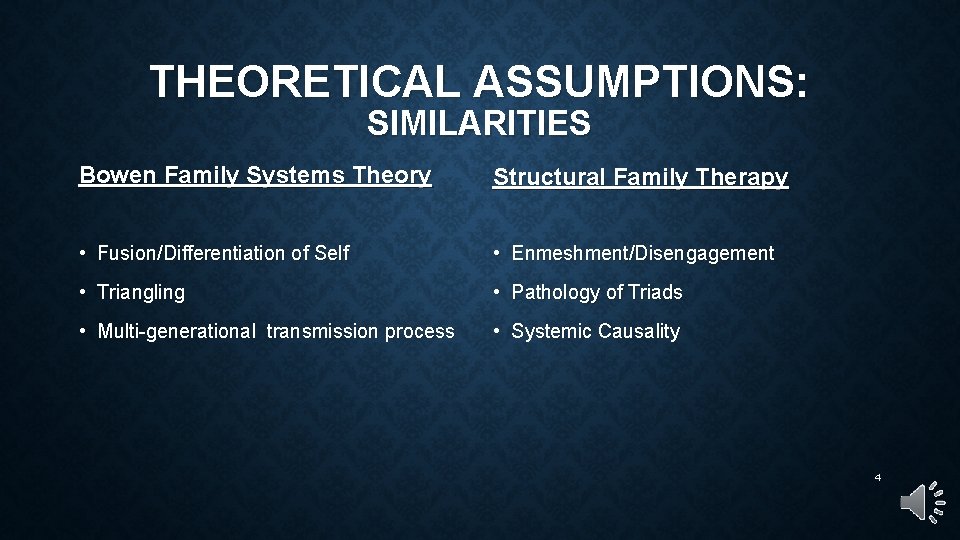
THEORETICAL ASSUMPTIONS: SIMILARITIES Bowen Family Systems Theory Structural Family Therapy • Fusion/Differentiation of Self • Enmeshment/Disengagement • Triangling • Pathology of Triads • Multi-generational transmission process • Systemic Causality 4
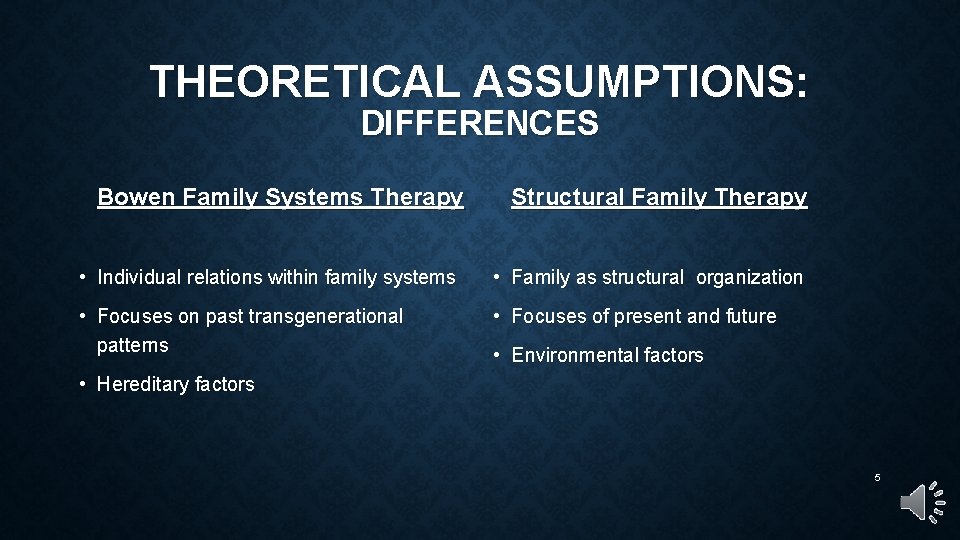
THEORETICAL ASSUMPTIONS: DIFFERENCES Bowen Family Systems Therapy Structural Family Therapy • Individual relations within family systems • Family as structural organization • Focuses on past transgenerational patterns • Focuses of present and future • Environmental factors • Hereditary factors 5

TECHNIQUES: SIMILARITIES Bowen Family Systems Therapy Structural Family Therapy • Use of Genogram (discover emotional dynamics of family) • Use of Genogram (to show family structures) • Boundary making (differentiate self from others) • Boundaries (define subsystems) 6

TECHNIQUES UNIQUENESS: Bowen Family Systems Therapy • Spousal relationship • De-triangulation • Emotional systems • Model differentiation (I statements) Structural Family Therapy • Helping members by finding a healthy balance between family and separate identity • Help clarify boundaries that exist between subsystems • Shift family focus from the identified client to therapist, to allow client to rejoin family 7
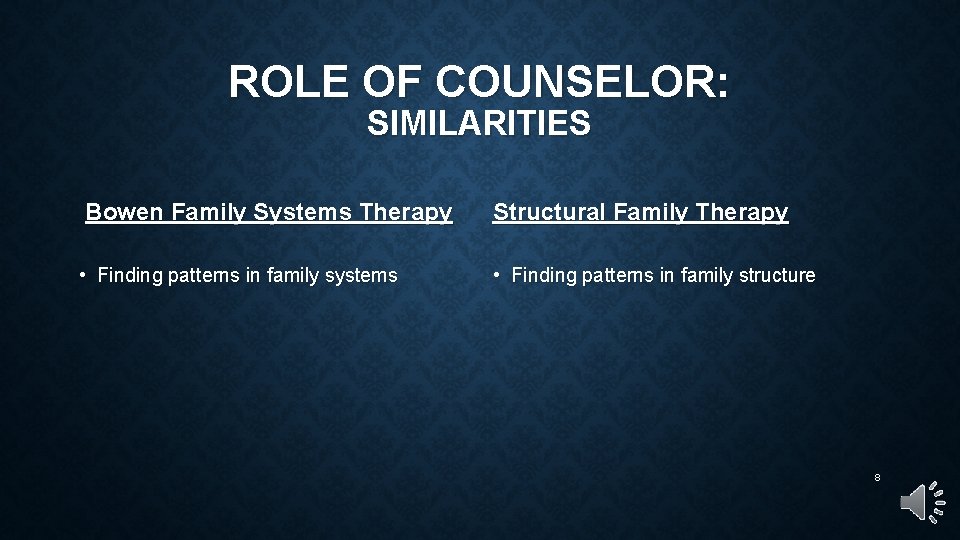
ROLE OF COUNSELOR: SIMILARITIES Bowen Family Systems Therapy • Finding patterns in family systems Structural Family Therapy • Finding patterns in family structure 8
ROLE OF COUNSELOR: UNIQUENESS Bowen Family Systems Therapy Structural Family Therapy • Maintaining ‘differentiated’ stance • Active and Directive • Clients talk directly to therapist, not each other • Warns of mediating and being part of the triangle • Don’t rush to fix problems • Therapists join the system • Direct leadership role • Find Solutions • Enact dysfunctions transactions, so they can be addressed • Provoke family crisis 9
CONCLUSION: As a professional school counselor I would prefer working with the Bowen Family Systems Theory because I like the concept of helping families develop their own individual identities, while maintaining a sense of closeness and togetherness with their families. I would like to work through the emotional process over the structural organization. I also am against provoking people. 10

REFERENCES Brown, J. (1999). Bowen Family Systems Theory and Practice: Illustration and Australian and New Zealand Journal of Family Therapy, 94 -103. Critique. Colapinto, J. (2014, August 12). Structural Family Therapy. Retrieved from www. colapinto. com/files/SFT. doc. Instructors Notes: Structural Family Therapy Jered B. Kolbert, L. M. (2013). Clinical Interventions with Adolescents Using a Family Systems Approach. The Family Journal: Counseling and Therapy for Couples and Families, 8794. Nims, D. R. , & Duba, J. D. (2010). Using play therapy techniques in a Bowenian theoretical context. The Family Journal, 19(1) 83 -89. 11
- Slides: 11