
Theory and Practice of Counseling and Psychotherapy Chapter
- Slides: 15
Theory and Practice of Counseling and Psychotherapy Chapter 10 by Gerald Corey Brooks/Cole, A division of Cengage Learning
Rational Emotive Behavioral Therapy (REBT) • Stresses thinking, judging, deciding, analyzing, and doing • Assumes that cognitions, emotions, and behaviors interact and have a reciprocal cause-and-effect relationship • Is highly didactic, very directive, and concerned as much with thinking as with feeling • Teaches that our emotions stem mainly from our beliefs, evaluations, interpretations, and reactions to life situations Theory and Practice of Counseling and Psychotherapy - Chapter 10 (1)
The Therapeutic Process • Therapy is seen as an educational process • Clients learn – To identify the interplay of their thoughts, feelings and behaviors – To identify and dispute irrational beliefs that are maintained by self-indoctrination – To replace ineffective ways of thinking with effective and rational cognitions – To stop absolutistic thinking, blaming, and repeating false beliefs Theory and Practice of Counseling and Psychotherapy - Chapter 10 (2)
View of Human Nature • We are born with a potential for both rational and irrational thinking • We have the biological and cultural tendency to think crookedly and to needlessly disturb ourselves • We learn and invent disturbing beliefs and keep ourselves disturbed through our self-talk • We have the capacity to change our cognitive, emotive, and behavioral processes Theory and Practice of Counseling and Psychotherapy - Chapter 10 (3)
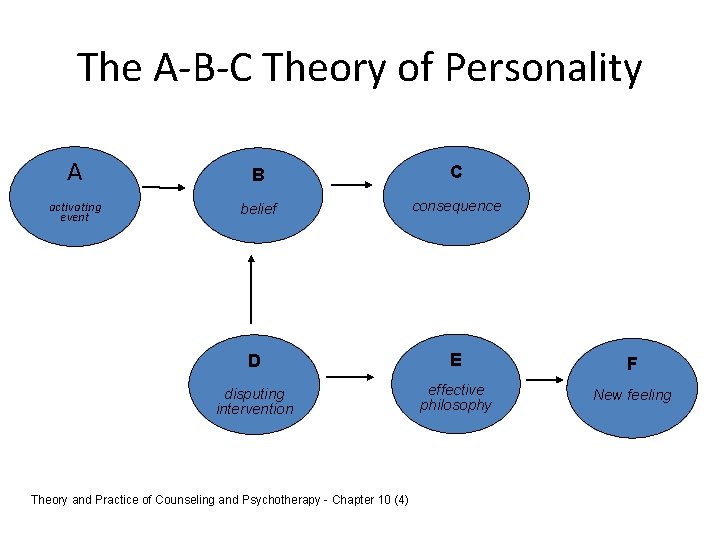
The A-B-C Theory of Personality A B C activating event belief consequence D E F disputing intervention effective philosophy New feeling Theory and Practice of Counseling and Psychotherapy - Chapter 10 (4)
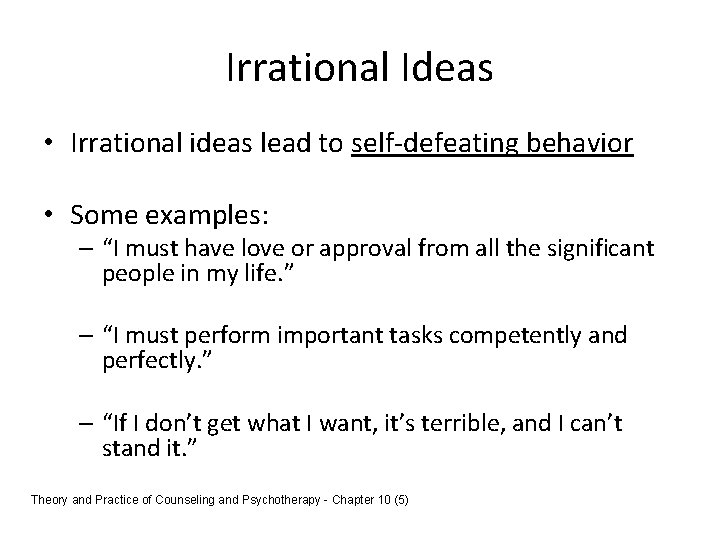
Irrational Ideas • Irrational ideas lead to self-defeating behavior • Some examples: – “I must have love or approval from all the significant people in my life. ” – “I must perform important tasks competently and perfectly. ” – “If I don’t get what I want, it’s terrible, and I can’t stand it. ” Theory and Practice of Counseling and Psychotherapy - Chapter 10 (5)
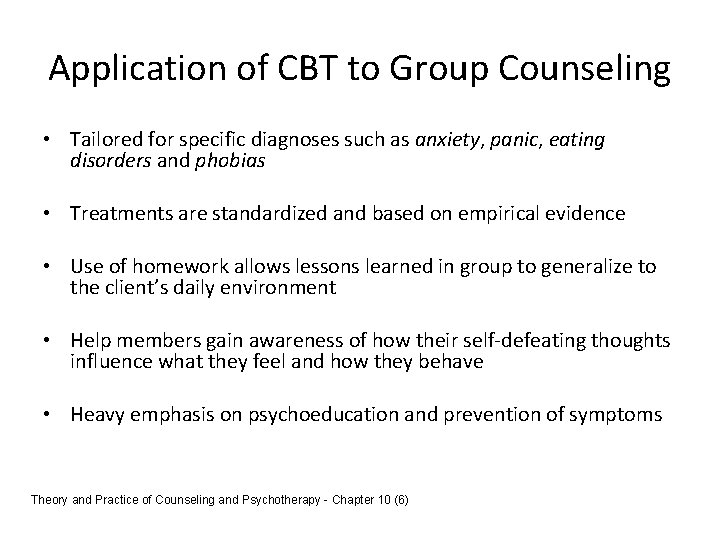
Application of CBT to Group Counseling • Tailored for specific diagnoses such as anxiety, panic, eating disorders and phobias • Treatments are standardized and based on empirical evidence • Use of homework allows lessons learned in group to generalize to the client’s daily environment • Help members gain awareness of how their self-defeating thoughts influence what they feel and how they behave • Heavy emphasis on psychoeducation and prevention of symptoms Theory and Practice of Counseling and Psychotherapy - Chapter 10 (6)
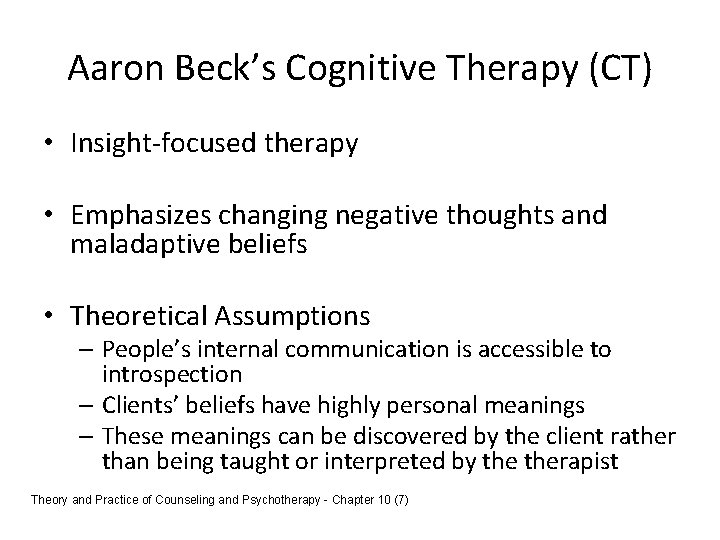
Aaron Beck’s Cognitive Therapy (CT) • Insight-focused therapy • Emphasizes changing negative thoughts and maladaptive beliefs • Theoretical Assumptions – People’s internal communication is accessible to introspection – Clients’ beliefs have highly personal meanings – These meanings can be discovered by the client rather than being taught or interpreted by therapist Theory and Practice of Counseling and Psychotherapy - Chapter 10 (7)
Theory, Goals & Principles of CT • Basic theory: – To understand the nature of an emotional episode or disturbance it is essential to focus on the cognitive content of an individual’s reaction to the upsetting event or stream of thoughts • Goals: – To change the way clients think by using their automatic thoughts to reach the core schemata and begin to introduce the idea of schema restructuring • Principles: – Automatic thoughts: personalized notions that are triggered by particular stimuli that lead to emotional responses Theory and Practice of Counseling and Psychotherapy - Chapter 10 (8)
CT’s Cognitive Distortions • Arbitrary inferences • Selective abstraction • Overgeneralization • Magnification and minimization • Personalization • Labeling and mislabeling • Polarized thinking Theory and Practice of Counseling and Psychotherapy - Chapter 10 (9)
Beck’s Cognitive Triad • Pattern that triggers depression 1. Clients hold negative views of themselves – “I am a lousy person” 2. Selective Abstraction – Client interprets life events through a negative filter – “The world is a negative place where bad things are bound to happen to me” 3. Client holds a gloomy vision of the future – “The world is bleak and it isn’t going to improve” Theory and Practice of Counseling and Psychotherapy - Chapter 10 (10)
Donald Meichenbaum’s Cognitive Behavior Modification (CBM) • Focus: – Client’s self-verbalizations or self-statements • Premise: – As a prerequisite to behavior change, clients must notice how they think, feel, and behave, and what impact they have on others • Basic assumption: – Distressing emotions are typically the result of maladaptive thoughts Theory and Practice of Counseling and Psychotherapy - Chapter 10 (11)
Meichenbaum’s CBM • Self-instructional therapy focus: – Trains clients to modify the instructions they give to themselves so that they can cope – Emphasis is on acquiring practical coping skills • Cognitive structure: – The organizing aspect of thinking, which seems to monitor and direct the choice of thoughts – The “executive processor, ” which “holds the blueprints of thinking” that determine when to continue, interrupt, or change thinking Theory and Practice of Counseling and Psychotherapy - Chapter 10 (12)
Behavior Change & Coping (CBM) • 3 Phases of Behavior Change 1. Self-observation 2. Starting a new internal dialogue 3. Learning new skills • Coping skills programs– Stress inoculation training (3 phase model) 1. The conceptual phase 2. Skills acquisition and rehearsal phase 3. Application and follow-through phase Theory and Practice of Counseling and Psychotherapy - Chapter 10 (13)
Limitations of Cognitive Behavior Therapy • Extensive training is required to practice CBT • Therapist may misuse power by imposing their ideas of what constitutes “rational” thinking on a client – Therapists must take special care to encourage clients to act rationally within the framework their own value system and cultural context • The strong confrontational style of Ellis’ REBT may overwhelm some clients • Some clinicians think CBT interventions overlook the value of exploring a client’s past experiences Theory and Practice of Counseling and Psychotherapy - Chapter 10 (14)