
Theory and phenomenology of a knot particle model

- Slides: 29
Theory and phenomenology of a knot particle model in deformed spacetime Niels Gresnigt HEP 2016, 6 -12 January 2016, Valparaiso
Aim Present a possible systematic theoretical framework for developing HEP beyond the SM The approach is as follows: Replace point particles in Minkowski spacetime by solitons in anti de Sitter spacetime
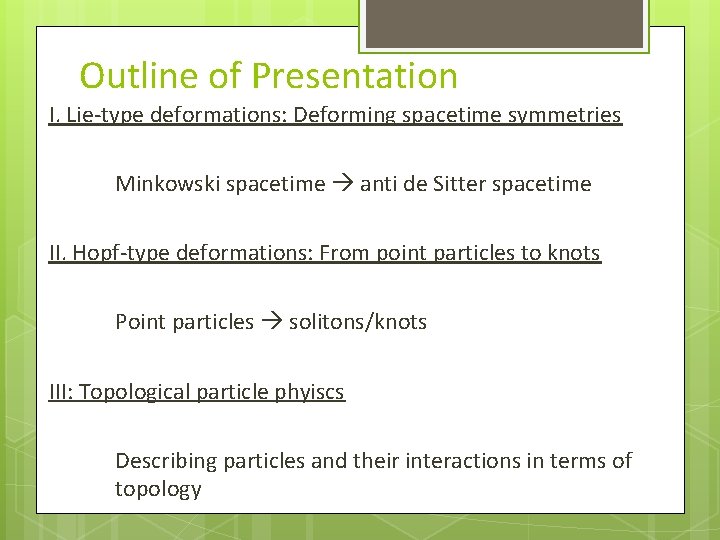
Outline of Presentation I. Lie-type deformations: Deforming spacetime symmetries Minkowski spacetime anti de Sitter spacetime II. Hopf-type deformations: From point particles to knots Point particles solitons/knots III: Topological particle phyiscs Describing particles and their interactions in terms of topology
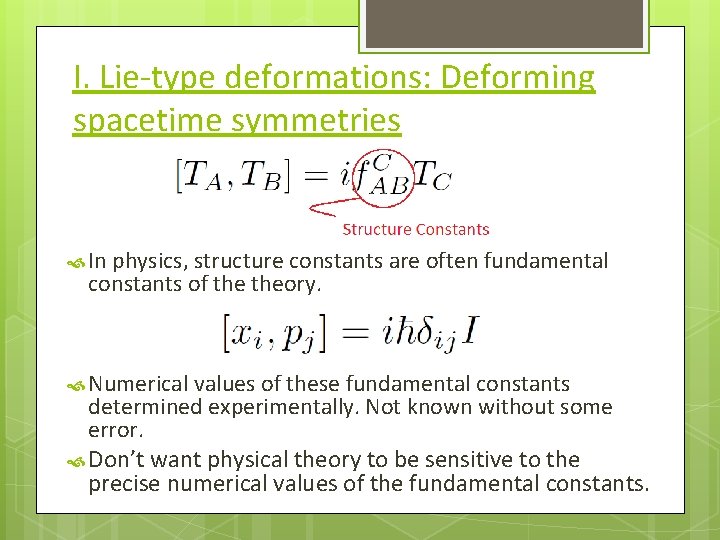
I. Lie-type deformations: Deforming spacetime symmetries In physics, structure constants are often fundamental constants of theory. Numerical values of these fundamental constants determined experimentally. Not known without some error. Don’t want physical theory to be sensitive to the precise numerical values of the fundamental constants.
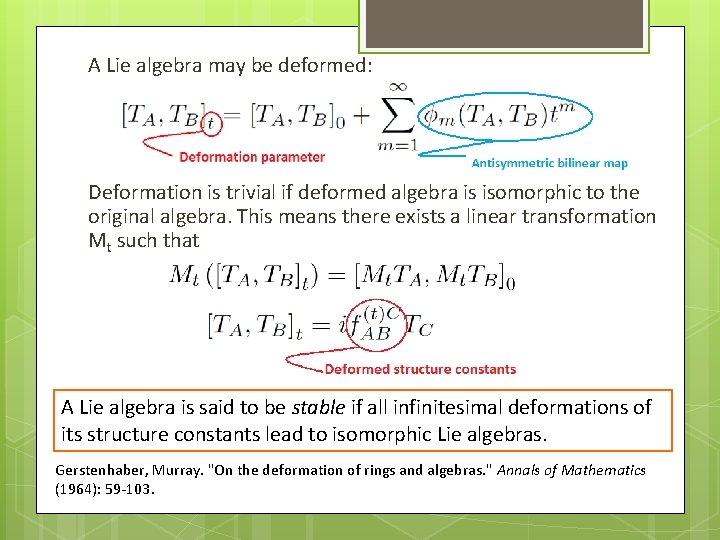
A Lie algebra may be deformed: Deformation is trivial if deformed algebra is isomorphic to the original algebra. This means there exists a linear transformation Mt such that A Lie algebra is said to be stable if all infinitesimal deformations of its structure constants lead to isomorphic Lie algebras. Gerstenhaber, Murray. "On the deformation of rings and algebras. " Annals of Mathematics (1964): 59 -103.
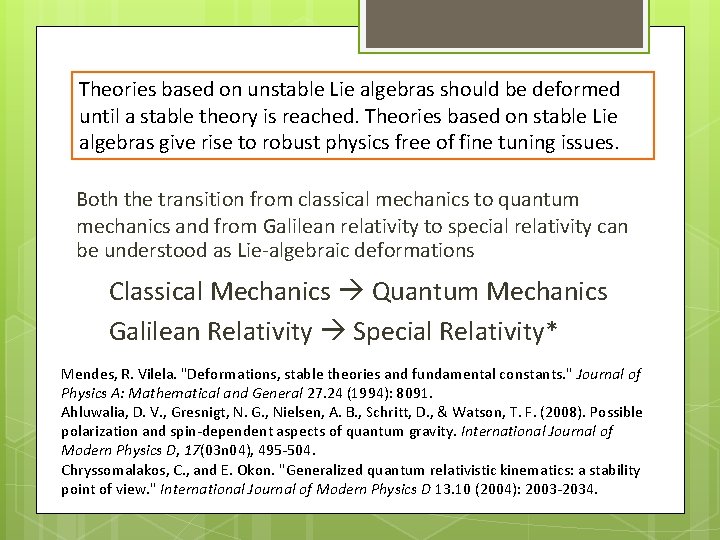
Theories based on unstable Lie algebras should be deformed until a stable theory is reached. Theories based on stable Lie algebras give rise to robust physics free of fine tuning issues. Both the transition from classical mechanics to quantum mechanics and from Galilean relativity to special relativity can be understood as Lie-algebraic deformations Classical Mechanics Quantum Mechanics Galilean Relativity Special Relativity* Mendes, R. Vilela. "Deformations, stable theories and fundamental constants. " Journal of Physics A: Mathematical and General 27. 24 (1994): 8091. Ahluwalia, D. V. , Gresnigt, N. G. , Nielsen, A. B. , Schritt, D. , & Watson, T. F. (2008). Possible polarization and spin-dependent aspects of quantum gravity. International Journal of Modern Physics D, 17(03 n 04), 495 -504. Chryssomalakos, C. , and E. Okon. "Generalized quantum relativistic kinematics: a stability point of view. " International Journal of Modern Physics D 13. 10 (2004): 2003 -2034.
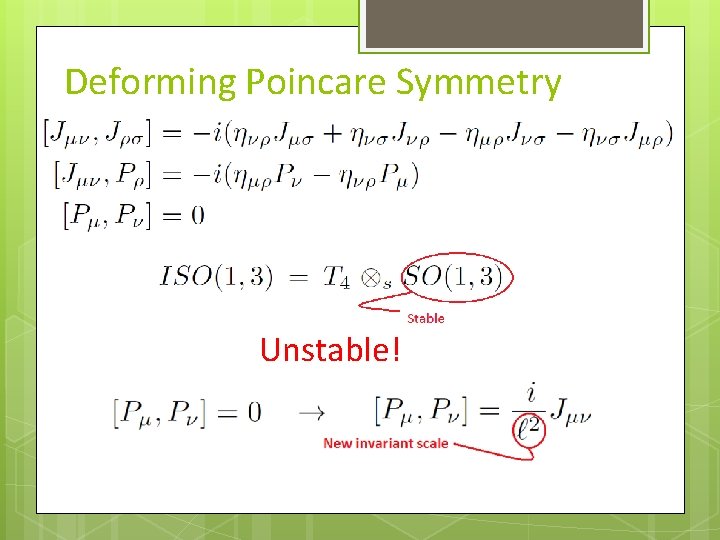
Deforming Poincare Symmetry Unstable!
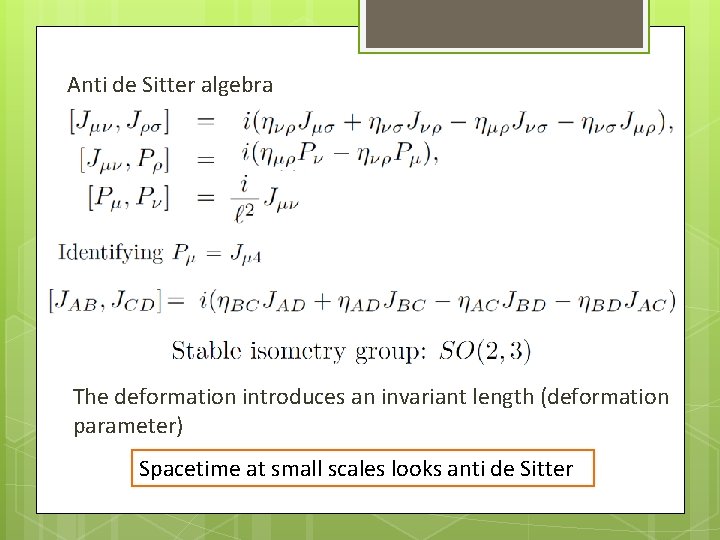
Anti de Sitter algebra The deformation introduces an invariant length (deformation parameter) Spacetime at small scales looks anti de Sitter
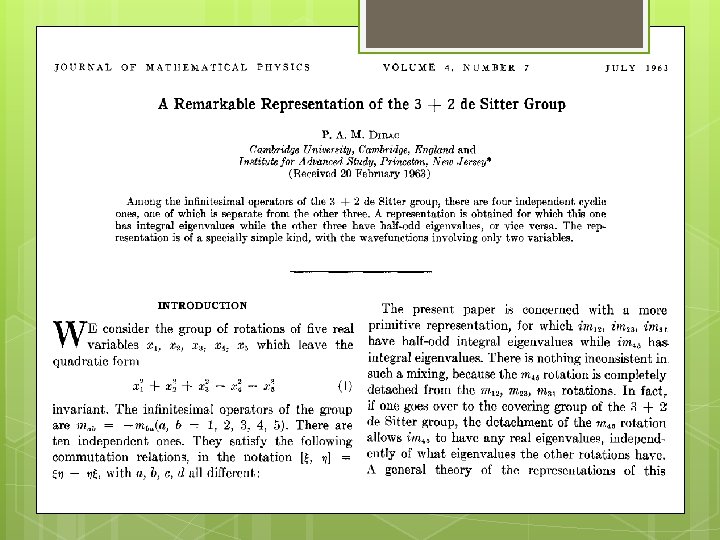
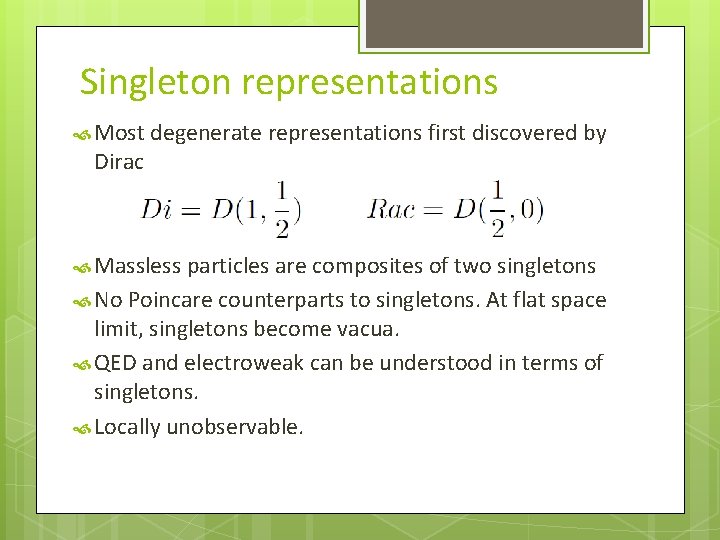
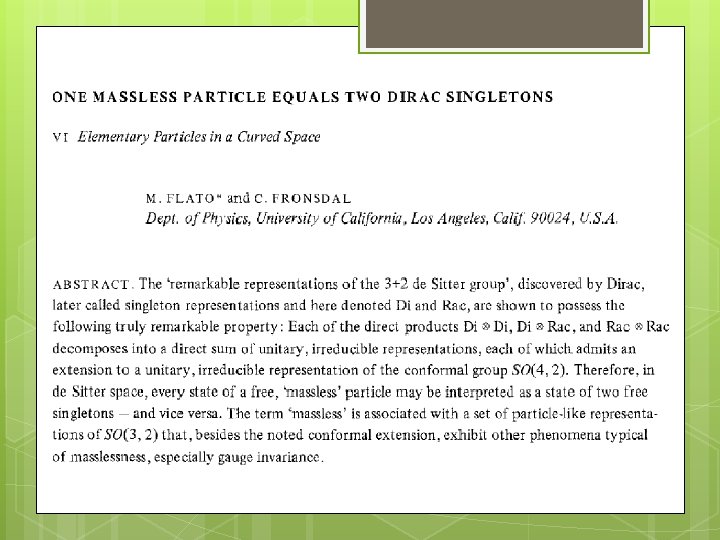
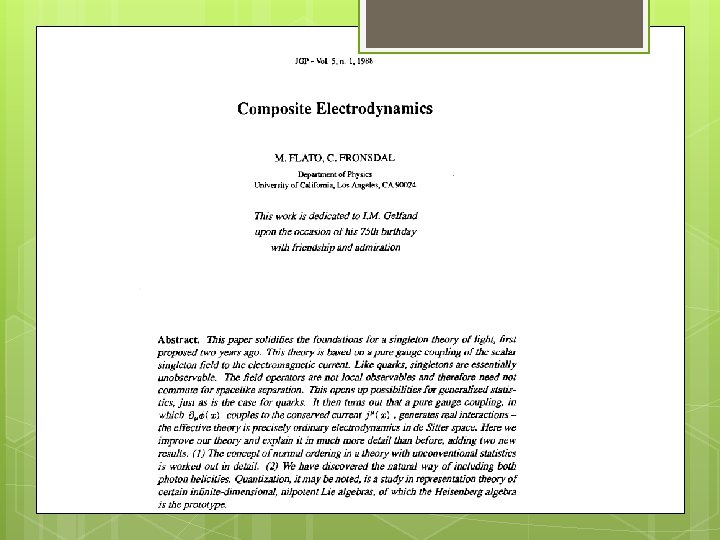
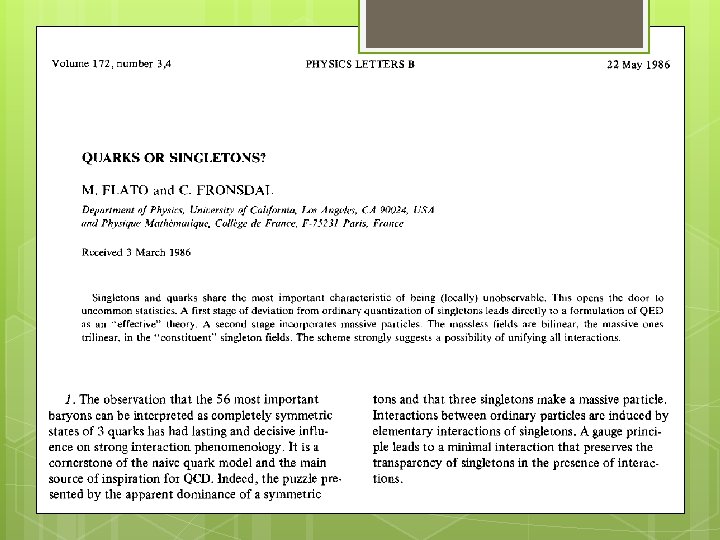
Singleton representations Most degenerate representations first discovered by Dirac Massless particles are composites of two singletons No Poincare counterparts to singletons. At flat space limit, singletons become vacua. QED and electroweak can be understood in terms of singletons. Locally unobservable.
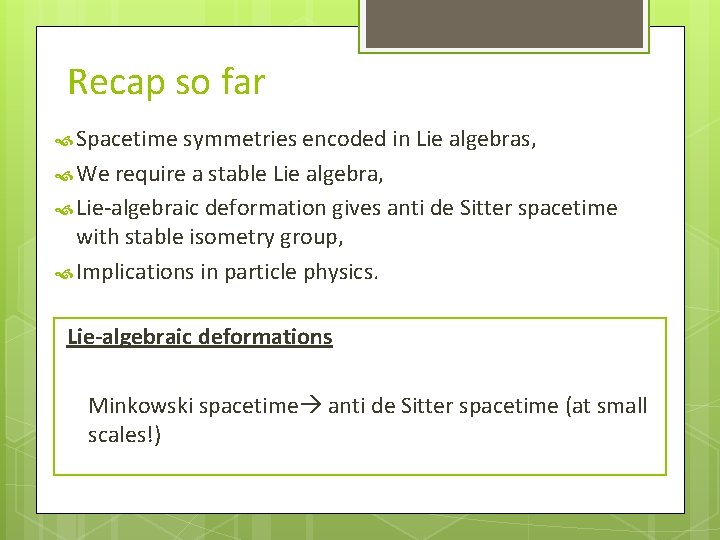
Recap so far Spacetime symmetries encoded in Lie algebras, We require a stable Lie algebra, Lie-algebraic deformation gives anti de Sitter spacetime with stable isometry group, Implications in particle physics. Lie-algebraic deformations Minkowski spacetime anti de Sitter spacetime (at small scales!)
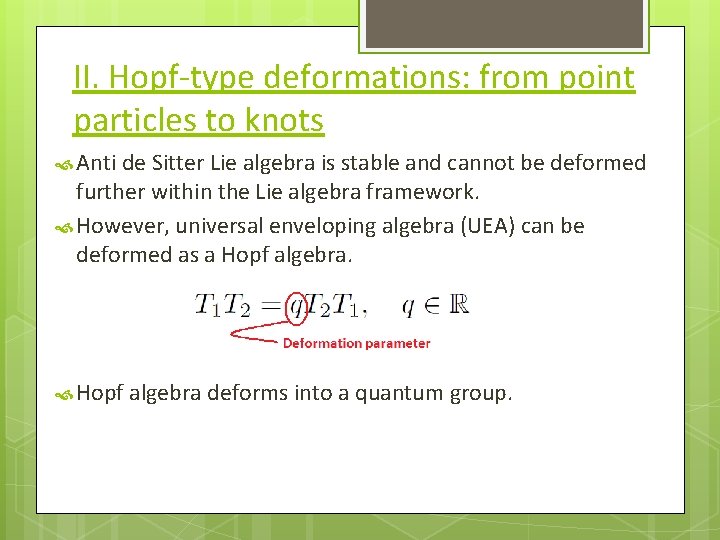
II. Hopf-type deformations: from point particles to knots Anti de Sitter Lie algebra is stable and cannot be deformed further within the Lie algebra framework. However, universal enveloping algebra (UEA) can be deformed as a Hopf algebra deforms into a quantum group.
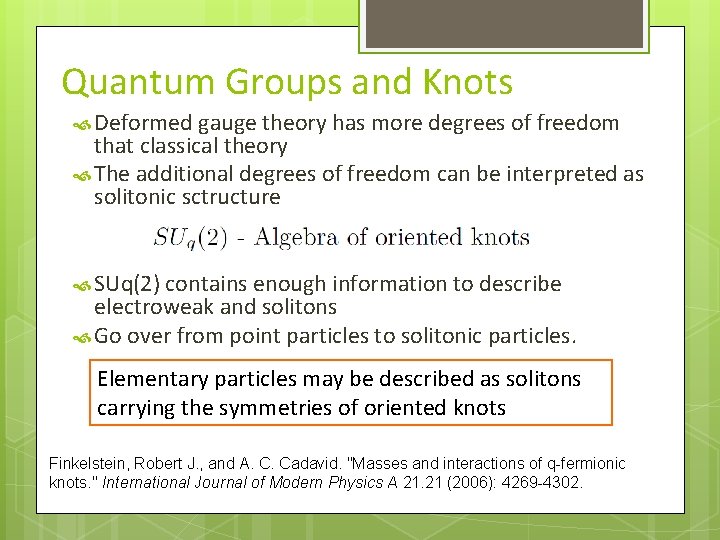
Quantum Groups and Knots Deformed gauge theory has more degrees of freedom that classical theory The additional degrees of freedom can be interpreted as solitonic sctructure SUq(2) contains enough information to describe electroweak and solitons Go over from point particles to solitonic particles. Elementary particles may be described as solitons carrying the symmetries of oriented knots Finkelstein, Robert J. , and A. C. Cadavid. "Masses and interactions of q-fermionic knots. " International Journal of Modern Physics A 21. 21 (2006): 4269 -4302.
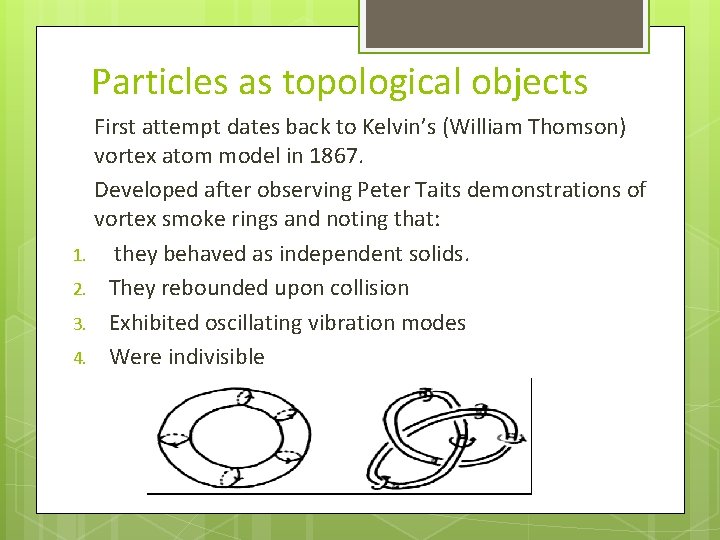
Particles as topological objects 1. 2. 3. 4. First attempt dates back to Kelvin’s (William Thomson) vortex atom model in 1867. Developed after observing Peter Taits demonstrations of vortex smoke rings and noting that: they behaved as independent solids. They rebounded upon collision Exhibited oscillating vibration modes Were indivisible
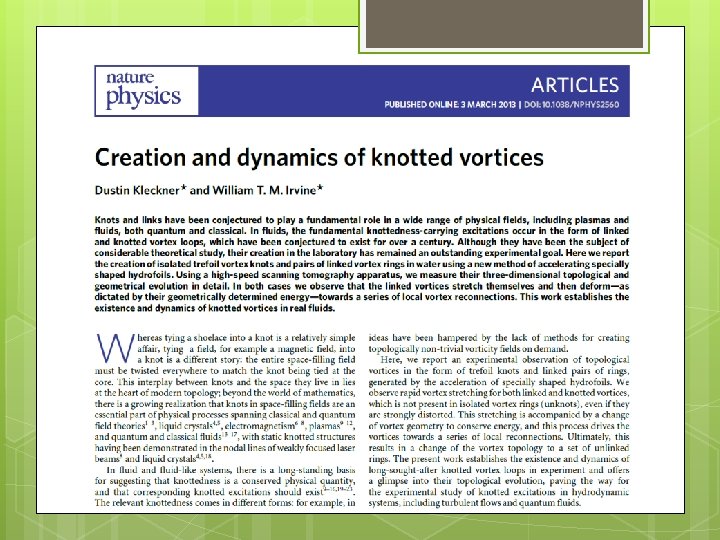
Jehle considered quantized magnetic flux tubes as a model for leptons, Stability of flux tubes investigated by Faddeev and Niemi (trefoil stable), Finkelstein studied particles as irreducible representations of quantum group SUq(2), Ranada showed that there exist knotted solutions to Maxwell’s equations, Bilson-Thompson developed a model of SM particles in terms of braids. Knots have played an increasingly important role in physics.
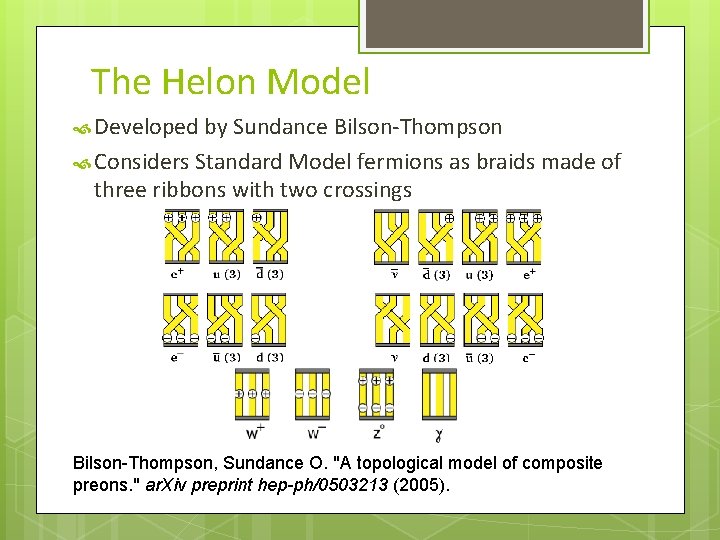
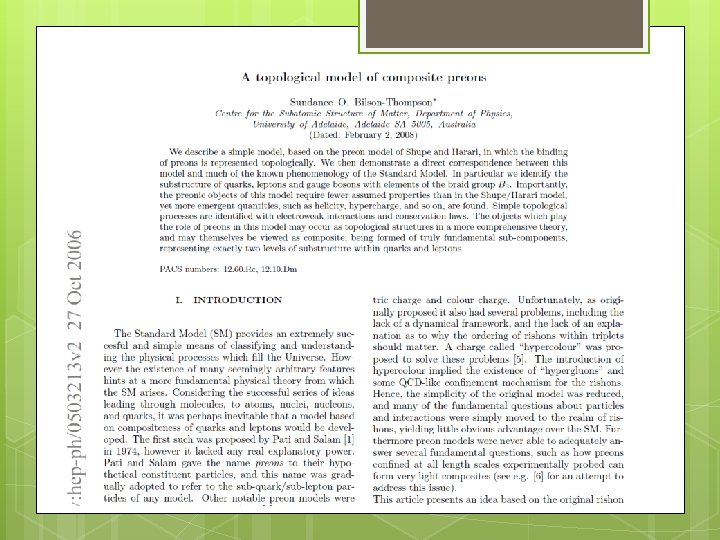
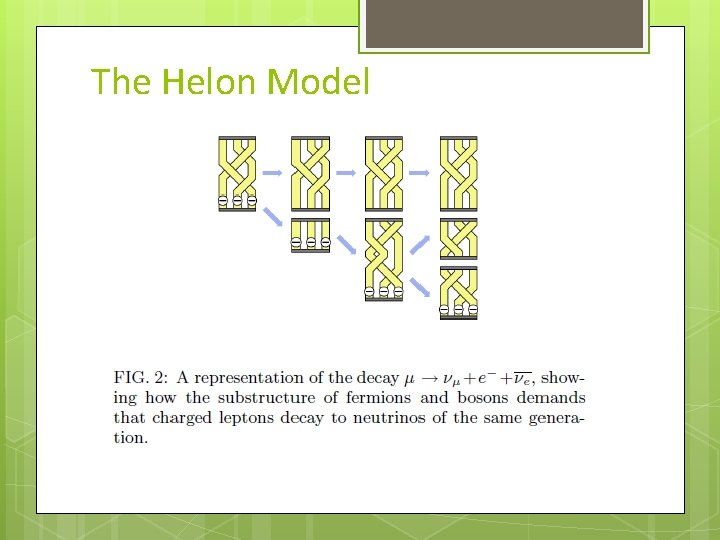
The Helon Model Developed by Sundance Bilson-Thompson Considers Standard Model fermions as braids made of three ribbons with two crossings Bilson-Thompson, Sundance O. "A topological model of composite preons. " ar. Xiv preprint hep-ph/0503213 (2005).
The Helon Model
The Helon Model
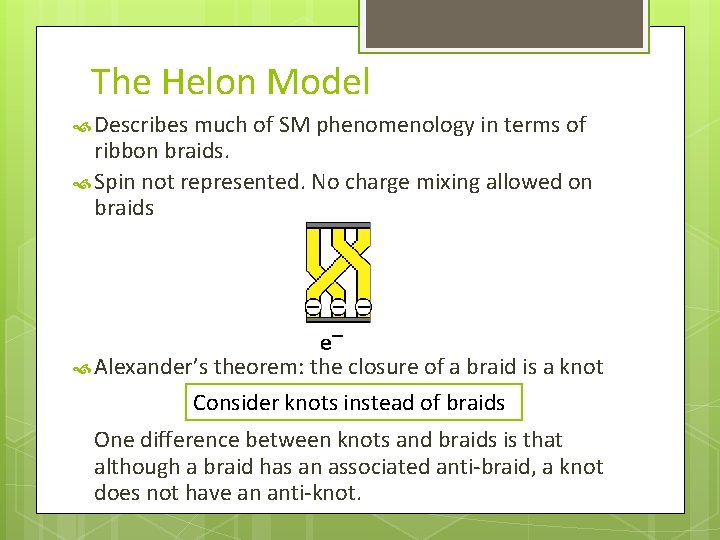
The Helon Model Describes much of SM phenomenology in terms of ribbon braids. Spin not represented. No charge mixing allowed on braids Alexander’s theorem: the closure of a braid is a knot Consider knots instead of braids One difference between knots and braids is that although a braid has an associated anti-braid, a knot does not have an anti-knot.
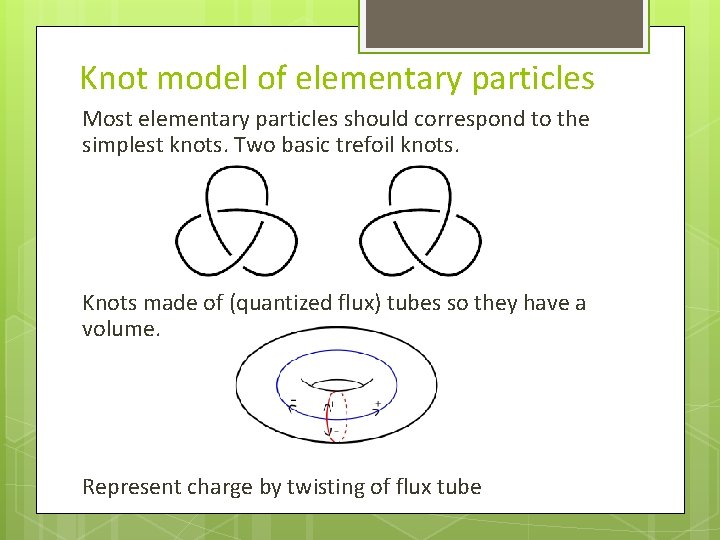
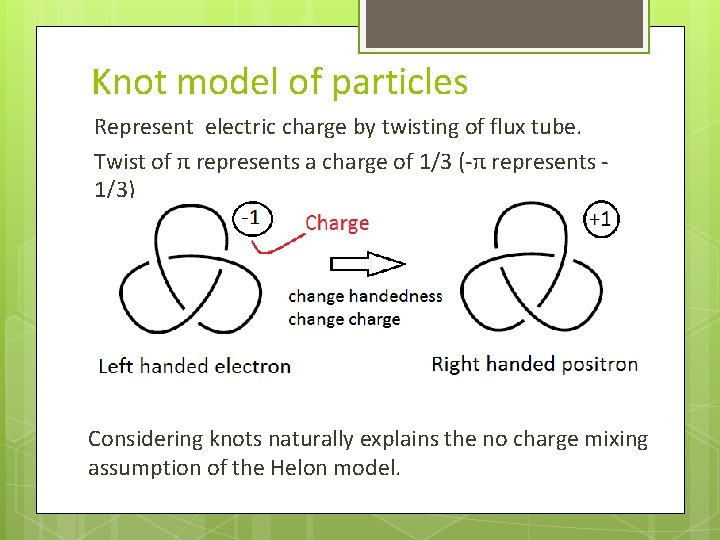
Knot model of elementary particles Most elementary particles should correspond to the simplest knots. Two basic trefoil knots. Knots made of (quantized flux) tubes so they have a volume. Represent charge by twisting of flux tube
Knot model of particles Represent electric charge by twisting of flux tube. Twist of π represents a charge of 1/3 (-π represents 1/3) Considering knots naturally explains the no charge mixing assumption of the Helon model.
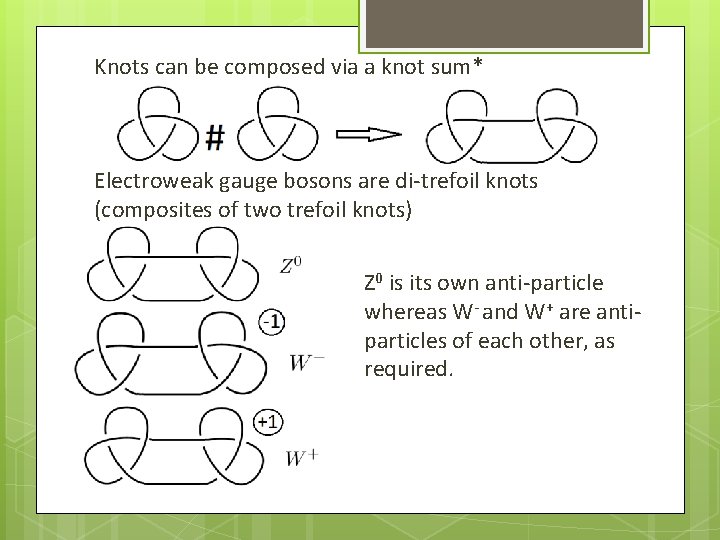
Knots can be composed via a knot sum* Electroweak gauge bosons are di-trefoil knots (composites of two trefoil knots) Z 0 is its own anti-particle whereas W- and W+ are antiparticles of each other, as required.
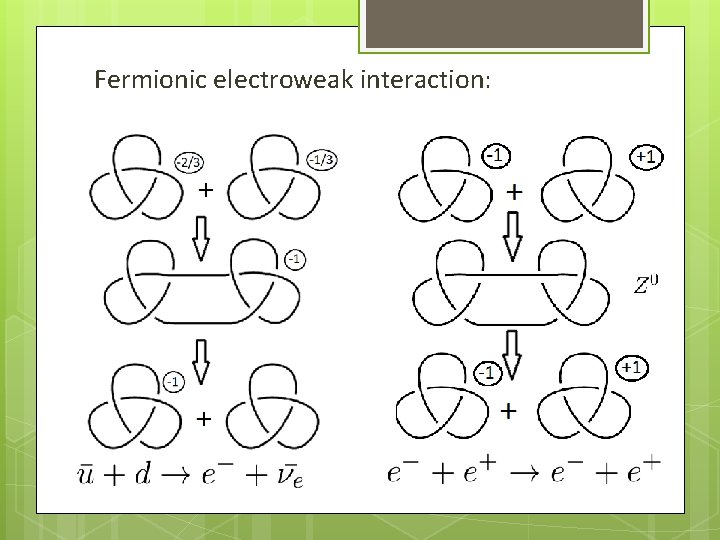
Fermionic electroweak interaction:
Conclusion Lie algebra deformations: Spacetime at small scales looks like anti de Sitter spacetime Hopf algebra deformations: Elementary particles may be described as solitons carrying the symmetries of oriented knots Deformations provide a systematic approach to developing HEP theory. Some initial success in describing electroweak interactions between fermions in terms of knots. Some advantages over Helon model. Likely of interest in Loop Quantum Gravity Many questions remain! Much work still to be done!
Thank you