
Theory and numerics of partiallyrelaxed topologicallyconstrained MHD equilibria

Theory and numerics of partially-relaxed, topologically-constrained, MHD equilibria with chaotic magnetic fields Stuart Hudson Princeton Plasma Physics Laboratory R. L. Dewar, M. J. Hole & M. Mc. Gann The Australian National University 20 th International Toki Conference, 7 -10 December 2010, Toki, Japan Motivation & Outline → The simplest model of approximating global, macroscopic force balance in toroidal plasma confinement with arbitrary geometry is magnetohydrodynamics (MHD) → As toroidal magnetic fields are analogous to 1 -1/2 Hamiltonians, and are generally chaotic, we need an MHD equilibrium code that allows for chaotic fields. → Existing ideal MHD equilibrium codes with chaotic fields fail to accommodate the fractal structure of Hamiltonian chaos. This leads to an ill-posed numerical algorithm for computing numericallyintractable, pathological equilibria. → A new partially-relaxed, topologically-constrained MHD equilibrium model is described and implemented numerically. Results demonstrating convergence tests, benchmarks, and non-trivial solutions are presented.
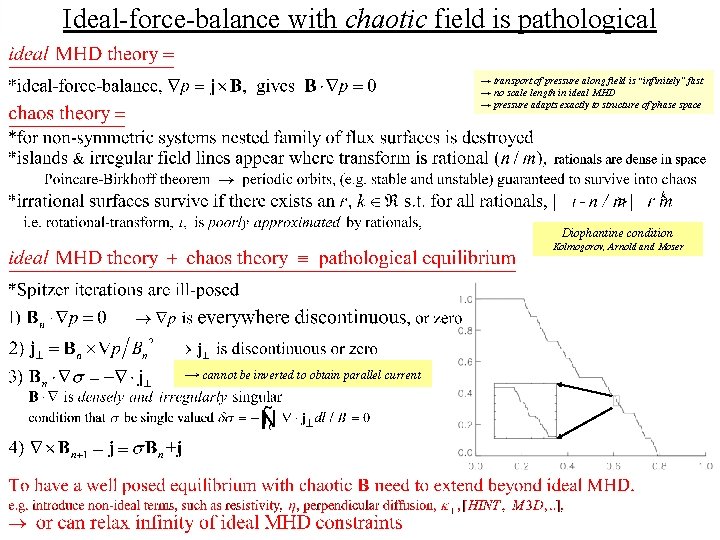
Ideal-force-balance with chaotic field is pathological → transport of pressure along field is “infinitely” fast → no scale length in ideal MHD → pressure adapts exactly to structure of phase space Diophantine condition Kolmogorov, Arnold and Moser → cannot be inverted to obtain parallel current
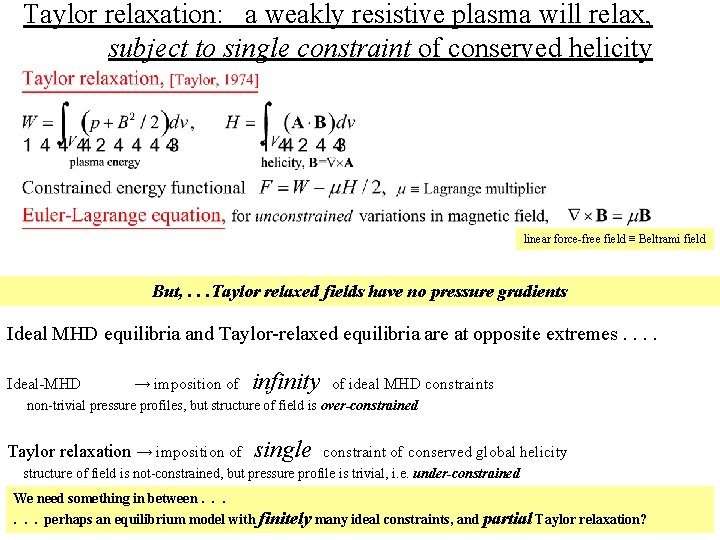
Taylor relaxation: a weakly resistive plasma will relax, subject to single constraint of conserved helicity linear force-free field ≡ Beltrami field But, . . . Taylor relaxed fields have no pressure gradients Ideal MHD equilibria and Taylor-relaxed equilibria are at opposite extremes. . Ideal-MHD → imposition of infinity of ideal MHD constraints non-trivial pressure profiles, but structure of field is over-constrained Taylor relaxation → imposition of single constraint of conserved global helicity structure of field is not-constrained, but pressure profile is trivial, i. e. under-constrained We need something in between. . . perhaps an equilibrium model with finitely many ideal constraints, and partial Taylor relaxation?
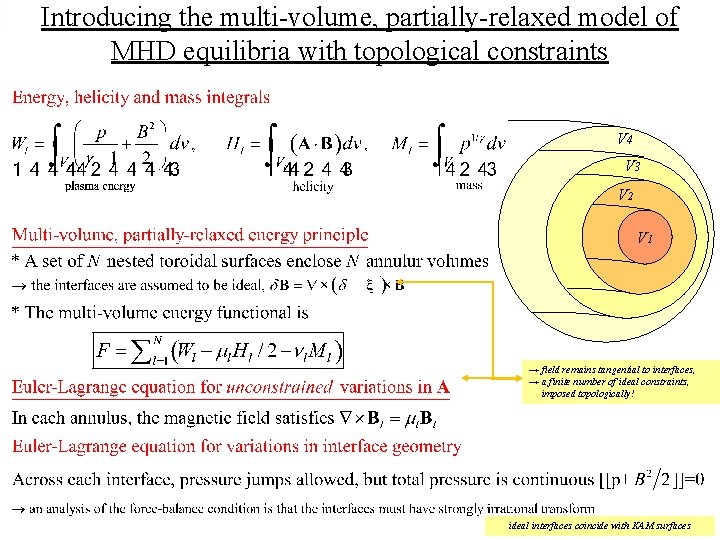
Introducing the multi-volume, partially-relaxed model of MHD equilibria with topological constraints V 4 V 3 V 2 V 1 → field remains tangential to interfaces, → a finite number of ideal constraints, imposed topologically! ideal interfaces coincide with KAM surfaces
Topological constraints : pressure gradients coincide with flux surfaces → structure of B and structure of the pressure are intimately connected; → cannot apriori specify pressure without apriori constraining structure of the field;
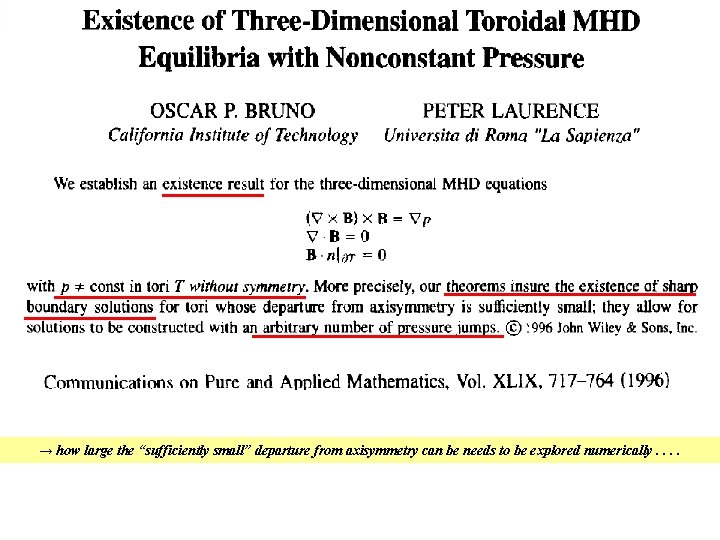
→ how large the “sufficiently small” departure from axisymmetry can be needs to be explored numerically. .

Extrema of energy functional obtained numerically; introducing the Stepped Pressure Equilibrium Code, SPEC piecewise cubic or quintic basis polynomials solved using sparse linear solver adjusted so interface transform is strongly irrational minimal spectral width [Hirshman, VMEC] future work. . . 1) approximate derivative matrix ~ 2 nd variation of energy functional 2) implement pre-conditioner

Numerical error in Beltrami field scales as expected h = radial grid size = 1 / N n = order of polynomial cubic , n=3 qu Example of chaotic Beltrami field (m, n)=(3, 1) island + (m, n)=(2, 1) island = chaos Poincaré plot, =0 int ic, n= 5 Poincaré plot, =π
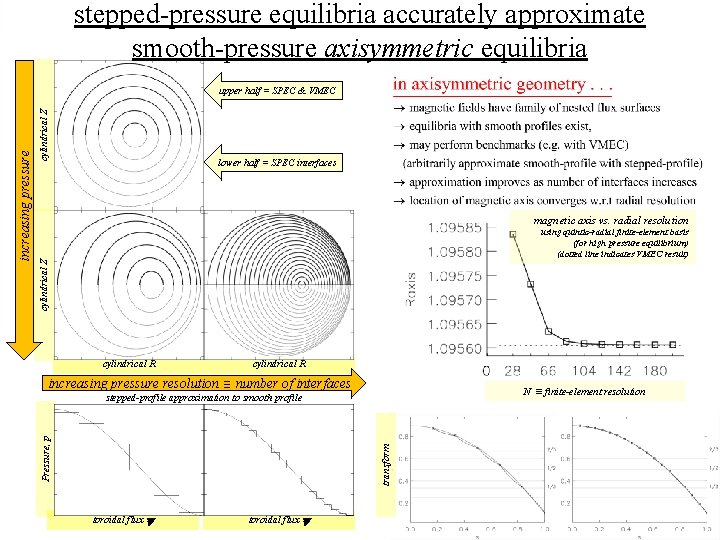
stepped-pressure equilibria accurately approximate smooth-pressure axisymmetric equilibria cylindrical Z lower half = SPEC interfaces magnetic axis vs. radial resolution cylindrical Z using quintic-radial finite-element basis (for high pressure equilibrium) (dotted line indicates VMEC result) cylindrical R increasing pressure resolution ≡ number of interfaces N ≡ finite-element resolution stepped-profile approximation to smooth profile transform Pressure, p increasing pressure upper half = SPEC & VMEC toroidal flux
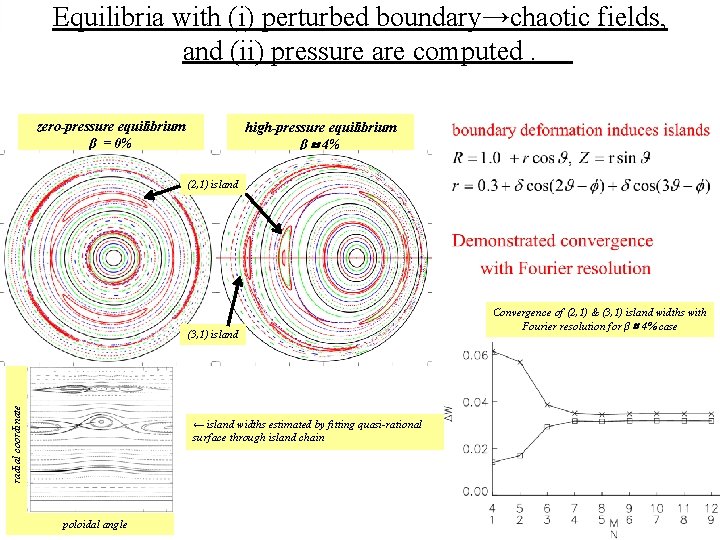
Equilibria with (i) perturbed boundary→chaotic fields, and (ii) pressure are computed. zero-pressure equilibrium β = 0% high-pressure equilibrium β 4% (2, 1) island radial coordinate (3, 1) island ← island widths estimated by fitting quasi-rational surface through island chain poloidal angle Convergence of (2, 1) & (3, 1) island widths with Fourier resolution for β 4% case
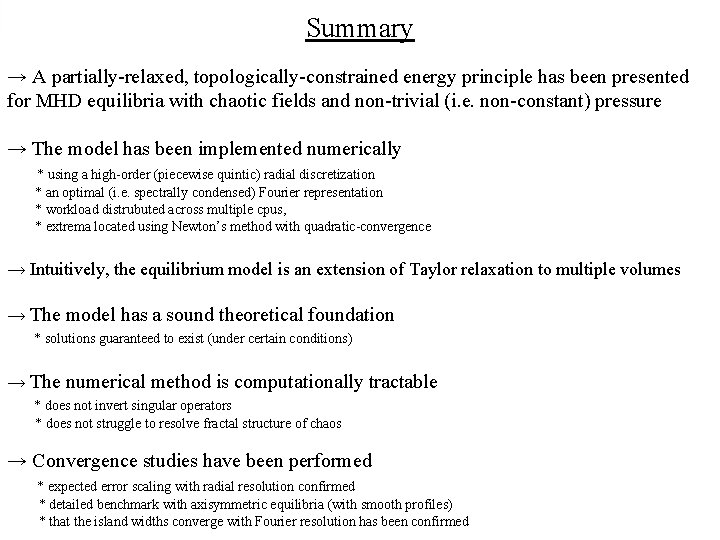
Summary → A partially-relaxed, topologically-constrained energy principle has been presented for MHD equilibria with chaotic fields and non-trivial (i. e. non-constant) pressure → The model has been implemented numerically * using a high-order (piecewise quintic) radial discretization * an optimal (i. e. spectrally condensed) Fourier representation * workload distrubuted across multiple cpus, * extrema located using Newton’s method with quadratic-convergence → Intuitively, the equilibrium model is an extension of Taylor relaxation to multiple volumes → The model has a sound theoretical foundation * solutions guaranteed to exist (under certain conditions) → The numerical method is computationally tractable * does not invert singular operators * does not struggle to resolve fractal structure of chaos → Convergence studies have been performed * expected error scaling with radial resolution confirmed * detailed benchmark with axisymmetric equilibria (with smooth profiles) * that the island widths converge with Fourier resolution has been confirmed

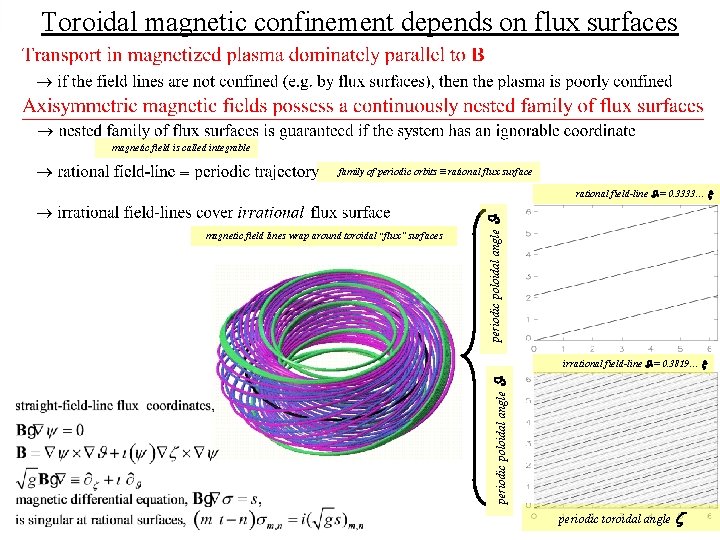
Toroidal magnetic confinement depends on flux surfaces magnetic field is called integrable family of periodic orbits ≡ rational flux surface irrational field-line = 0. 3819… periodic poloidal angle magnetic field lines wrap around toroidal “flux” surfaces periodic poloidal angle rational field-line = 0. 3333… periodic toroidal angle
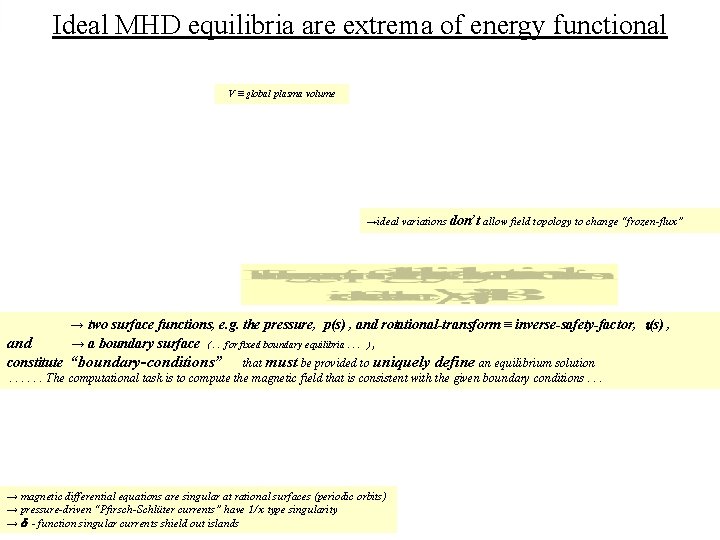
Ideal MHD equilibria are extrema of energy functional V ≡ global plasma volume →ideal variations don’t allow field topology to change “frozen-flux” and → two surface functions, e. g. the pressure, p(s) , and rotational-transform ≡ inverse-safety-factor, (s) , → a boundary surface (. . for fixed boundary equilibria. . . ) , constitute “boundary-conditions” that must be provided to uniquely define an equilibrium solution. . . The computational task is to compute the magnetic field that is consistent with the given boundary conditions. . . → magnetic differential equations are singular at rational surfaces (periodic orbits) → pressure-driven “Pfirsch-Schlüter currents” have 1/ x type singularity → - function singular currents shield out islands

Topological constraints : pressure gradients coincide with flux surfaces → structure of B and structure of the pressure are intimately connected; → cannot apriori specify pressure without apriori constraining structure of the field; → where there are significant pressure gradients, there can be no islands or chaotic regions with width > ∆wc
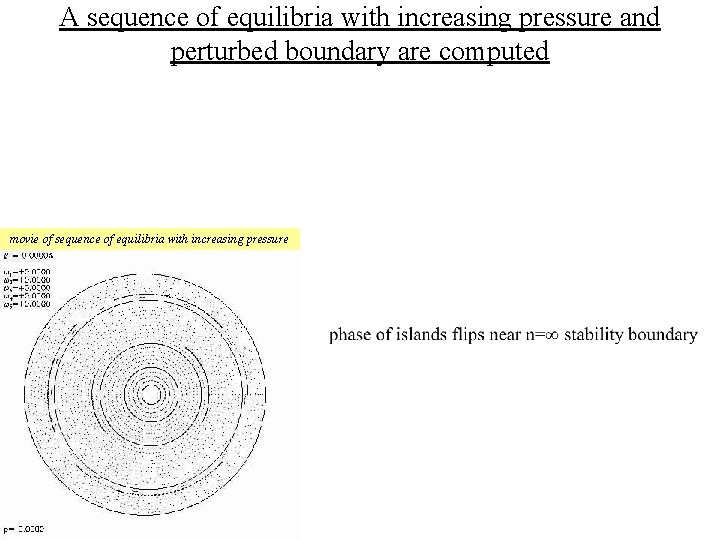
A sequence of equilibria with increasing pressure and perturbed boundary are computed movie of sequence of equilibria with increasing pressure
- Slides: 16