
THEORY ACTION PLAN PARENTAL INVOLVEMENT Katherine Christiansen Chantal
- Slides: 15
THEORY & ACTION PLAN PARENTAL INVOLVEMENT Katherine Christiansen & Chantal Ntibategera
INTRODUCTION • • 1. Introduction: In Part 1 of the presentation, we focused on the definition of Parental involvement in children education. We also reminded ourselves the role each of us in the audience we play in the process of parental involvement. We also visited the six main areas parents are involved in: framework of parent involvement consisting of six types of involvement, ranging from more proximal to more distal types. Described from the teacher’s perspective, the six types are (1) Parenting—helping families establish home environments which support children’s academic achievement; (2) Communicating—designing effective forms of school‐to‐home and home‐to‐school communication; (3) Volunteering—recruiting parents to help; (4) Learning at home—providing information and ideas to families regarding how to help children with homework; (5) Decision making—involving parents in school decisions; and (6) Collaborating with the community—integrate services and resources from the community to strengthen schools, families, and children’s learning.
REFLECTIVE PROCESS • Kumashiro has been a pioneer in Teaching and Learning Towards Social Justice. • He gave me the language , theories, and tangible experiences to look up while I am teaching towards social justice. • Always want to dig deeper for more understanding(Learning is about releasing our dependence on knowledge that has until now framed the ways we live in this world (Kumashiro p. 48) Katherine For me the number one lesson that I have taken away from Kevin Kumashiro’s book is the idea of learning through crisis. It never occurred to me that some of our most important lessons might challenge our perceptions and threaten our comforts. After thinking about it more, anti‐ oppressive learning wouldn’t take place without stress! Secondly after examining the assumptions that shaped my teaching practices , I realize that these assumptions were not only untrue but I perpetuated practices that I don’t agree with. Last, because I generally don’t dwell in the past it surprised me how much my past educational experiences affected. In particular the subject of parental involvement. Parents were generally not involved in schools or decision making when I was in school.
RESEARCH • Researches on School parent Council support the crucial role of parental involvement. • As parental representative, the council is a channel of communication between school and parents Books, journals, workshops, magazines, articles, all are a proof that School councils are important to have. • The following journals show the parent council play a big role in advocating for parental involvements in schools: • ‐ SRSD Handbook and Manual 2005 and • ‐ To cite this article: Gunilla Johansson (2009) Parental involvement in the development of a culture‐based school curriculum, Intercultural Education, 20: 4, 311‐ 319, DOI: 10. 1080/14675980903351946. To link to this article: http: //dx. doi. org/10. 1080/14675980903351946. ‐ Sa are the journals my colleague Katherine mentioned. Talking to the Vice President of our parent council, I realized that parent councils are simpler than how the researches I consulted. Mostly
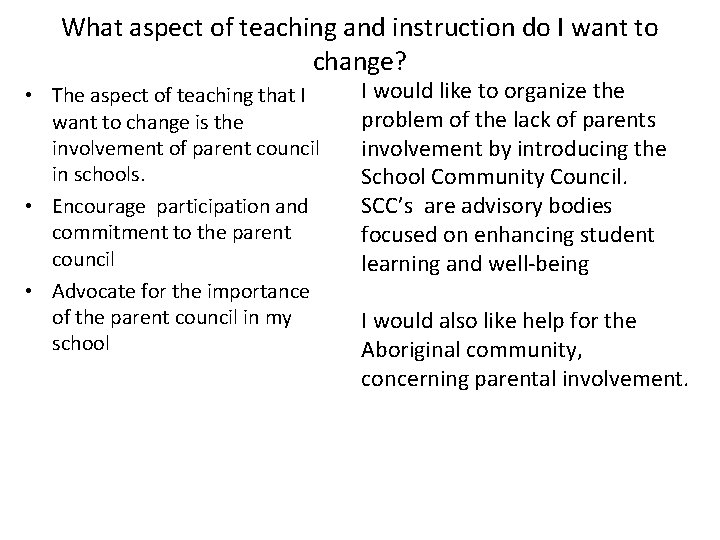
What aspect of teaching and instruction do I want to change? • The aspect of teaching that I want to change is the involvement of parent council in schools. • Encourage participation and commitment to the parent council • Advocate for the importance of the parent council in my school I would like to organize the problem of the lack of parents involvement by introducing the School Community Council. SCC’s are advisory bodies focused on enhancing student learning and well‐being I would also like help for the Aboriginal community, concerning parental involvement.
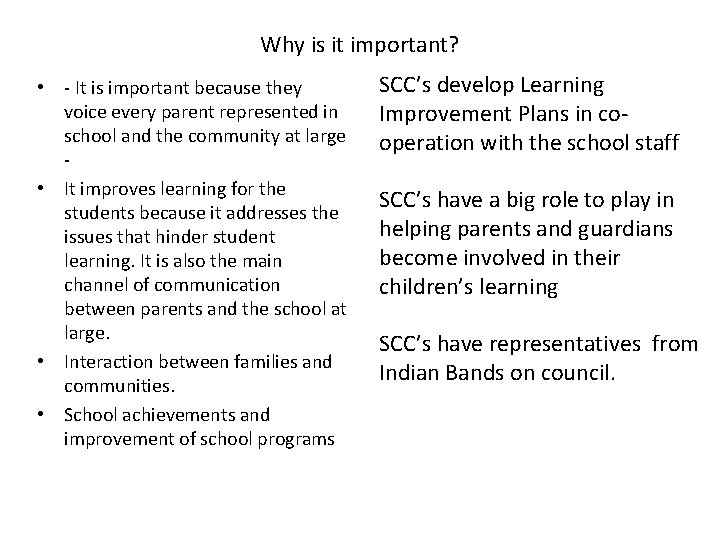
Why is it important? • ‐ It is important because they voice every parent represented in school and the community at large ‐ • It improves learning for the students because it addresses the issues that hinder student learning. It is also the main channel of communication between parents and the school at large. • Interaction between families and communities. • School achievements and improvement of school programs SCC’s develop Learning Improvement Plans in co‐ operation with the school staff SCC’s have a big role to play in helping parents and guardians become involved in their children’s learning SCC’s have representatives from Indian Bands on council.
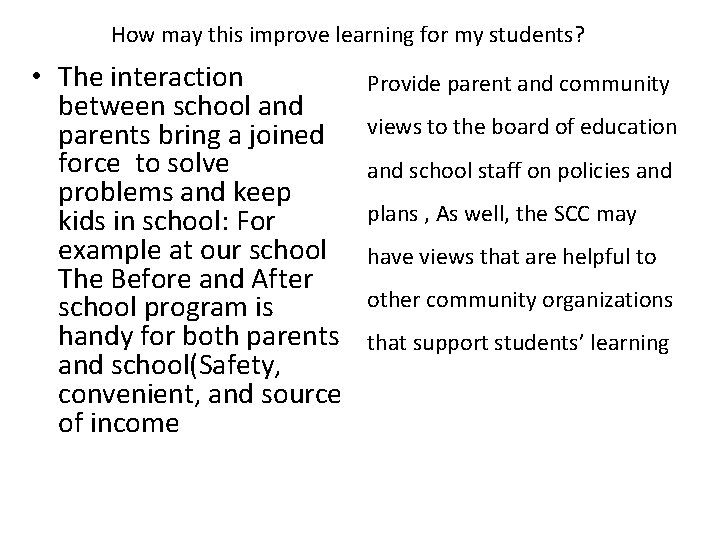
How may this improve learning for my students? • The interaction between school and parents bring a joined force to solve problems and keep kids in school: For example at our school The Before and After school program is handy for both parents and school(Safety, convenient, and source of income Provide parent and community views to the board of education and school staff on policies and plans , As well, the SCC may have views that are helpful to other community organizations that support students’ learning
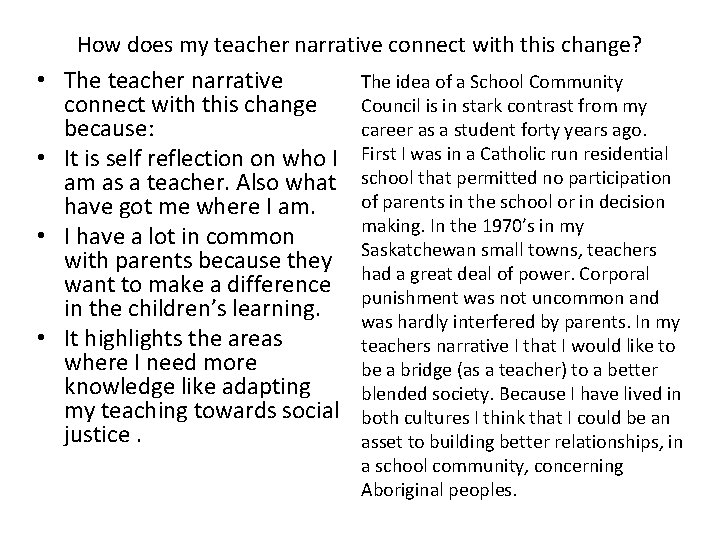
How does my teacher narrative connect with this change? • The teacher narrative connect with this change because: • It is self reflection on who I am as a teacher. Also what have got me where I am. • I have a lot in common with parents because they want to make a difference in the children’s learning. • It highlights the areas where I need more knowledge like adapting my teaching towards social justice. The idea of a School Community Council is in stark contrast from my career as a student forty years ago. First I was in a Catholic run residential school that permitted no participation of parents in the school or in decision making. In the 1970’s in my Saskatchewan small towns, teachers had a great deal of power. Corporal punishment was not uncommon and was hardly interfered by parents. In my teachers narrative I that I would like to be a bridge (as a teacher) to a better blended society. Because I have lived in both cultures I think that I could be an asset to building better relationships, in a school community, concerning Aboriginal peoples.
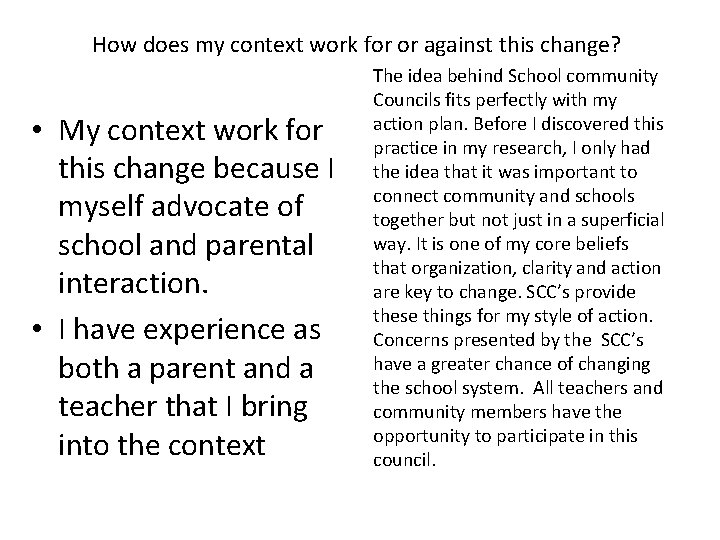
How does my context work for or against this change? • My context work for this change because I myself advocate of school and parental interaction. • I have experience as both a parent and a teacher that I bring into the context The idea behind School community Councils fits perfectly with my action plan. Before I discovered this practice in my research, I only had the idea that it was important to connect community and schools together but not just in a superficial way. It is one of my core beliefs that organization, clarity and action are key to change. SCC’s provide these things for my style of action. Concerns presented by the SCC’s have a greater chance of changing the school system. All teachers and community members have the opportunity to participate in this council.
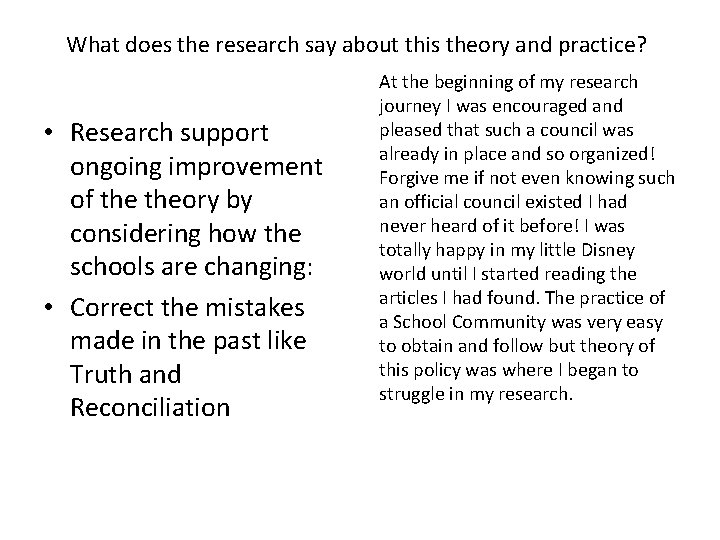
What does the research say about this theory and practice? • Research support ongoing improvement of theory by considering how the schools are changing: • Correct the mistakes made in the past like Truth and Reconciliation At the beginning of my research journey I was encouraged and pleased that such a council was already in place and so organized! Forgive me if not even knowing such an official council existed I had never heard of it before! I was totally happy in my little Disney world until I started reading the articles I had found. The practice of a School Community was very easy to obtain and follow but theory of this policy was where I began to struggle in my research.
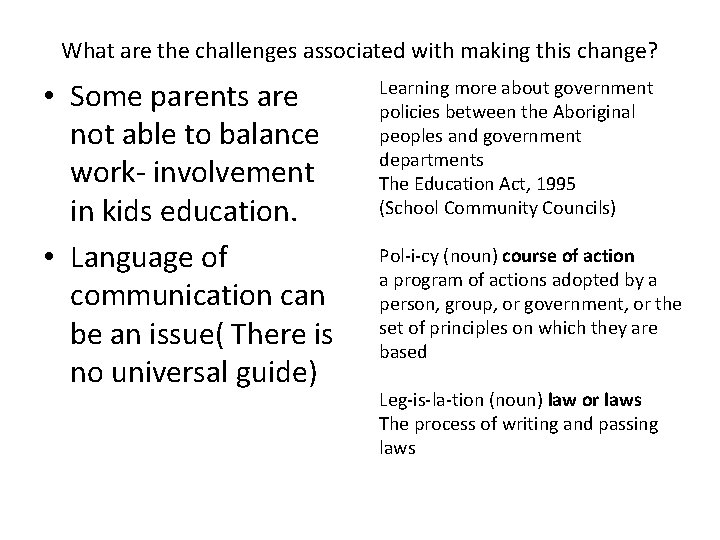
What are the challenges associated with making this change? • Some parents are not able to balance work‐ involvement in kids education. • Language of communication can be an issue( There is no universal guide) Learning more about government policies between the Aboriginal peoples and government departments The Education Act, 1995 (School Community Councils) Pol‐i‐cy (noun) course of action a program of actions adopted by a person, group, or government, or the set of principles on which they are based Leg‐is‐la‐tion (noun) law or laws The process of writing and passing laws
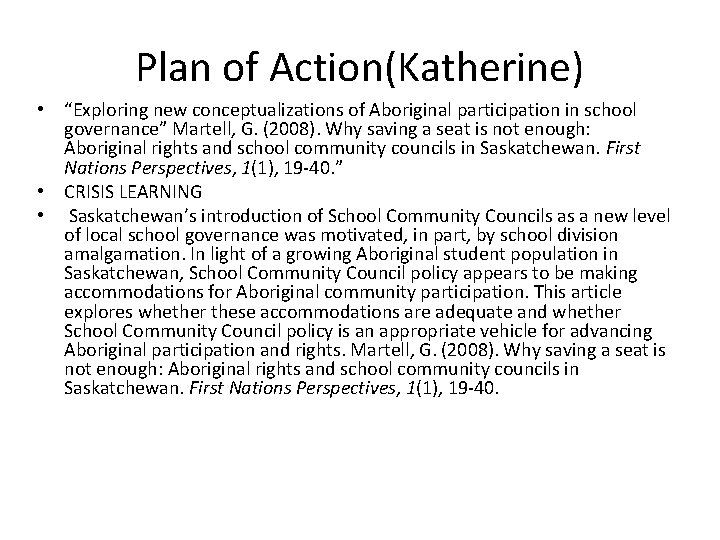
Plan of Action(Katherine) • “Exploring new conceptualizations of Aboriginal participation in school governance” Martell, G. (2008). Why saving a seat is not enough: Aboriginal rights and school community councils in Saskatchewan. First Nations Perspectives, 1(1), 19‐ 40. ” • CRISIS LEARNING • Saskatchewan’s introduction of School Community Councils as a new level of local school governance was motivated, in part, by school division amalgamation. In light of a growing Aboriginal student population in Saskatchewan, School Community Council policy appears to be making accommodations for Aboriginal community participation. This article explores whether these accommodations are adequate and whether School Community Council policy is an appropriate vehicle for advancing Aboriginal participation and rights. Martell, G. (2008). Why saving a seat is not enough: Aboriginal rights and school community councils in Saskatchewan. First Nations Perspectives, 1(1), 19‐ 40.
Plan of Action(Chantal) • My plan of action is: Educating the parties involved in the role of School councils. • Creating a task force that would follow –up on the improvements made and the what didn’t work. • Publish the accomplishment in the school newspaper so that everyone can be inspired by what is being done. • Diversify the roles so that everyone involved can carry a workable role: For example consider the time and affordability when it comes to fundraisings. (Prairie South School community council p. 4)
Conclusions. There is no one way to go when it comes to parental involvement in children education. • It is always a life journey that requires to be revisited to adapt to any changes. • Always follow the vision of making a difference in kids work,
References Partners at School: A Handbook on How To Involve Indian and Métis Parents in School Activities. Davis, Sydney, Ed. www. eric. ed. gov/? id=ED 382364 School Community Councils: A Handbook for School Community Councils and Principals, Saskatoon Public School Division. www. spsd. sk. ca/school/collagepark/Parents/School. Community. Councils. D ocuments/A%20 Handbook%20 for%20 school%20 community%20 councils. p df Living Sky School Division No. 202. School Community Council Handbook www. Iskysd. ca Martell, G. (2008). Why saving a seat is not enough: Aboriginal rights and school community councils in Saskatchewan. First Nations Perspectives, 1(1), 19 -40.