
THEORIES OF TRANSLATION An Anthology of Essays from

- Slides: 25
THEORIES OF TRANSLATION An Anthology of Essays from Dryden to Derrida “INTRODUCTION” Dudu ÖZBEK
PURPOSE The aim of this presentation is to focus on the introduction part of the book Theories of Translation: An Anthology of Essays from Dryden to Derrida which presents a historical overview on theories about the nature of translation while discussing some important statements on the function and feasibility of translating literary texts.
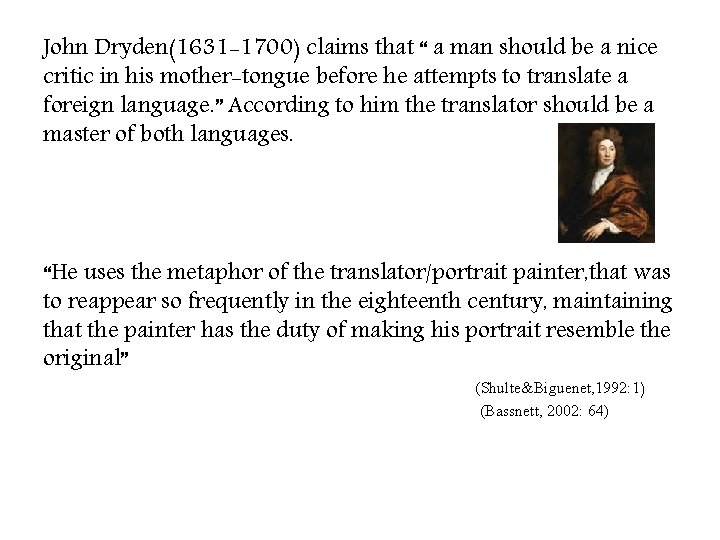
John Dryden(1631 -1700) claims that “ a man should be a nice critic in his mother-tongue before he attempts to translate a foreign language. ” According to him the translator should be a master of both languages. “He uses the metaphor of the translator/portrait painter, that was to reappear so frequently in the eighteenth century, maintaining that the painter has the duty of making his portrait resemble the original” (Shulte&Biguenet, 1992: 1) (Bassnett, 2002: 64)
Dryden formulates three basic types of translation: • ‘metaphrase’ : “word by word and line by line translation”, which corresponds to literal translation • ‘paraphrase’ : “translation with latitude, where the author is kept in view by the translator, so as never to be lost, but his words are not so strictly followed as his sense” ; this may correspond to sense-for-sense view of translation. • ‘imitation’ : “forsaking” both words and sense; this corresponds to free translation and is more or less adaptation Of these types Dryden chooses the second as the more balanced path (Munday, 2001: 25)
Translation theories need to be seen in a historical context. So, it is important to mention Hugo Friedrich’s essay entitled “On the Art of Translation”. In his essay, he outlines the major translation attitudes from the Romans to the present.
During Roman times translation meant taking elements of the foreign culture to enhance their own language without paying particular attention to lexical or stylistic characteristics of the original source-language texts. “Whether a translation accurately transmitted the linguistic and semantic meanings of the original didn’t appear to be a primary concern of the translator” (Shulte&Biguenet, 1992: 2)
“In the Republic and early Empire, Roman authors sought to capitalize on the cultural prestige of Greece by submitting Greek texts to various forms of translation and adaptation” (Venuti, 2012: 14) For example, Cicero stated that “ he was translating ideas and their forms and therefore less interested in a word-for-word rendering of the original-language text. ” Saint Jerome is another representative of this view. He saw himself “in competition with the original text, and the goal was to supersede the foreign text, since the translator had the ability and the freedom to make the translation better than the original. ” (Shulte&Biguenet, 1992: 2)
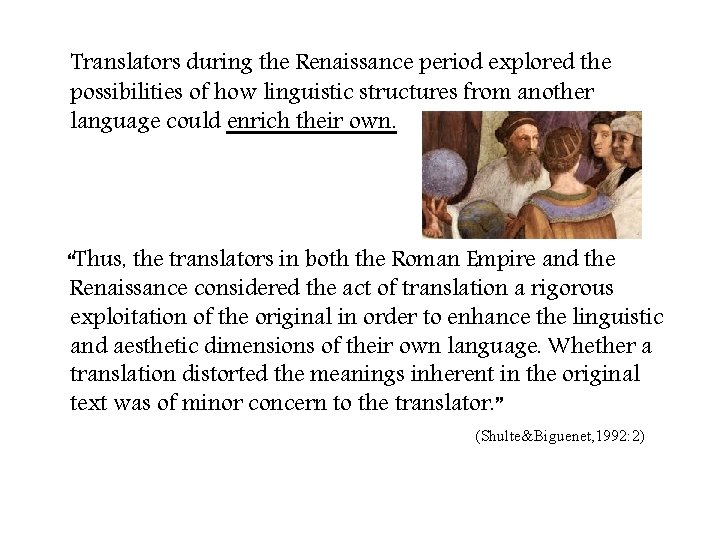
Translators during the Renaissance period explored the possibilities of how linguistic structures from another language could enrich their own. “Thus, the translators in both the Roman Empire and the Renaissance considered the act of translation a rigorous exploitation of the original in order to enhance the linguistic and aesthetic dimensions of their own language. Whether a translation distorted the meanings inherent in the original text was of minor concern to the translator. ” (Shulte&Biguenet, 1992: 2)
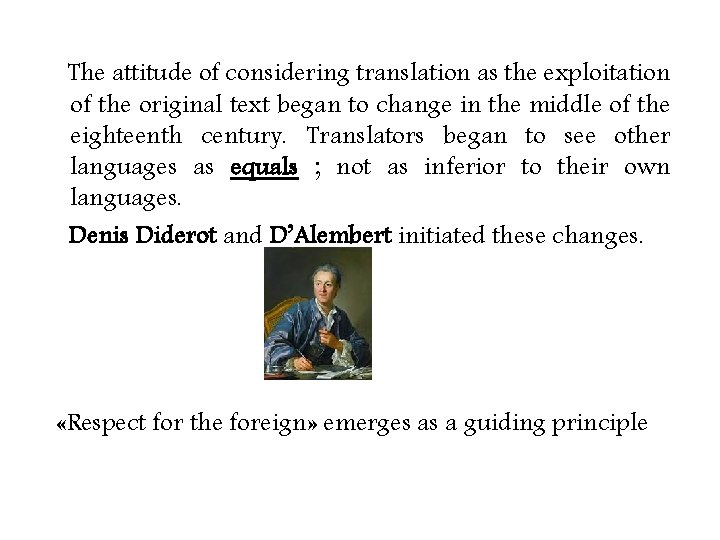
The attitude of considering translation as the exploitation of the original text began to change in the middle of the eighteenth century. Translators began to see other languages as equals ; not as inferior to their own languages. Denis Diderot and D’Alembert initiated these changes. «Respect for the foreign» emerges as a guiding principle
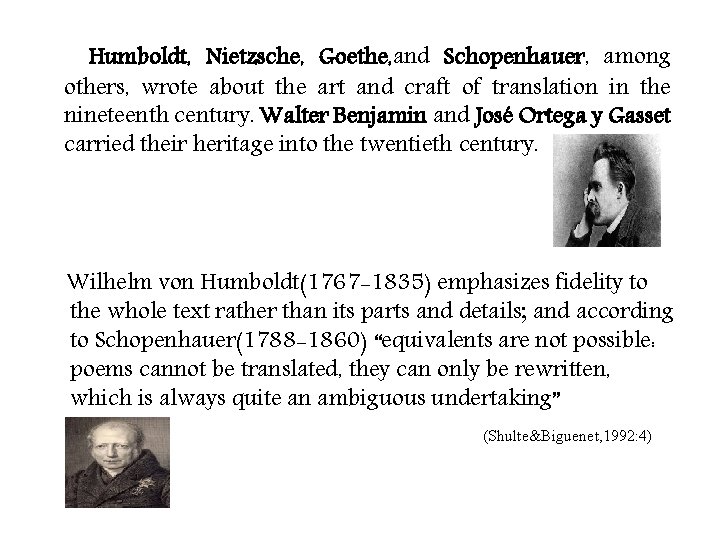
Humboldt, Nietzsche, Goethe, and Schopenhauer, among others, wrote about the art and craft of translation in the nineteenth century. Walter Benjamin and José Ortega y Gasset carried their heritage into the twentieth century. Wilhelm von Humboldt(1767 -1835) emphasizes fidelity to the whole text rather than its parts and details; and according to Schopenhauer(1788 -1860) “equivalents are not possible: poems cannot be translated, they can only be rewritten, which is always quite an ambiguous undertaking” (Shulte&Biguenet, 1992: 4)
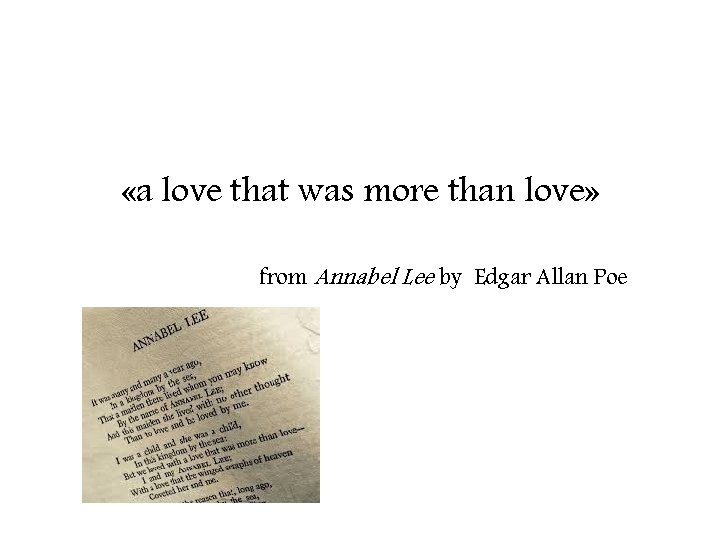
«a love that was more than love» from Annabel Lee by Edgar Allan Poe
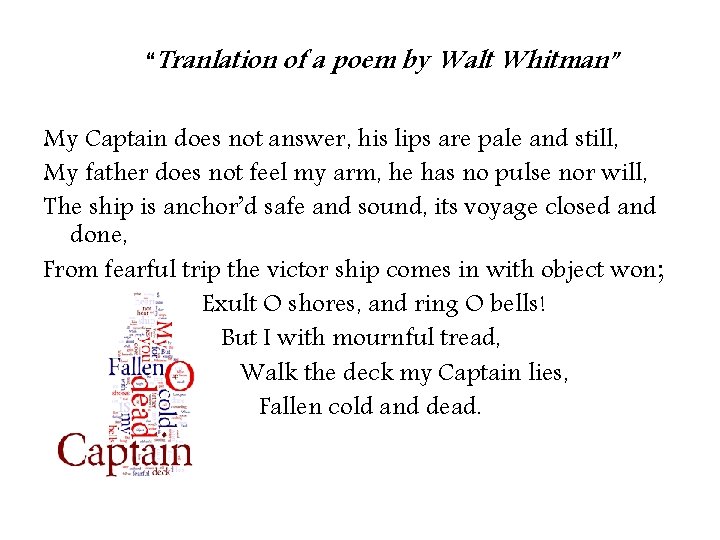
“Tranlation of a poem by Walt Whitman” My Captain does not answer, his lips are pale and still, My father does not feel my arm, he has no pulse nor will, The ship is anchor’d safe and sound, its voyage closed and done, From fearful trip the victor ship comes in with object won; Exult O shores, and ring O bells! But I with mournful tread, Walk the deck my Captain lies, Fallen cold and dead.
«Multiple translations» can be a solution for some problems about the translation of the literary texts. HOWEVER How are we going to evaluate them ? Who is going to evaluate different translations of the same text?
Matthew Arnold (1822 -1888) proposes “literary scholars” to be involved. “No one can tell him [the translator] how Homer affected the Greeks; but there are those who can tell him how Homer affects them. Those are scholars, who possess, at the same time with knowledge of Greek, adequate poetical taste and feeling. No translation will seem to them of much worth compared with the original; but they alone can say whether the translation produces more or less the same effect upon them as the original” (Shulte&Biguenet, 1992: 5)
METHODOLOGIES Goethe describes three kinds of translation in his work West- Östlicher Divan(1819) a simple prosaic translation which acquaints us with foreign countries on our own terms a parodistic epoch in which the translator only tries to appropriate foreign content and to reproduce it in his own sense even though he tries to transport himself in foreign situations a third epoch which is called the highest and the final one, namely the one in which the aim is to make the translation identical with the original (Lefevere, 1977: 35 -9)
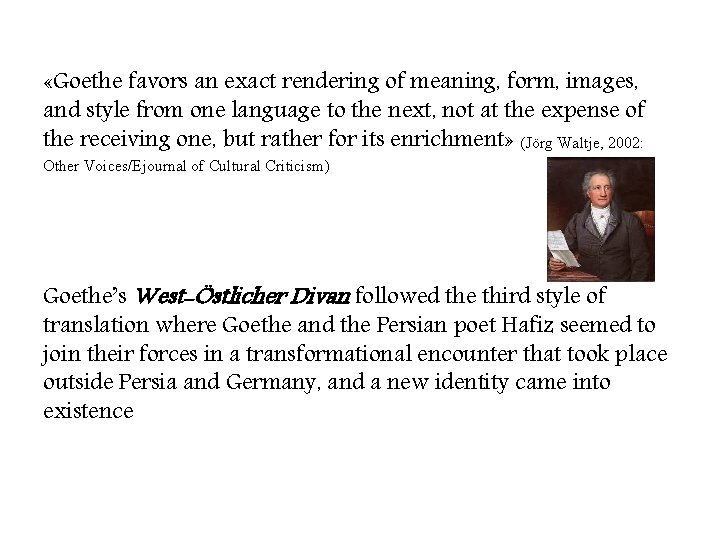
«Goethe favors an exact rendering of meaning, form, images, and style from one language to the next, not at the expense of the receiving one, but rather for its enrichment» (Jörg Waltje, 2002: Other Voices/Ejournal of Cultural Criticism) Goethe’s West-Östlicher Divan followed the third style of translation where Goethe and the Persian poet Hafiz seemed to join their forces in a transformational encounter that took place outside Persia and Germany, and a new identity came into existence
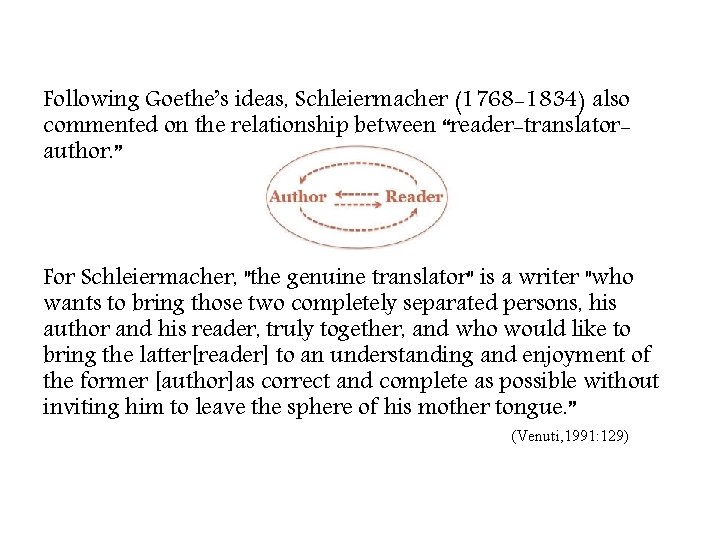
Following Goethe’s ideas, Schleiermacher (1768 -1834) also commented on the relationship between “reader-translatorauthor. ” For Schleiermacher, "the genuine translator" is a writer "who wants to bring those two completely separated persons, his author and his reader, truly together, and who would like to bring the latter[reader] to an understanding and enjoyment of the former [author]as correct and complete as possible without inviting him to leave the sphere of his mother tongue. ” (Venuti, 1991: 129)
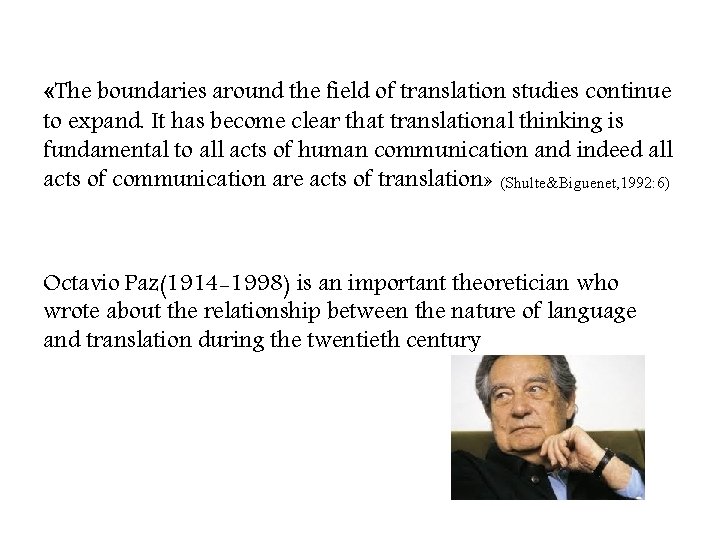
«The boundaries around the field of translation studies continue to expand. It has become clear that translational thinking is fundamental to all acts of human communication and indeed all acts of communication are acts of translation» (Shulte&Biguenet, 1992: 6) Octavio Paz(1914 -1998) is an important theoretician who wrote about the relationship between the nature of language and translation during the twentieth century
Paz starts his article «Translation: Literature and Letters» with the following words: «When we learn to speak, we are learning to translate; the child who asks his mother the meaning of a word is really asking her to translate the unfamiliar term into the simple words he already knows. In this sense, translation within the same language is not essentially different from translation between two tongues» and he concludes: « A plurality of languages and societies: each language is a view of the world, each civilization is a world» (Paz , 1971)
According to Paz (1971)“no text can be completely original because language itself, in its very essence, is already a translation: first from nonverbal world and then because each sign and each phrase is a translation of another sign, another phrase”.
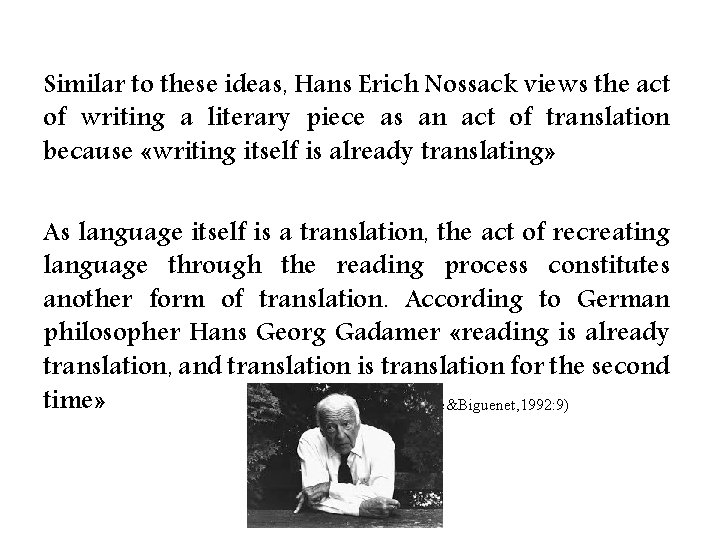
Similar to these ideas, Hans Erich Nossack views the act of writing a literary piece as an act of translation because «writing itself is already translating» As language itself is a translation, the act of recreating language through the reading process constitutes another form of translation. According to German philosopher Hans Georg Gadamer «reading is already translation, and translation is translation for the second time» (Shulte&Biguenet, 1992: 9)
CONCLUSION The book Theories of Translation: An Anthology of Essays from Dryden to Derrida contributes to the field of translation studies by presenting various theories of translation with a historical perspective. “The 21 st century, known as knowledge century, demands reconsideration of disciplinary domains of knowledge, like translation studies that is witnessing ‘Technological Turn’ after the ‘Linguistic Turn” and the ‘Cultural Turn’” (Singh, 2014: 5).
Two distinct impressions can be drawn from these essays: (1) the transferral of the foreign from other languages into our own allows us to explore and formulate emotions and concepts that otherwise we would not have experienced (2) the act of translation continuously stretches the linguistic boundaries of one’s own language. «In that sense, translation functions as a revitalizing force of language»
REFERENCES (1)Bassnett, S. (2002). Translation Studies (3 rd ed). London: Routledge (2)Lefevere, A. (1977) Translating Literature : The German Tradition from Luther to Rosenzweig. Assen/Amsterdam : Van Gorcum Publishers (3)Munday, J. (2001). Introducing Translation Studies. London: Routledge (4)Paz, Octavio. (1971). Translation: Literature and Letters. In Rainer Schulte & John Biguenet(ed. ), Theories of Translation: An Anthology of Essays from Dryden to Derrida. Chicago: University of Chicago Press, 1992. 152– 162. (5)Schulte, R. & Biguenet, J. (ed. )(1992). Theories of Translation: An Anthology of Essays from Dryden to Derrida. Chicago: University of Chicago Press (6) Singh, A. K. (2014). Translation Studies in the 21 st Century. Translation Today. vol. 8, n. 1, 5 -44 (7)Venuti, L. (1991). Genealogies of Translation Theory: Schleiermacher. TTR : traduction, terminologie, rédaction. vol. 4, n. 2, 125 -150 (8) Venuti, L. (2012). The Translation Studies Reader(3 rd ed). London: Routledge (9)Waltje, J. (2002). Johann Wolfgang von Goethe's Theory of Translation in the West-Eastern Divan. Other Voices/Ejournal of Cultural Criticism. vol. 2, n. 2 Web: http: //www. othervoices. org/