
Theories of statesociety relations in Vietnam Causes for
- Slides: 26
Theories of state-society relations in Vietnam Causes for and consequences of socio-political transformations: focus on the Đổi Mới policy
Introduction • 6 th National Party Congress 1986: Renovation policy (Đổi Mới) Central Planning “Socialist market economy under state guidance” Transformations of state and society + state-society relations • Influx of foreign aid & businesses • High GDP growth middle class • New legislation for societal organisations / civil society Economic ‘model’ is not yet in its concrete, raising questions on contemporary state-society relations.
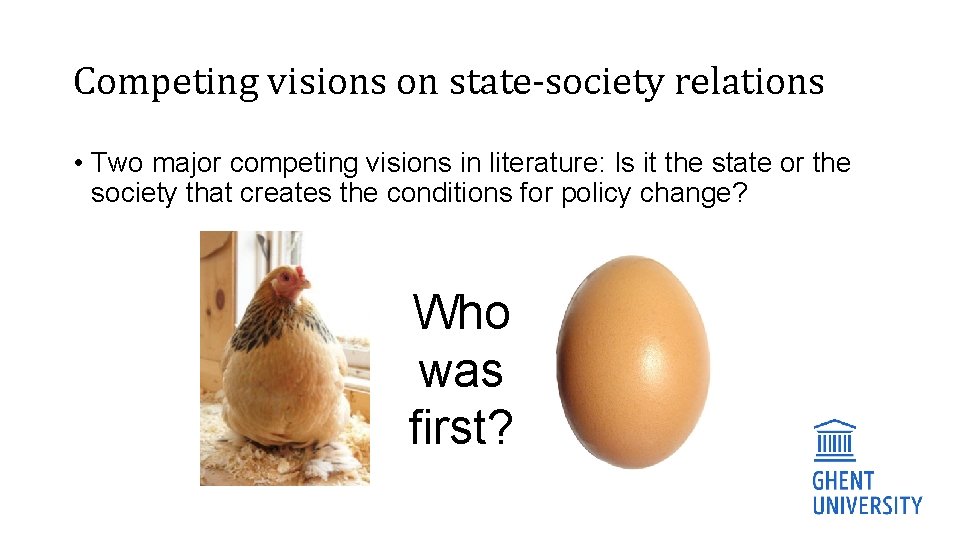
Competing visions on state-society relations • Two major competing visions in literature: Is it the state or the society that creates the conditions for policy change? Who was first?
Duality in literature • State-centred approaches: Tries to convince of the state’s autonomous space for manoeuvre and its capacity to effectively implement policies and legal frameworks. • Society-centred approaches: Focus on the strength of societal organisations to advocate their aspirations or to put obstacles to state power.
State-centred approaches on Vietnam (1) • The dominating state interpretation (Kerkvliet, 2018) • Womack (1992): “Vietnam is a vast and co-ordinated party-state that pre-empts alternative and autonomous societal organisations from the national centre down to the grassroots of the village and the workplace. ” • Thayer (2009): Mono-organisational socialism: • “The party exercises hegemonic control over state institutions, the armed forces and other organisations in society by the penetration of these institutions by party cells and committees. ” • “The Vietnamese civil society should await the further erosion of mono-organisational socialism before developing further. ”
State-centred approaches on Vietnam (2) • Modification by Kerkvliet: ‘Mobilizational corporatist’ view • Vietnamese Fatherland Front and mass organisations create popular support and legitimacy for the Party’s programme. • Both the ‘dominating state’ and the ‘mobilizational corporatist’ interpretations allocate the largest power to the state to create conditions for policy change.
Society-centred approaches The state is believed not to be able to counter domestic and international pressures and only draws the legal frameworks for an independently changing society.
Third interpretation Neither approach solely contains the analytical capacity that is necessary to understand socio-political adaptation in all its aspects. A third interpretation that recognises the interaction between state and society (to come to socio-political change) is necessary. ‘Dialectic interaction’
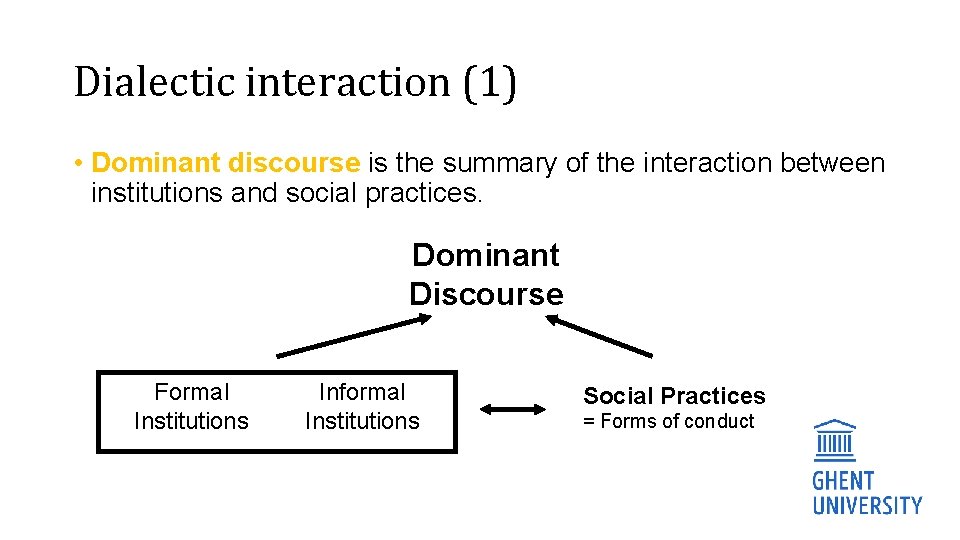
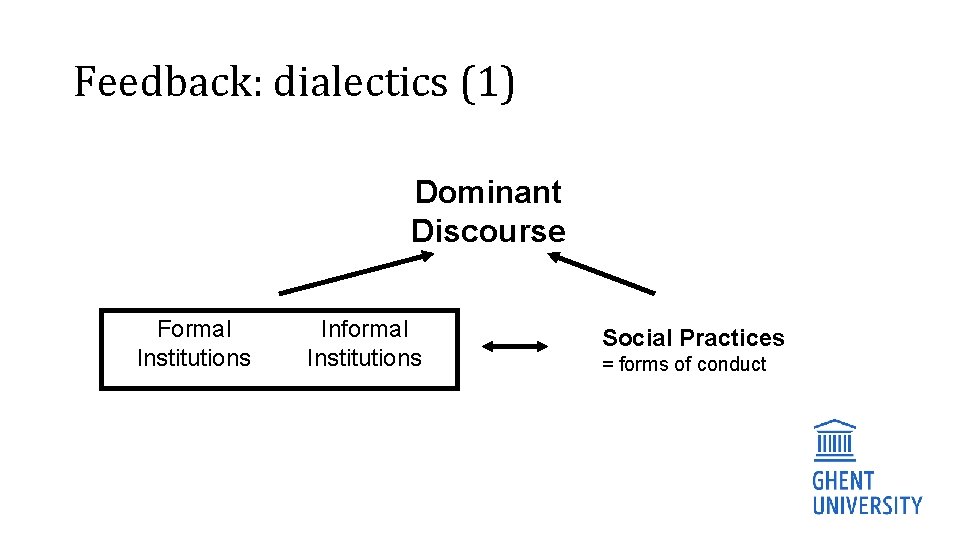
Dialectic interaction (1) • Dominant discourse is the summary of the interaction between institutions and social practices. Dominant Discourse Formal Institutions Informal Institutions Social Practices = Forms of conduct
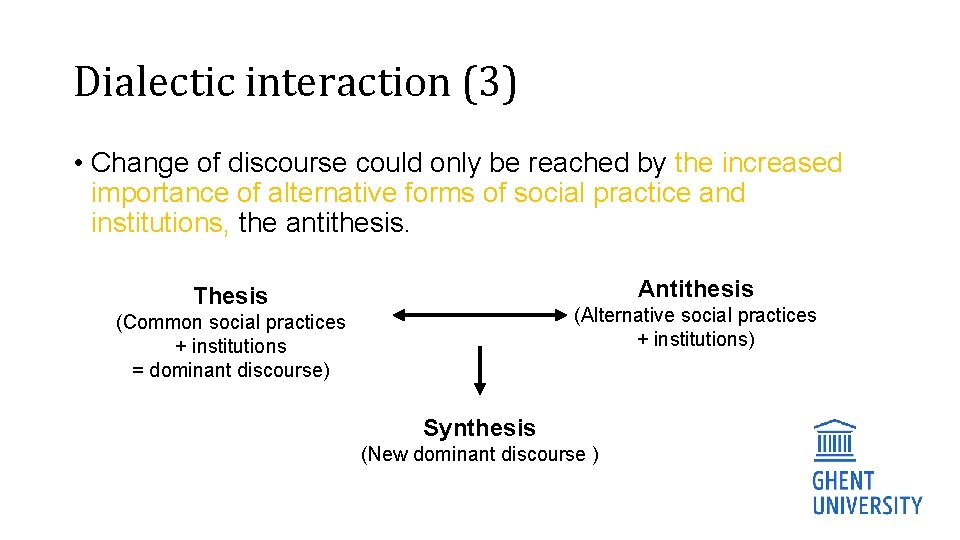
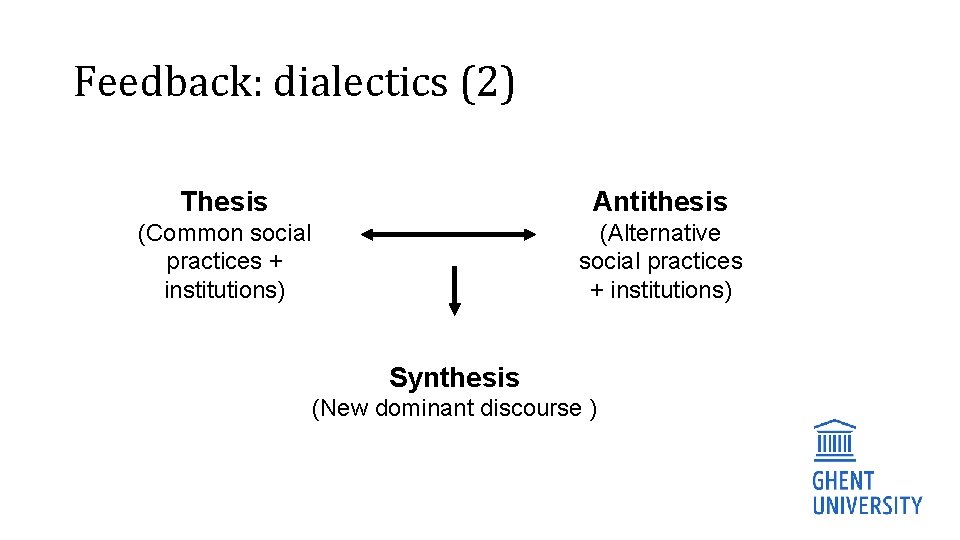
Dialectic interaction (3) • Change of discourse could only be reached by the increased importance of alternative forms of social practice and institutions, the antithesis. Antithesis Thesis (Alternative social practices + institutions) (Common social practices + institutions = dominant discourse) Synthesis (New dominant discourse )
Boundaries between ‘state’ and ‘society’ (1) • No society is completely uniform • However, it should have some important features, habits and values in common to be defined as such. E. g. Government legislation. • It is hard to define the specific and respective spaces for ‘state’ and ‘society’: • since all organisations are penentrated by both. They are different, but never entirely separate. (E. g. a university/ a parliament) • Guan (2004): Socialist practice: try to penetrate all forms of social life with party cells.
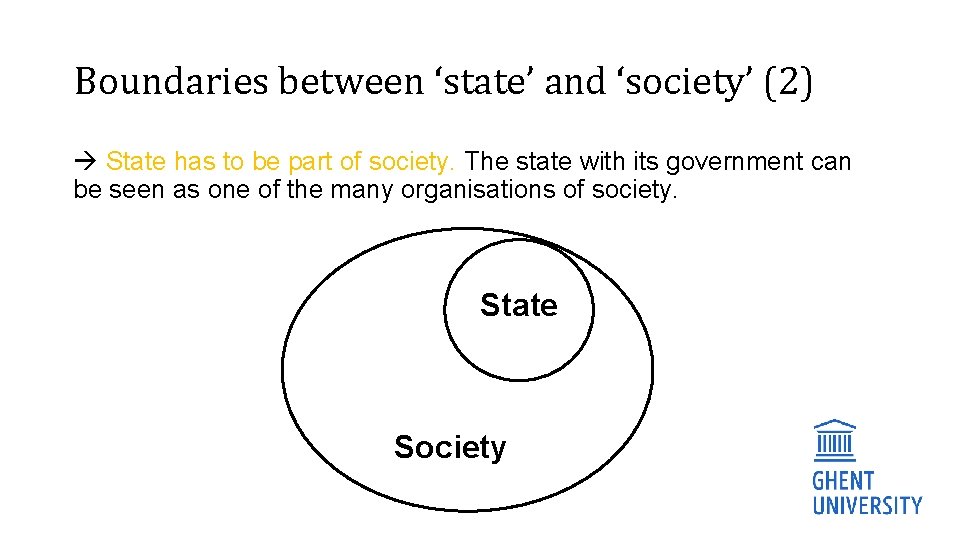
Boundaries between ‘state’ and ‘society’ (2) State has to be part of society. The state with its government can be seen as one of the many organisations of society. State Society
Boundaries between ‘state’ and ‘society’ (3) • “The state, as it often claims to be, can be seen as the supreme organisation of society, delineating the way of conduct of its people. (laws & regulations + enforcement) • This does not mean society-wide acceptance of state policy; • Nor does this presume that the state is capable of ruling and regulating all sectors of society, or that it acts alone in attempting to do so. ” (Kerkvliet, 2018) Contrast between • What the state prescribes; • What occurs in practice!
Abilities of both states and societies (1) • The state is the supreme organisation of society, regulating the behaviour of its citizens by law & enforcement. • Migdal (1988): “all states have limited capabilities at some time, or with some groups, or on some issues. ” ‘Dominating state’ and ‘mobilizational corporatist’ views attribute too much relative power to the state. Society-centred approaches attribute too much power to society.
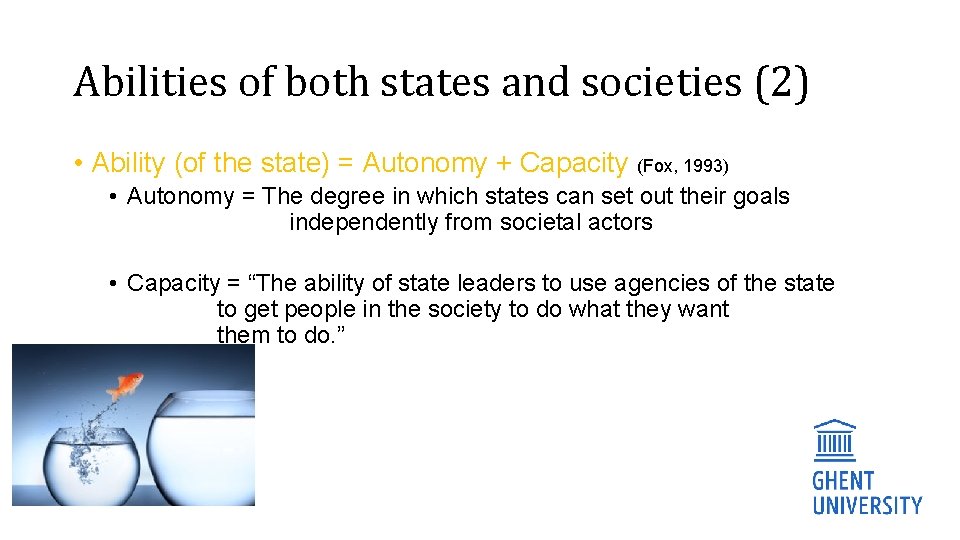
Abilities of both states and societies (2) • Ability (of the state) = Autonomy + Capacity (Fox, 1993) • Autonomy = The degree in which states can set out their goals independently from societal actors • Capacity = “The ability of state leaders to use agencies of the state to get people in the society to do what they want them to do. ”
Abilities of both states and societies (3) • Inversely, this tells a lot about society’s ‘democratic space’. (Only apliccable to the VN case or similar ones. ) • If the state is neither autonomous nor capable enough to reach out to every citizen, those groups that are not (or do not want to be) reached, will take the advantage to set up a self-help system in the political vacuum the state leaves behind. Large political autonomy and capacity for those groups in society; The state would want to incorporate those groups eventually: struggle.
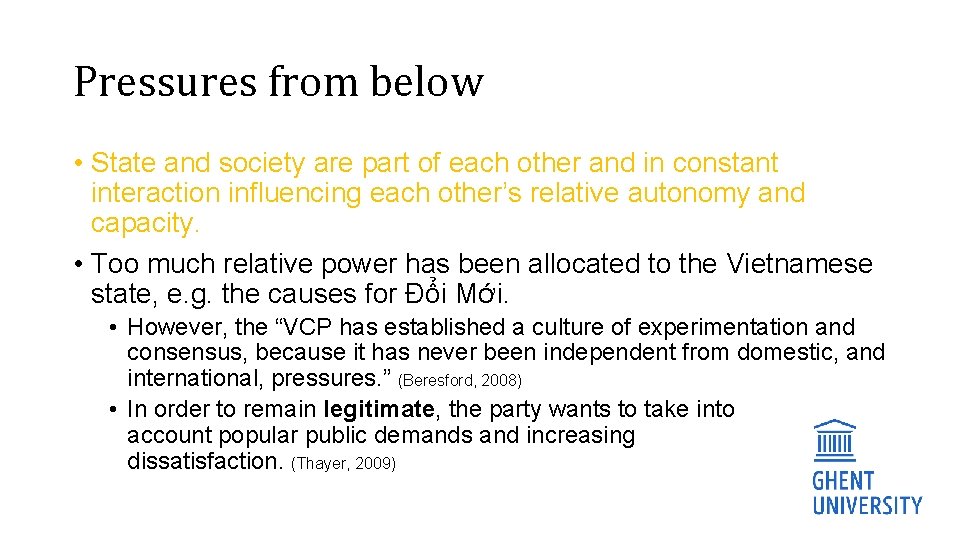
Pressures from below • State and society are part of each other and in constant interaction influencing each other’s relative autonomy and capacity. • Too much relative power has been allocated to the Vietnamese state, e. g. the causes for Đổi Mới. • However, the “VCP has established a culture of experimentation and consensus, because it has never been independent from domestic, and international, pressures. ” (Beresford, 2008) • In order to remain legitimate, the party wants to take into account popular public demands and increasing dissatisfaction. (Thayer, 2009)
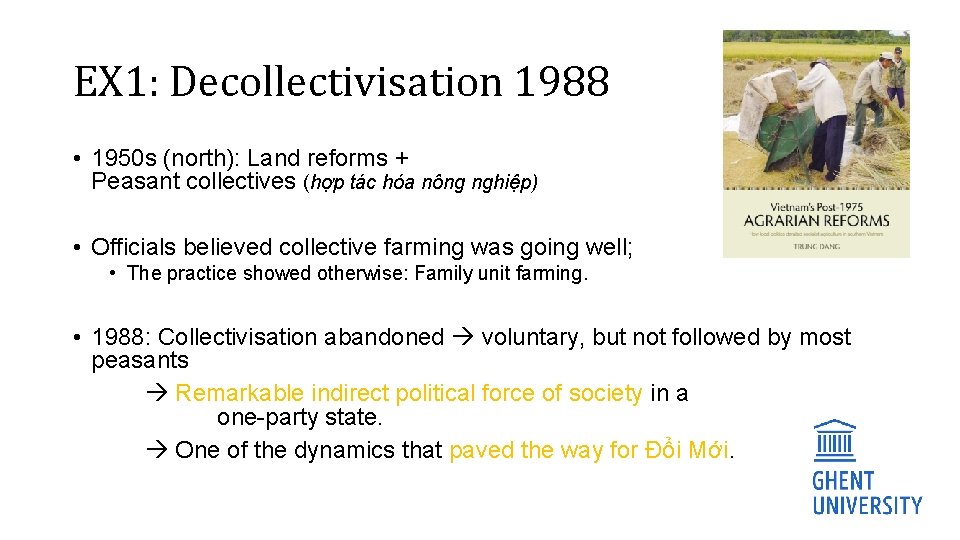
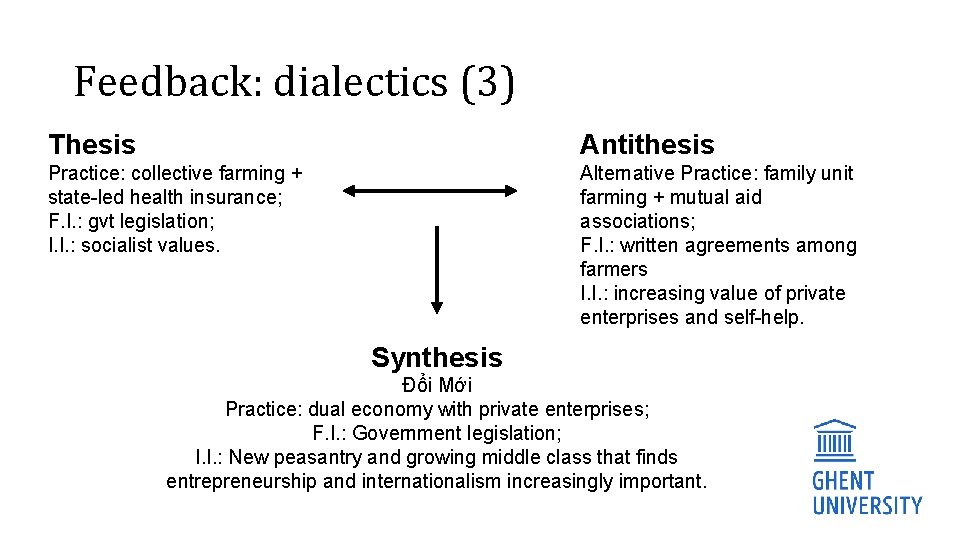
EX 1: Decollectivisation 1988 • 1950 s (north): Land reforms + Peasant collectives (hợp tác hóa nông nghiệp) • Officials believed collective farming was going well; • The practice showed otherwise: Family unit farming. • 1988: Collectivisation abandoned voluntary, but not followed by most peasants Remarkable indirect political force of society in a one-party state. One of the dynamics that paved the way for Đổi Mới.
EX 2: Mutual aid associations • Collective farming voluntary in 1988 • There was no incentive among the peasantry to remain within the collectives, because most of them had already abandoned the practice. • Search for alternatives for an adequate social security system, since that of the government was not sufficient. re-entrace of mutual aid societies Self-help systems which could influence state policy on the longer term; as we have seen with decollectivisation, which acted as one of the domestic pressures toward privatisation of a part of the economy.
Feedback: State: Autonomy + Capacity 1. The VN state has the autonomy to, for instance, create collectivisation among the peasantry and to decide upon Đổi Mới. 2. The VN state does not have enough capacity that is necessary push through large socialist reforms: collectivisation and following state-led social security. There is a difference between state policy and what practice. dialectics! occurs in
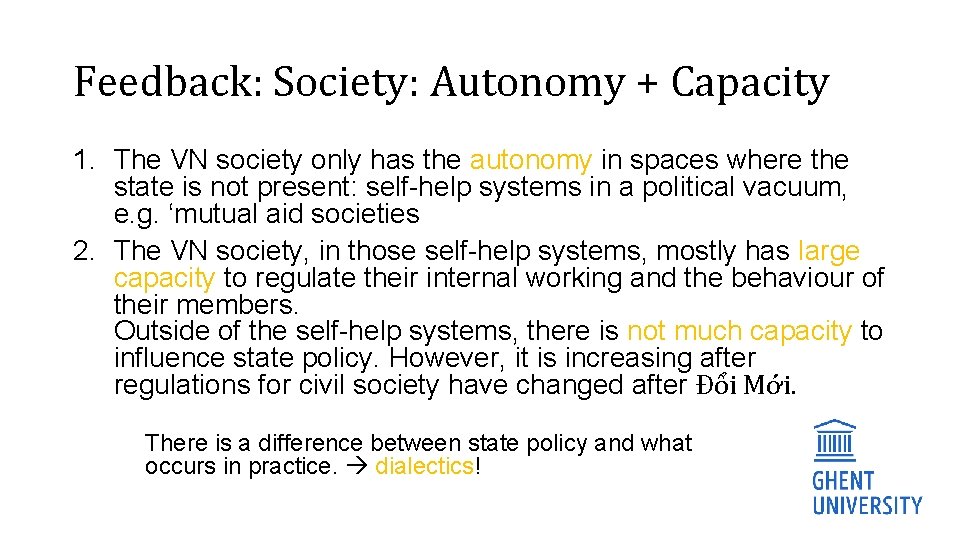
Feedback: Society: Autonomy + Capacity 1. The VN society only has the autonomy in spaces where the state is not present: self-help systems in a political vacuum, e. g. ‘mutual aid societies 2. The VN society, in those self-help systems, mostly has large capacity to regulate their internal working and the behaviour of their members. Outside of the self-help systems, there is not much capacity to influence state policy. However, it is increasing after regulations for civil society have changed after Đổi Mới. There is a difference between state policy and what occurs in practice. dialectics!
Feedback: dialectics (1) Dominant Discourse Formal Institutions Informal Institutions Social Practices = forms of conduct
Feedback: dialectics (2) Thesis Antithesis (Common social practices + institutions) (Alternative social practices + institutions) Synthesis (New dominant discourse )
Feedback: dialectics (3) Thesis Antithesis Practice: collective farming + state-led health insurance; F. I. : gvt legislation; I. I. : socialist values. Alternative Practice: family unit farming + mutual aid associations; F. I. : written agreements among farmers I. I. : increasing value of private enterprises and self-help. Synthesis Đổi Mới Practice: dual economy with private enterprises; F. I. : Government legislation; I. I. : New peasantry and growing middle class that finds entrepreneurship and internationalism increasingly important.
Conclusion: After Đổi Mới “The dynamic situation occurs in Vietnam: • On the one hand, people are enjoying more space that doesn’t require interacting with agencies of the state (political vacuums and less strict regulations); • On the other hand, the state still retains key control of its citizens giving them the privilege to organise and act publicly on important issues. ” (Guan, 2004) Dialectic interaction never ends. Model that was meant in 1986 is not in its concrete, giving the opportunity for interaction toward a stabilisation of the ‘model’. Some issues will be contested, resulting in change.