
THEORIES OF SECOND LANGUAGE ACQUISITION WHAT ARE THEIR











- Slides: 22
THEORIES OF SECOND LANGUAGE ACQUISITION: WHAT ARE THEIR IMPLICATIONS & APPLICATIONS IN THE WRITING CENTER? Colorado State University April 12 t h , 2014 Leslie Davis Devon Jancin Moriah Kent Kristen Foster
WHAT IS SECOND LANGUAGE ACQUISITION? The field of SECOND LANGUAGE ACQUISITION (SLA) concerns itself with exploring the factors and processes that contribute to the acquisition of second and foreign languages. “Tutors who are aware of the processes involved in the development of second languages and second language writing competence can be more effective in their conferences” (Williams, 2002, p. 86).
COLORADO STATE UNIVERSITY INTO CSU Fall 2013: International student enrollment up 280 students, or 23 percent Past 5 years: up 70 percent more than 5. 5 percent of CSU’s student population
FALL 2013 STATISTICS 1, 553 clients 493 (32%) ESL clients 3, 136 consultations 1, 316 (42%) ESL consultations
DISCUSSION GOALS to explore with other writing center directors and consultants § the implications and applicability of five SLA hypotheses § if and how an introduction to these hypotheses should be incorporated into writing center consultant training
SCHEDULE 10 minutes: Introduction to five influential SLA Theories 15 minutes: Small group discussion & brainstorm of applications/implications in the Writing Center 10 minutes: discuss brainstorm 20 minutes: Should we incorporate these theories into Writing Center training?
THEORIES OF SECOND LANGUAGE ACQUISITION “(The writing center) is a unique place where talk and writing come together, where interaction nearly always focuses on meaningful communication” (Williams, 2002, p. 86).
COMPREHENSIBLE INPUT HYPOTHESIS KRASHEN (1991)
COMPREHENSIBLE INPUT HYPOTHESIS i+1 Language input should be slightly above student’s ability level “If the pupil is at a level that we shall call ‘i’, then the aim is for the teacher to raise the level of his/her use of the language to ensure that the pupil is receiving input a bit above ‘i’ and hence pushing up acquisition to the next level ‘+1’” (Krashen & Terrell, 1983, p. 32).
INTERACTION HYPOTHESIS LONG (1996)
INTERACTION HYPOTHESIS Posits that “the best kind of comprehensible input leaners can hope to obtain is input that has been interactionally modified… …in other words, adjusted after receiving some signal that the interlocutor needs some help in order to fully understand the message” (Ortega, 2009, p. 61) interactional modifications negotiation for meaning
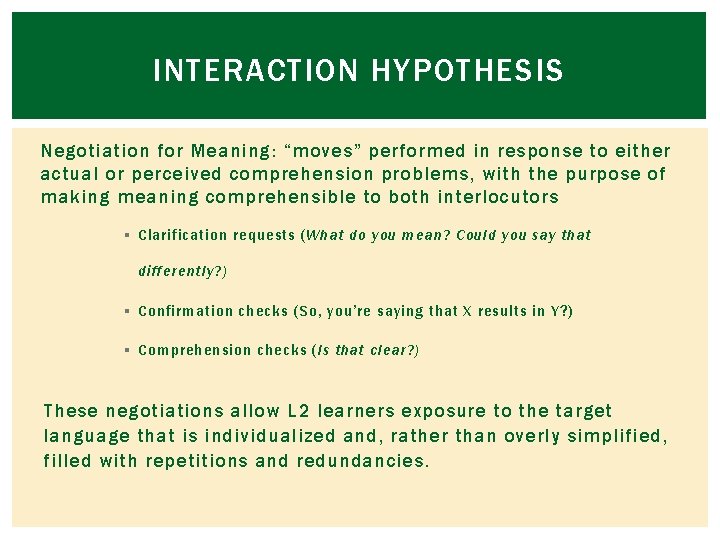
INTERACTION HYPOTHESIS Negotiation for Meaning: “moves” performed in response to either actual or perceived comprehension problems, with the purpose of making meaning comprehensible to both interlocutors § Clarification requests (What do you mean? Could you say that differently? ) § Confirmation checks (So, you’re saying that X results in Y? ) § Comprehension checks (Is that clear? ) These negotiations allow L 2 learners exposure to the target language that is individualized and, rather than overly simplified, filled with repetitions and redundancies.
NOTICING HYPOTHESIS SCHMIDT (1990)
NOTICING HYPOTHESIS students must notice gaps in their knowledge Learners cannot learn grammatical features unless they notice them.
NOTICING HYPOTHESIS Was born out of the idea that “positive attitudes and an optimal learning environment will afford the linguistic data needed for learning…[but that] grammar acquisition cannot be successful without applying ‘interest’, ‘attention’ and ‘hard work’. (Schmidt, 1990, pg. 58) The more learners notice, the more they’ll learn. What is “Noticing”? - Learners should notice linguistic material. - The brain “registers new material” (pg. 63). - Understanding does not need to happen, as long as a new piece of information is noticed. - Memory of the new material is not necessarily needed, either.
COMPREHENSIBLE OUTPUT HYPOTHESIS SWAIN (1995)
COMPREHENSIBLE OUTPUT HYPOTHESIS Noticing - students recognize what they don’t know Hypothesis testing - students test out new forms based on what they already know Metalinguistic reflection - using language to reflect on language mediates learning
AFFECTIVE FILTER KRASHEN (1987)
AFFECTIVE FILTER HYPOTHESIS Motivation, self-confidence, and anxiety level of the student must be taken into account. If their “affective filter” is up, they cannot acquire as much new information (Krashen, 1987, p. 3).
BRAINSTORMING In pairs or groups of three, discuss: How do these hypotheses connect to the work we do in the writing center? How do they help clarify or explain our contributions to the language development of non-native English speakers?
BRAINSTORMING Should we incorporate the presentation of these hypotheses and/or others into Writing Center training? How might they be best introduced to consultants?
WORKS CITED Krashen, S. D. , & Terrell, T. D. (1983). The natural approach: Language acquisition in the classroom. Oxford: Pergamon Press Ltd. Krashen, S. D. (1991). The input hypothesis: an update. In James E. Alatis (Ed. ), Georgetown University Roundtable on Languages and Linguistics 1991 (p. 409 -431). Washington, DC: Georgetown University Press. Ortega, Lourdes. (2009). Understanding Second Language Acquisition. London: Hodder Education. Schmidt, R. W. (1990). The role of consciousness in second language learning. Applied Linguistics, 11(2), 129 -158. Williams, J. (2002). Undergraduate second language writers in the writing classroom. Journal of Basic Writing, 21(2), 73 -91.