
Theories of relativity and what they mean to
- Slides: 30
Theories of relativity. . . and what they mean to us
• In 1905, Albert Einstein proposed the special theory of relativity It was based on two ideas. . . 2
The special theory of relativity Idea 1 Light always travels through a vacuum at a fixed and constant speed. The speed of light is constant and independent of the motion of the emitting body. 3
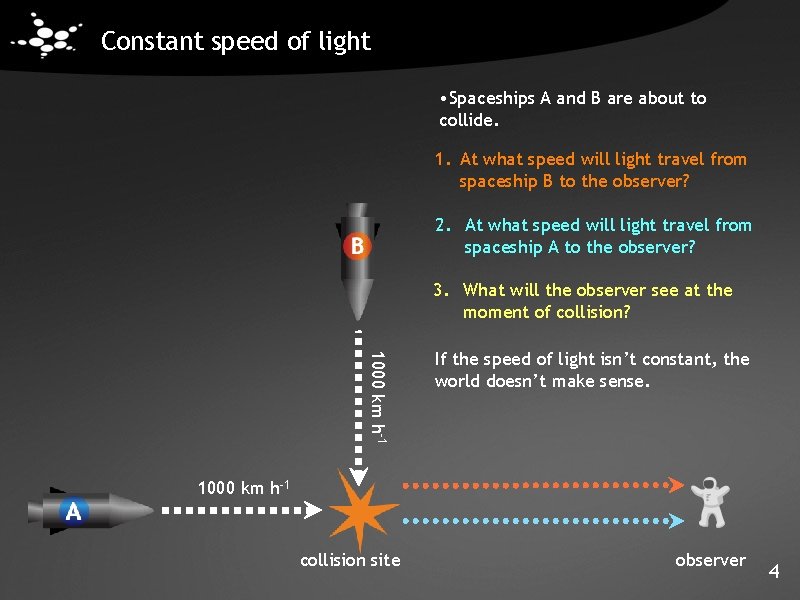
Constant speed of light • Spaceships A and B are about to collide. 1. At what speed will light travel from spaceship B to the observer? 2. At what speed will light travel from spaceship A to the observer? 3. What will the observer see at the moment of collision? 1000 km h-1 If the speed of light isn’t constant, the world doesn’t make sense. 1000 km h-1 collision site observer 4
The special theory of relativity Idea 2 There is no absolute frame of reference 5
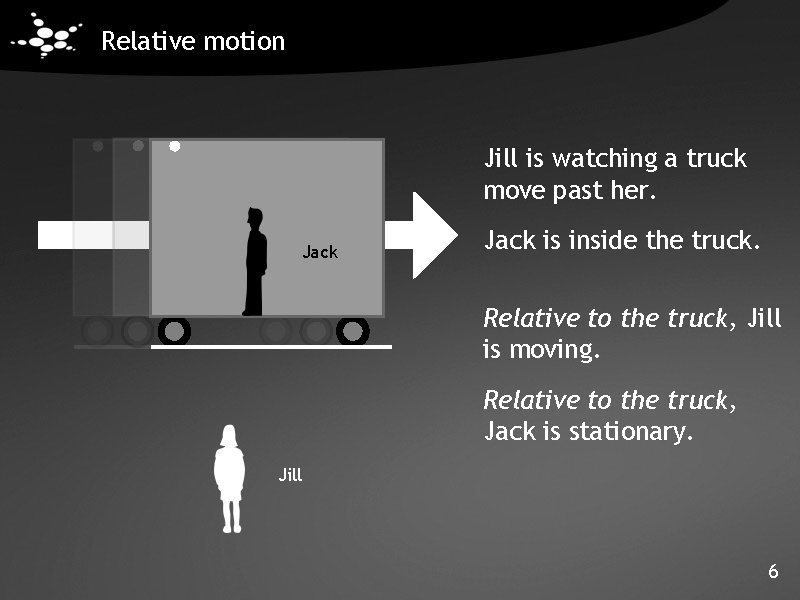
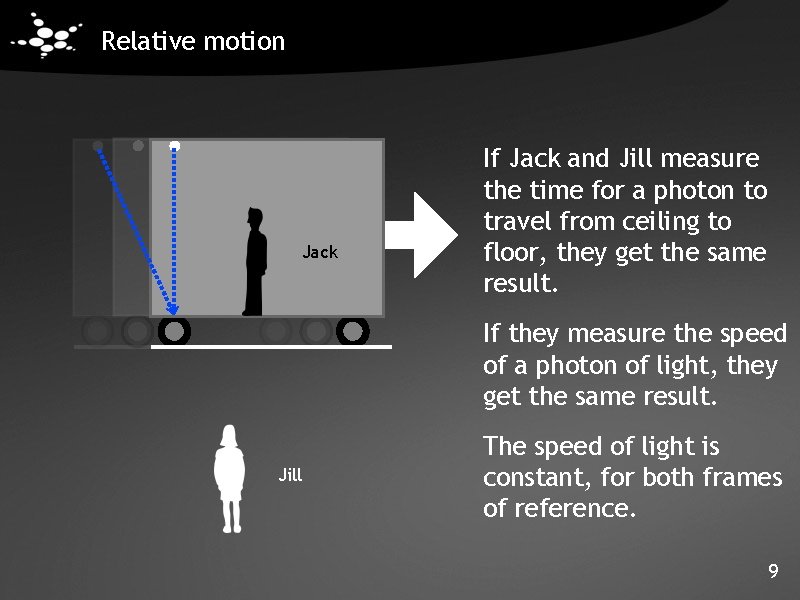
Relative motion Jill is watching a truck move past her. Jack is inside the truck. Relative to the truck, Jill is moving. Relative to the truck, Jack is stationary. Jill 6
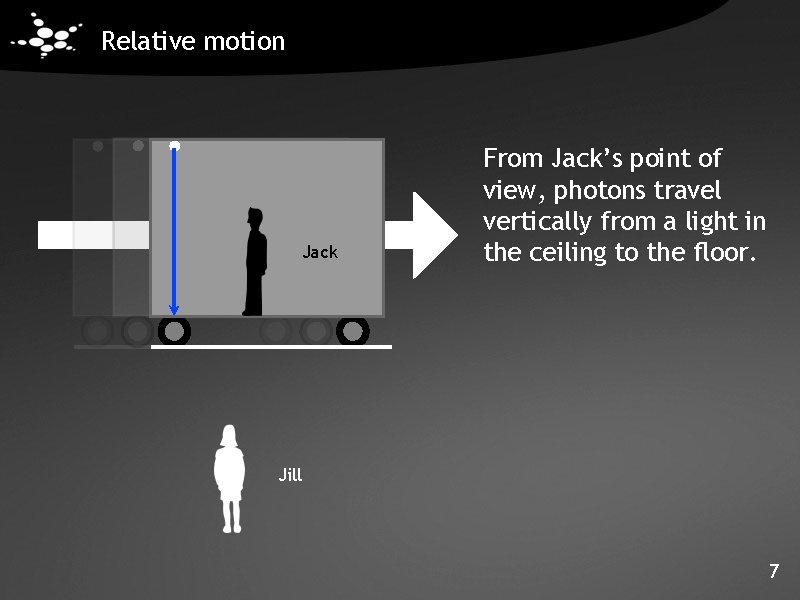
Relative motion Jack From Jack’s point of view, photons travel vertically from a light in the ceiling to the floor. Jill 7
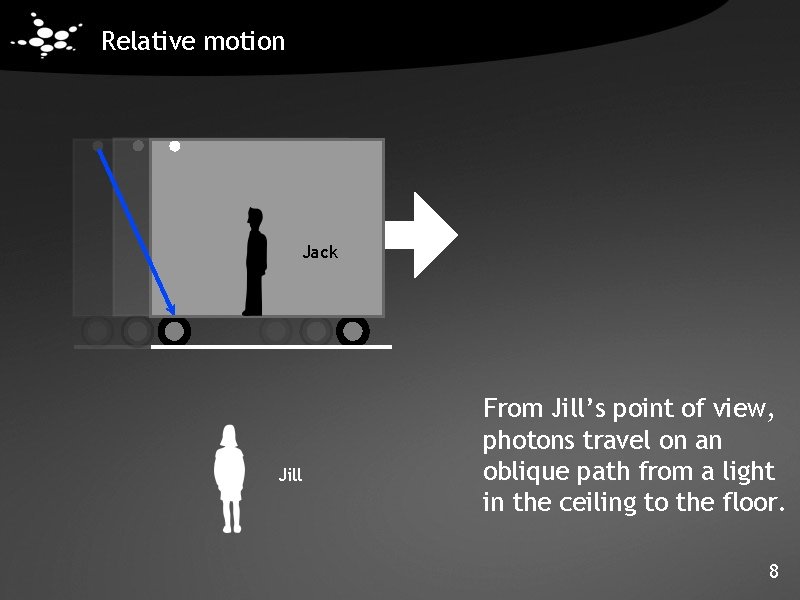
Relative motion Jack Jill From Jill’s point of view, photons travel on an oblique path from a light in the ceiling to the floor. 8
Relative motion Jack If Jack and Jill measure the time for a photon to travel from ceiling to floor, they get the same result. If they measure the speed of a photon of light, they get the same result. Jill The speed of light is constant, for both frames of reference. 9
Consequences of the special theory 1 The effects of speed 10
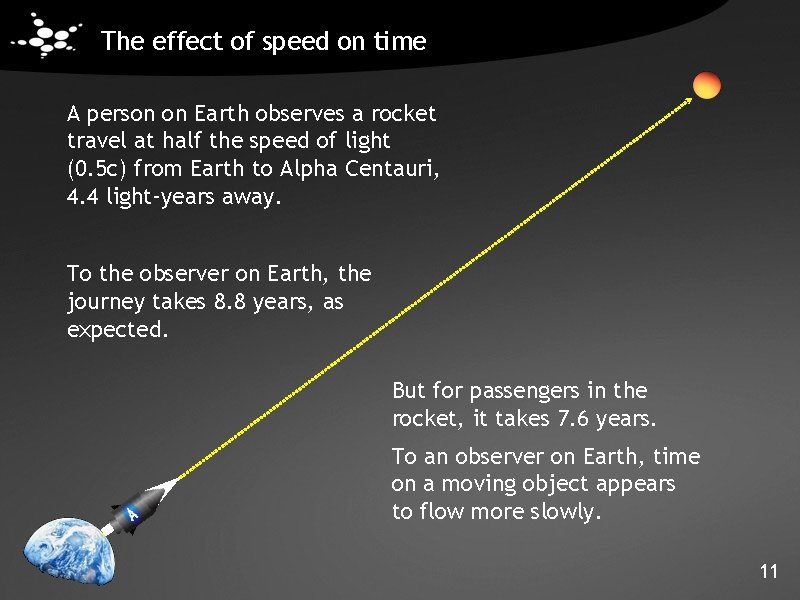
The effect of speed on time A person on Earth observes a rocket travel at half the speed of light (0. 5 c) from Earth to Alpha Centauri, 4. 4 light-years away. To the observer on Earth, the journey takes 8. 8 years, as expected. But for passengers in the rocket, it takes 7. 6 years. To an observer on Earth, time on a moving object appears to flow more slowly. 11
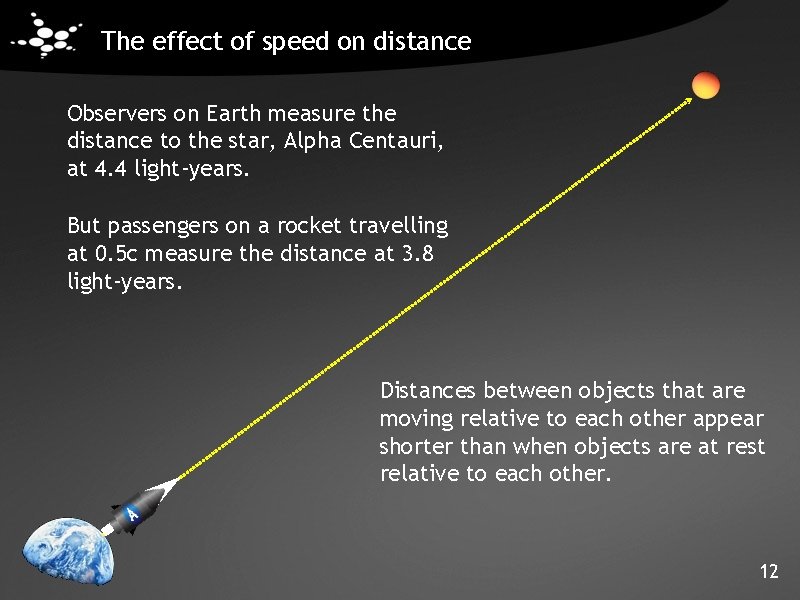
The effect of speed on distance Observers on Earth measure the distance to the star, Alpha Centauri, at 4. 4 light-years. But passengers on a rocket travelling at 0. 5 c measure the distance at 3. 8 light-years. Distances between objects that are moving relative to each other appear shorter than when objects are at rest relative to each other. 12
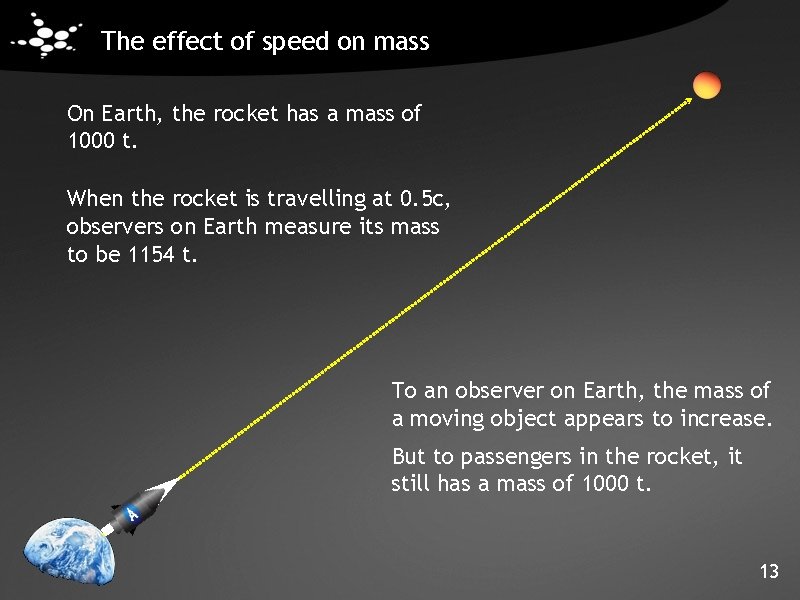
The effect of speed on mass On Earth, the rocket has a mass of 1000 t. When the rocket is travelling at 0. 5 c, observers on Earth measure its mass to be 1154 t. To an observer on Earth, the mass of a moving object appears to increase. But to passengers in the rocket, it still has a mass of 1000 t. 13
Consequences of the special theory 2 The cosmic speed limit 14
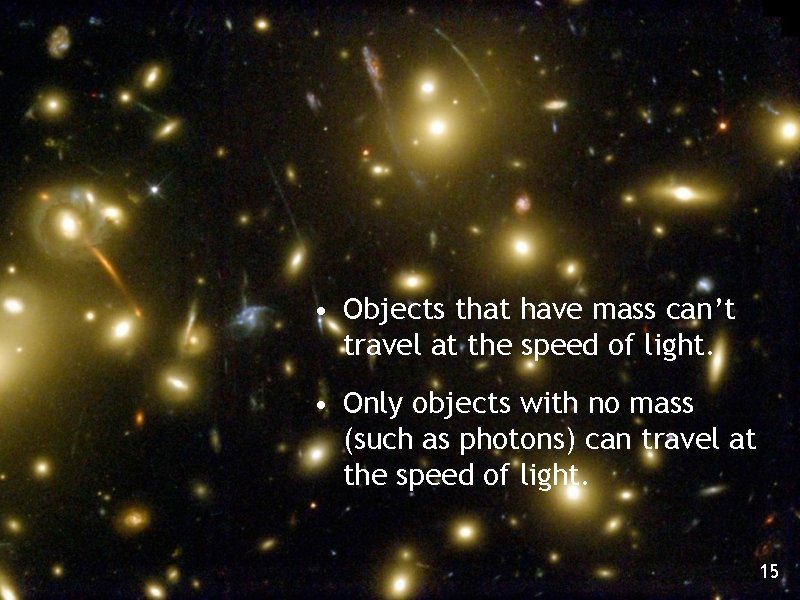
• Objects that have mass can’t travel at the speed of light. • Only objects with no mass (such as photons) can travel at the speed of light. 15
Consequences of the special theory 3 Energy and mass 16
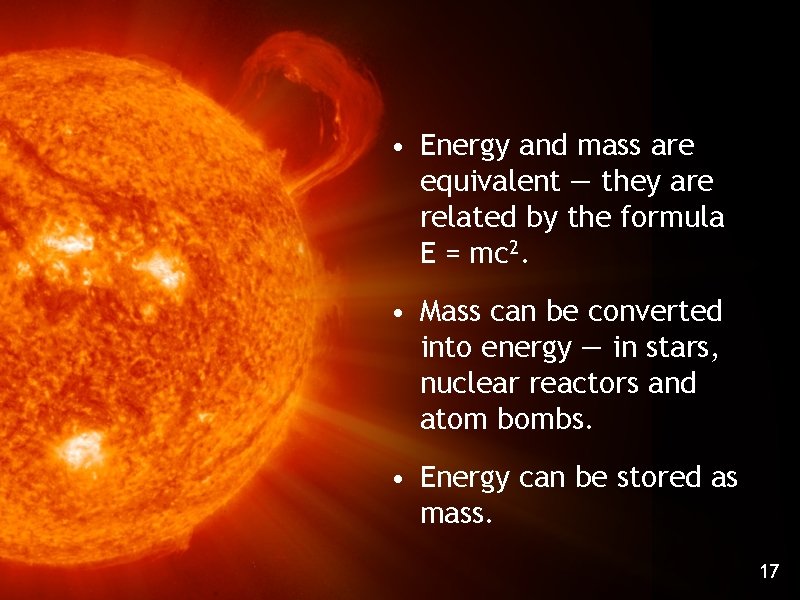
• Energy and mass are equivalent — they are related by the formula E = mc 2. • Mass can be converted into energy — in stars, nuclear reactors and atom bombs. • Energy can be stored as mass. 17
The special theory of relativity What’s so special about the special theory of relativity? • The theory only applies in the special case where there are no gravitational fields. • A more comprehensive theory is required to describe the behaviour of objects in the presence of gravitational fields. � 18
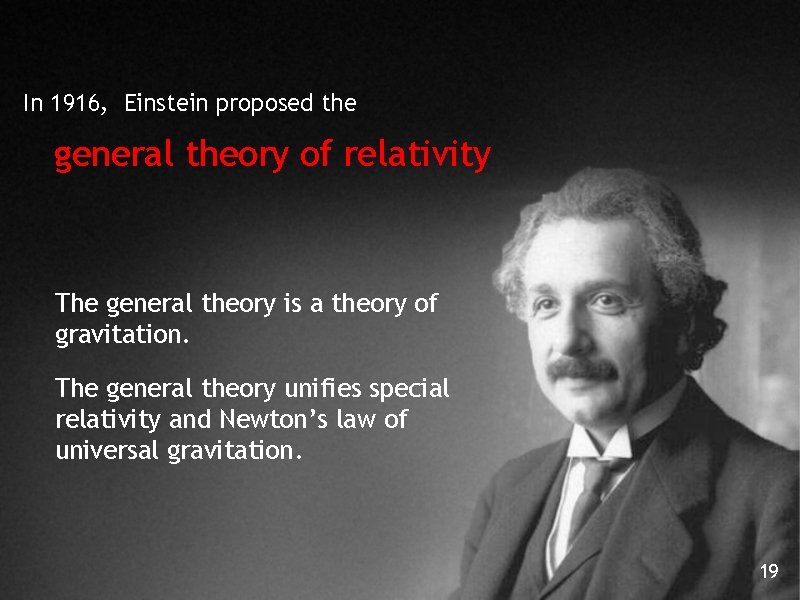
In 1916, Einstein proposed the general theory of relativity The general theory is a theory of gravitation. The general theory unifies special relativity and Newton’s law of universal gravitation. 19
The general theory means. . . • Space and time merge to form spacetime. • Spacetime has four dimensions: length, width, height and time. • The geometry of spacetime is distorted by massive objects. 20
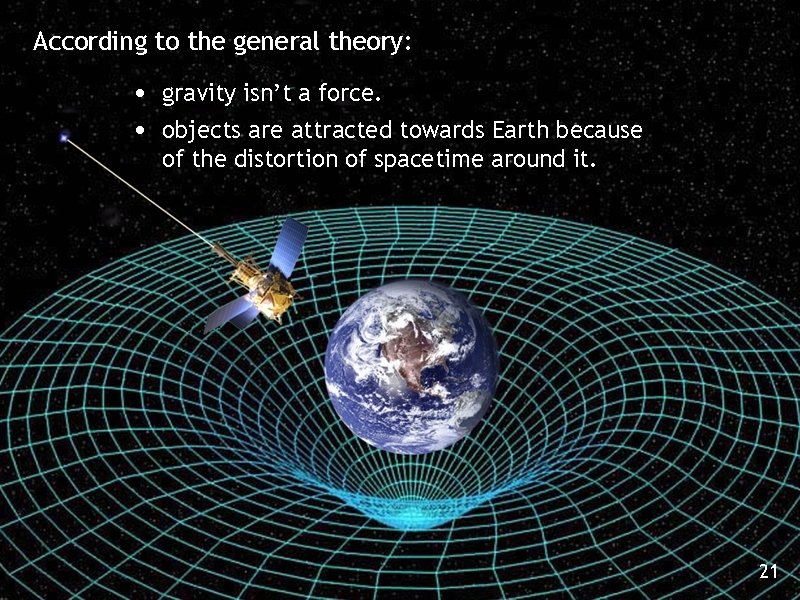
According to the general theory: • • gravity isn’t a force. objects are attracted towards Earth because of the distortion of spacetime around it. 21
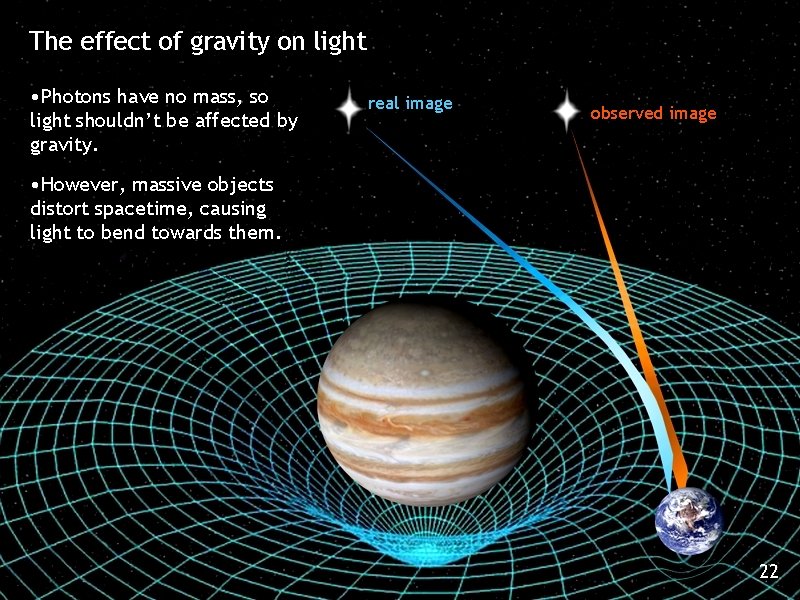
The effect of gravity on light • Photons have no mass, so light shouldn’t be affected by gravity. real image observed image • However, massive objects distort spacetime, causing light to bend towards them. 22
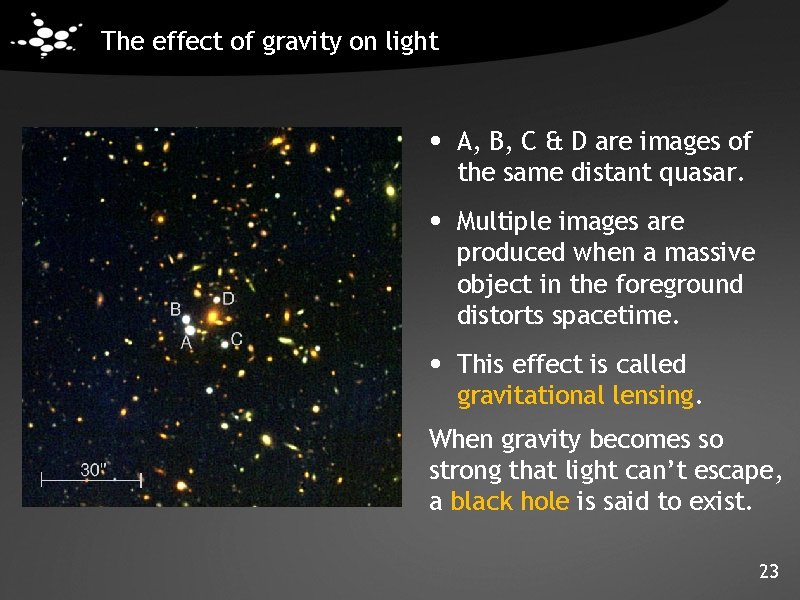
The effect of gravity on light • A, B, C & D are images of the same distant quasar. • Multiple images are produced when a massive object in the foreground distorts spacetime. • This effect is called gravitational lensing. When gravity becomes so strong that light can’t escape, a black hole is said to exist. 23
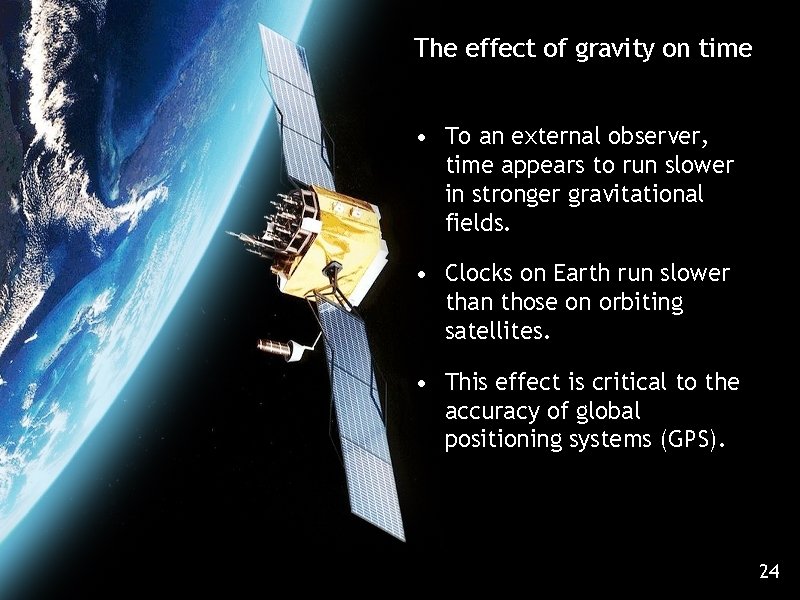
The effect of gravity on time • To an external observer, time appears to run slower in stronger gravitational fields. • Clocks on Earth run slower than those on orbiting satellites. • This effect is critical to the accuracy of global positioning systems (GPS). 24
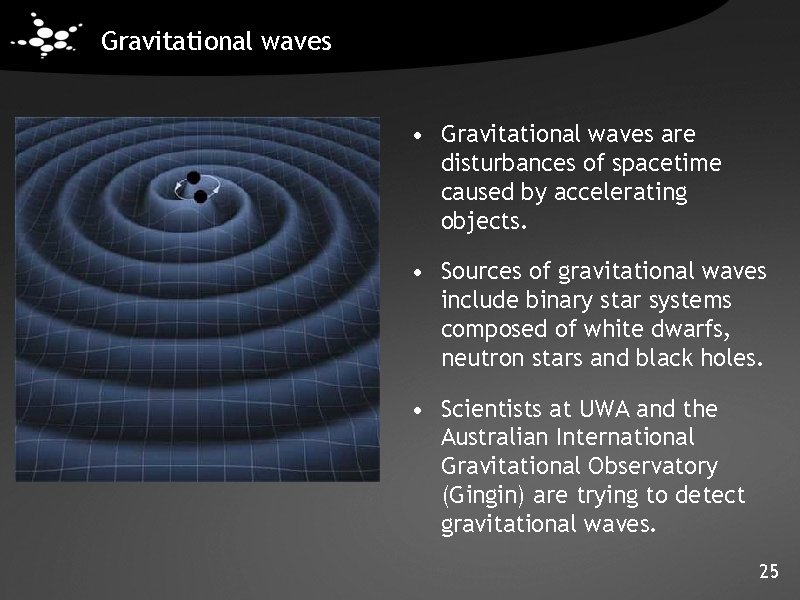
Gravitational waves • Gravitational waves are disturbances of spacetime caused by accelerating objects. • Sources of gravitational waves include binary star systems composed of white dwarfs, neutron stars and black holes. • Scientists at UWA and the Australian International Gravitational Observatory (Gingin) are trying to detect gravitational waves. 25
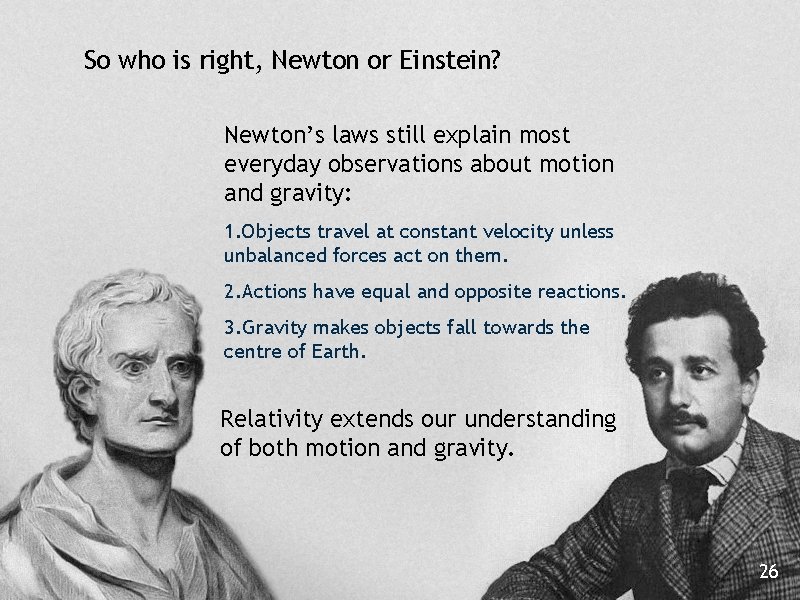
So who is right, Newton or Einstein? Newton’s laws still explain most everyday observations about motion and gravity: 1. Objects travel at constant velocity unless unbalanced forces act on them. 2. Actions have equal and opposite reactions. 3. Gravity makes objects fall towards the centre of Earth. Relativity extends our understanding of both motion and gravity. 26
Motion • Newton’s laws are still used to explain motion at speeds normally seen on Earth. • At ‘normal’ speeds, relativistic changes in mass, length and time are insignificant. • It’s only when objects approach the speed of light, that relativistic effects become significant. 27
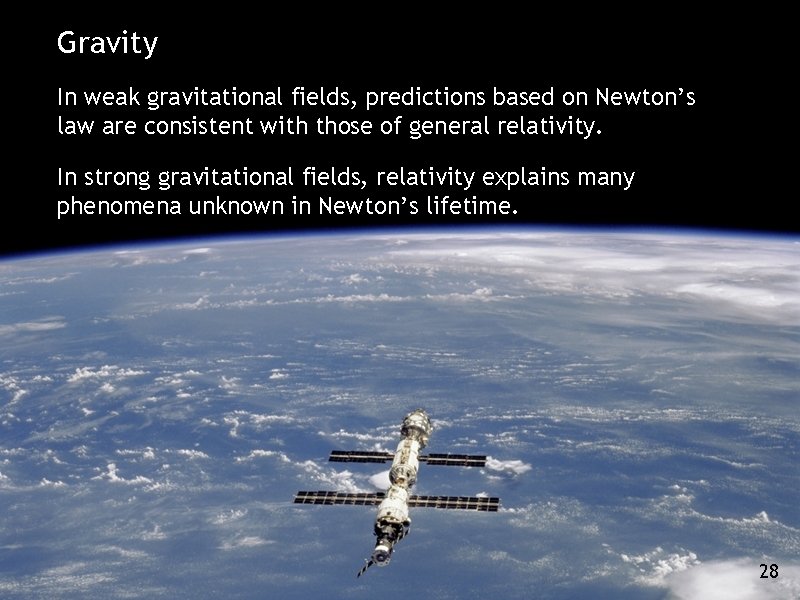
Gravity In weak gravitational fields, predictions based on Newton’s law are consistent with those of general relativity. In strong gravitational fields, relativity explains many phenomena unknown in Newton’s lifetime. 28
So where does this leave us? • The special theory of relativity describes the effects of relative motion on time, mass and length; and the equivalence of energy and mass. • The general theory of relativity describes the effects of gravity on light and spacetime. • Both Newton’s law of universal gravitation and Einstein’s relativity theories are currently used to explain how the Universe works. 29
© 2010 The University of Western Australia ast 0595 | version 1. 0