
Theories of Priming I Associative Distance and Lag
- Slides: 26
Theories of Priming: I. Associative Distance and Lag Mc. Namara Presenter 08. 05. 27(火) 조성일 Ergo Lab 1 Presenter 조성일
Theories of Priming: I. Associative Distance and Lag • • • Intro Theories Priming Spreading-Activation Models of Priming Non-Spreading-Activation Models of Priming Associative Distance Experiment 1 Experiment 2 Experiment 3 General Discussion Conclusion Ergo Lab 3 Presenter 조성일
Intro Theories of Priming: I. Associative Distance and Lag • Performance is affected – By previous retrieval operation – By the context in the retrieval task place • The dominant explanation of priming appealed to the concept of spreading activation – Retrieving an item from memory amounted to activating internal representation – Activation spread throughout interconnected network of memory traces – Residual activation accumulation at memory traces facilitated subsequent retrieval • Automatic associative priming occurs in a large number of memory retrieval task – Semantic categorization, lexical decisions, item recognition, naming, judgments of spatial location – One or other of 2 alternative mechanisms • Spreading activation • Construction of compound retrieval cues (Non-spreading activation) Ergo Lab 4 Presenter 조성일
Intro Theories of Priming: I. Associative Distance and Lag • Experiment 1 – Summarize two spreading-activation and two non-spreadingactivation model • Experiment 2 – Examines the effects of associative distance on priming – Experiment 1 test for three-step mediated priming in lexical decisions (mane-lion-tiger-stripe) • Experiment 3 – Investigates priming across lags of zero, one, or two unrelated items – Considers the implications of these results for theories priming • Findings – Spreading-activation : consistent – Non-spreading-activation : inconsistent Ergo Lab 5 Presenter 조성일 – Rejection of spreading-activation mechanisms is premature
Theories of priming Theories of Priming: I. Associative Distance and Lag • Simple comparisons between the two classes of models can be misleading – The variance in predictions within classes is often as great as the variance in prediction between classes • The priming effects are caused by mechanisms different from – Associative priming in item recognition, lexical decision, and naming • Concern with automatic component of associative priming – Property of the way information is retrieved from memory • Use response latency as the primary dependent variable – Difficult to get high error rates without introducing strategic components to the task Ergo Lab 6 Presenter 조성일
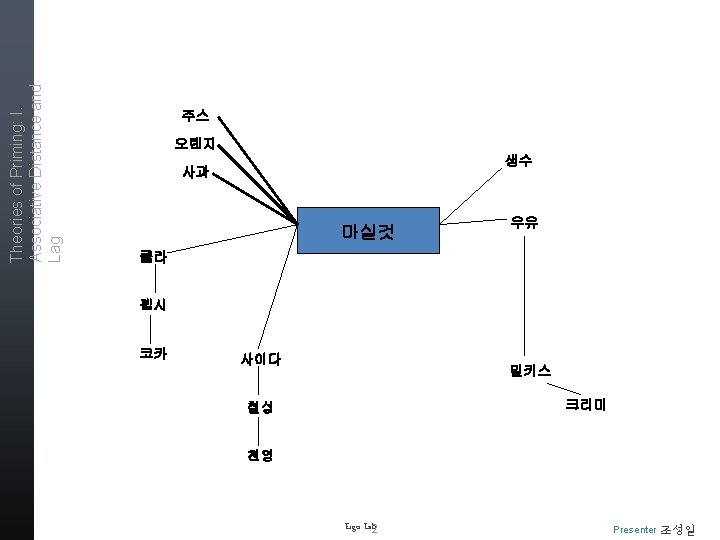
Spreading-Activation Models of Priming Theories of Priming: I. Associative Distance and Lag • Memory is conceived of as a network of interconnected memory traces, or nodes – Activation spreads to all connected nodes – Decays with distance and time • One concept can be actively processed at a time – But activation continues to spread en after a concept has ceased to be processed • The residual activation that accumulates at neighboring traces facilitates their subsequent retrieval (e. g. lion-tiger) • The time required for activation to spread from one node to another cannot be used to explain effects of network distance on retrieval time – The effects of distance must be attributed to asymptotic activation level • Decay of activation can be quite rapid, within 500 ms – Close to ACT – Attention is shifted, activation of the node decays very rapidly (exponentially) Ergo Lab 7 Presenter 조성일 – Priming in ACT are different from priming in the Quillian(1967)
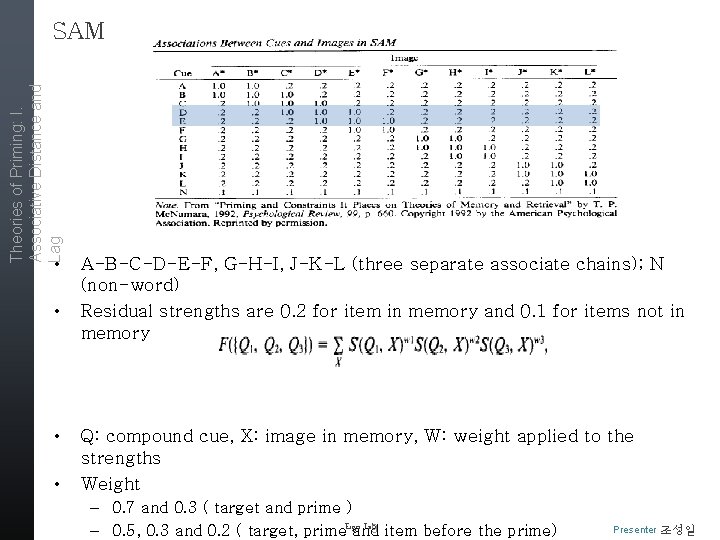
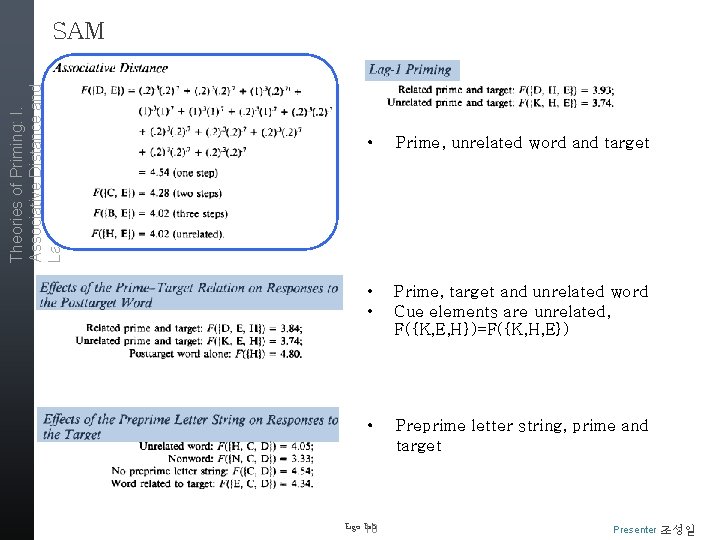
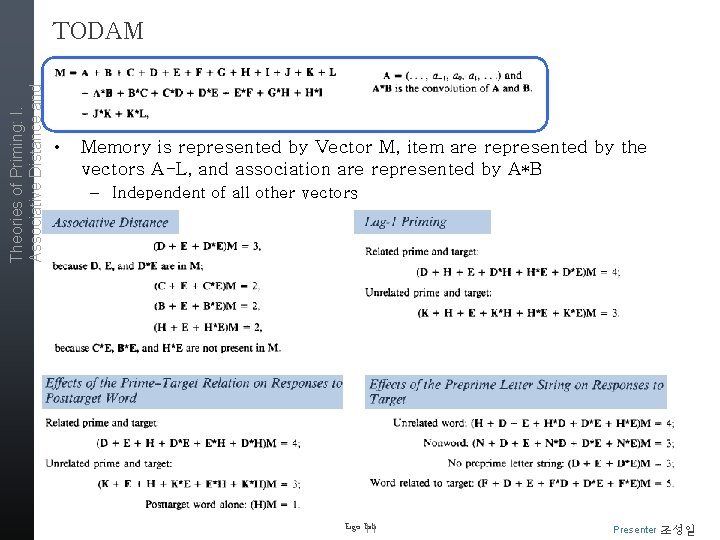
Non-Spreading-Activation Models of Priming Theories of Priming: I. Associative Distance and Lag • Compound-cue model must be combined with theory of memory – Make predictions about performance in memory retrieval tasks • In SAM (search of associative memory), a matrix of association among cues and memory traces, which are called images – Cues are assembled in a short-term store, or probe set, which is the match against all item in memory • In TODAM (theory of distributed associative memory), to-beremembered items are represented as vectors of features – Sum of vectors, convolution – The resulting scalar can be mapped into familiarity and, in turn, into response time and accuracy • Examine mechanisms of priming and extent to explain of priming effects Ergo Lab 8 Presenter 조성일
Theories of Priming: I. Associative Distance and Lag SAM • • A-B-C-D-E-F, G-H-I, J-K-L (three separate associate chains); N (non-word) Residual strengths are 0. 2 for item in memory and 0. 1 for items not in memory Q: compound cue, X: image in memory, W: weight applied to the strengths Weight – 0. 7 and 0. 3 ( target and prime ) Lab 9 – 0. 5, 0. 3 and 0. 2 ( target, prime. Ergo and item before the prime) Presenter 조성일
Theories of Priming: I. Associative Distance and Lag SAM • Prime, unrelated word and target • • Prime, target and unrelated word Cue elements are unrelated, F({K, E, H})=F({K, H, E}) • Preprime letter string, prime and target Ergo Lab 10 Presenter 조성일
Theories of Priming: I. Associative Distance and Lag TODAM • Memory is represented by Vector M, item are represented by the vectors A-L, and association are represented by A*B – Independent of all other vectors Ergo Lab 11 Presenter 조성일
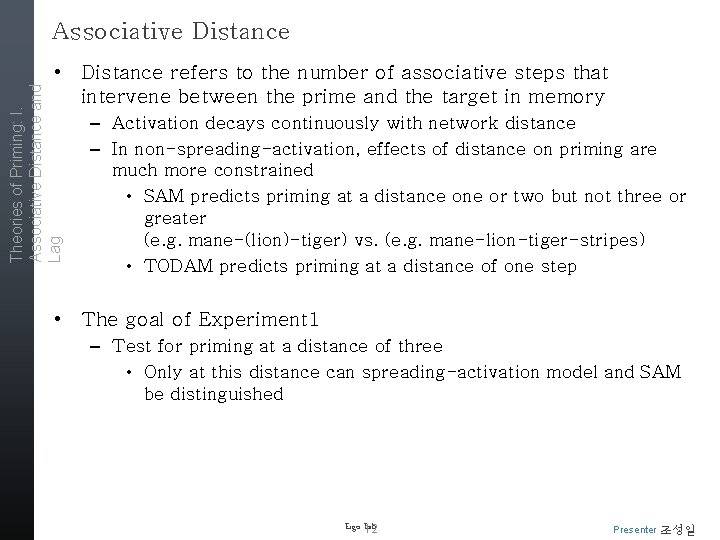
Associative Distance Theories of Priming: I. Associative Distance and Lag • Distance refers to the number of associative steps that intervene between the prime and the target in memory – Activation decays continuously with network distance – In non-spreading-activation, effects of distance on priming are much more constrained • SAM predicts priming at a distance one or two but not three or greater (e. g. mane-(lion)-tiger) vs. (e. g. mane-lion-tiger-stripes) • TODAM predicts priming at a distance of one step • The goal of Experiment 1 – Test for priming at a distance of three • Only at this distance can spreading-activation model and SAM be distinguished Ergo Lab 12 Presenter 조성일
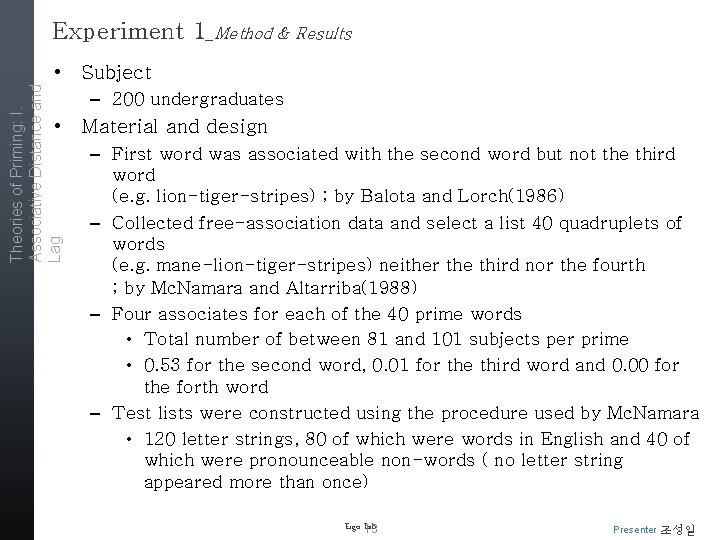
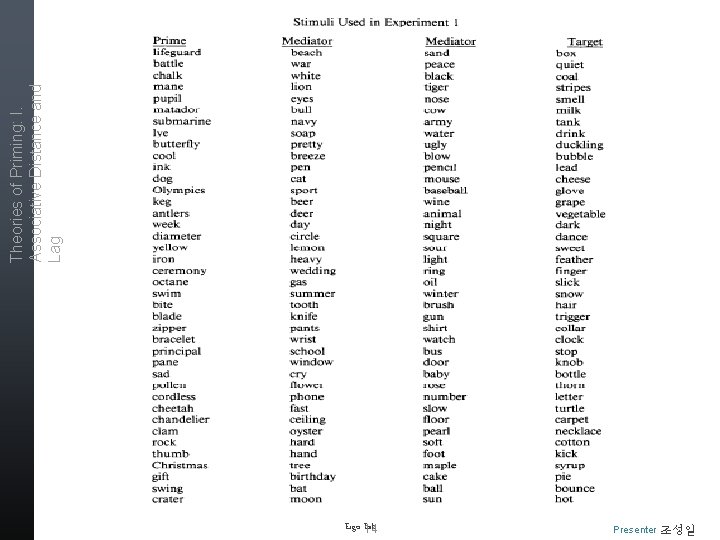
Experiment 1_Method & Results Theories of Priming: I. Associative Distance and Lag • Subject – 200 undergraduates • Material and design – First word was associated with the second word but not the third word (e. g. lion-tiger-stripes) ; by Balota and Lorch(1986) – Collected free-association data and select a list 40 quadruplets of words (e. g. mane-lion-tiger-stripes) neither the third nor the fourth ; by Mc. Namara and Altarriba(1988) – Four associates for each of the 40 prime words • Total number of between 81 and 101 subjects per prime • 0. 53 for the second word, 0. 01 for the third word and 0. 00 for the forth word – Test lists were constructed using the procedure used by Mc. Namara • 120 letter strings, 80 of which were words in English and 40 of which were pronounceable non-words ( no letter string appeared more than once) Ergo Lab 13 Presenter 조성일
Ergo Lab 14 Presenter 조성일 Theories of Priming: I. Associative Distance and Lag
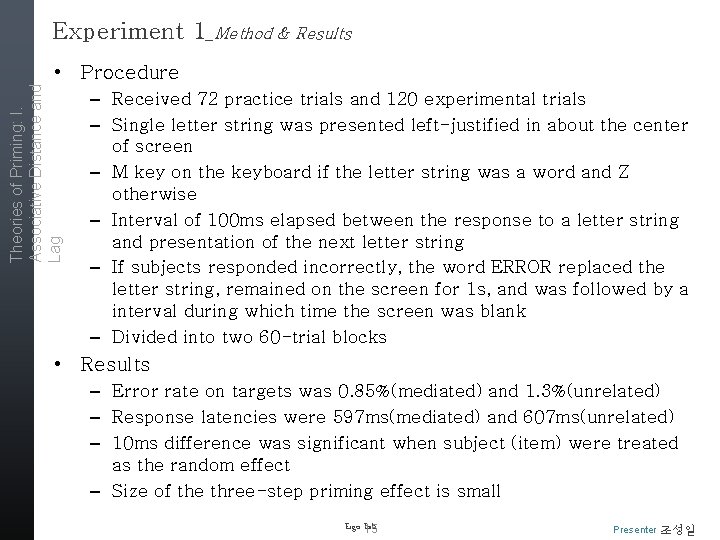
Experiment 1_Method & Results Theories of Priming: I. Associative Distance and Lag • Procedure – Received 72 practice trials and 120 experimental trials – Single letter string was presented left-justified in about the center of screen – M key on the keyboard if the letter string was a word and Z otherwise – Interval of 100 ms elapsed between the response to a letter string and presentation of the next letter string – If subjects responded incorrectly, the word ERROR replaced the letter string, remained on the screen for 1 s, and was followed by a interval during which time the screen was blank – Divided into two 60 -trial blocks • Results – Error rate on targets was 0. 85%(mediated) and 1. 3%(unrelated) – Response latencies were 597 ms(mediated) and 607 ms(unrelated) – 10 ms difference was significant when subject (item) were treated as the random effect – Size of the three-step priming effect is small Ergo Lab 15 Presenter 조성일
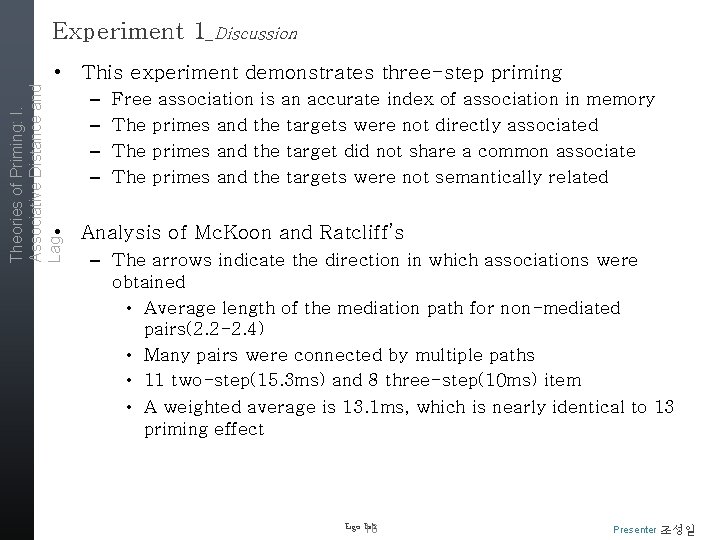
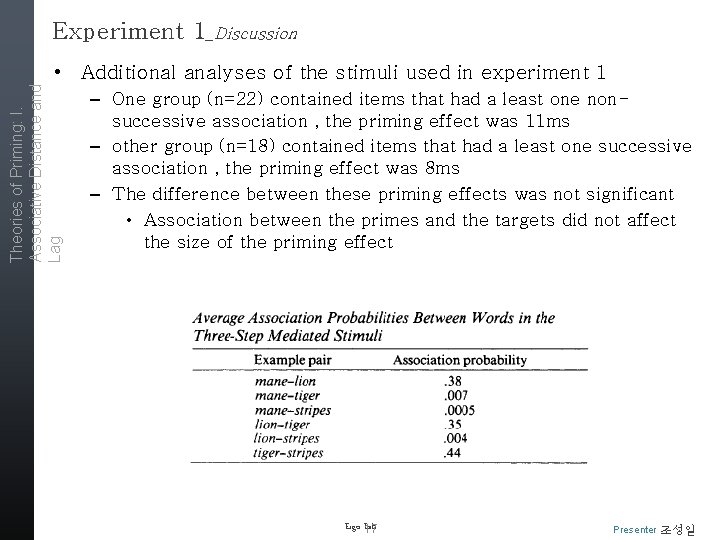
Experiment 1_Discussion Theories of Priming: I. Associative Distance and Lag • This experiment demonstrates three-step priming – – Free association is an accurate index of association in memory The primes and the targets were not directly associated The primes and the target did not share a common associate The primes and the targets were not semantically related • Analysis of Mc. Koon and Ratcliff’s – The arrows indicate the direction in which associations were obtained • Average length of the mediation path for non-mediated pairs(2. 2 -2. 4) • Many pairs were connected by multiple paths • 11 two-step(15. 3 ms) and 8 three-step(10 ms) item • A weighted average is 13. 1 ms, which is nearly identical to 13 priming effect Ergo Lab 16 Presenter 조성일
Experiment 1_Discussion Theories of Priming: I. Associative Distance and Lag • Additional analyses of the stimuli used in experiment 1 – One group (n=22) contained items that had a least one nonsuccessive association , the priming effect was 11 ms – other group (n=18) contained items that had a least one successive association , the priming effect was 8 ms – The difference between these priming effects was not significant • Association between the primes and the targets did not affect the size of the priming effect Ergo Lab 17 Presenter 조성일
Lag Theories of Priming: I. Associative Distance and Lag • The number of the items that intervene between the prime and the target – Standard priming uses a lag of 0 – The goal of experiment 2 was to examine semantic priming in lexical decision over of 0, 1 and 2 intervening words Ergo Lab 18 Presenter 조성일
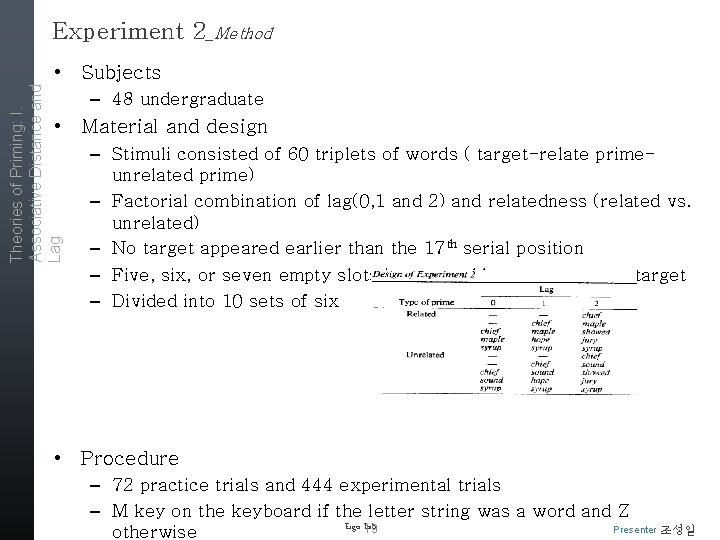
Experiment 2_Method Theories of Priming: I. Associative Distance and Lag • Subjects – 48 undergraduate • Material and design – Stimuli consisted of 60 triplets of words ( target-relate primeunrelated prime) – Factorial combination of lag(0, 1 and 2) and relatedness (related vs. unrelated) – No target appeared earlier than the 17 th serial position – Five, six, or seven empty slots intervened between any two target – Divided into 10 sets of six • Procedure – 72 practice trials and 444 experimental trials – M key on the keyboard if the letter string was a word and Z Ergo Lab 19 Presenter 조성일 otherwise
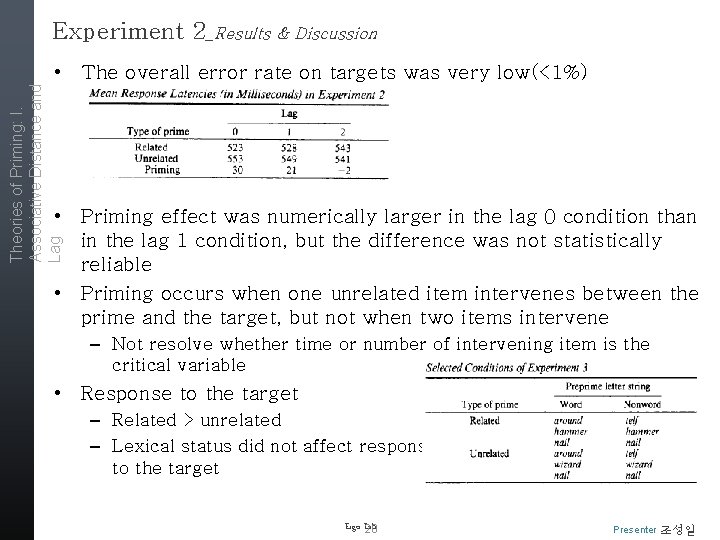
Experiment 2_Results & Discussion Theories of Priming: I. Associative Distance and Lag • The overall error rate on targets was very low(<1%) • Priming effect was numerically larger in the lag 0 condition than in the lag 1 condition, but the difference was not statistically reliable • Priming occurs when one unrelated item intervenes between the prime and the target, but not when two items intervene – Not resolve whether time or number of intervening item is the critical variable • Response to the target – Related > unrelated – Lexical status did not affect response to the target Ergo Lab 20 Presenter 조성일
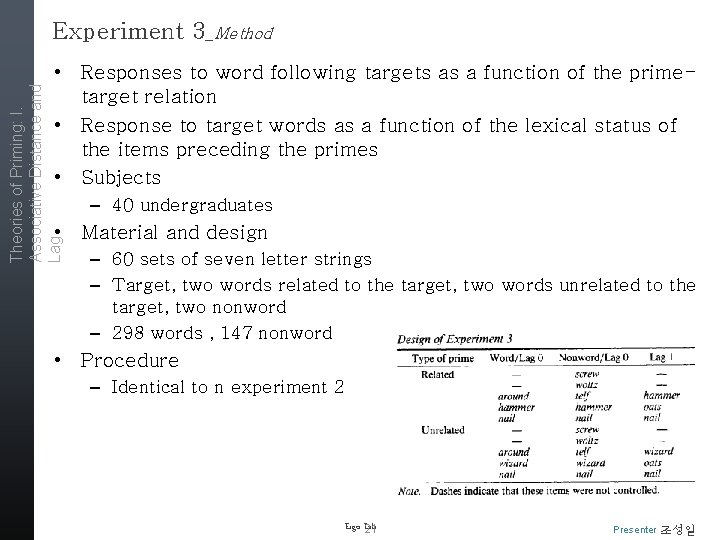
Experiment 3_Method Theories of Priming: I. Associative Distance and Lag • Responses to word following targets as a function of the primetarget relation • Response to target words as a function of the lexical status of the items preceding the primes • Subjects – 40 undergraduates • Material and design – 60 sets of seven letter strings – Target, two words related to the target, two words unrelated to the target, two nonword – 298 words , 147 nonword • Procedure – Identical to n experiment 2 Ergo Lab 21 Presenter 조성일
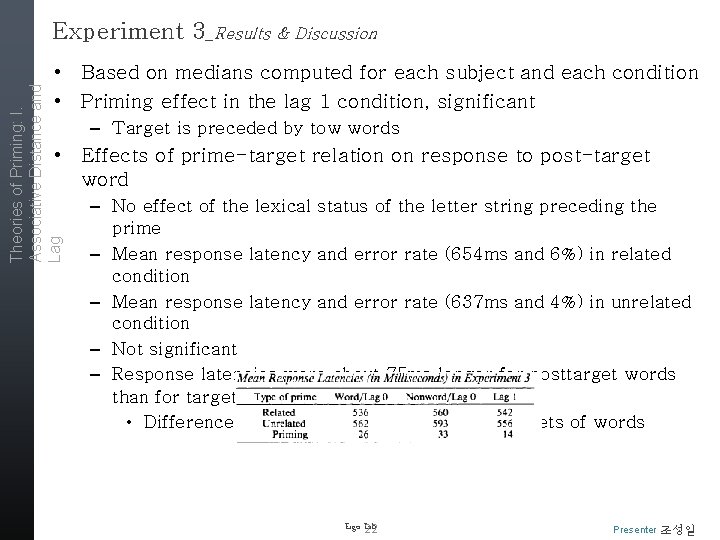
Experiment 3_Results & Discussion Theories of Priming: I. Associative Distance and Lag • Based on medians computed for each subject and each condition • Priming effect in the lag 1 condition, significant – Target is preceded by tow words • Effects of prime-target relation on response to post-target word – No effect of the lexical status of the letter string preceding the prime – Mean response latency and error rate (654 ms and 6%) in related condition – Mean response latency and error rate (637 ms and 4%) in unrelated condition – Not significant – Response latencies were about 75 ms longer for posttarget words than for targets in the unrelated prime condition • Differences in word frequencies for the two sets of words Ergo Lab 22 Presenter 조성일
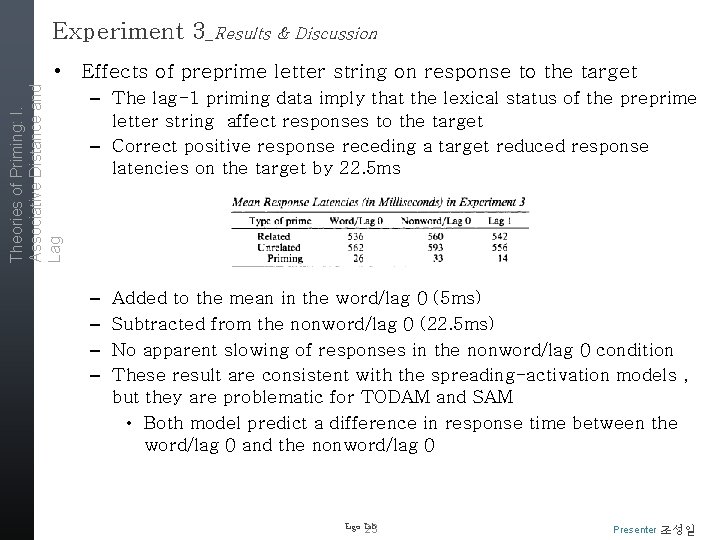
Experiment 3_Results & Discussion Theories of Priming: I. Associative Distance and Lag • Effects of preprime letter string on response to the target – The lag-1 priming data imply that the lexical status of the preprime letter string affect responses to the target – Correct positive response receding a target reduced response latencies on the target by 22. 5 ms – – Added to the mean in the word/lag 0 (5 ms) Subtracted from the nonword/lag 0 (22. 5 ms) No apparent slowing of responses in the nonword/lag 0 condition These result are consistent with the spreading-activation models , but they are problematic for TODAM and SAM • Both model predict a difference in response time between the word/lag 0 and the nonword/lag 0 Ergo Lab 23 Presenter 조성일
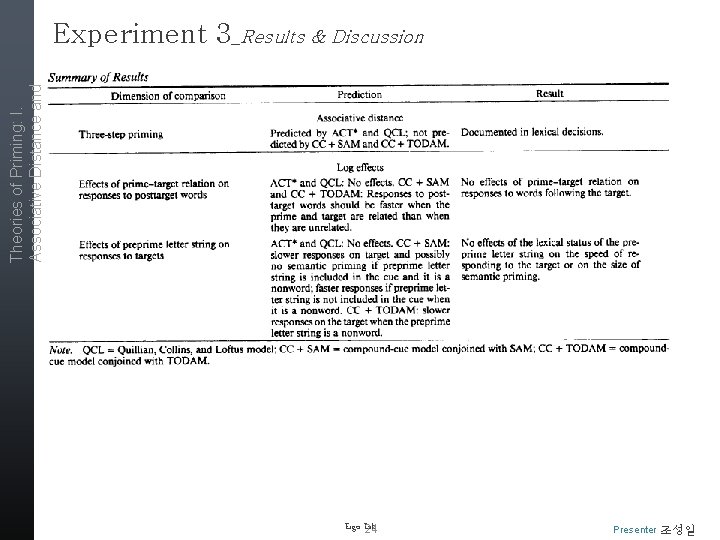
Theories of Priming: I. Associative Distance and Lag Experiment 3_Results & Discussion Ergo Lab 24 Presenter 조성일
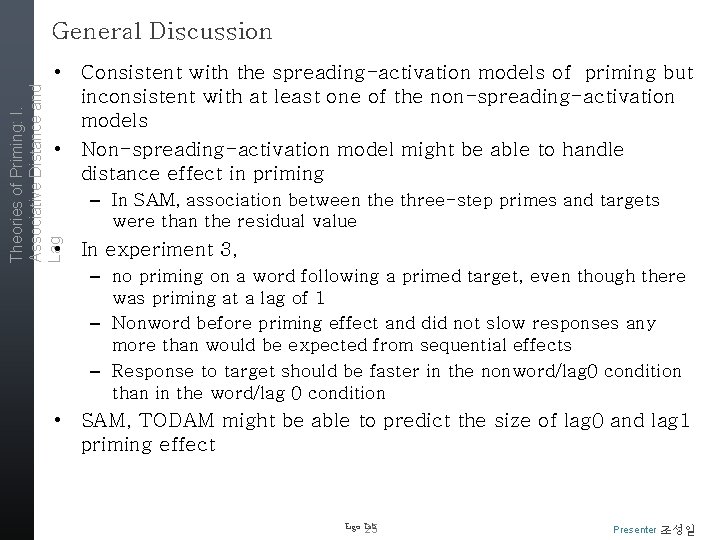
General Discussion Theories of Priming: I. Associative Distance and Lag • Consistent with the spreading-activation models of priming but inconsistent with at least one of the non-spreading-activation models • Non-spreading-activation model might be able to handle distance effect in priming – In SAM, association between the three-step primes and targets were than the residual value • In experiment 3, – no priming on a word following a primed target, even though there was priming at a lag of 1 – Nonword before priming effect and did not slow responses any more than would be expected from sequential effects – Response to target should be faster in the nonword/lag 0 condition than in the word/lag 0 condition • SAM, TODAM might be able to predict the size of lag 0 and lag 1 priming effect Ergo Lab 25 Presenter 조성일
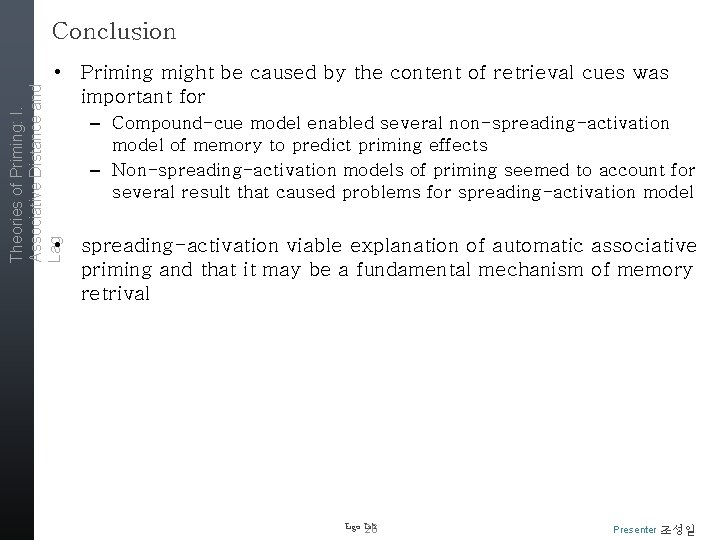
Conclusion Theories of Priming: I. Associative Distance and Lag • Priming might be caused by the content of retrieval cues was important for – Compound-cue model enabled several non-spreading-activation model of memory to predict priming effects – Non-spreading-activation models of priming seemed to account for several result that caused problems for spreading-activation model • spreading-activation viable explanation of automatic associative priming and that it may be a fundamental mechanism of memory retrival Ergo Lab 26 Presenter 조성일