
Theories of Political Representation Delegate Model You elect


- Slides: 15
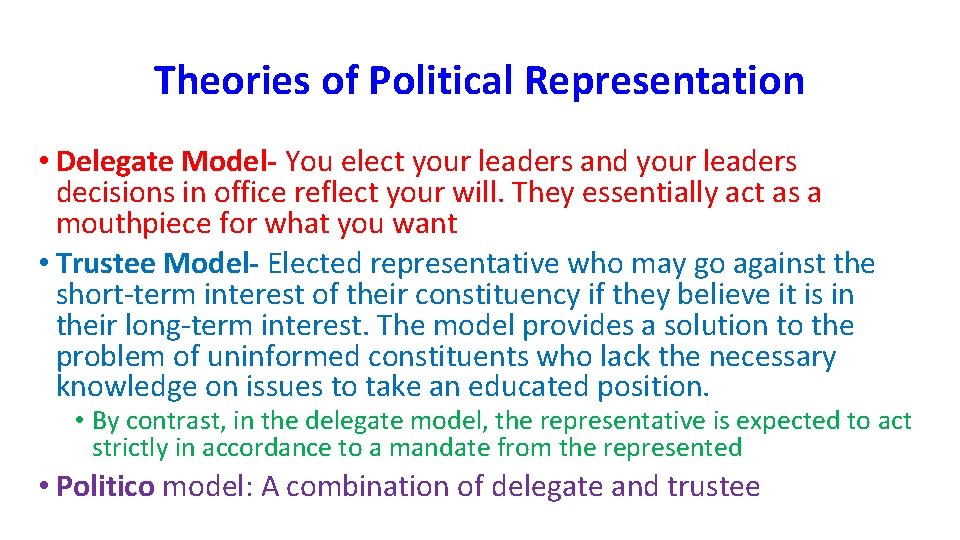
Theories of Political Representation • Delegate Model- You elect your leaders and your leaders decisions in office reflect your will. They essentially act as a mouthpiece for what you want • Trustee Model- Elected representative who may go against the short-term interest of their constituency if they believe it is in their long-term interest. The model provides a solution to the problem of uninformed constituents who lack the necessary knowledge on issues to take an educated position. • By contrast, in the delegate model, the representative is expected to act strictly in accordance to a mandate from the represented • Politico model: A combination of delegate and trustee
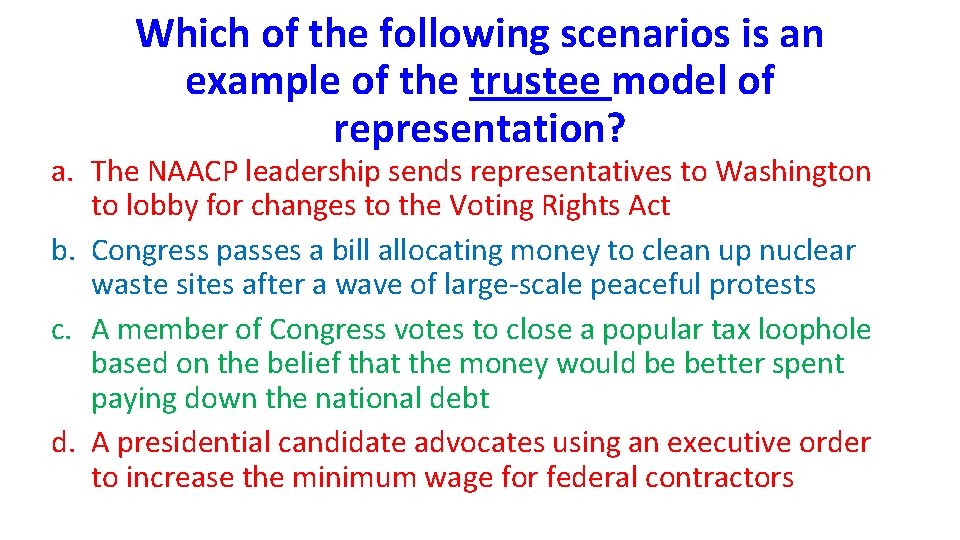
Which of the following scenarios is an example of the trustee model of representation? a. The NAACP leadership sends representatives to Washington to lobby for changes to the Voting Rights Act b. Congress passes a bill allocating money to clean up nuclear waste sites after a wave of large-scale peaceful protests c. A member of Congress votes to close a popular tax loophole based on the belief that the money would be better spent paying down the national debt d. A presidential candidate advocates using an executive order to increase the minimum wage for federal contractors
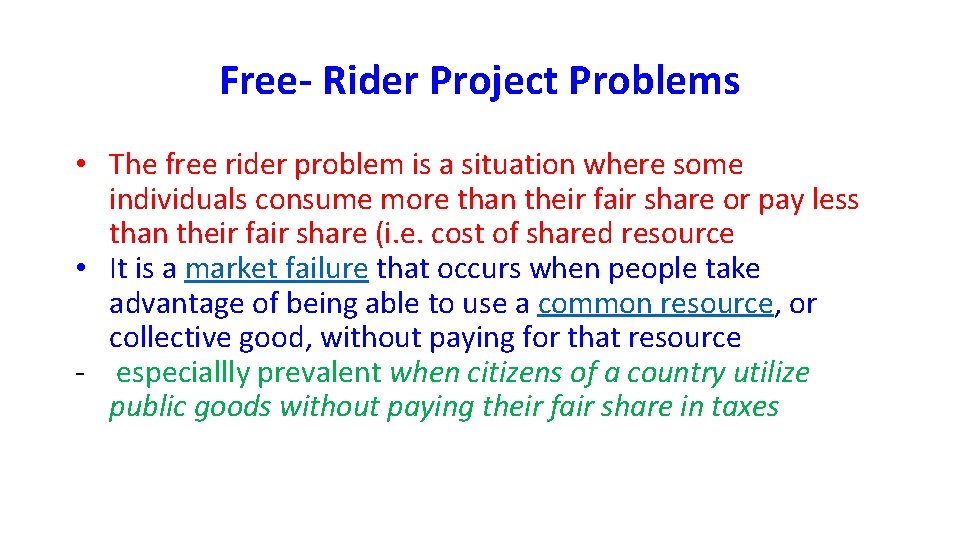
Free- Rider Project Problems • The free rider problem is a situation where some individuals consume more than their fair share or pay less than their fair share (i. e. cost of shared resource • It is a market failure that occurs when people take advantage of being able to use a common resource, or collective good, without paying for that resource - especiallly prevalent when citizens of a country utilize public goods without paying their fair share in taxes
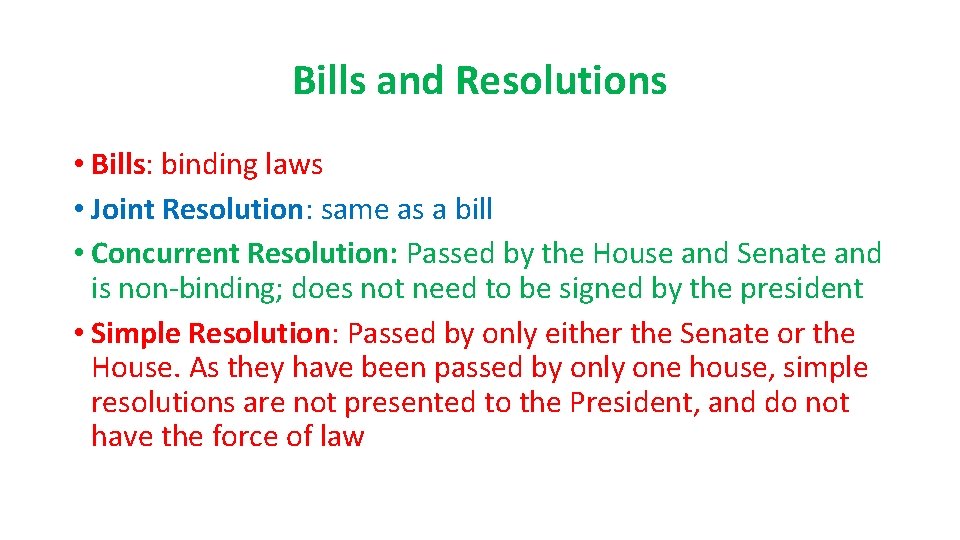
Bills and Resolutions • Bills: binding laws • Joint Resolution: same as a bill • Concurrent Resolution: Passed by the House and Senate and is non-binding; does not need to be signed by the president • Simple Resolution: Passed by only either the Senate or the House. As they have been passed by only one house, simple resolutions are not presented to the President, and do not have the force of law
Discharge Petition • A device by which any member of the House, after a committee has had the bill for thirty days, may petition to have it brought to the floor • Gives some power to the individual; takes away complete control from the leadership • Rarely successful as they require a majority of the House to approve
Major jobs of the legislative branch • Makes bills • Controls taxing (house) and spending (both) • Oversees bureaucracy (Executive controls bureaucracy but Congress makes laws, funding, etc) • Conducts investigations (think Michael Cohen, other Trump investigations, etc. )
How are amendments passed? Found in ARTICLE V of the Constiution! • Congress (Senate and House) propose an amendment with a 2/3 vote, and 3/4 of the state legislatures approve. 26 of the 27 amendments were approved in this manner. • Congress (Senate and House) propose an amendment with a 2/3 vote, and ¾ of the states approve the amendment via ratifying conventions. Only the 21 st Amendment, which repealed Prohibition, was passed in this manner.
Presidential Formal Powers (found in the Constitution) • Legislation: Vetoes and pocket vetoes • Foreign Policy: Commander-in-Chief (power to command military) and Treaties (can sign them if 2/3 of Congress passes it)
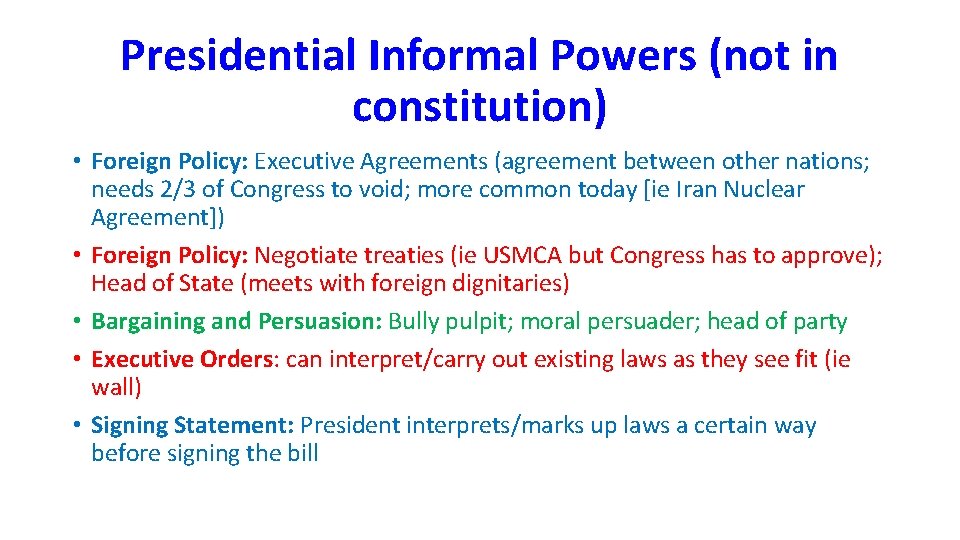
Presidential Informal Powers (not in constitution) • Foreign Policy: Executive Agreements (agreement between other nations; needs 2/3 of Congress to void; more common today [ie Iran Nuclear Agreement]) • Foreign Policy: Negotiate treaties (ie USMCA but Congress has to approve); Head of State (meets with foreign dignitaries) • Bargaining and Persuasion: Bully pulpit; moral persuader; head of party • Executive Orders: can interpret/carry out existing laws as they see fit (ie wall) • Signing Statement: President interprets/marks up laws a certain way before signing the bill
Checks and Balances: Legislative/ Executive Branch • Impeachment power (House); Removal (Senate) • Selection of the President (House) and Vice President (Senate) in the case of no majority of electoral votes • May override Presidential vetoes (2/3 of the vote) • Senate approves Executive Cabinet appointments • Senate approves treaties and ambassadors • President must, from time-to-time, deliver a State of the Union address • War Powers Act: Can limit military action abroad to 90 days (60 days with a 30 day extension)
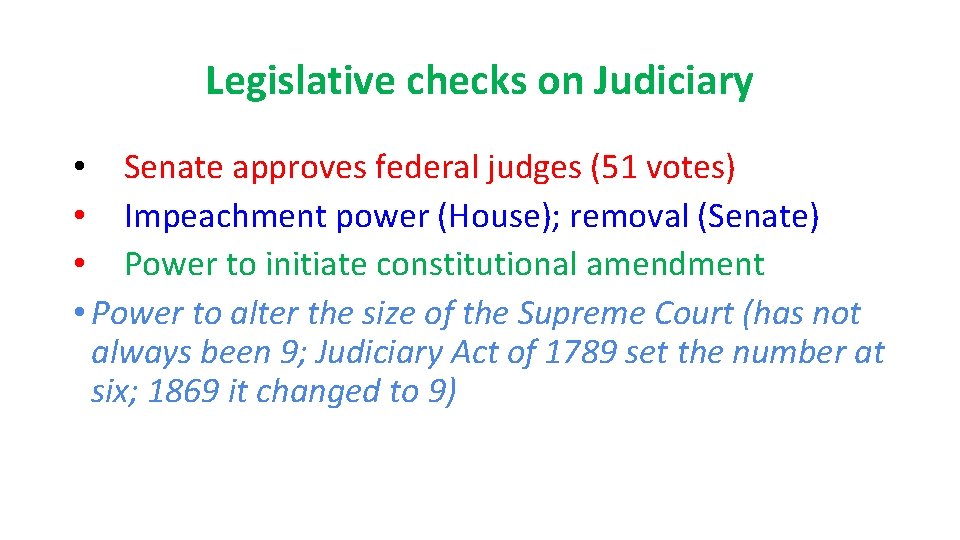
Legislative checks on Judiciary • Senate approves federal judges (51 votes) • Impeachment power (House); removal (Senate) • Power to initiate constitutional amendment • Power to alter the size of the Supreme Court (has not always been 9; Judiciary Act of 1789 set the number at six; 1869 it changed to 9)
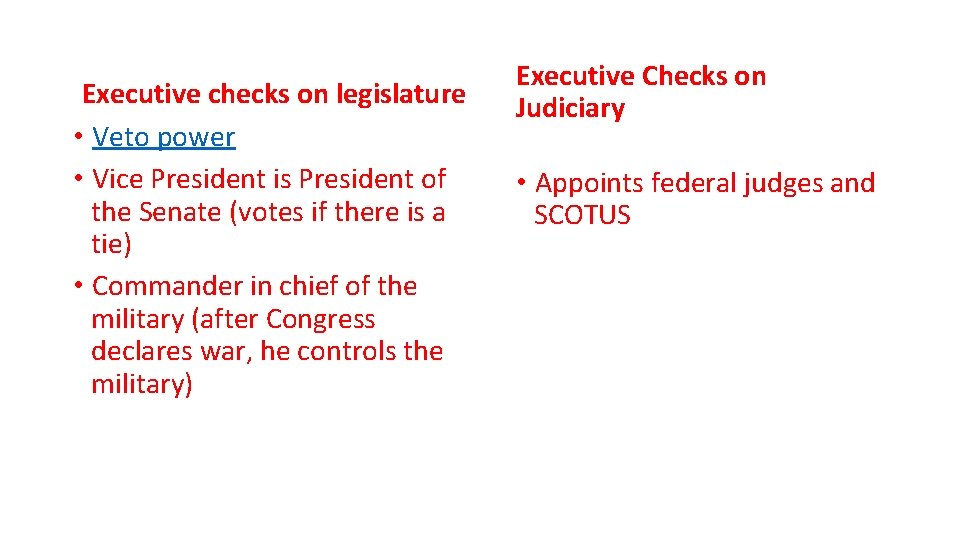
Executive checks on legislature • Veto power • Vice President is President of the Senate (votes if there is a tie) • Commander in chief of the military (after Congress declares war, he controls the military) Executive Checks on Judiciary • Appoints federal judges and SCOTUS
Checks and Balances: Judicial Branch Checks on the Legislature • Judicial review Checks on the Executive • Judicial review
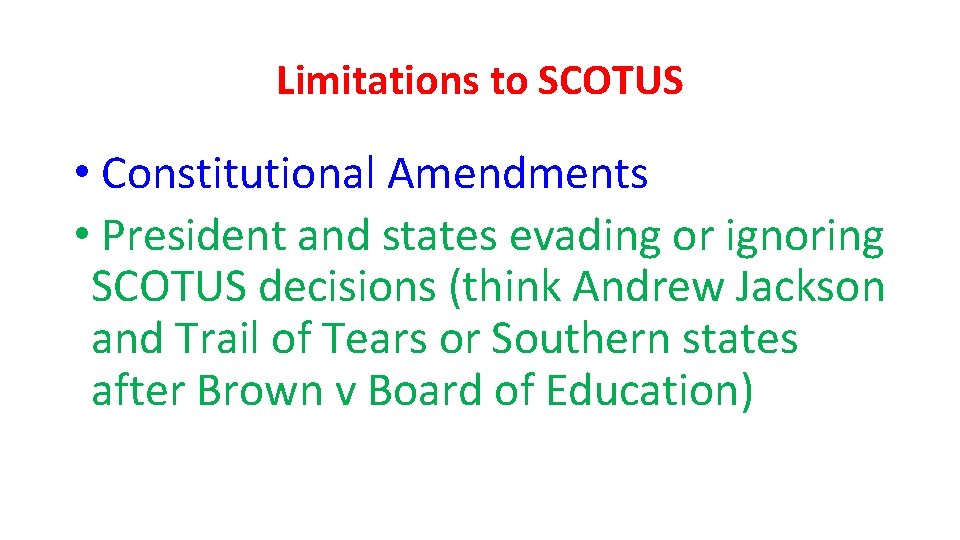
Limitations to SCOTUS • Constitutional Amendments • President and states evading or ignoring SCOTUS decisions (think Andrew Jackson and Trail of Tears or Southern states after Brown v Board of Education)
Random Definitions • Concurrent Powers • Logrolling • Rules Committee • “lame duck” presidents • Title IX • Free Rider problem with SIGs • Incumbency Advantage