
Theories of Personality Structure Theories Measurement chapter 2
![BF Skinner Burrhus Frederic Skinner [1904 -1990] - Operant conditioning - Focused on the](https://slidetodoc.com/presentation_image/78571e56a63a71f46f2e0515bae80a20/image-19.jpg "BF Skinner Burrhus Frederic Skinner [1904 -1990] - Operant conditioning - Focused on the")

- Slides: 45
Theories of Personality Structure, Theories, Measurement
chapter 2 Definitions Personality Distinctive and relatively stable pattern of behaviors, thoughts, motives, and emotions that characterizes an individual Trait A characteristic of an individual, describing a habitual way of behaving, thinking, and feeling shy, outgoing, ambitious, lazy, easy-going, anal, high-strung, confident, grumpy, happy, friendly, etc
Definitions continued - Personality is defined differently by many but generally as - the enduring or lasting patterns of behavior and thought (across time and situation). Personality consists of all the relatively STABLE and DISTINCTIVE styles of thought, behavior and emotional response that characterize a person’s adaptations to surrounding circumstances
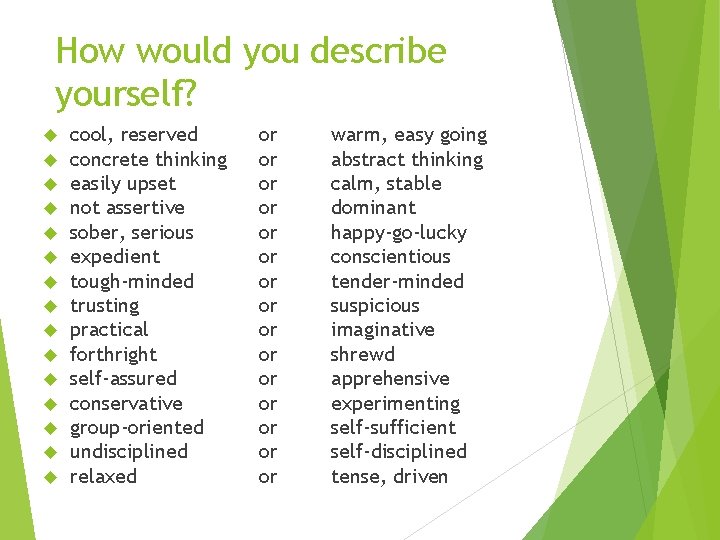
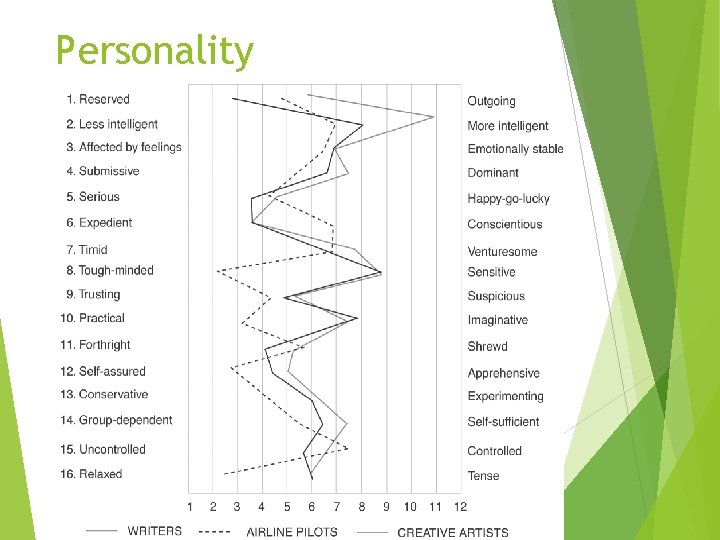
How would you describe yourself? cool, reserved concrete thinking easily upset not assertive sober, serious expedient tough-minded trusting practical forthright self-assured conservative group-oriented undisciplined relaxed or or or or warm, easy going abstract thinking calm, stable dominant happy-go-lucky conscientious tender-minded suspicious imaginative shrewd apprehensive experimenting self-sufficient self-disciplined tense, driven
Personality
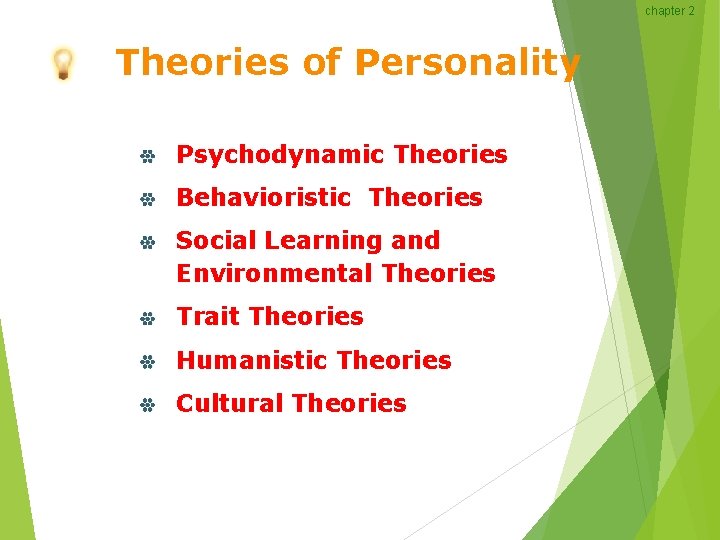
chapter 2 Theories of Personality Psychodynamic Theories Behavioristic Theories Social Learning and Environmental Theories Trait Theories Humanistic Theories Cultural Theories
Psychodynamic theorists
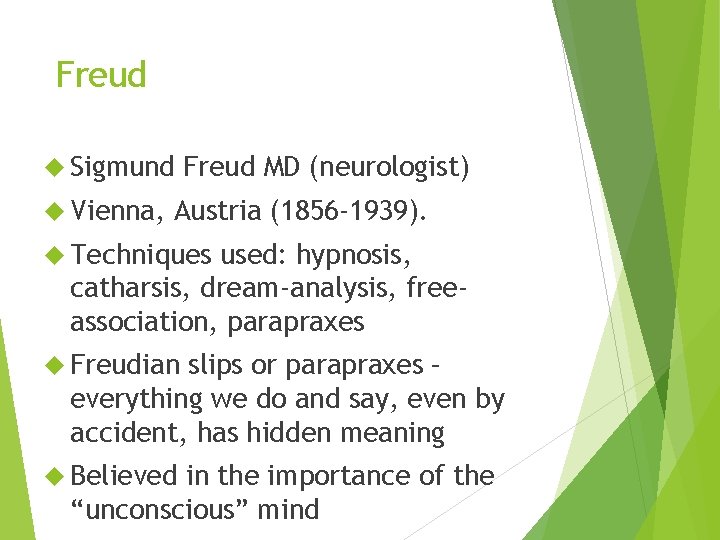
Freud Sigmund Vienna, Freud MD (neurologist) Austria (1856 -1939). Techniques used: hypnosis, catharsis, dream-analysis, freeassociation, parapraxes Freudian slips or parapraxes – everything we do and say, even by accident, has hidden meaning Believed in the importance of the “unconscious” mind
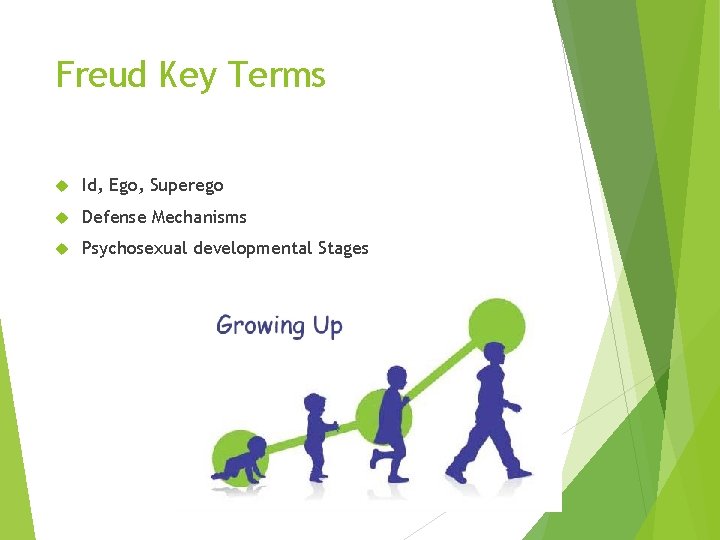
Freud Key Terms Id, Ego, Superego Defense Mechanisms Psychosexual developmental Stages
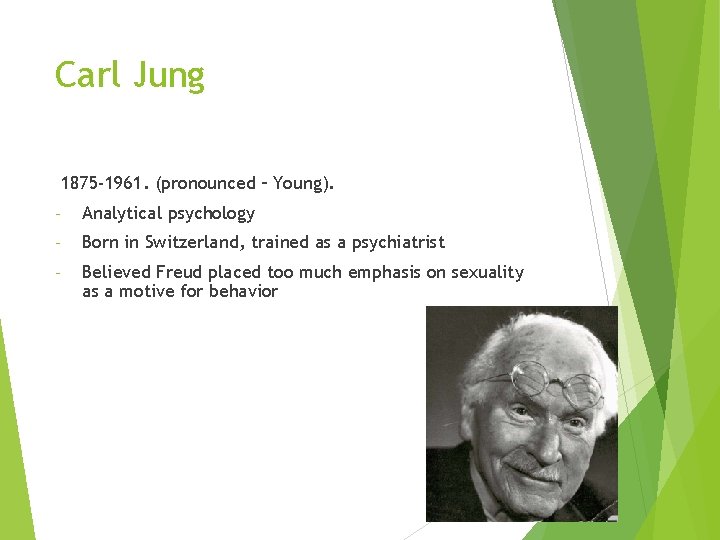
Carl Jung 1875 -1961. (pronounced – Young). - Analytical psychology - Born in Switzerland, trained as a psychiatrist - Believed Freud placed too much emphasis on sexuality as a motive for behavior
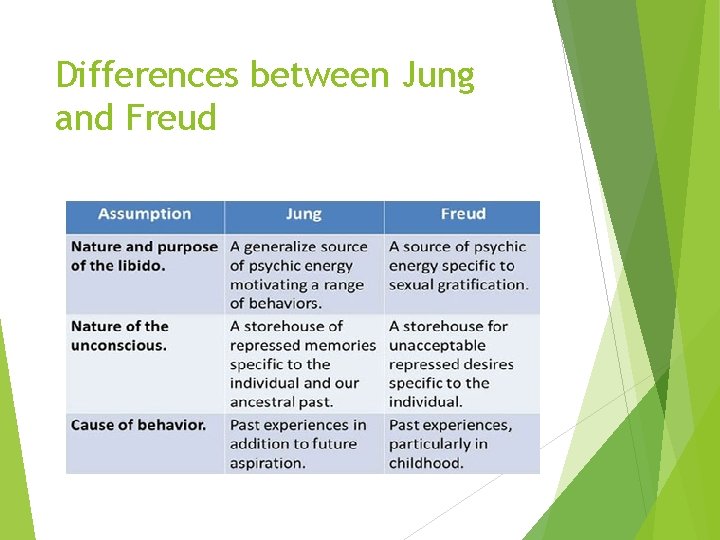
Differences between Jung and Freud
Jungian quotes “The word 'happy' would lose its meaning if it were not balanced by sadness. ” “We cannot change anything until we accept it. Condemnation does not liberate, it oppresses. ” “I am not what happened to me, I am what I choose to become. ” “There's no coming to consciousness without pain. ”
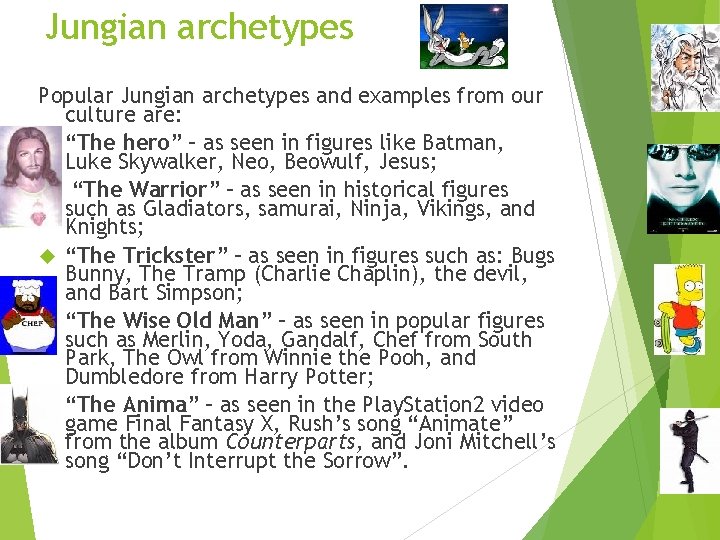
Jungian archetypes Popular Jungian archetypes and examples from our culture are: “The hero” – as seen in figures like Batman, Luke Skywalker, Neo, Beowulf, Jesus; “The Warrior” – as seen in historical figures such as Gladiators, samurai, Ninja, Vikings, and Knights; “The Trickster” – as seen in figures such as: Bugs Bunny, The Tramp (Charlie Chaplin), the devil, and Bart Simpson; “The Wise Old Man” – as seen in popular figures such as Merlin, Yoda, Gandalf, Chef from South Park, The Owl from Winnie the Pooh, and Dumbledore from Harry Potter; “The Anima” – as seen in the Play. Station 2 video game Final Fantasy X, Rush’s song “Animate” from the album Counterparts, and Joni Mitchell’s song “Don’t Interrupt the Sorrow”.
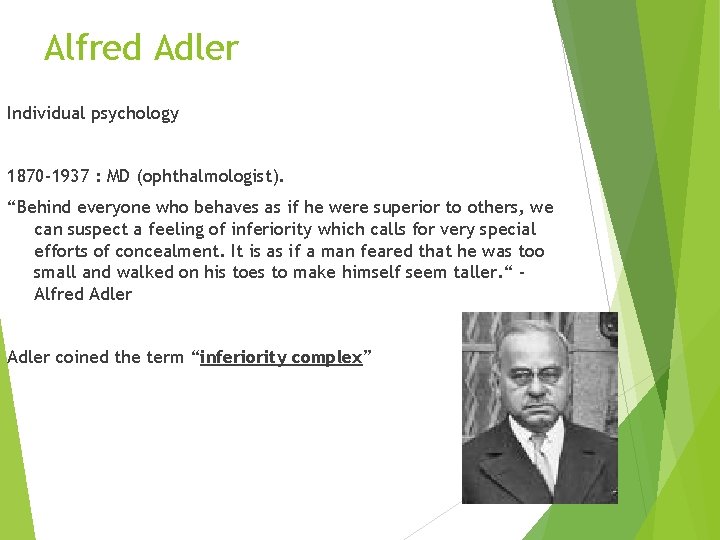
Alfred Adler Individual psychology 1870 -1937 : MD (ophthalmologist). “Behind everyone who behaves as if he were superior to others, we can suspect a feeling of inferiority which calls for very special efforts of concealment. It is as if a man feared that he was too small and walked on his toes to make himself seem taller. “ Alfred Adler coined the term “inferiority complex”
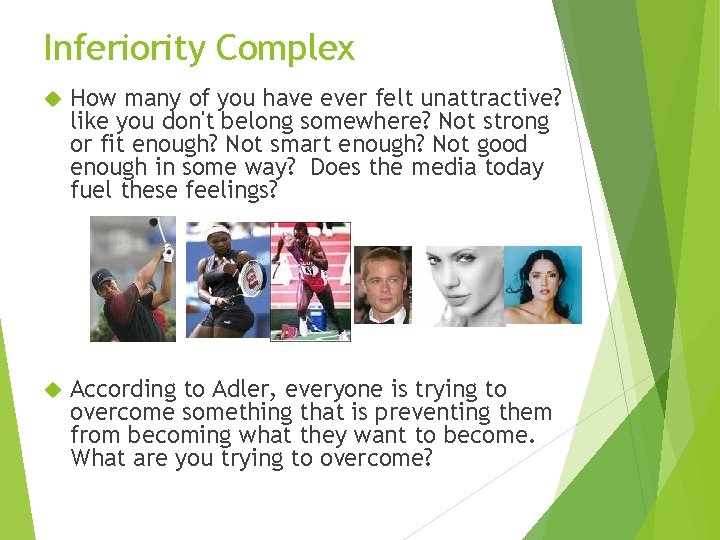
Inferiority Complex How many of you have ever felt unattractive? like you don't belong somewhere? Not strong or fit enough? Not smart enough? Not good enough in some way? Does the media today fuel these feelings? According to Adler, everyone is trying to overcome something that is preventing them from becoming what they want to become. What are you trying to overcome?
Karen Horney 1885 – 1952 Studied to be an MD. In 1909 she entered the University of Freiburg [very unusual for a woman] Feminine psychology. Argued strongly against Freud’s notion of both the Oedipus and Electra complex Disagreed with Freud’s psychosexual stages Did not accept Freud’s division of the psyche into the id, ego, and superego Countered Freud’s idea of “penis envy” with what she called “womb envy” Agreed with Freud on the importance of the unconscious and early childhood Believed that personality could continue to develop and change throughout life
Karen Horney Key Terms. basic anxiety: the insecurity that results when children perceive their parents as indifferent, harsh, disapproving, or inconsistent in their responsiveness basic hostility: a deep resentment toward the parents that arises from basic anxiety and motivates one of three different coping strategies or patterns of interacting with others that she believed to be ineffective: 1. Moving against others: dominating others 2. Moving away from others: withdrawal from others, self-focus, aloof, isolation 3. Moving toward others: being overly compliant, driven by the need to please and gain approval from others Horney believed that for both men and women to be healthy, they need to let go of the irrational neurotic need to be prefect !!
Behavioristic theorists
BF Skinner Burrhus Frederic Skinner [1904 -1990] - Operant conditioning - Focused on the overt or observable behavior - - the consequences that follow a behavior were seen as critical determinants of future behavior Disagreed with the concept of free-will Why are you taking this class? Was it your freewill? Believed in the importance of the use of reinforcement
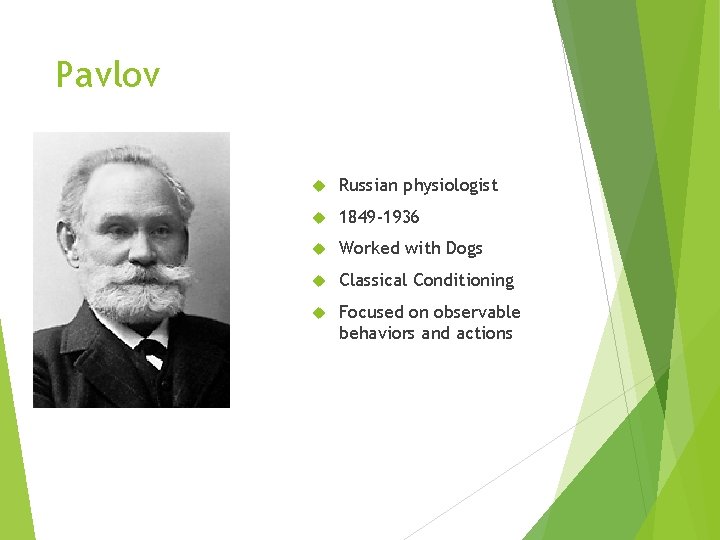
Pavlov Russian physiologist 1849 -1936 Worked with Dogs Classical Conditioning Focused on observable behaviors and actions
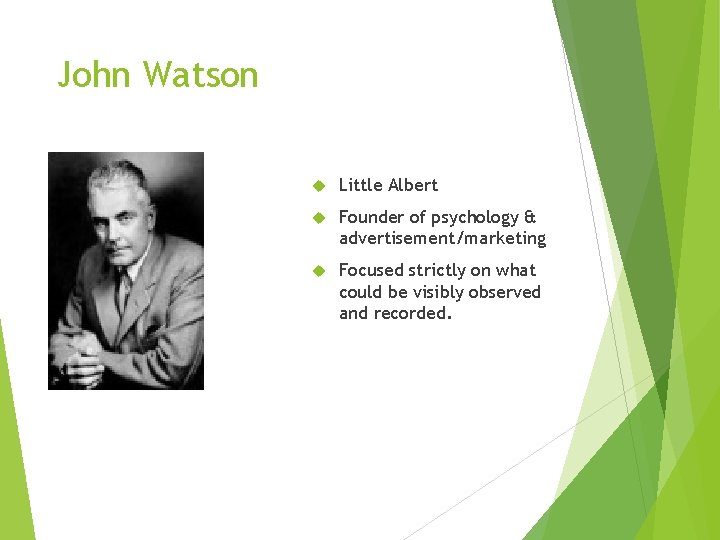
John Watson Little Albert Founder of psychology & advertisement/marketing Focused strictly on what could be visibly observed and recorded.
Humanistic development
Humanism focused on uniquely human issues such as: the self, health, hope, love, creativity, nature, and individuality. Believed in innate goodness – born good Derived somewhat from existentialism: a strong belief in free-will and conscious rational decision-making Arose in reaction to behaviorism and psychodynamic theory Key players Abraham Maslow & Carl Rogers
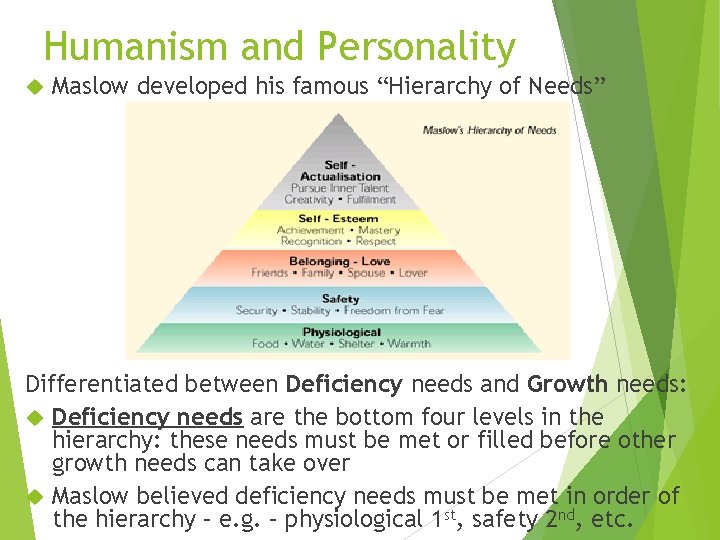
Humanism and Personality Maslow developed his famous “Hierarchy of Needs” Differentiated between Deficiency needs and Growth needs: Deficiency needs are the bottom four levels in the hierarchy: these needs must be met or filled before other growth needs can take over Maslow believed deficiency needs must be met in order of the hierarchy – e. g. – physiological 1 st, safety 2 nd, etc.
chapter 2 Your turn You are on your way to a restaurant to meet some friends, and you are hungry. As you are walking from your car to the restaurant, you are looking forward to talking with your friends. Just then, you hear a gunshot. According to Maslow, your primary motivation would be determined by 1. Your hunger 2. Your desire to converse with your friends 3. Your desire for safety
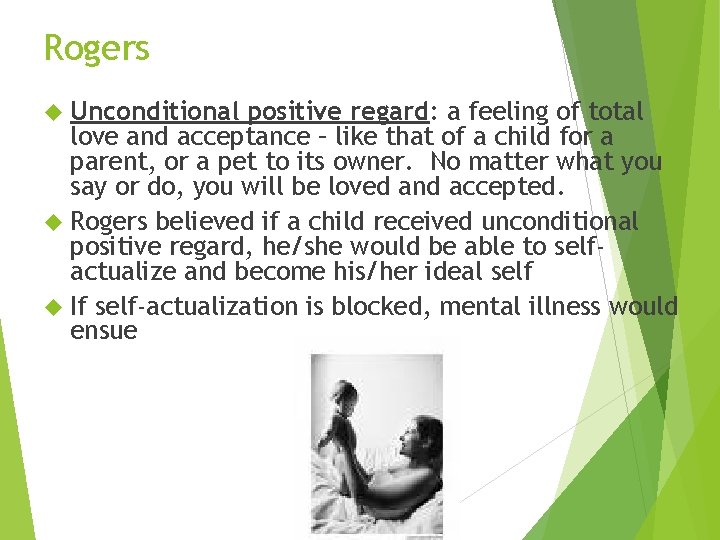
Rogers Unconditional positive regard: a feeling of total love and acceptance – like that of a child for a parent, or a pet to its owner. No matter what you say or do, you will be loved and accepted. Rogers believed if a child received unconditional positive regard, he/she would be able to selfactualize and become his/her ideal self If self-actualization is blocked, mental illness would ensue
Social Learning and Enviromental
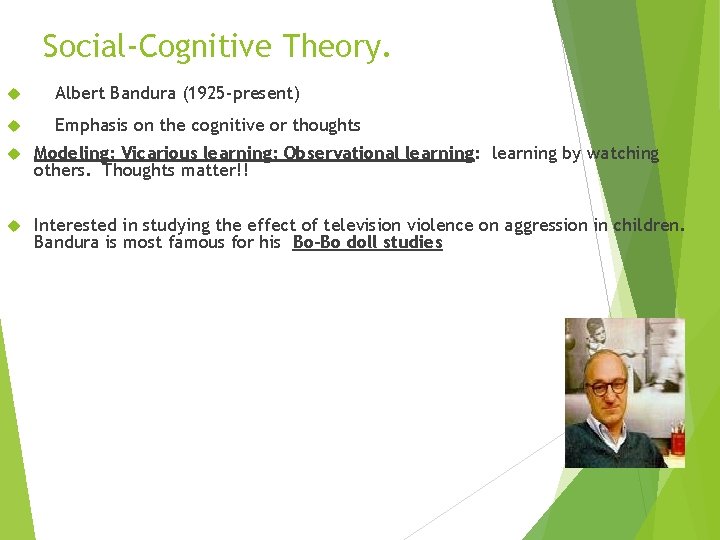
Social-Cognitive Theory. Albert Bandura (1925 -present) Emphasis on the cognitive or thoughts Modeling; Vicarious learning; Observational learning: learning by watching others. Thoughts matter!! Interested in studying the effect of television violence on aggression in children. Bandura is most famous for his Bo-Bo doll studies
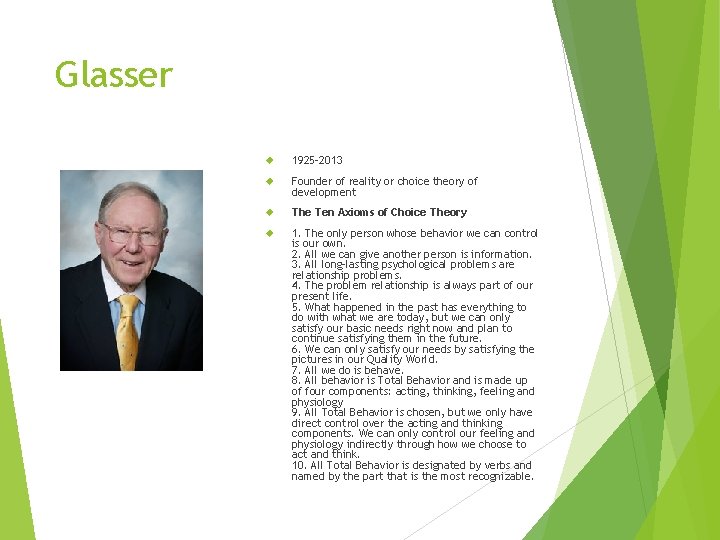
Glasser 1925 -2013 Founder of reality or choice theory of development The Ten Axioms of Choice Theory 1. The only person whose behavior we can control is our own. 2. All we can give another person is information. 3. All long-lasting psychological problems are relationship problems. 4. The problem relationship is always part of our present life. 5. What happened in the past has everything to do with what we are today, but we can only satisfy our basic needs right now and plan to continue satisfying them in the future. 6. We can only satisfy our needs by satisfying the pictures in our Quality World. 7. All we do is behave. 8. All behavior is Total Behavior and is made up of four components: acting, thinking, feeling and physiology 9. All Total Behavior is chosen, but we only have direct control over the acting and thinking components. We can only control our feeling and physiology indirectly through how we choose to act and think. 10. All Total Behavior is designated by verbs and named by the part that is the most recognizable.
Trait Theorists
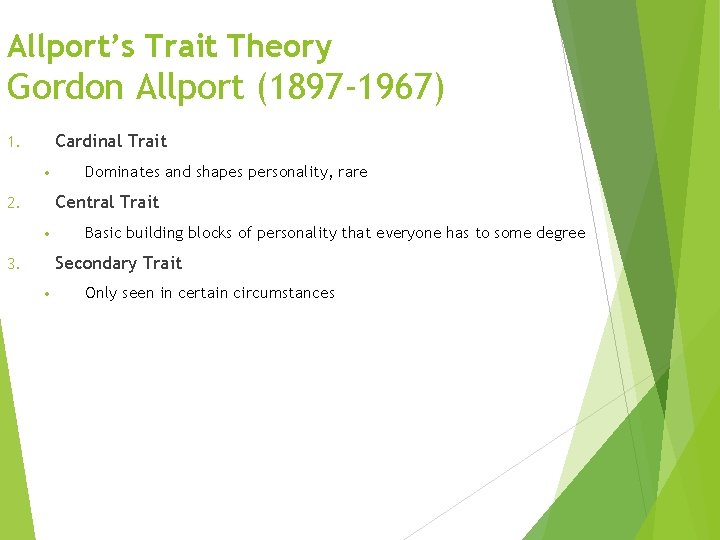
Allport’s Trait Theory Gordon Allport (1897 -1967) Cardinal Trait 1. • Dominates and shapes personality, rare Central Trait 2. • Basic building blocks of personality that everyone has to some degree Secondary Trait 3. • Only seen in certain circumstances
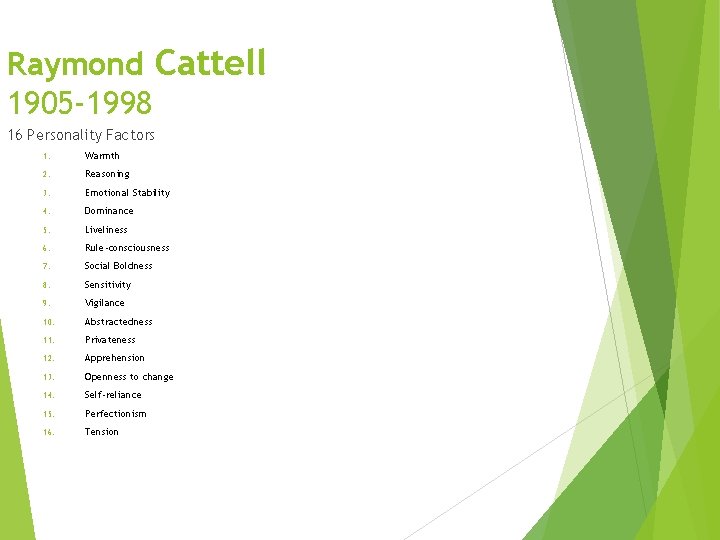
Raymond Cattell 1905 -1998 16 Personality Factors 1. Warmth 2. Reasoning 3. Emotional Stability 4. Dominance 5. Liveliness 6. Rule-consciousness 7. Social Boldness 8. Sensitivity 9. Vigilance 10. Abstractedness 11. Privateness 12. Apprehension 13. Openness to change 14. Self-reliance 15. Perfectionism 16. Tension
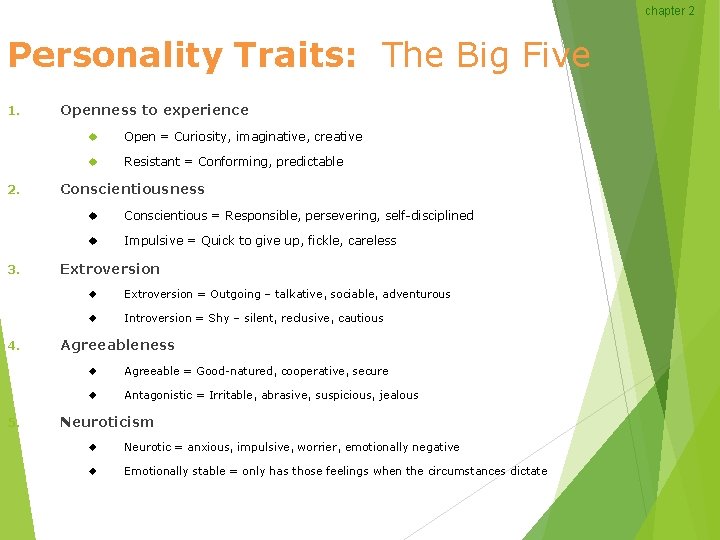
chapter 2 Personality Traits: The Big Five 1. 2. 3. 4. 5. Openness to experience Open = Curiosity, imaginative, creative Resistant = Conforming, predictable Conscientiousness Conscientious = Responsible, persevering, self-disciplined Impulsive = Quick to give up, fickle, careless Extroversion = Outgoing – talkative, sociable, adventurous Introversion = Shy – silent, reclusive, cautious Agreeableness Agreeable = Good-natured, cooperative, secure Antagonistic = Irritable, abrasive, suspicious, jealous Neuroticism Neurotic = anxious, impulsive, worrier, emotionally negative Emotionally stable = only has those feelings when the circumstances dictate
Measuring and Assessing Personality
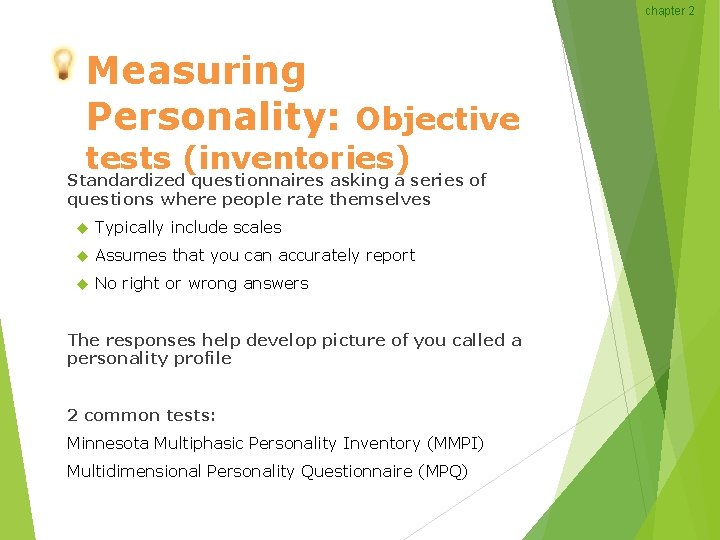
chapter 2 Measuring Personality: Objective tests (inventories) Standardized questionnaires asking a series of questions where people rate themselves Typically include scales Assumes that you can accurately report No right or wrong answers The responses help develop picture of you called a personality profile 2 common tests: Minnesota Multiphasic Personality Inventory (MMPI) Multidimensional Personality Questionnaire (MPQ)
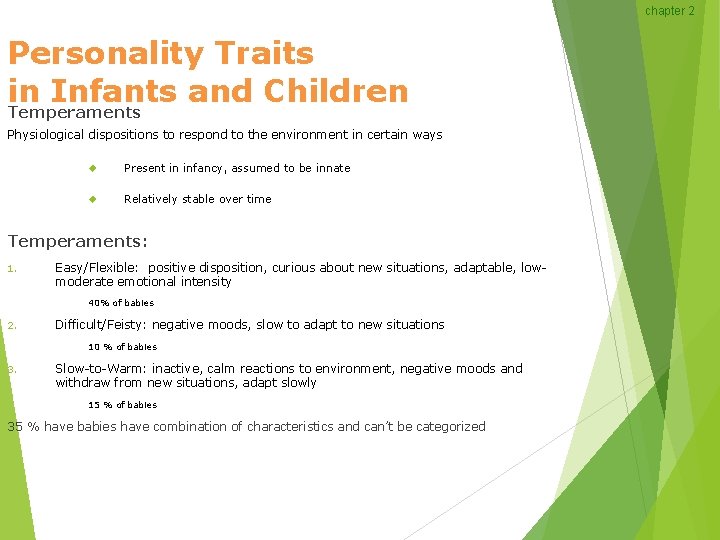
chapter 2 Personality Traits in Infants and Children Temperaments Physiological dispositions to respond to the environment in certain ways Present in infancy, assumed to be innate Relatively stable over time Temperaments: 1. Easy/Flexible: positive disposition, curious about new situations, adaptable, lowmoderate emotional intensity 40% of babies 2. Difficult/Feisty: negative moods, slow to adapt to new situations 10 % of babies 3. Slow-to-Warm: inactive, calm reactions to environment, negative moods and withdraw from new situations, adapt slowly 15 % of babies 35 % have babies have combination of characteristics and can’t be categorized
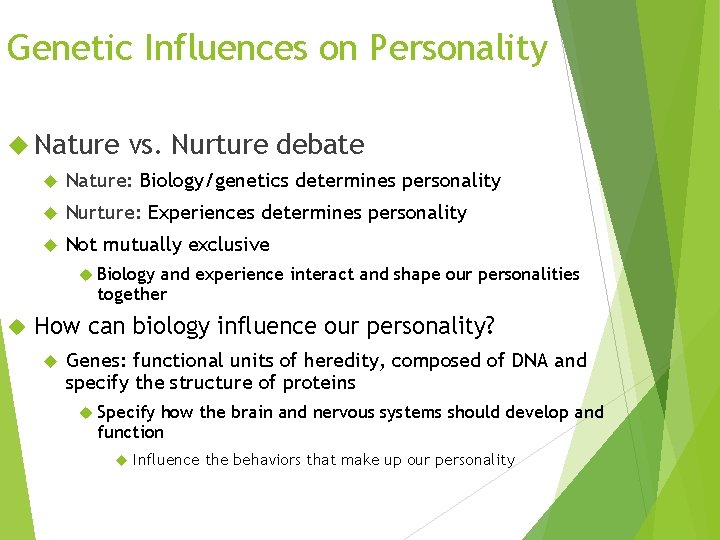
Genetic Influences on Personality Nature vs. Nurture debate Nature: Biology/genetics determines personality Nurture: Experiences determines personality Not mutually exclusive Biology and experience interact and shape our personalities together How can biology influence our personality? Genes: functional units of heredity, composed of DNA and specify the structure of proteins Specify how the brain and nervous systems should develop and function Influence the behaviors that make up our personality
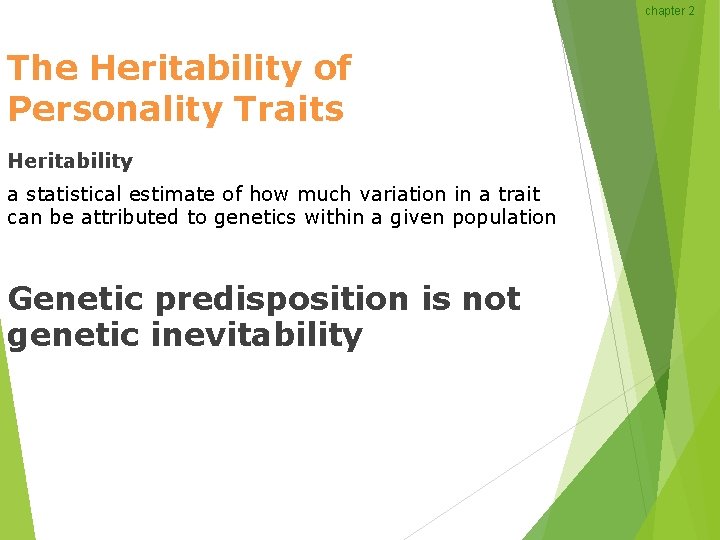
chapter 2 The Heritability of Personality Traits Heritability a statistical estimate of how much variation in a trait can be attributed to genetics within a given population Genetic predisposition is not genetic inevitability
chapter 2 The Heritability of Personality Traits How is heritability studied? Adoption studies Compare correlations between traits of children and their biological and adoptive parents Twin Studies Identical twins = share 100 % of genes Fraternal twins = share about ½ genes, just like regular siblings Compare same-sex groups of identical and fraternal twins Look at personality traits in adopted identical and fraternal twins
Influences on Personality Development
chapter 2 Parental Influences Parental child-rearing practices have a strong influence on who we become, but research has shown that it is not the primary determinant: 1. The shared environment of the home has little influence on personality. The non-shared environment is a more important influence. 2. Few parents have a single child-rearing style that is consistent over time and that they use with all children. 3. Even when parents try to be consistent, there may be little relation between what they do and how their children turn out.
chapter 2 Parental Influences Nevertheless, parents still do influence their children in a number of ways: Religious beliefs and values Intellectual and occupational interests, skills Feelings of self-esteem or inadequacy Degree of helpfulness Influence on traits that are highly heritable: Aggressiveness Shyness
chapter 2 Social Influence: Peer Pressure How many of you have behaved differently around your parents that you do your friends? Adolescent culture: different peer groups, organized by different interests, ethnicity and status Peer acceptance is so important to children and adolescents that being bullied, victimized, or rejected by peers is far more traumatic than punitive treatment by parents.
chapter 2 Cultural Influences on Personality Culture A program of shared rules that govern the behavior of members of a community or society A set of values, beliefs, and attitudes shared by most members of that community Individualist cultures Cultures in which the self is regarded as autonomous, and individual goals and wishes are prized above duty and relations with others Collectivist cultures Cultures in which the self is regarded as embedded in relationships, and harmony with one’s group is prized above individual goals and wishes
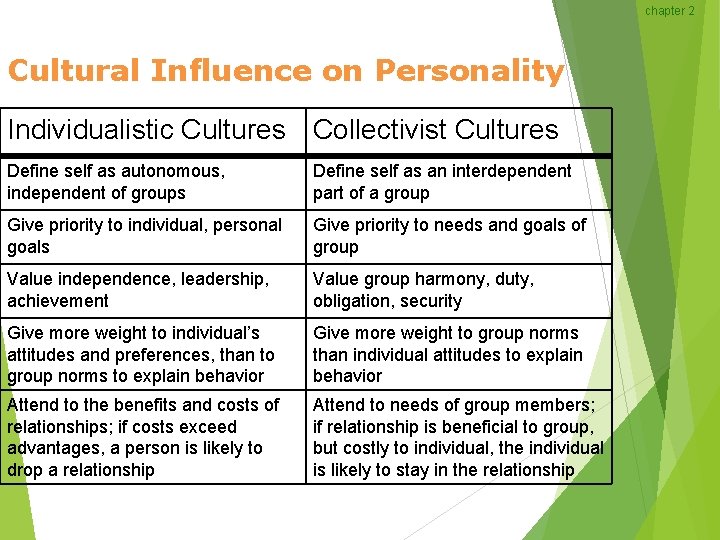
chapter 2 Cultural Influence on Personality Individualistic Cultures Collectivist Cultures Define self as autonomous, independent of groups Define self as an interdependent part of a group Give priority to individual, personal goals Give priority to needs and goals of group Value independence, leadership, achievement Value group harmony, duty, obligation, security Give more weight to individual’s attitudes and preferences, than to group norms to explain behavior Give more weight to group norms than individual attitudes to explain behavior Attend to the benefits and costs of relationships; if costs exceed advantages, a person is likely to drop a relationship Attend to needs of group members; if relationship is beneficial to group, but costly to individual, the individual is likely to stay in the relationship