
Theories of Personality Maslow Chapter 10 Mc GrawHill



- Slides: 19
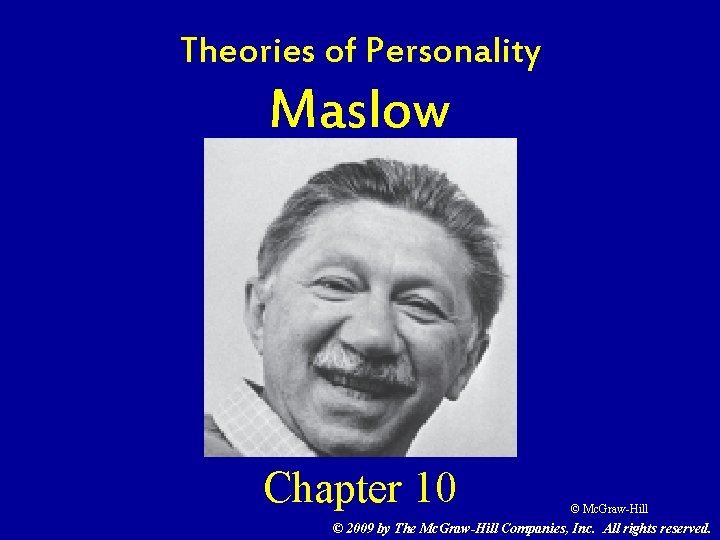
Theories of Personality Maslow Chapter 10 © Mc. Graw-Hill © 2009 by The Mc. Graw-Hill Companies, Inc. All rights reserved.
Outline • • • Overview of Holistic-Dynamic Theory Biography of Maslow’s View of Motivation Self-Actualization Philosophy of Science Measuring Self-Actualization Cont’d © Mc. Graw-Hill
Outline • • • The Jonah Complex Psychotherapy Related Research Critique of Maslow Concept of Humanity © Mc. Graw-Hill
Overview of Holistic-Dynamic Theory • Assumes Whole Person Is Motivated by One Need or Another • People Have Potential to Grow toward Psychological Health/Self-Actualization • Lower Level Needs Must Be Satisfied Before Higher Level Needs Can Be Met © Mc. Graw-Hill
Biography of Maslow • Born in New York City in 1908 • Oldest of seven children of Russian-Jewish immigrants • Harbors lifelong animosity toward mother • Received a Ph. D in 1934 in psychology from University of Wisconsin where he worked with Harry Harlow © Mc. Graw-Hill
Biography (cont’d) • Returns to New York in 1935 and works with E. L. Thorndike at Columbia University • Met and was influenced by Alfred Adler, Erich Fromm, and Karen Horney • In 1951, became chairperson of the psychology department at Brandeis University • President of American Psychological Association 1967 -1968 • Died in 1970 of a heart attack © Mc. Graw-Hill
Maslow’s View of Motivation • Holistic Approach to Motivation • Motivation Is Complex • People Are Continually Motivated by One Need or Another • All People Everywhere Are Motivated by the Same Basic Needs • Needs Can Be Arranged on a Hierarchy © Mc. Graw-Hill
Hierarchy of Needs • Conative or Basic Needs – – – Physiological Safety Love and belongingness Esteem Self-Actualization • Aesthetic Needs – The need for order and beauty • Cognitive Needs – The need for curiosity and knowledge • Neurotic Needs – An unproductive relating to other people © Mc. Graw-Hill
General Discussion of Needs • • • Reversed Order of Needs Unmotivated Behavior Expressive and Coping Behavior Deprivation of Needs Instinctoid Nature of Needs Comparison of Higher and Lower Needs © Mc. Graw-Hill
Self-Actualization • • Maslow’s Quest for the Self-Actualized Person Criteria for Self-Actualization – – • Free from psychopathology Have progressed through hierarchy of needs Embracing of the B-values Full use of talents, capacities, and potentialities Values of Self-Actualizers – – Motivated by Eternal Verities or B-Values Metamotivation © Mc. Graw-Hill
Self-Actualization (cont’d) • Characteristics of Self-Actualizing People – – – – More efficient perception of reality Acceptance of self, others, and nature Spontaneity, simplicity, and naturalness Problem-centering The need for privacy Autonomy Continued freshness of appreciation The peak experience © Mc. Graw-Hill
Self-Actualization (cont’d) • Characteristics of Self-Actualizing People (cont’d) – – – – • Gemeinschaftsgefuhl Profound interpersonal relations The democratic character structure Discrimination between means and ends Philosophical sense of humor Creativeness Resistance to enculturation Love, Sex, and Self-Actualization © Mc. Graw-Hill
Philosophy of Science • Maslow argued for a humanistic, holistic approach that is not value free • Psychological science should stress the importance of individual procedures • Scientists should put values, emotion, and ritual back into their work and be creative in their pursuit of knowledge © Mc. Graw-Hill
Measuring Self-Actualization • Personal Orientation Inventory (POI) – Comprehensive measure of the values and behaviors of self-actualizing people • • Short Index of Self-Actualization Brief Index of Self-Actualization – Four factors: 1. 2. 3. 4. Core self-actualization Autonomy Openness to experience Comfort with solitude © Mc. Graw-Hill
The Jonah Complex • The Jonah complex is an abnormal syndrome defined as the fear of being or doing one’s best • Probably all of us have some timidity about seeking perfection or greatness • People allow false humility to stifle creativity, and therefore they prevent themselves from becoming self-actualizing © Mc. Graw-Hill
Psychotherapy • The aim of therapy is for clients to embrace the being-values • Clients must be freed from their dependence on others so that their natural impulse to grow can become active • Psychotherapy must not be value free © Mc. Graw-Hill
Related Research • Positive Psychology – Burton & King (2004) • Writing about positive experiences was associated with better physical health in the following months – Lyubomirsky et al. (2009) • While simply thinking about positive experiences did not confer physical health benefits, it did result in greater wellbeing a month later • Personality Development, Growth, and Goals – Bauer & Mc. Adams (2004 a) • Intrinsic and exploratory growth goals were associated with greater well-being and ego-development, and hence greater life satisfaction; these all were higher in older than younger adults © Mc. Graw-Hill
Critique of Maslow • Maslow’s Theory Is: – Very High on Organizing Knowledge – High on Guiding Action – Moderate on Generating Research, Internal Consistency, and Parsimony – Low on Falsifiability © Mc. Graw-Hill
Concept of Humanity • • • Free Choice over Determinism Optimism over Pessimism Teleology over Causality Conscious over Unconscious Equal Emphasis on Culture and Biology Uniqueness over Similarity © Mc. Graw-Hill