
Theories of Personality Freud Chapter 2 Mc GrawHill
- Slides: 15
Theories of Personality Freud Chapter 2 © Mc. Graw-Hill © 2009 by The Mc. Graw-Hill Companies, Inc. All rights reserved
Outline • • • Overview of Psychoanalytic Theory Biography of Freud Levels of Mental Life Provinces of Mind Dynamics of Personality Defense Mechanisms Cont’d © Mc. Graw-Hill
Outline • • • Stages of Development Applications of Psychoanalytic Theory Related Research Critique of Freud Concept of Humanity © Mc. Graw-Hill
Overview of Psychoanalytic Theory • What Made This Theory Interesting – Cornerstones: Sex and aggression – Spread by a dedicated group – Brilliant language (Goethe Prize in Literature) © Mc. Graw-Hill
Biography of Freud • Born in Freiberg Moravia (now the Czech Republic) in 1856 • Spent most of life (80 years) in Vienna Austria • Was the eldest son of eight • Studied Medicine, specializing in psychiatry; interested in science • Studied hysteria with Charcot & Breuer © Mc. Graw-Hill
Biography (cont’d) • Studies on Hysteria (1895) • Abandoned seduction theory in 1897 and replaced it with Oedipus Complex • In 1900 wrote Interpretation of Dreams • After 1900 developed international circle of followers (Adler, Jung, and others) • Was driven out of Austria by Nazis in 1938 • Died in London in 1939 © Mc. Graw-Hill
Level of Mental Life • Unconscious – Beyond awareness • Includes drives, urges, or instincts • Is known only indirectly – Two sources of unconscious processes • Repression • Phylogenetic Endowment • Preconscious – Not in conscious awareness, but can be • Conscious – Mental life that is directly available, plays a minor role © Mc. Graw-Hill
Provinces of the Mind • The Id – Pleasure Principle – Primary Process • The Ego – The Reality Principle – Secondary Process • The Superego – The Idealistic Principle – Conscience – Ego-Ideal © Mc. Graw-Hill
Dynamics of Personality • Drives – Libido or Sex Drive – Thanatos or Aggression/Destructive Drive • Anxiety – Neurotic Anxiety – Moral Anxiety – Realistic Anxiety © Mc. Graw-Hill
Defense Mechanisms • • Repression Reaction Formation Displacement Fixation Regression Projection Introjection Sublimation © Mc. Graw-Hill
Stages of Development • Infantile Period (Birth-5) – Oral Phase – Anal Phase – Phallic Phase • Male Oedipus Complex – Castration Complex • Female Oedipus Complex (Electra) – Penis Envy • Latency Period (5 -puberty) • Genital Period (puberty-adulthood) • Maturity © Mc. Graw-Hill
Applications of Psychoanalytic Theory • Free Association – Transference – Resistance • Dream Analysis – Manifest and latent content • Freudian or Unconscious Slips (Parapraxes) © Mc. Graw-Hill
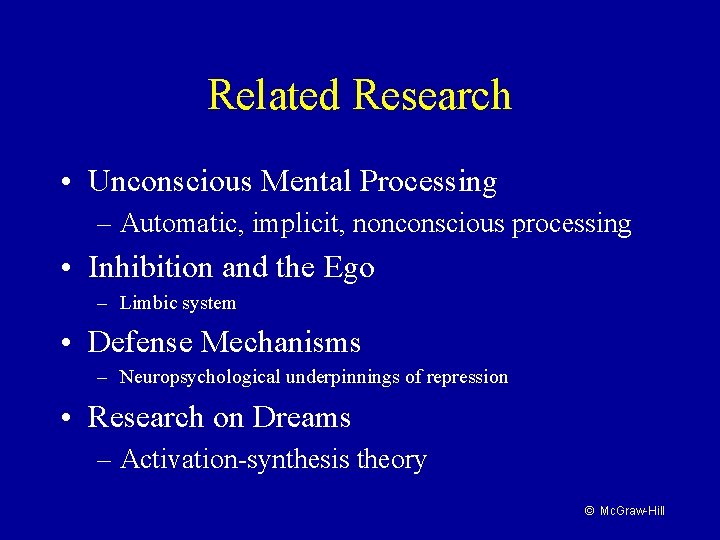
Related Research • Unconscious Mental Processing – Automatic, implicit, nonconscious processing • Inhibition and the Ego – Limbic system • Defense Mechanisms – Neuropsychological underpinnings of repression • Research on Dreams – Activation-synthesis theory © Mc. Graw-Hill
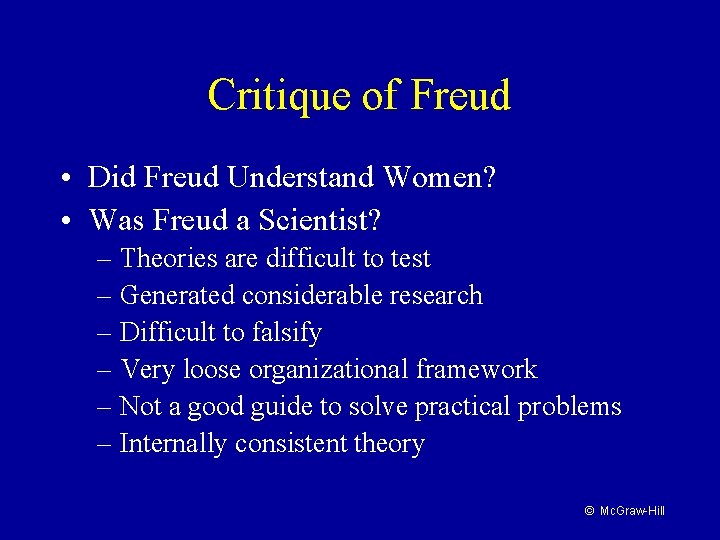
Critique of Freud • Did Freud Understand Women? • Was Freud a Scientist? – Theories are difficult to test – Generated considerable research – Difficult to falsify – Very loose organizational framework – Not a good guide to solve practical problems – Internally consistent theory © Mc. Graw-Hill
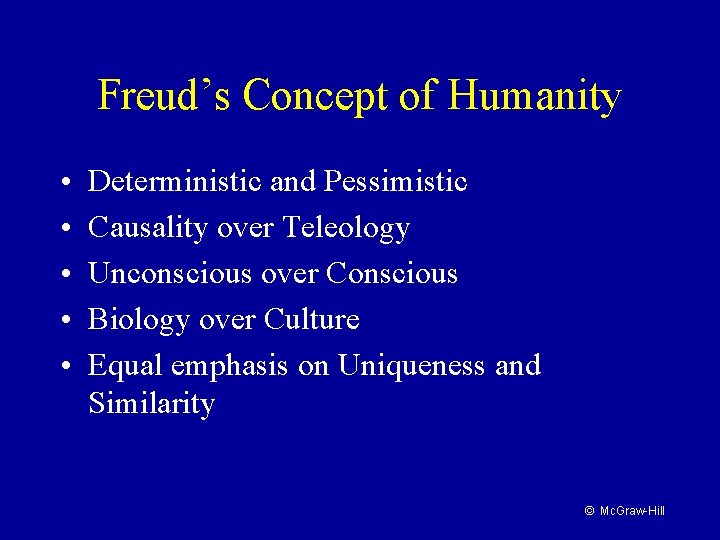
Freud’s Concept of Humanity • • • Deterministic and Pessimistic Causality over Teleology Unconscious over Conscious Biology over Culture Equal emphasis on Uniqueness and Similarity © Mc. Graw-Hill