
Theories of Personality Adler Chapter 3 Mc GrawHill
- Slides: 17
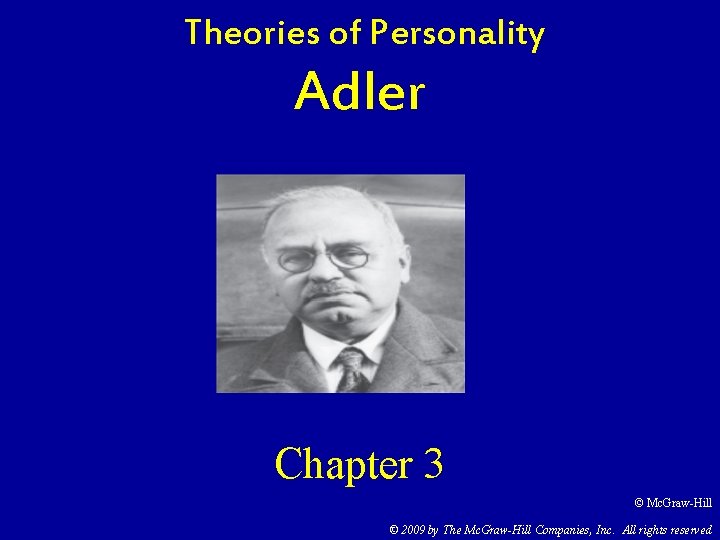
Theories of Personality Adler Chapter 3 © Mc. Graw-Hill © 2009 by The Mc. Graw-Hill Companies, Inc. All rights reserved
Outline • • Overview of Individual Psychology Biography of Adler Striving for Success or Superiority Subjective Perceptions Unity and Self-Consistency of Personality Social Interest Cont’d Style of Life © Mc. Graw-Hill
Outline • • • Creative Power Abnormal Development Applications of Individual Psychology Related Research Critique of Adler Concept of Humanity © Mc. Graw-Hill
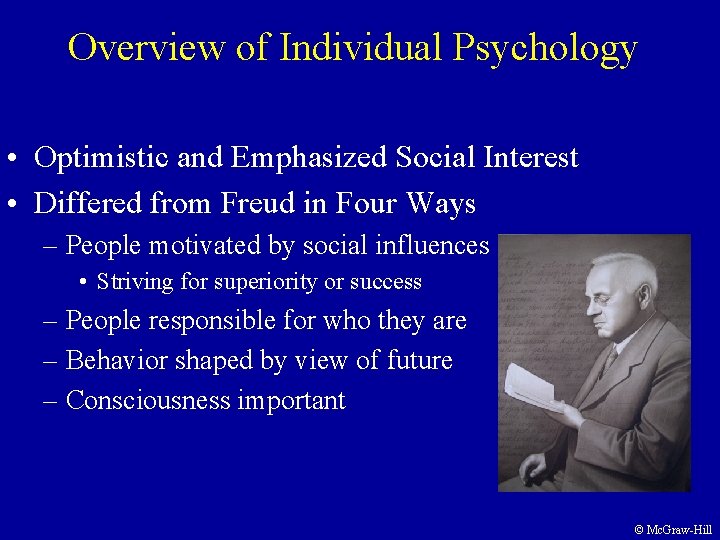
Overview of Individual Psychology • Optimistic and Emphasized Social Interest • Differed from Freud in Four Ways – People motivated by social influences • Striving for superiority or success – People responsible for who they are – Behavior shaped by view of future – Consciousness important © Mc. Graw-Hill
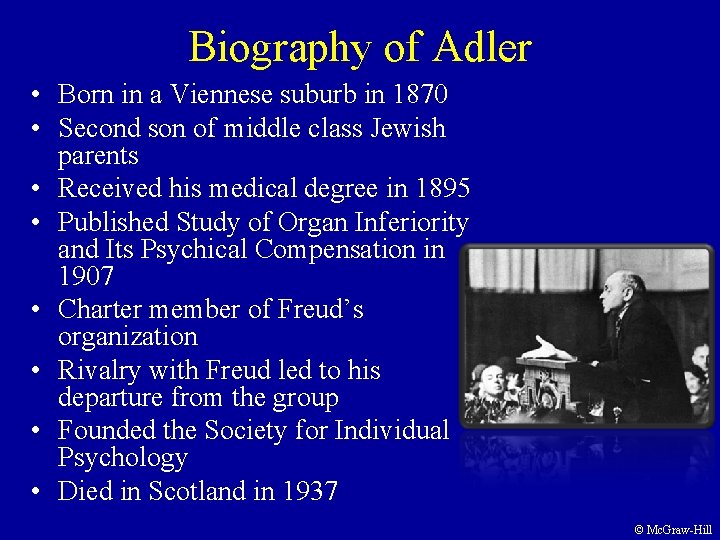
Biography of Adler • Born in a Viennese suburb in 1870 • Second son of middle class Jewish parents • Received his medical degree in 1895 • Published Study of Organ Inferiority and Its Psychical Compensation in 1907 • Charter member of Freud’s organization • Rivalry with Freud led to his departure from the group • Founded the Society for Individual Psychology • Died in Scotland in 1937 © Mc. Graw-Hill
Introduction to Adlerian Theory • Tenets of Individual Psychology – Striving for success is force behind behavior – Subjective perceptions shape behavior – Personality is unified and self-consistent – Value of all activity from social interest perspective – Personality structure becomes one’s style of life – Style of life molded by creative power © Mc. Graw-Hill
Striving for Success or Superiority • Striving: – The Final Goal of Behavior – Compensation – For Personal Superiority – For Success © Mc. Graw-Hill
Subjective Perceptions • Fictionalism – Final goal (which is a fiction): • Guides our style of life • Gives unity to our personality • Renders our behavior purposeful – Physical Inferiorities – All humans born physically inferior • Need fictions of strength to overcome these deficiencies – Serve as an impetus towards perfection © Mc. Graw-Hill
Unity of Personality • Organ Dialect – The deficient organ expresses the direction of the individual’s goal • Conscious and Unconscious – Unified personality is a function of harmony between conscious and unconscious processes aimed toward a single goal © Mc. Graw-Hill
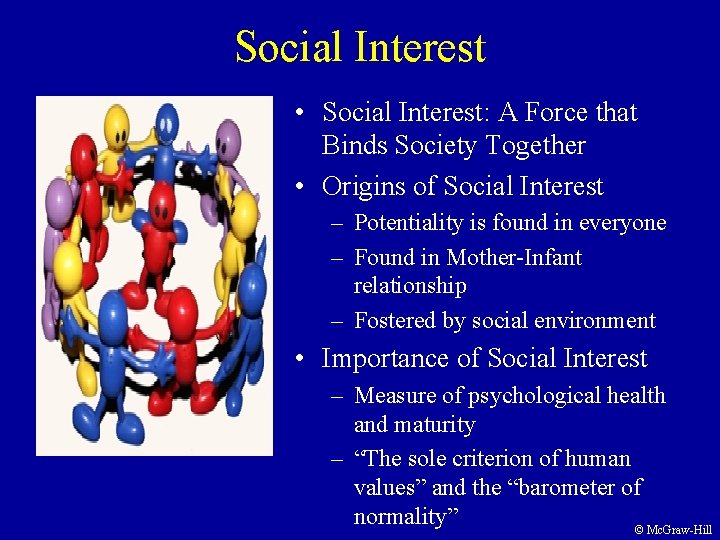
Social Interest • Social Interest: A Force that Binds Society Together • Origins of Social Interest – Potentiality is found in everyone – Found in Mother-Infant relationship – Fostered by social environment • Importance of Social Interest – Measure of psychological health and maturity – “The sole criterion of human values” and the “barometer of normality” © Mc. Graw-Hill
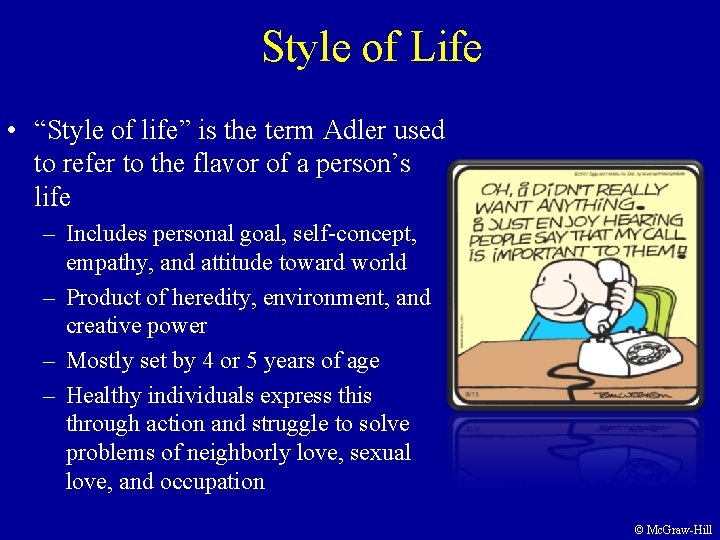
Style of Life • “Style of life” is the term Adler used to refer to the flavor of a person’s life – Includes personal goal, self-concept, empathy, and attitude toward world – Product of heredity, environment, and creative power – Mostly set by 4 or 5 years of age – Healthy individuals express this through action and struggle to solve problems of neighborly love, sexual love, and occupation © Mc. Graw-Hill
Creative Power • Creative power is Adler’s term for an inner freedom that empowers each person to create his or her own style of life – Places one in control of his or her life – Responsible for one’s final goal – Determines one’s method of striving – Contributes to the development of one’s social interest • Importance is not endowment but how one uses this power © Mc. Graw-Hill
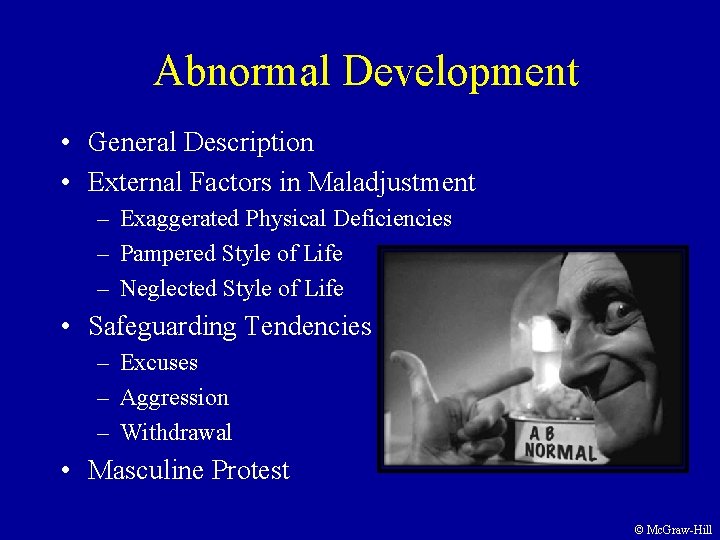
Abnormal Development • General Description • External Factors in Maladjustment – Exaggerated Physical Deficiencies – Pampered Style of Life – Neglected Style of Life • Safeguarding Tendencies – Excuses – Aggression – Withdrawal • Masculine Protest © Mc. Graw-Hill
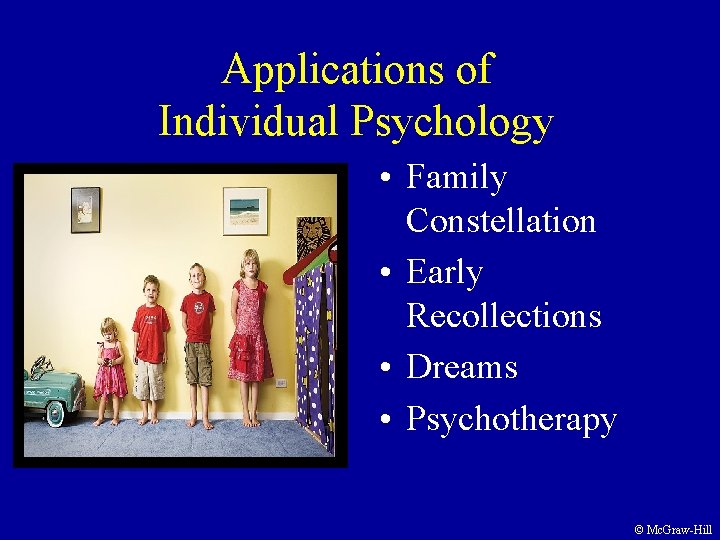
Applications of Individual Psychology • Family Constellation • Early Recollections • Dreams • Psychotherapy © Mc. Graw-Hill
Related Research • Early Recollections and Career Choice – Kasler & Nevo (2005) • Early Childhood and Health-Related Issues – Belangee (2009) – Laird and Shelton (2009) • Early Recollections and Counseling Outcomes – Savill & Eckstein (1987) – Statton & Wilborn (1991) © Mc. Graw-Hill
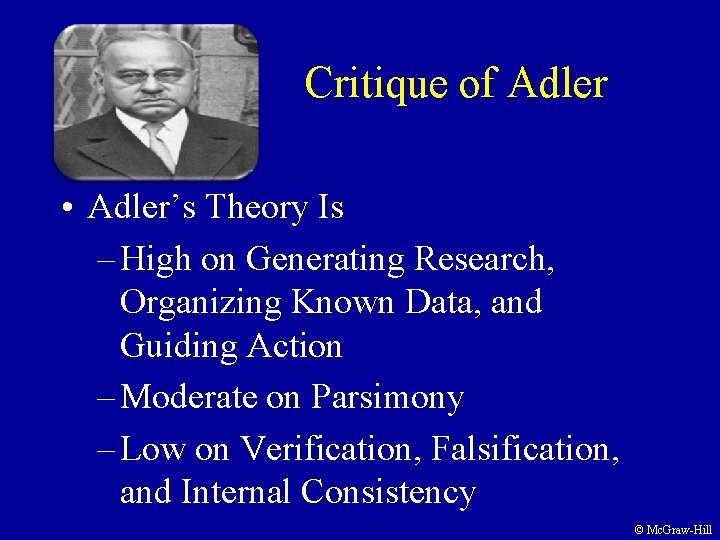
Critique of Adler • Adler’s Theory Is – High on Generating Research, Organizing Known Data, and Guiding Action – Moderate on Parsimony – Low on Verification, Falsification, and Internal Consistency © Mc. Graw-Hill
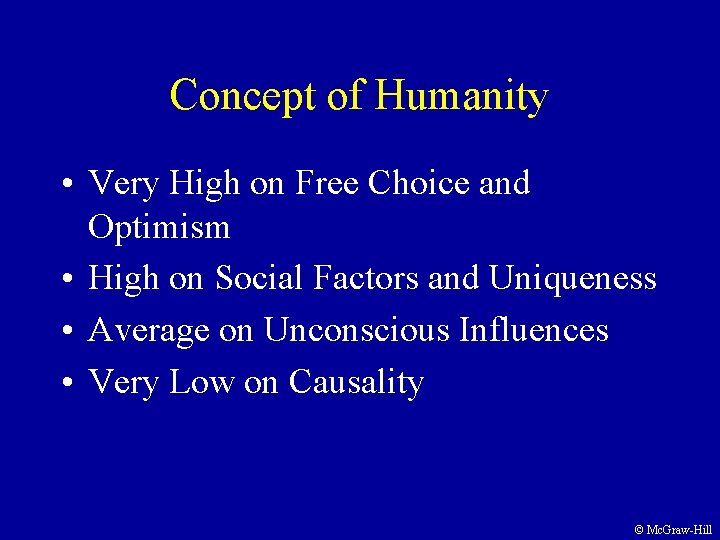
Concept of Humanity • Very High on Free Choice and Optimism • High on Social Factors and Uniqueness • Average on Unconscious Influences • Very Low on Causality © Mc. Graw-Hill