
Theories of Motivation By Dr Ashvini Ravi Theories
Theories of Motivation By Dr Ashvini Ravi Theories of Motivation by Dr Ashvini Ravi is licensed under a Creative Commons Attribution-Share. Alike 4. 0 International License. Dr Ashvini Ravi RC 1228
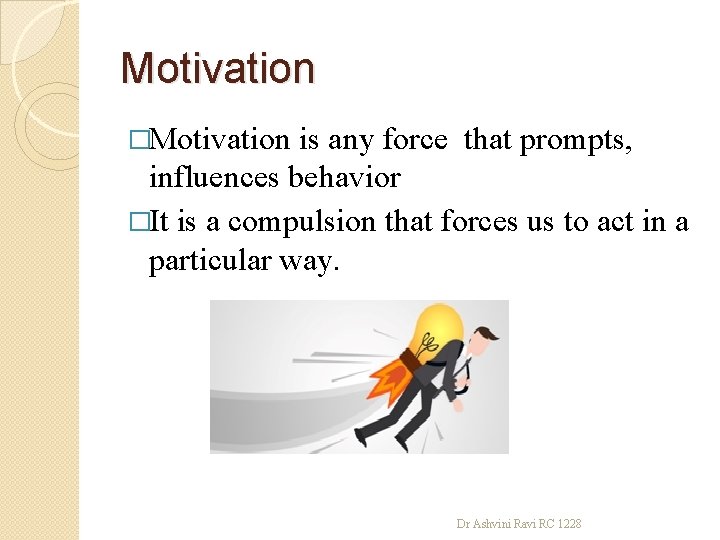
Motivation �Motivation is any force that prompts, influences behavior �It is a compulsion that forces us to act in a particular way. Dr Ashvini Ravi RC 1228
Content and Process Motivation Theories �Content theories ◦ These theories focus on the needs people have. · Process theories ◦ These theories focus more on the process by which the needs are reflected in behavior. Dr Ashvini Ravi RC 1228
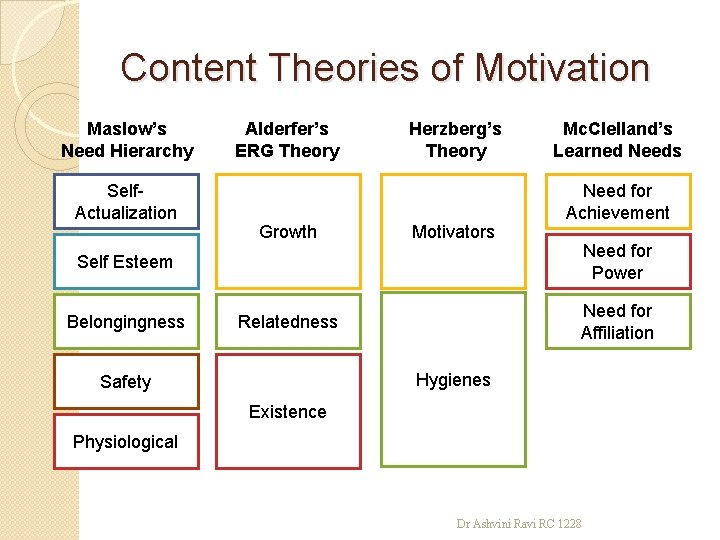
Content Theories of Motivation Maslow’s Need Hierarchy Self. Actualization Alderfer’s ERG Theory Growth Herzberg’s Theory Motivators Mc. Clelland’s Learned Needs Need for Achievement Need for Power Self Esteem Belongingness Need for Affiliation Relatedness Hygienes Safety Existence Physiological Dr Ashvini Ravi RC 1228
Maslow’s Need Hierarchy �According to Maslow needs in an individual are present as a hierarchy. �When a lower need is satisfied the person experiences the next higher need and is motivated to fulfill the need. �Once a need is satisfied it no longer motivates an individual. Dr Ashvini Ravi RC 1228
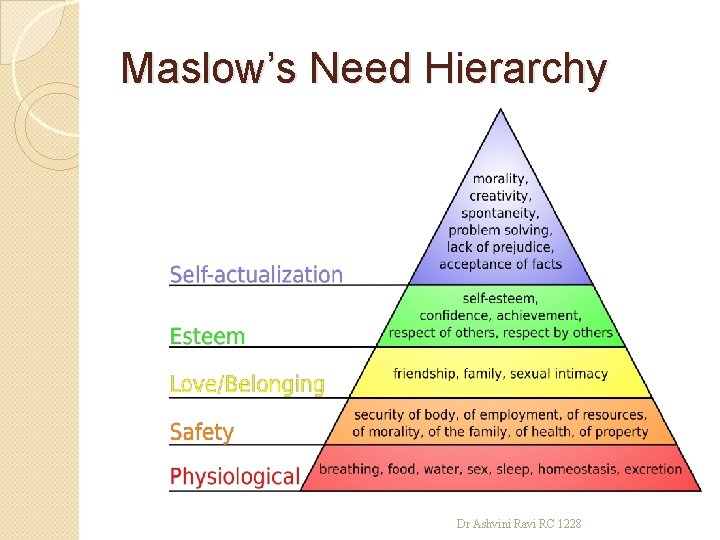
Maslow’s Need Hierarchy Dr Ashvini Ravi RC 1228
Alderfer’s ERG theory �This theory was proposed by Clayton Alderfer developed Maslow’s theory and categorized needs into Existence, Relatedness and Growth. �Existence corresponds to Maslow’s physiological and security needs �Relatedness corresponds to Maslow’s affiliation needs. �Growth corresponds to Maslow’s esteem and self-actualization needs. Dr Ashvini Ravi RC 1228
Alderfer’s ERG theory �Alderfer differs from Maslow in that when an individual is unable to satisfy upper level needs, the individual will revert to satisfying lower level needs �This is known as Regression. Frustration. Dr Ashvini Ravi RC 1228
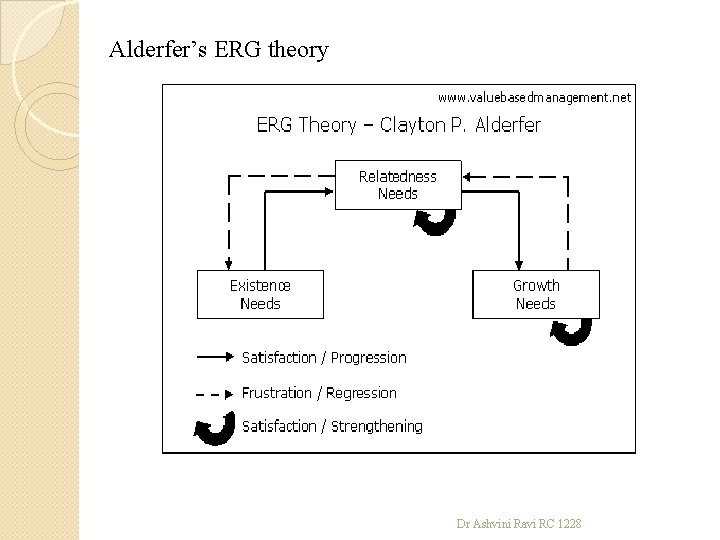
Alderfer’s ERG theory Dr Ashvini Ravi RC 1228
Mc. Clelland’s Needs theory �According to Mc. Clelland interaction with environment results in certain needs. �Needs are not in a hierarchy but different people have varying degrees of three types of basic needs. Dr Ashvini Ravi RC 1228
Mc. Clelland’s Needs theory. Types of Needs �N Ach- Need to achieve some predetermined goal. �N Aff-Need to have close relationships with others. �N Pow-Need for power and control Dr Ashvini Ravi RC 1228
Herzberg’s Two Factor Theory �Herzberg speaks about two factors; hygiene and motivation factors. Some variable prevent job dissatisfaction and some variables produce motivation �Hygiene: These factors prevent dissatisfaction. But satisfying them does not motivate employees ◦ Examples: ambience, food, comfortable chairs, temperature, pay, parking �Motivators: perform. These factors result in motivation to ◦ Examples: interesting work, advancement, growth, etc. Dr Ashvini Ravi RC 1228
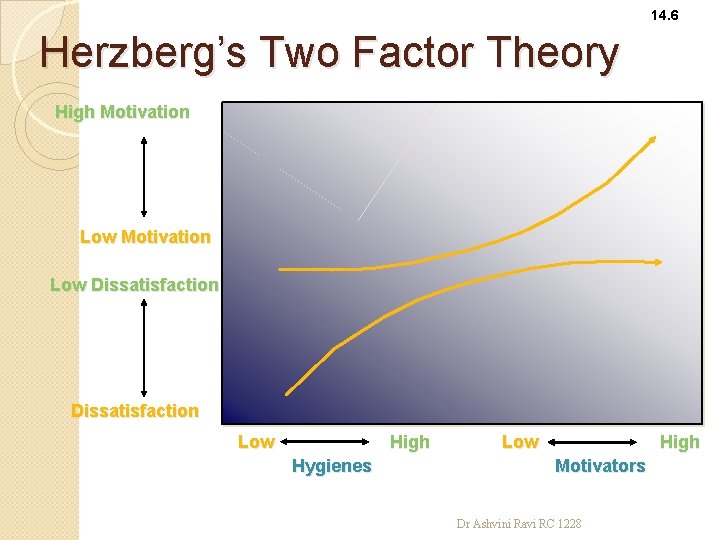
14. 6 Herzberg’s Two Factor Theory High Motivation Low Dissatisfaction Low High Hygienes Low High Motivators Dr Ashvini Ravi RC 1228
Implications of Content Theories in the Work Place �Have a reward system that is customized to the type of employee. �Financial rewards only address the lower needs. They are hygiene factors. �What really motivates are the higher level needs. These drive employees to superior performance. Dr Ashvini Ravi RC 1228
Process Theories of Motivation Reinforcement Expectancy Equity Goal Setting Dr Ashvini Ravi RC 1228
Reinforcement theory �Reinforcement theory says that when we reward (or remove a punishment )for a desired behavior it encourages that behavior and when we punish( or remove a reward) for an undesired behavior it reduces this behavior. �Positive Reinforcement-rewards / removal of punishment �Negative Reinforcement-punish/ remove a reward Dr Ashvini Ravi RC 1228
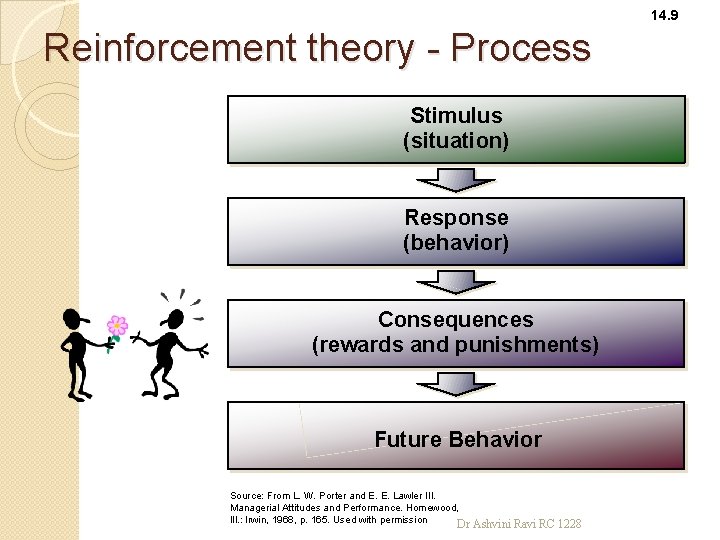
14. 9 Reinforcement theory - Process Stimulus (situation) Response (behavior) Consequences (rewards and punishments) Future Behavior Source: From L. W. Porter and E. E. Lawler III. Managerial Attitudes and Performance. Homewood, Ill. : Irwin, 1968, p. 165. Used with permission Dr Ashvini Ravi RC 1228
Reinforcement theory -Types of Rewards can be extrinsic or intrinsic Extrinsic rewards are external to the job while intrinsic rewards are internal to the job. �Extrinsic-Examples: pay, staff welfare, perks, job security �Intrinsic-Examples: Work itself, challenges, interesting work, empowerement Dr Ashvini Ravi RC 1228
Equity Theory �Individuals compare their inputs and outcomes relative to those whom they work with. �When they feel that there is inequity they will reduce or increase their effort accordingly Dr Ashvini Ravi RC 1228
Equity Theory-Results of Inequity �When employees feel they are treated fairly they will experience equity and will continue to perform. �Under-rewarded Inequity –Employee feels he is under rewarded and will want to increase rewards, or decrease inputs to match rewards �Over-rewarded Inequity –Employee will change his point of reference or will increase efforts due to guilt �In an inequitable situation employees may distort the inputs and outcomes in their mind( cognitive distortion) , change effort or leave the organization Dr Ashvini Ravi RC 1228
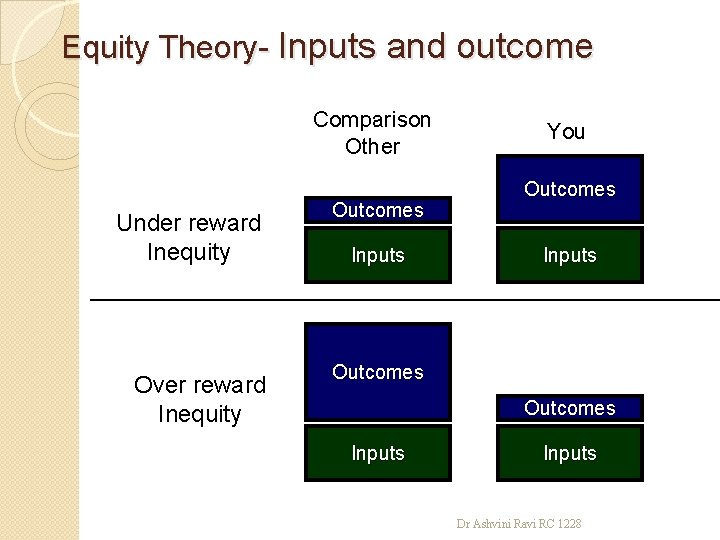
Equity Theory- Inputs and outcome Comparison Other Under reward Inequity Outcomes Over reward Inequity Outcomes Inputs You Outcomes Inputs Dr Ashvini Ravi RC 1228
Goal Setting Theory �Goals can motivate employees �Goals need to be: 1. Specific 2. Challenging( but not very difficult) 3. With feedback 4. Followed by Rewards when achieved 5. Set with employee participation 6. Accompanied by skill training for achievement Dr Ashvini Ravi RC 1228
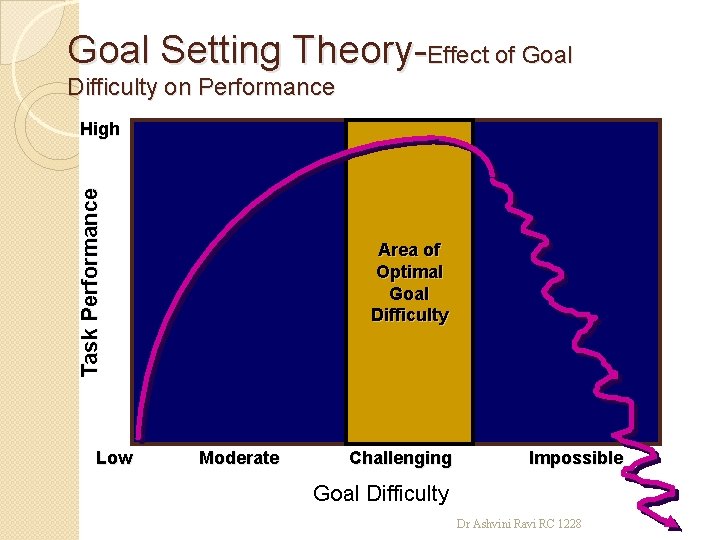
Goal Setting Theory-Effect of Goal Difficulty on Performance Task Performance High Low Area of Optimal Goal Difficulty Moderate Challenging Impossible Goal Difficulty Dr Ashvini Ravi RC 1228
Goal Setting Theory. Components �Goal Difficulty �Goal Specificity �Goal Acceptance �Goal Commitment Dr Ashvini Ravi RC 1228
Expectancy Theory �The Expectancy theory is based on effort, performance, and value. �The key issues in the Expectancy Theory are: 1. Will the effort result in performance? (Expectancy) 2. Will the performance result in reward? ( Instrumentality) 3. Is the reward of sufficient value to motivate the individual? ( valence) Dr Ashvini Ravi RC 1228
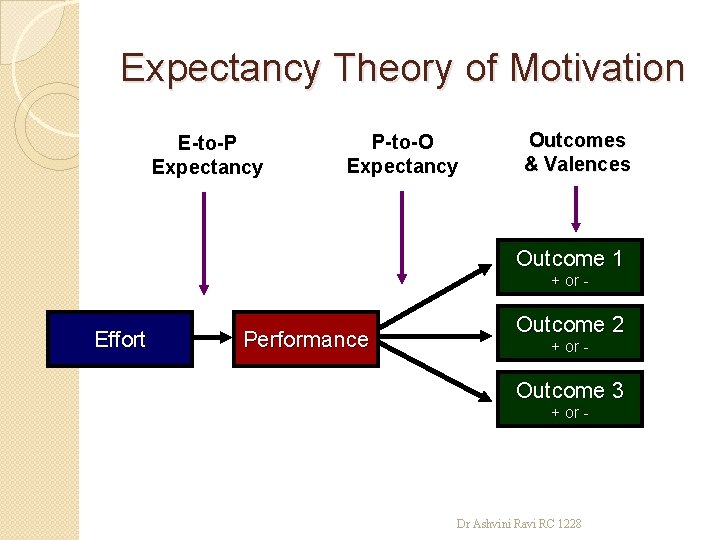
Expectancy Theory of Motivation E-to-P Expectancy P-to-O Expectancy Outcomes & Valences Outcome 1 + or - Effort Performance Outcome 2 + or - Outcome 3 + or - Dr Ashvini Ravi RC 1228
- Slides: 26