
Theories of Matter in Greek Philosophy The History
- Slides: 28
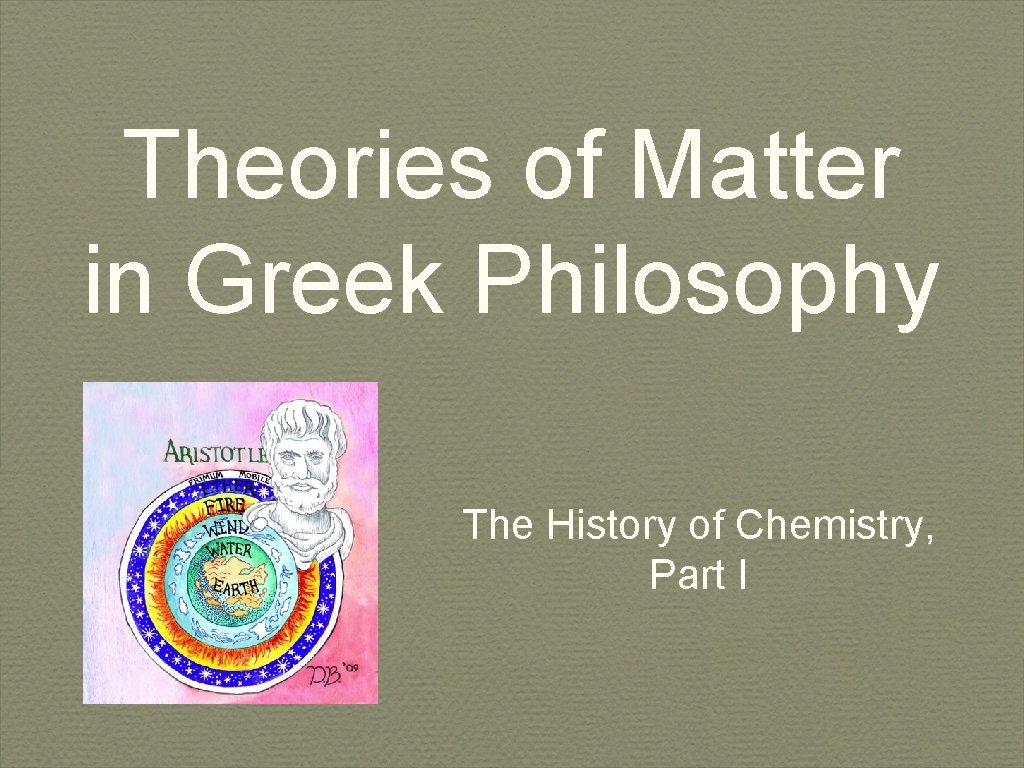
Theories of Matter in Greek Philosophy The History of Chemistry, Part I
Before 600 B. C. • Nature was unpredictable • Fate was determined by capricious gods • Truth was dogma handed down by priests
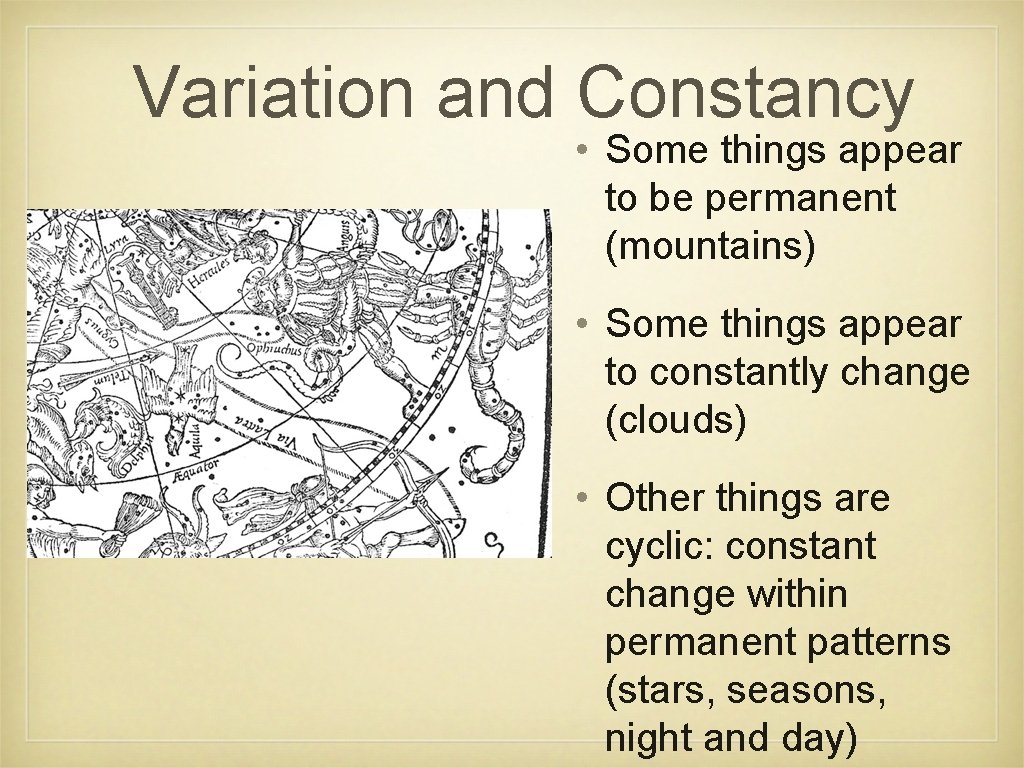
Variation and Constancy • Some things appear to be permanent (mountains) • Some things appear to constantly change (clouds) • Other things are cyclic: constant change within permanent patterns (stars, seasons, night and day)
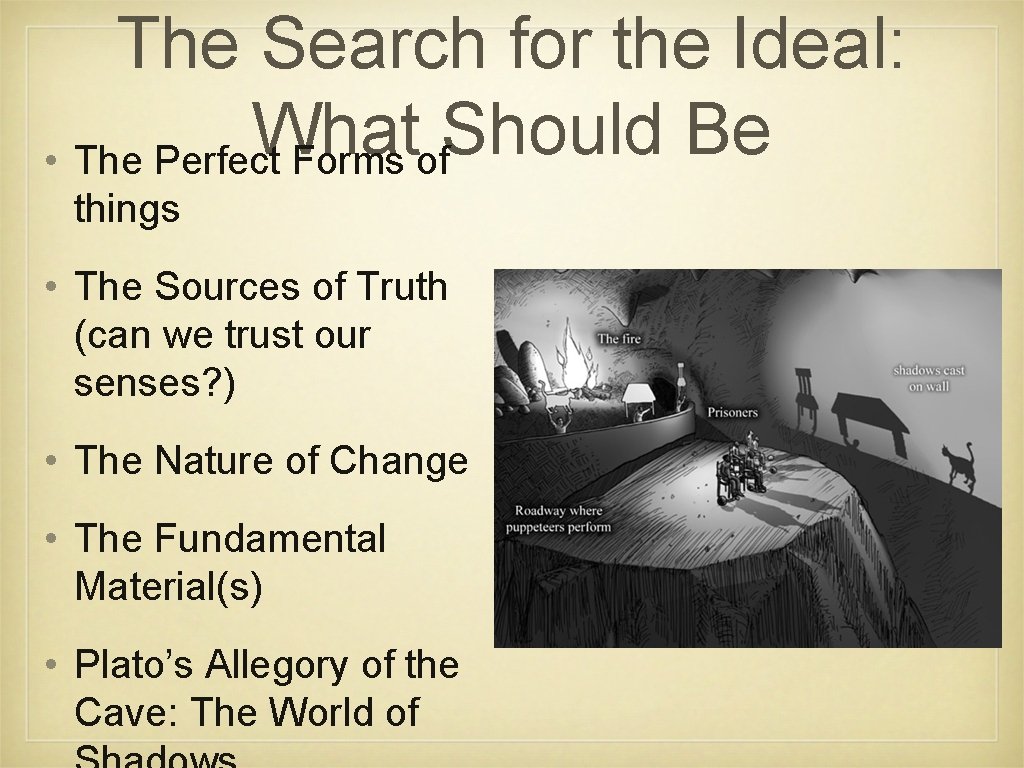
The Search for the Ideal: What Should Be • The Perfect Forms of things • The Sources of Truth (can we trust our senses? ) • The Nature of Change • The Fundamental Material(s) • Plato’s Allegory of the Cave: The World of
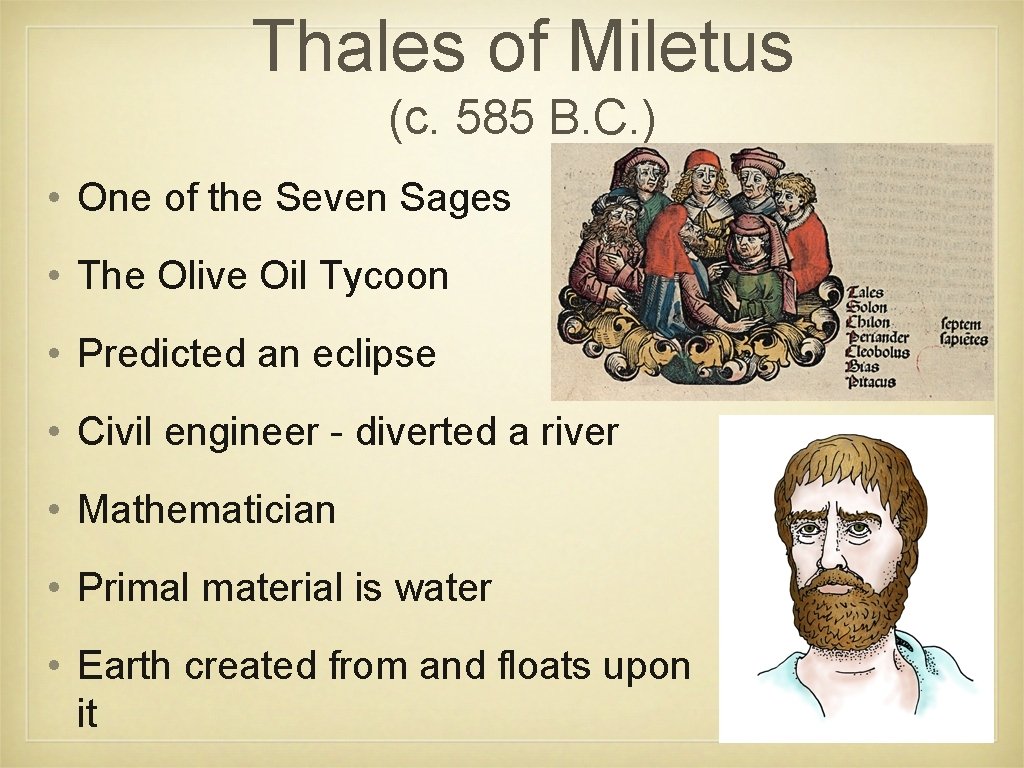
Thales of Miletus (c. 585 B. C. ) • One of the Seven Sages • The Olive Oil Tycoon • Predicted an eclipse • Civil engineer - diverted a river • Mathematician • Primal material is water • Earth created from and floats upon it
Anaximander (c. 570 B. C. ) • The Gnomon • Primal material is The Boundless (Apeiron) • Earth equidistant from all things, needs no support
Anaximenes (c. 550 B. C. ) • Primal material is air • Fire is rarefied air • Water is condensed air • Earth is very condensed air
Parmenides of Elea (c. 490 B. C. ) • Only two states: Being (Eon) and Non-being • Both states are permanent • Change is an illusion • The senses can’t be trusted; truth comes through reason alone
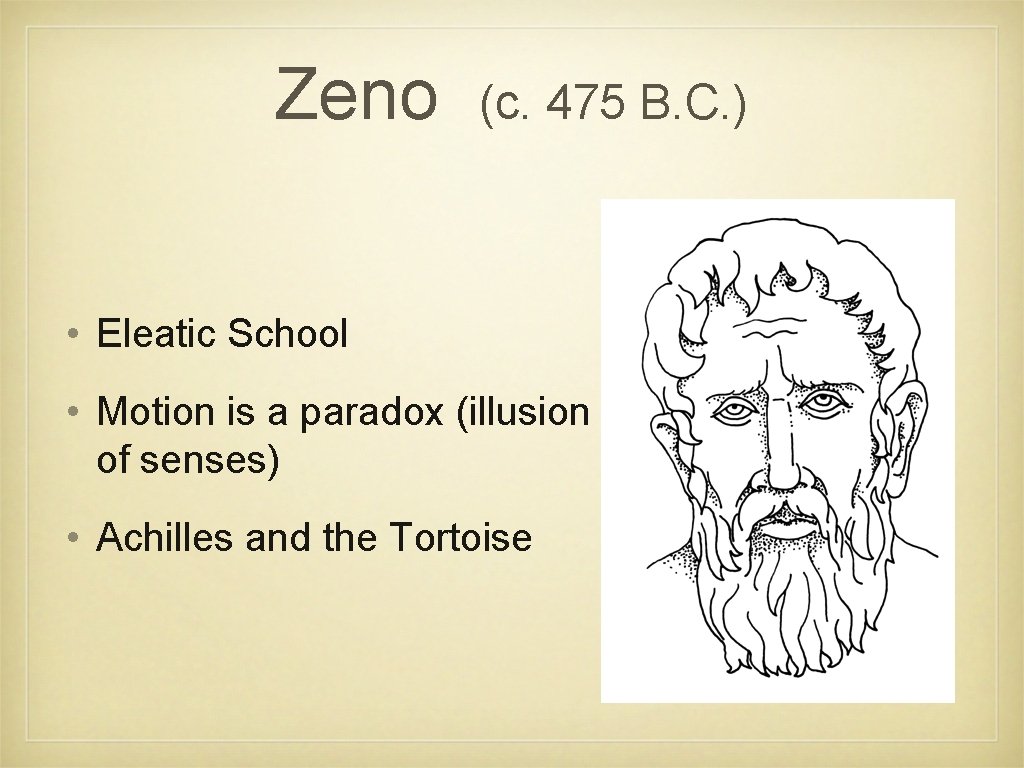
Zeno (c. 475 B. C. ) • Eleatic School • Motion is a paradox (illusion of senses) • Achilles and the Tortoise
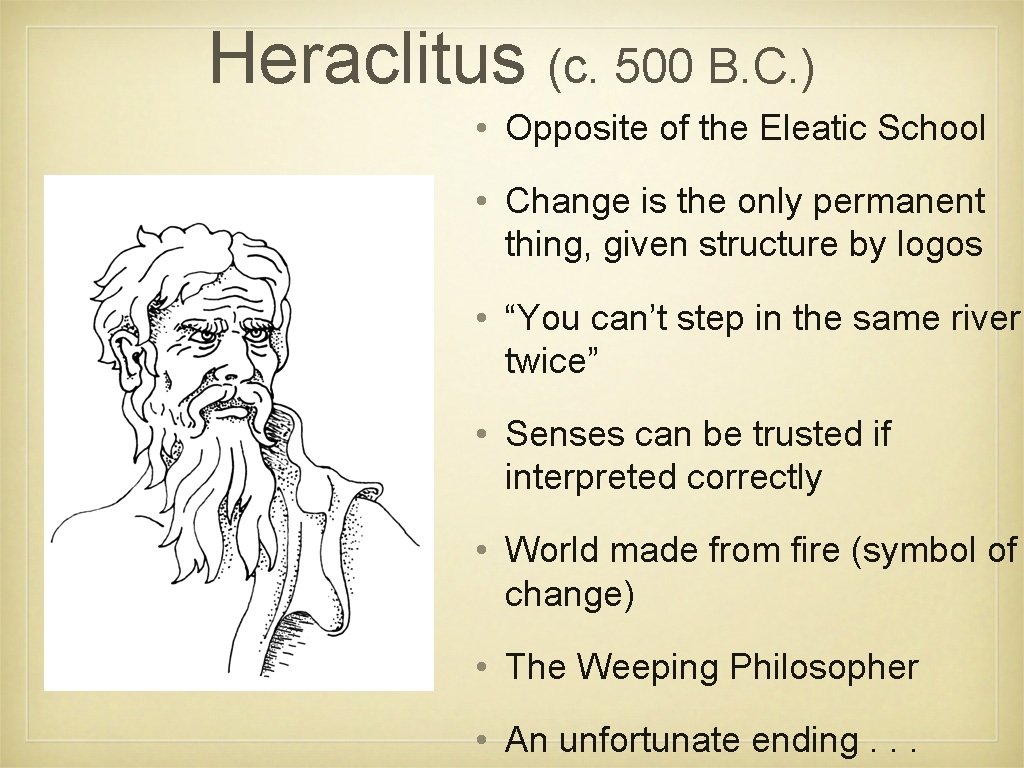
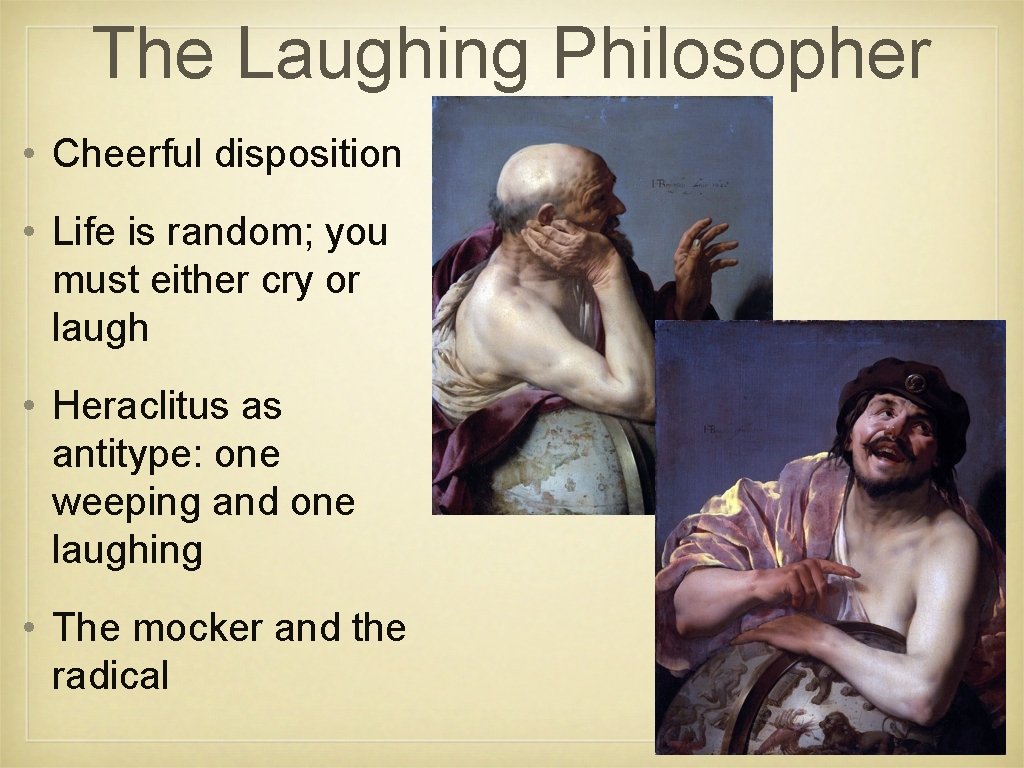
Heraclitus (c. 500 B. C. ) • Opposite of the Eleatic School • Change is the only permanent thing, given structure by logos • “You can’t step in the same river twice” • Senses can be trusted if interpreted correctly • World made from fire (symbol of change) • The Weeping Philosopher • An unfortunate ending. . .
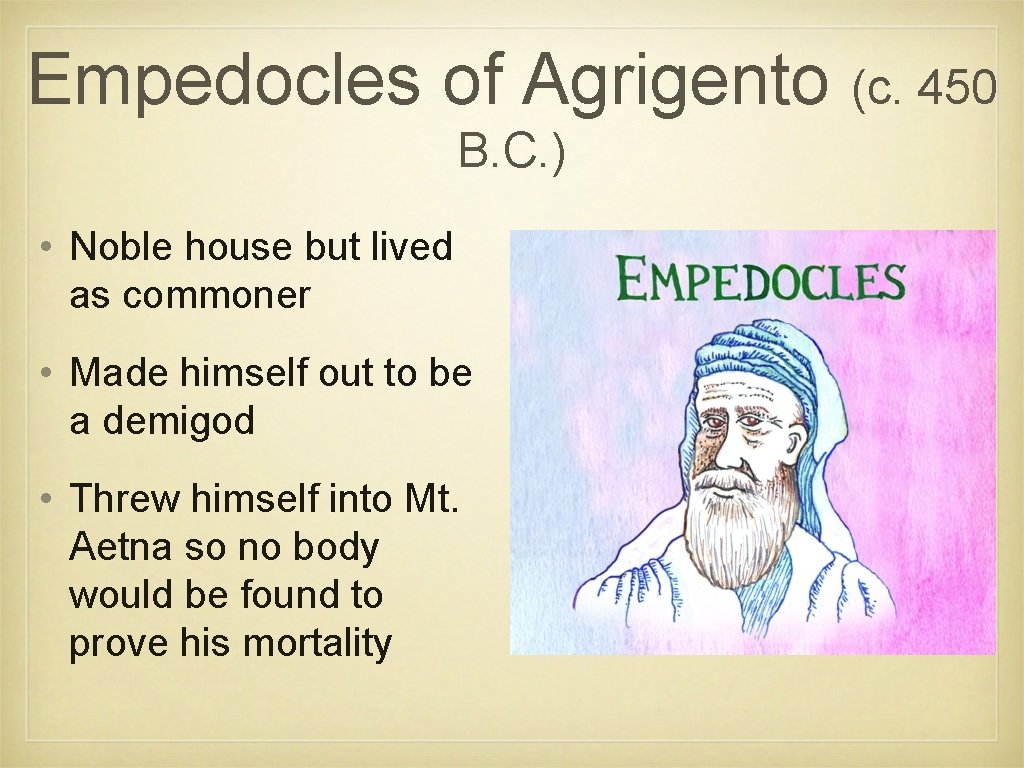
Empedocles of Agrigento (c. 450 B. C. ) • Noble house but lived as commoner • Made himself out to be a demigod • Threw himself into Mt. Aetna so no body would be found to prove his mortality
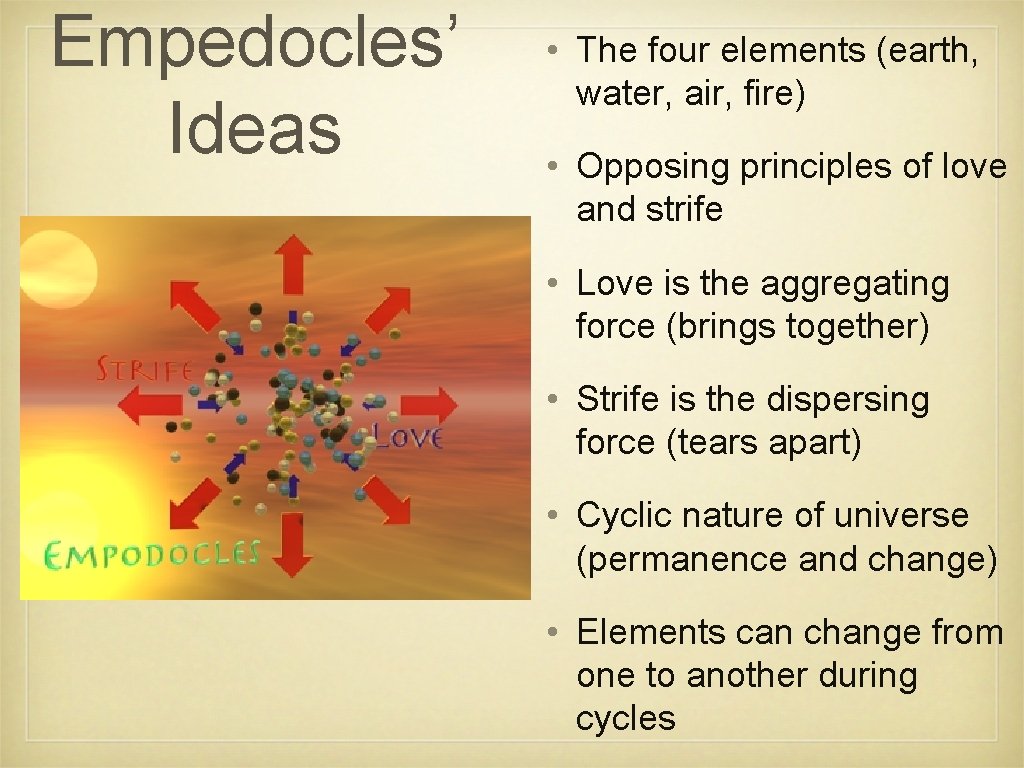
Empedocles’ Ideas • The four elements (earth, water, air, fire) • Opposing principles of love and strife • Love is the aggregating force (brings together) • Strife is the dispersing force (tears apart) • Cyclic nature of universe (permanence and change) • Elements can change from one to another during cycles
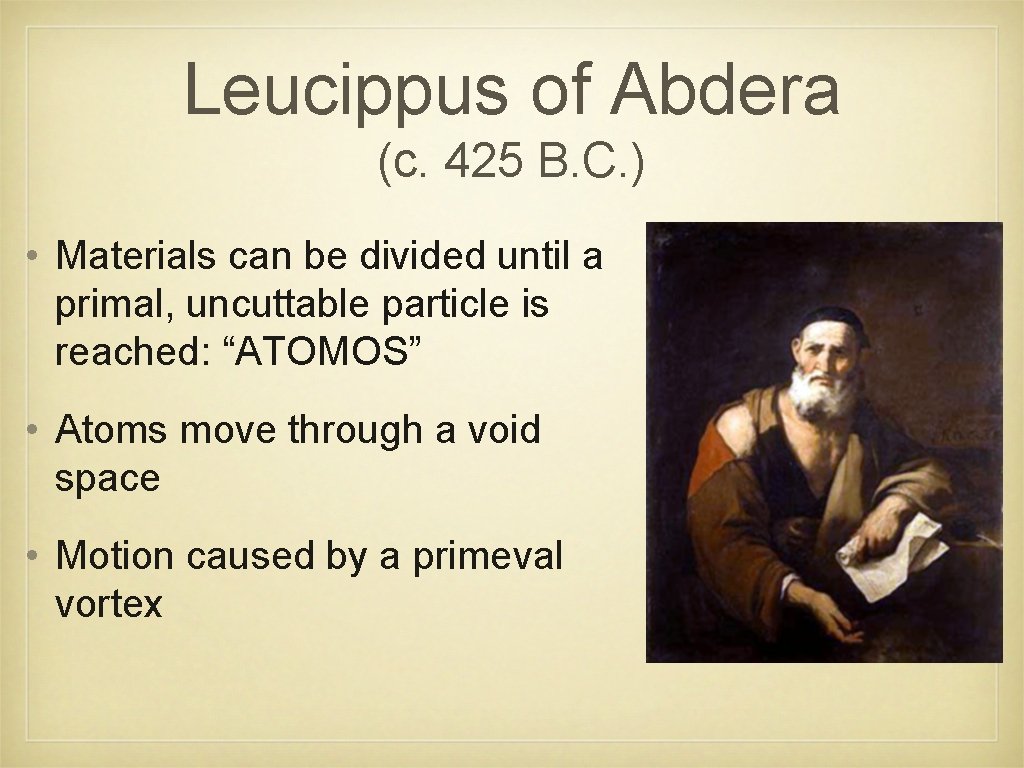
Leucippus of Abdera (c. 425 B. C. ) • Materials can be divided until a primal, uncuttable particle is reached: “ATOMOS” • Atoms move through a void space • Motion caused by a primeval vortex
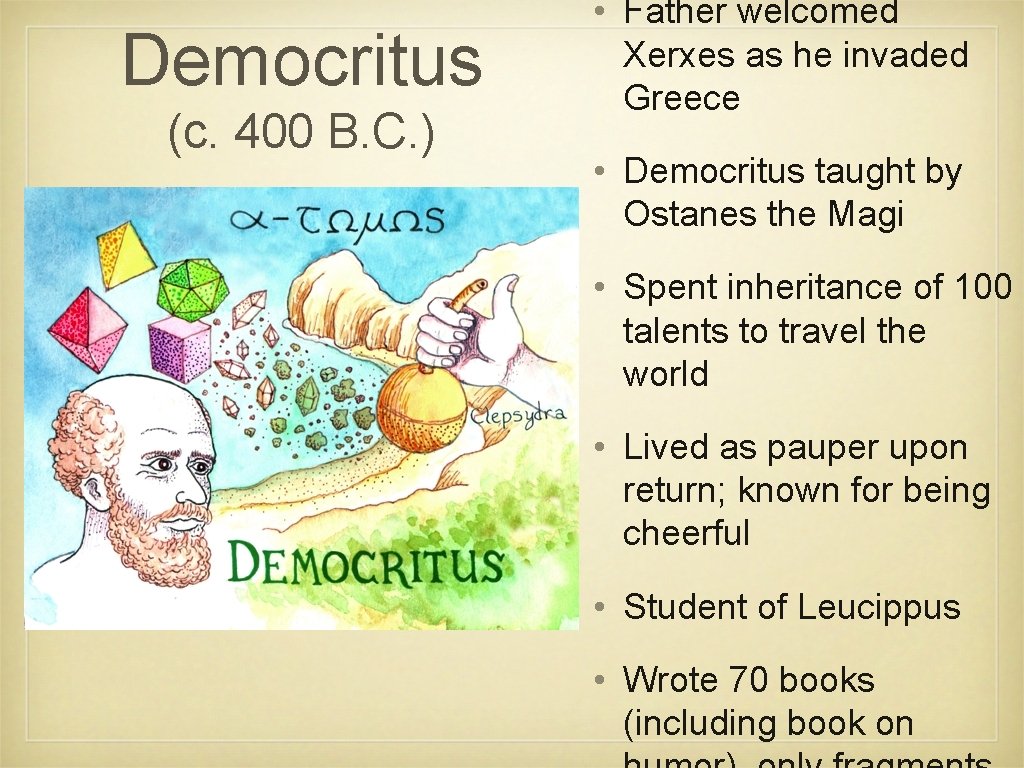
Democritus (c. 400 B. C. ) • Father welcomed Xerxes as he invaded Greece • Democritus taught by Ostanes the Magi • Spent inheritance of 100 talents to travel the world • Lived as pauper upon return; known for being cheerful • Student of Leucippus • Wrote 70 books (including book on
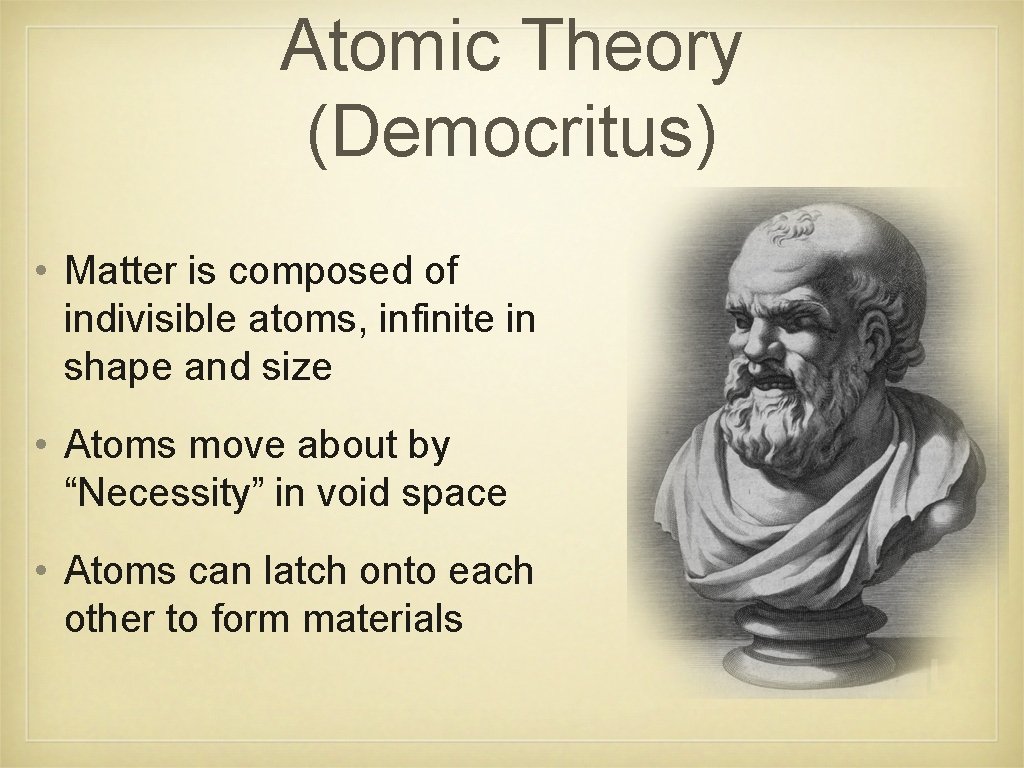
Atomic Theory (Democritus) • Matter is composed of indivisible atoms, infinite in shape and size • Atoms move about by “Necessity” in void space • Atoms can latch onto each other to form materials
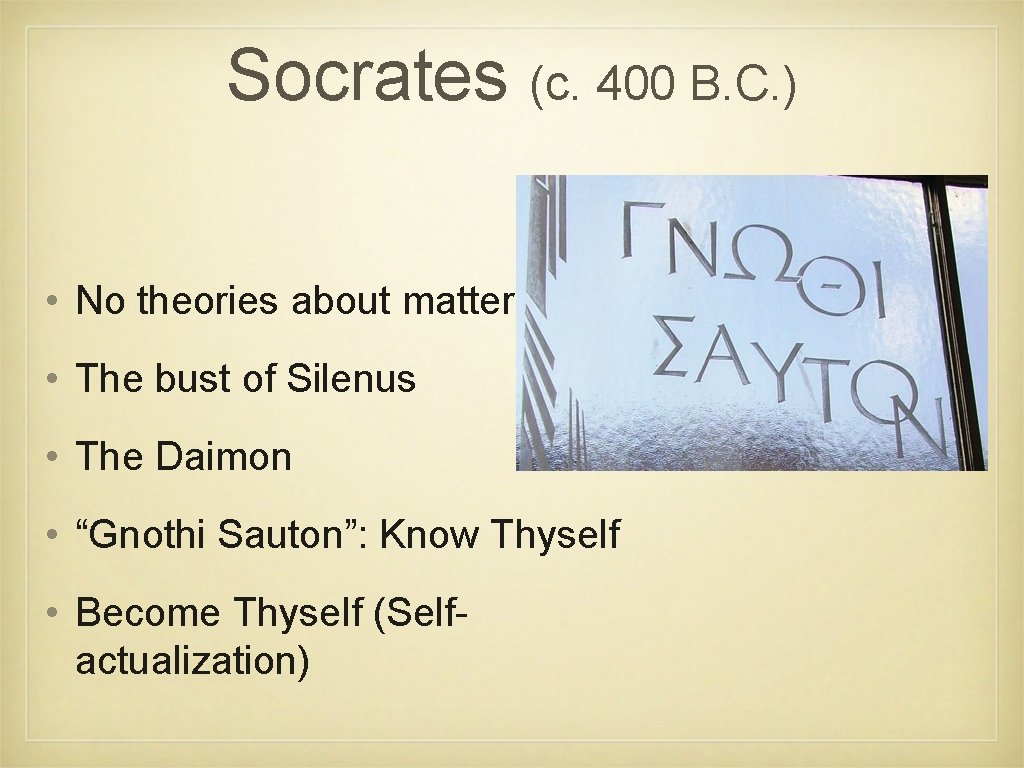
Socrates (c. 400 B. C. ) • No theories about matter • The bust of Silenus • The Daimon • “Gnothi Sauton”: Know Thyself • Become Thyself (Selfactualization)
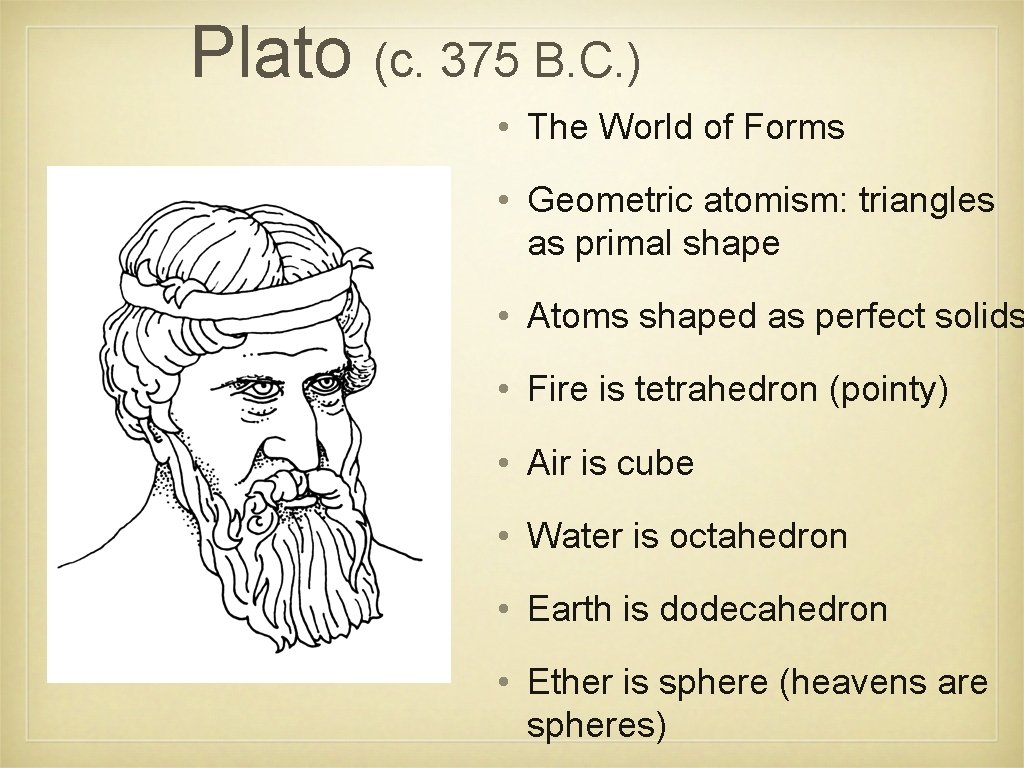
Plato (c. 375 B. C. ) • The World of Forms • Geometric atomism: triangles as primal shape • Atoms shaped as perfect solids • Fire is tetrahedron (pointy) • Air is cube • Water is octahedron • Earth is dodecahedron • Ether is sphere (heavens are spheres)
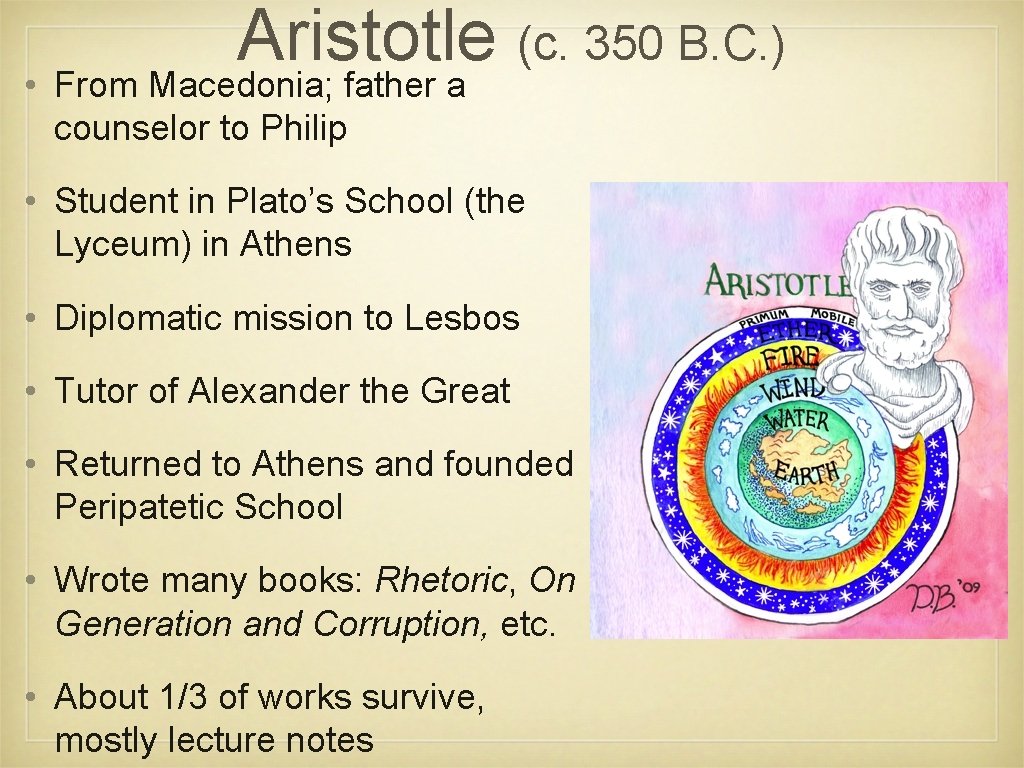
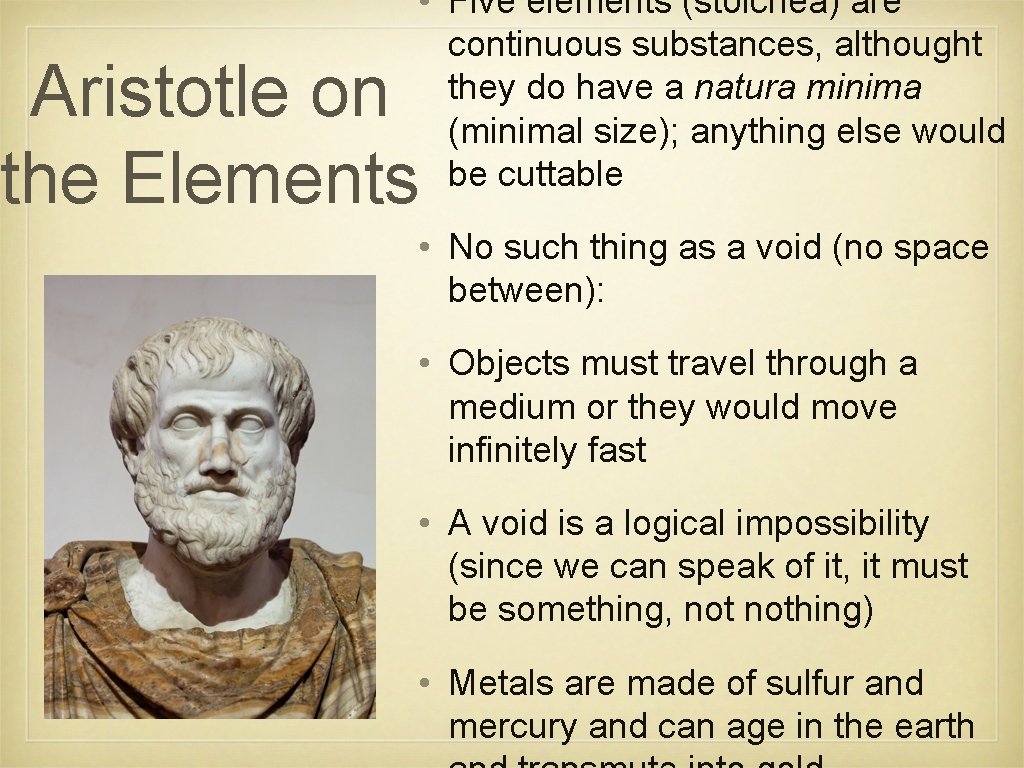
Aristotle (c. 350 B. C. ) • From Macedonia; father a counselor to Philip • Student in Plato’s School (the Lyceum) in Athens • Diplomatic mission to Lesbos • Tutor of Alexander the Great • Returned to Athens and founded Peripatetic School • Wrote many books: Rhetoric, On Generation and Corruption, etc. • About 1/3 of works survive, mostly lecture notes
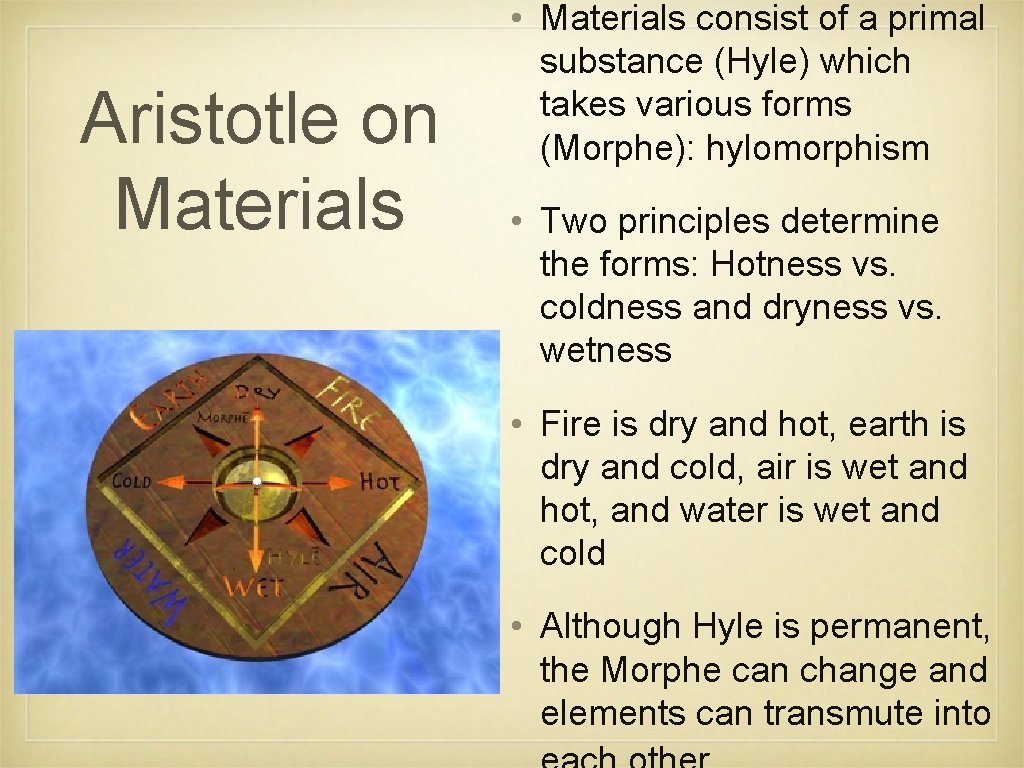
Aristotle on Materials • Materials consist of a primal substance (Hyle) which takes various forms (Morphe): hylomorphism • Two principles determine the forms: Hotness vs. coldness and dryness vs. wetness • Fire is dry and hot, earth is dry and cold, air is wet and hot, and water is wet and cold • Although Hyle is permanent, the Morphe can change and elements can transmute into
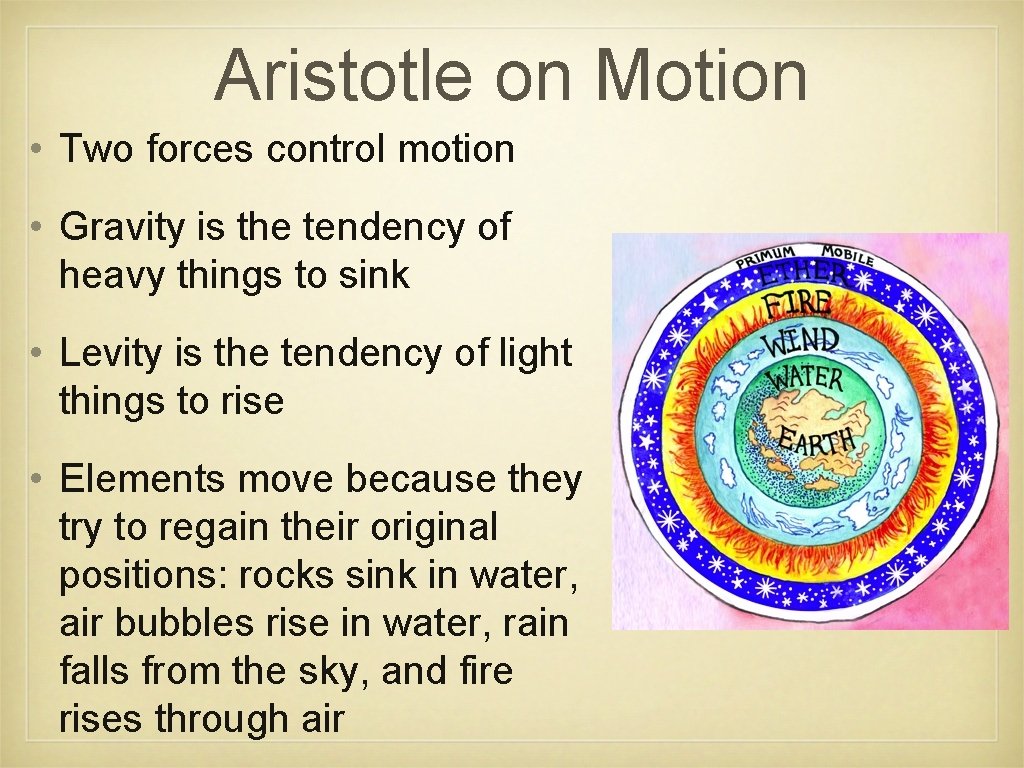
Aristotle on Motion • Two forces control motion • Gravity is the tendency of heavy things to sink • Levity is the tendency of light things to rise • Elements move because they try to regain their original positions: rocks sink in water, air bubbles rise in water, rain falls from the sky, and fire rises through air
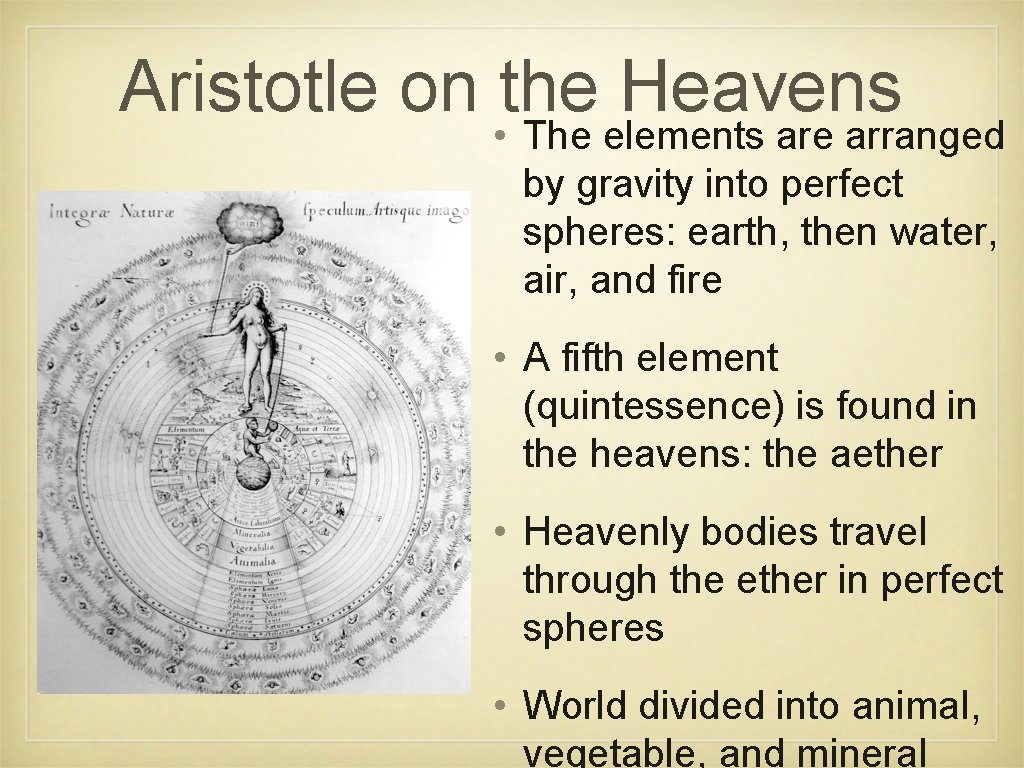
Aristotle on the Heavens • The elements are arranged by gravity into perfect spheres: earth, then water, air, and fire • A fifth element (quintessence) is found in the heavens: the aether • Heavenly bodies travel through the ether in perfect spheres • World divided into animal, vegetable, and mineral
• Five elements (stoichea) are continuous substances, althought they do have a natura minima (minimal size); anything else would be cuttable Aristotle on the Elements • No such thing as a void (no space between): • Objects must travel through a medium or they would move infinitely fast • A void is a logical impossibility (since we can speak of it, it must be something, nothing) • Metals are made of sulfur and mercury and can age in the earth
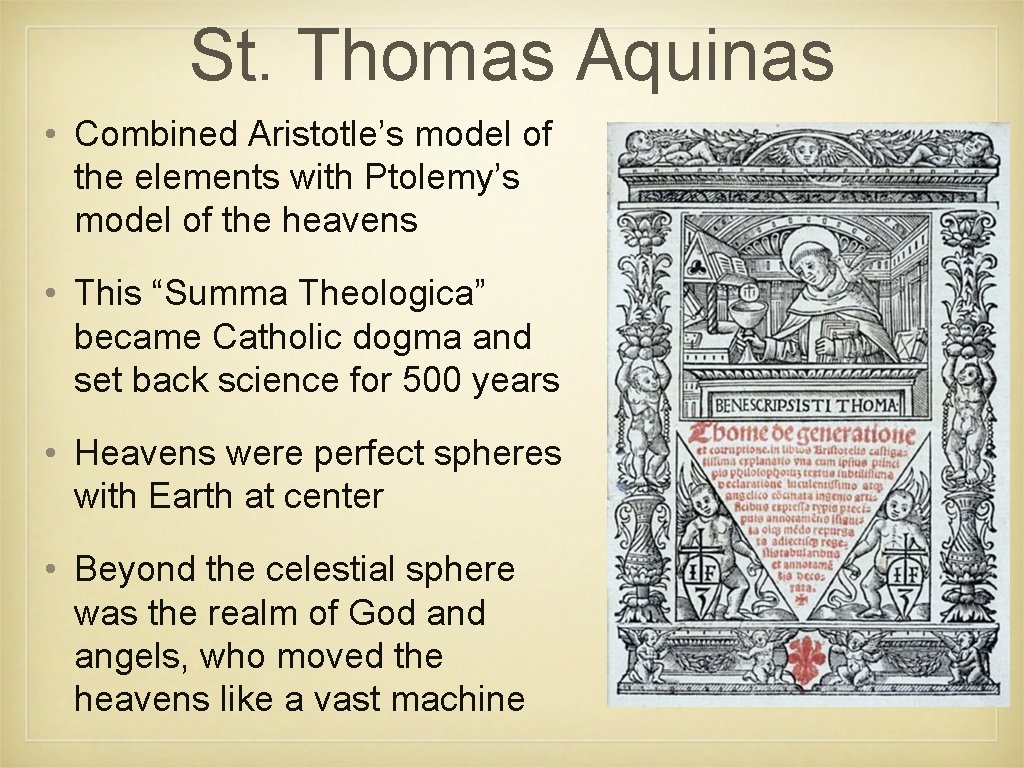
St. Thomas Aquinas • Combined Aristotle’s model of the elements with Ptolemy’s model of the heavens • This “Summa Theologica” became Catholic dogma and set back science for 500 years • Heavens were perfect spheres with Earth at center • Beyond the celestial sphere was the realm of God angels, who moved the heavens like a vast machine
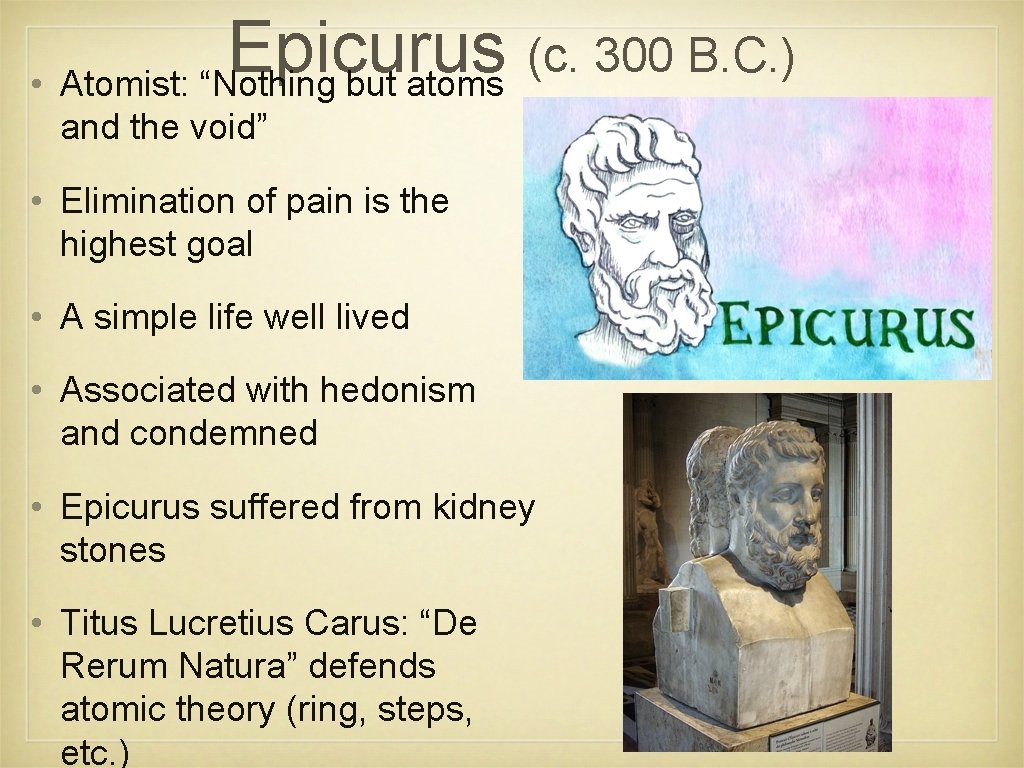
Epicurus (c. 300 B. C. ) • Atomist: “Nothing but atoms and the void” • Elimination of pain is the highest goal • A simple life well lived • Associated with hedonism and condemned • Epicurus suffered from kidney stones • Titus Lucretius Carus: “De Rerum Natura” defends atomic theory (ring, steps, etc. )
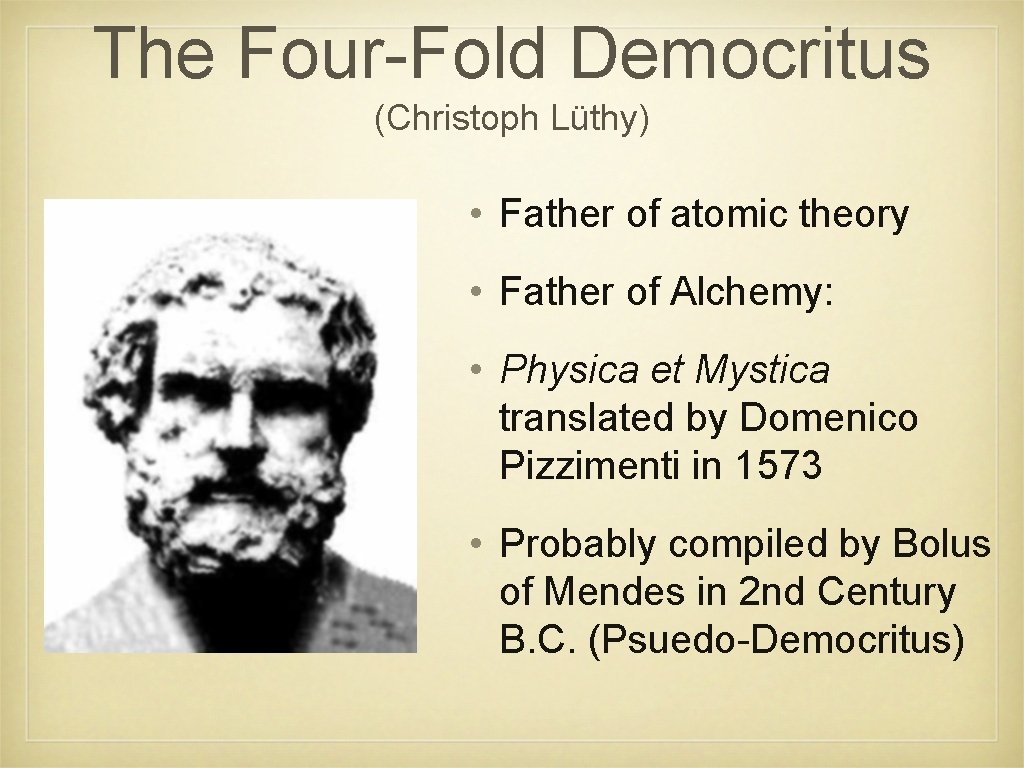
The Four-Fold Democritus (Christoph Lüthy) • Father of atomic theory • Father of Alchemy: • Physica et Mystica translated by Domenico Pizzimenti in 1573 • Probably compiled by Bolus of Mendes in 2 nd Century B. C. (Psuedo-Democritus)
The Laughing Philosopher • Cheerful disposition • Life is random; you must either cry or laugh • Heraclitus as antitype: one weeping and one laughing • The mocker and the radical
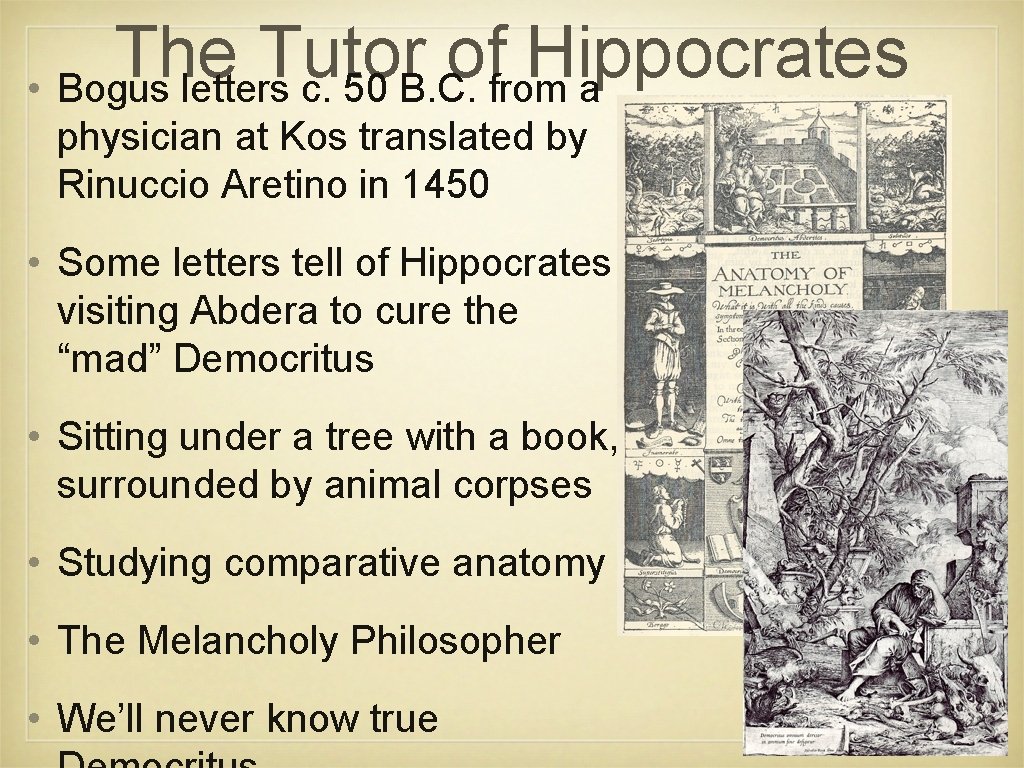
The Tutor of Hippocrates • Bogus letters c. 50 B. C. from a physician at Kos translated by Rinuccio Aretino in 1450 • Some letters tell of Hippocrates visiting Abdera to cure the “mad” Democritus • Sitting under a tree with a book, surrounded by animal corpses • Studying comparative anatomy • The Melancholy Philosopher • We’ll never know true
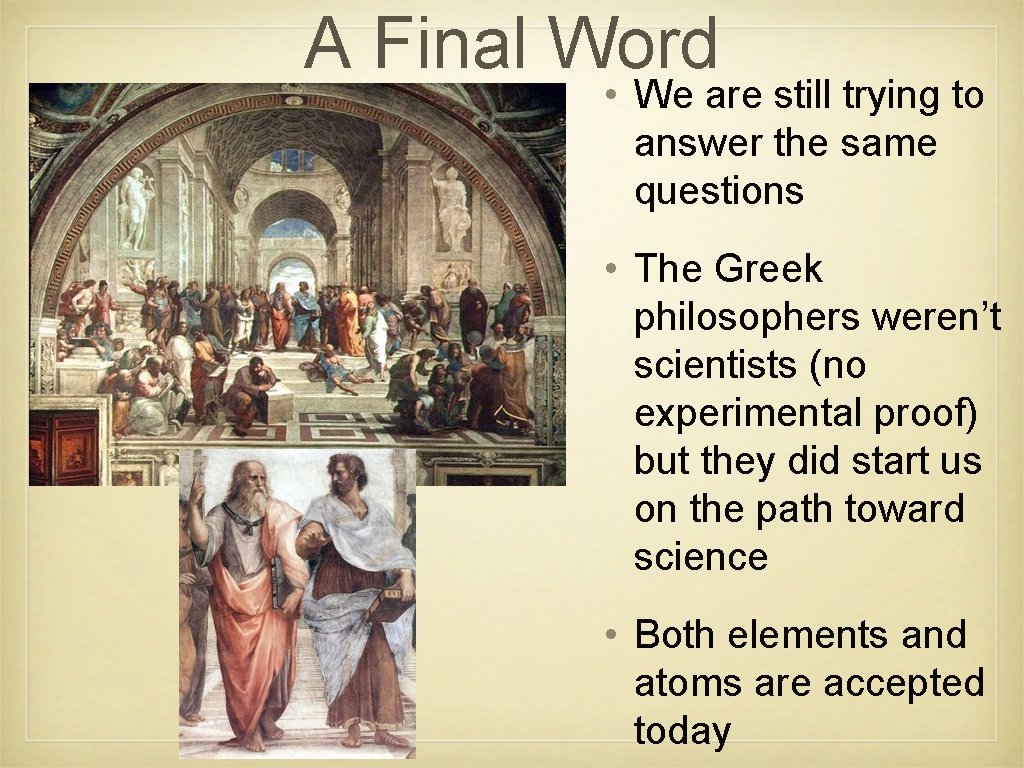
A Final Word • We are still trying to answer the same questions • The Greek philosophers weren’t scientists (no experimental proof) but they did start us on the path toward science • Both elements and atoms are accepted today