
Theories of Learning Classical Conditioning Degree Course Three
- Slides: 39
Theories of Learning: Classical Conditioning Degree Course (Three Years) Psychology Honours B. A. Part– I Honours Paper I : General Psychology Unit 4 by Dr. Ranjan Kumar Ph. D Assistant Professor of Psychology Ram Ratan Singh College, Mokama Patliputra University, Patna
Theories of Learning: Classical Conditioning Presented by Dr. Ranjan Kumar Ph. D in Clinical Psychology (RINPAS, Ranchi) M. Phil. in Medical & Social Psychology (RINPAS, Ranchi) PG Diploma in Guidance & Counselling (RIE, NCERT, BBSR) Assistant Professor of Psychology Ram Ratan Singh College, Mokama Patliputra University, Patna
Learning is any relatively permanent change in behaviour that occurs as a result of practice or experience. Three important components of the definition: • Learning is a change in behaviour • It is a change that takes place through practice or experience; changes due to growth or maturation are not learning. • the change must be relatively permanent.
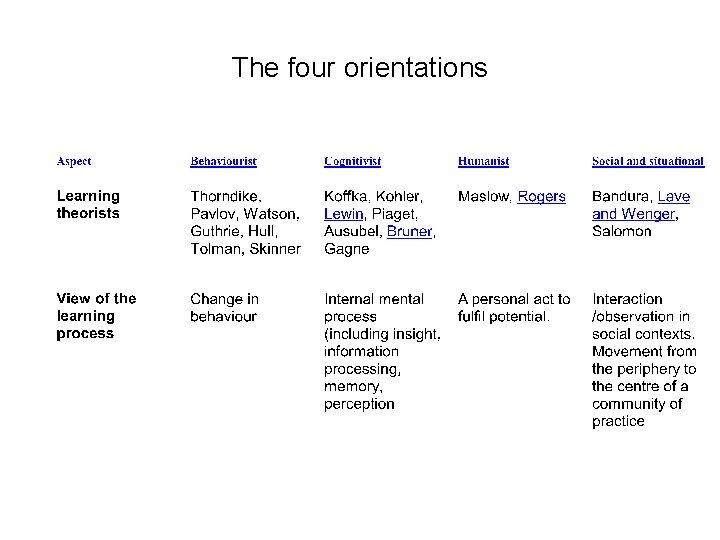
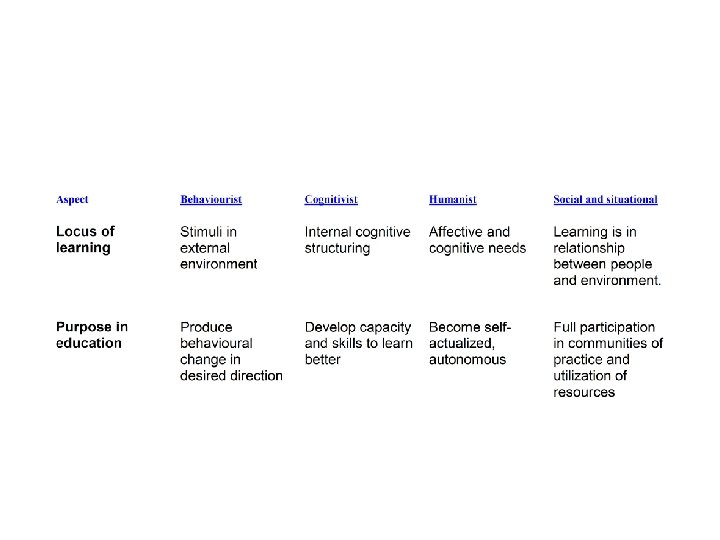
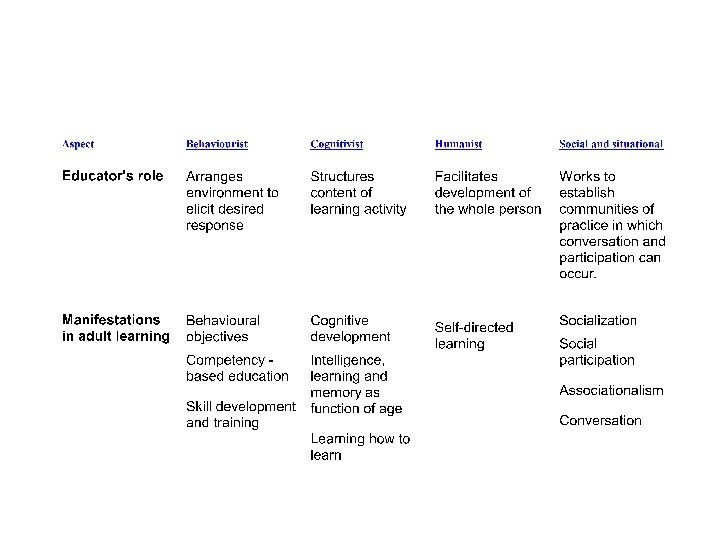
The four orientations can be summed up in the following figure: • • • Four orientations to learning Aspect Behaviourist Cognitivist Humanist Social and situational
The four orientations
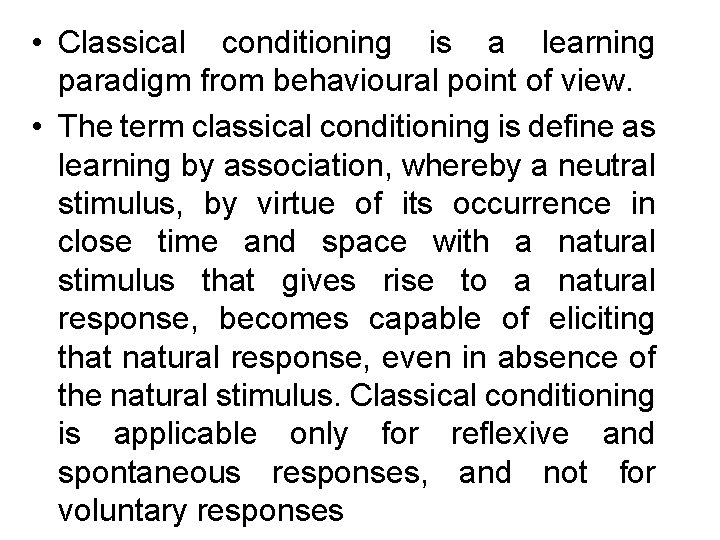
• Classical conditioning is a learning paradigm from behavioural point of view. • The term classical conditioning is define as learning by association, whereby a neutral stimulus, by virtue of its occurrence in close time and space with a natural stimulus that gives rise to a natural response, becomes capable of eliciting that natural response, even in absence of the natural stimulus. Classical conditioning is applicable only for reflexive and spontaneous responses, and not for voluntary responses
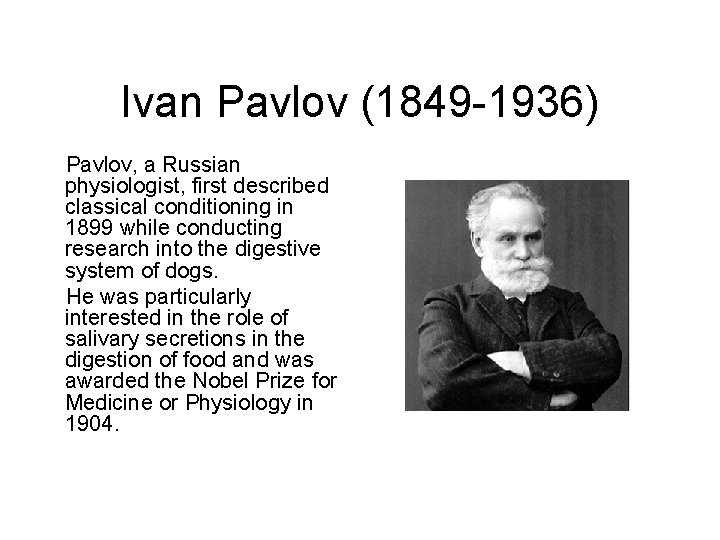
Ivan Pavlov (1849 -1936) Pavlov, a Russian physiologist, first described classical conditioning in 1899 while conducting research into the digestive system of dogs. He was particularly interested in the role of salivary secretions in the digestion of food and was awarded the Nobel Prize for Medicine or Physiology in 1904.
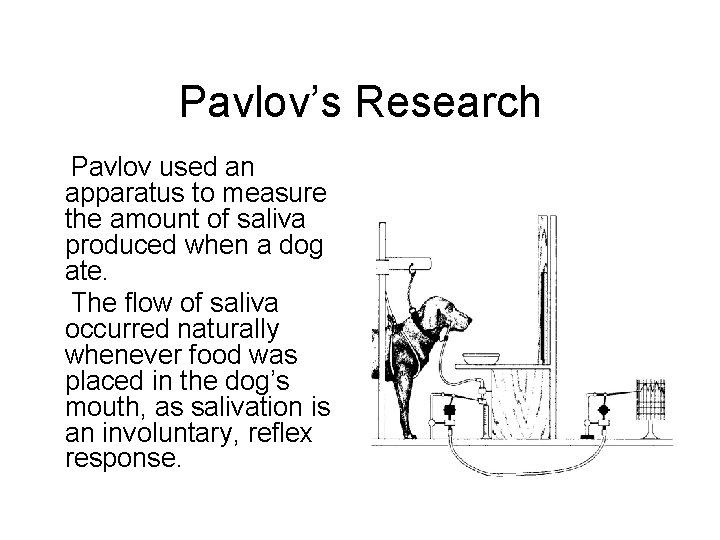
Pavlov’s Research Pavlov used an apparatus to measure the amount of saliva produced when a dog ate. The flow of saliva occurred naturally whenever food was placed in the dog’s mouth, as salivation is an involuntary, reflex response.
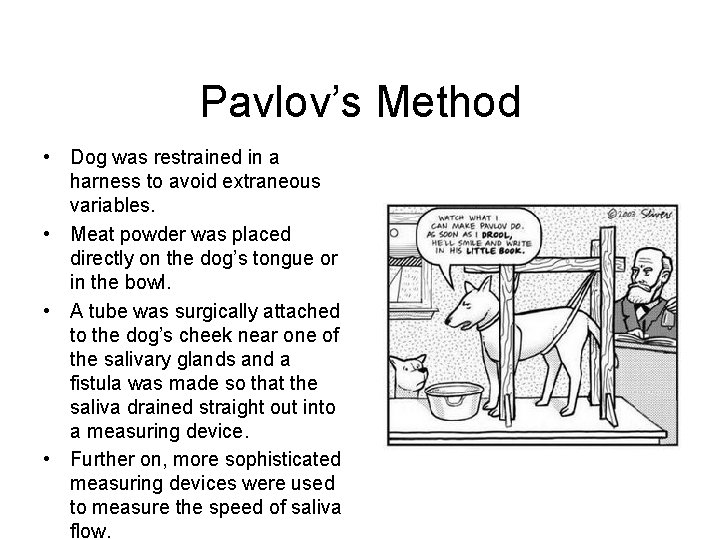
Pavlov’s Method • Dog was restrained in a harness to avoid extraneous variables. • Meat powder was placed directly on the dog’s tongue or in the bowl. • A tube was surgically attached to the dog’s cheek near one of the salivary glands and a fistula was made so that the saliva drained straight out into a measuring device. • Further on, more sophisticated measuring devices were used to measure the speed of saliva flow.
What did Pavlov observe? • Pavlov observed that the dogs salivated not only at the sight of the food, but also at the sight or sound of the lab tech who had been preparing the food. • Pavlov was intrigued by these unintentional observations & he decided to conduct further experiments. • His subsequent experiments provided clear evidence of a form of learning based on the repeated association of 2 different stimuli. • A stimulus is any event that elicits a response from an organism. • A response is a reaction by an organism to a stimulus. In Pavlov’s experiment, the stimulus of food initially produced the response of salivation. • Eventually the sight or sound of the tech became the stimulus.
How is this response explained? • The salivation response is controlled by the autonomic division of the PNS. • Involuntary. • The salivation had become associated with, and conditioned to, a new stimulus – the lab tech. • This process is in essence the process of classical conditioning.
What is Classical Conditioning? • Also known as respondent conditioning refers to a form of learning that occurs through the repeated association of 2 or more different stimuli. • Learning is only said to have occurred when a particular stimulus consistently produces a response that it did not previously produce. • In classical condition, a response that is automatically produced by one stimulus becomes associated, or linked, with another stimulus that would not normally produce this response.
Key Elements of Classical Conditioning There are 4 key elements that are used to describe the process of classical conditioning.
1. Unconditioned Stimulus Unconditioned stimulus (UCS): The natural stimulus that elicits a natural response. In Pavlov’s experiment, the meat powder was the UCS. • The unconditioned stimulus (UCS) is any stimulus that consistently produces a particular, naturally occurring, automatic response. • In Pavlov’s experiment, the UCS was the food (meat powder).
2. Unconditioned Response • Unconditioned response (UCR): The natural response elicited to the natural stimulus. In Pavlov’s experiment, the salivation was the UCR. • The unconditioned response (UCR) is the response that occurs automatically when the UCS is presented. • A UCR is a reflexive, involuntary response that is predictably caused by a UCS. • In Pavlov’s experiments, the UCR was the salivation.
3. Conditioned Stimulus • • • Conditioned stimulus (CS): The neutral stimulus that does not naturally elicit the target response, but may do so after being associated with the UCS for a number of times. In Pavlov’s experiment, the light or the sound of the bell was the CS. The conditioned stimulus (CS) is the stimulus that is neutral at the start of the conditioning process and does not normally produce the UCR. Yet, through repeated association with the UCS, the CS triggers a very similar response to that caused by the UCS. Association refers to the pairing or linking of 1 stimulus with another stimulus. In Pavlov’s experiments, the bell and subsequently other stimuli were initially neutral, but each became associated with the meat powder. Once conditioning has occurred and the originally neutral stimulus produces the response of salivating, then it is called the CS.
4. Conditioned Response • The target response similar to the UCR that originally occurred to the UCS only, but after conditioning occurred to CS, even in absence of the UCS. • The conditioned response (CR) is the learned response that is produced by the CS. • The CR occurs after the CS has been associated with the UCS. • The behaviour involved in a CR is very similar to that of the UCR, but it is triggered by the CS alone. • Pavlov’s dogs displayed a CR (salivation) only when they began to salivate to a CS. • When the dog responded to a CS, such as the sound of a bell, classical conditioning had taken place because salivation would not be a usual response to the sound of a
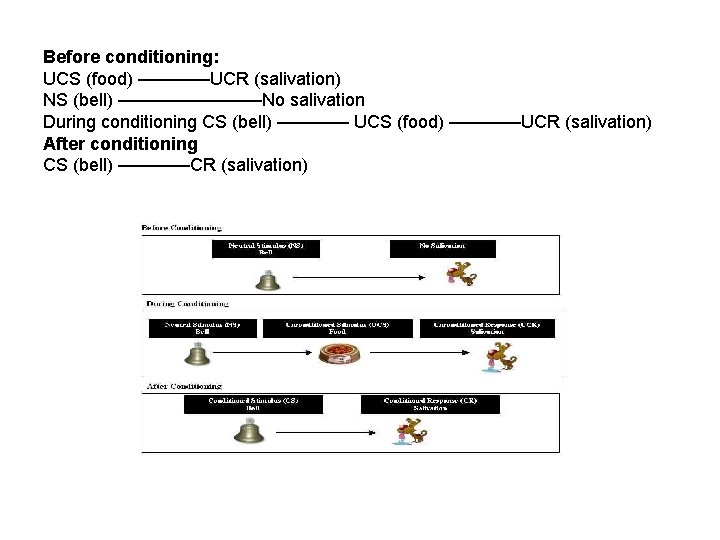
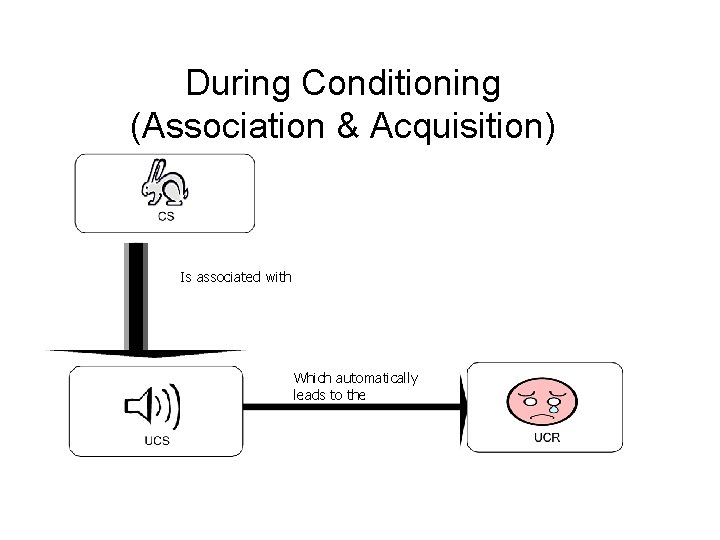
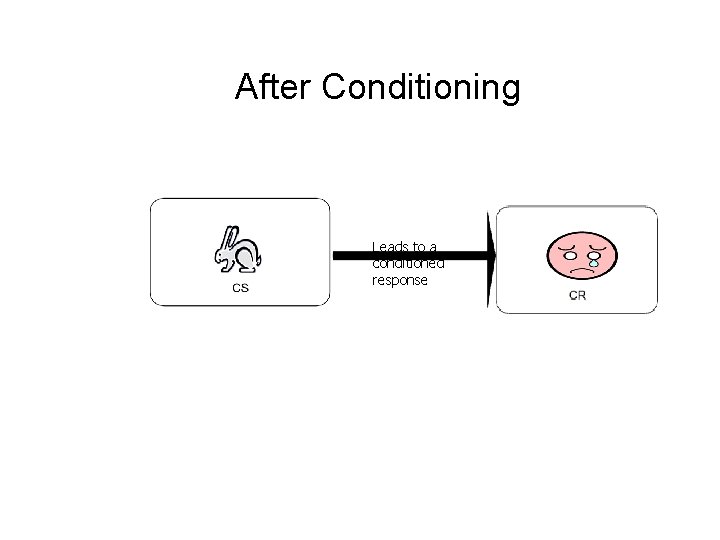
Before conditioning: UCS (food) ————UCR (salivation) NS (bell) ————No salivation During conditioning CS (bell) ———— UCS (food) ————UCR (salivation) After conditioning CS (bell) ————CR (salivation)
Key Processes in Classical Conditioning Pavlov distinguished several key processes that are involved in classical conditioning. These are known as: • Acquisition, extinction, stimulus, generalisation, stimulus discrimination and spontaneous recovery.
Acquisition • Each paired presentation of the CS with UCS is referred to as a trial. • Acquisition is the overall process during which the organism learns to associate 2 events. • The rate of learning is often very fast in the early stages of the acquisition phase. • Timing of the CS and UCS pairing is critical. • Pavlov found that a very short time between presentations of the 2 stimuli was most effective. • Acquisition is more rapid when the CS occurs and remains present until the UCS is presented. • The end of the acquisition stage is said to occur when the CS alone produces the CR.
Extinction • A conditioned stimulus-response association can fade over time or disappear altogether. • Extinction is the gradual decrease in the strength or rate of a CR that occurs when the UCS is no longer presented. • Extinction is said to have occurred when a CR no longer occurs following presentation of the CS. • E. g. Pavlov’s dogs eventually ceased salivating (CR) in response to the bell (CS) presented alone after a number of trials in which the food (UCS) did not follow the sound of the bell). • There is some variation between individuals in the rate at which extinction of the same conditioned response will occur. • There is also considerable variation between the rates at which different response will be extinguished.
Spontaneous Recovery • Extinction of a CR is not always permanent. • In CC, spontaneous recovery is the reappearance of a CR when the CS is presented, following a rest period after the CR appears to have been extinguished. • Spontaneous recovery does not always occur and when it does it is often short-lived. • Furthermore the CR tends to be weaker than it was originally.
Stimulus Generalisation • • • Pavlov observed that his dogs salivated to other noises that sounded like a bell. This is known as stimulus generalisation which is the tendency for another stimulus to produce a response that is similar to the CR. The greater the similarity between stimuli, the greater the possibility that a generalisation will occur. E. g. is a stimulus generalisation to the sounds of a bell occurred with one of Pavlov’s dogs, the dog might also salivate in response to the ringing of the front-door bell. However, the amount of saliva produced by the dog would tend to be less than the amount produced by the original bell to which the dog was conditioned
Stimulus Discrimination • Stimulus discrimination occurs when a person or animal responds to the CS only, but not to any other stimulus that is similar to the CS. • E. g. in a CC experiment, stimulus discrimination would be observed when a dog salivated only in response to the sound of the ‘experimental bell’, and not in response to any other similar sound such as a door bell.
Classical Conditioning of Behaviour • Behaviours that have been classically conditioned may occur so automatically that they appear to be reflexive. • CC behaviours are like reflexes in that they occur involuntarily, but they are unlike reflexes in that they are learned. • A conditioned reflex is an automatic response that occurs as the result of previous experience. • A conditioned reflex involves little conscious thought or awareness on the part of the learner. • E. g. listening for thunder when you see lightning.
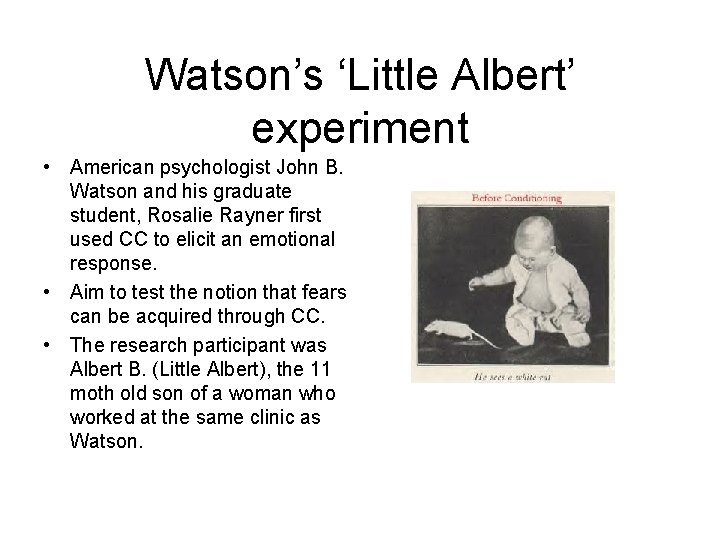
Watson’s ‘Little Albert’ experiment • American psychologist John B. Watson and his graduate student, Rosalie Rayner first used CC to elicit an emotional response. • Aim to test the notion that fears can be acquired through CC. • The research participant was Albert B. (Little Albert), the 11 moth old son of a woman who worked at the same clinic as Watson.
How was Little Albert conditioned to hate the rat? • They placed him on a mattress in a room where a white lab rat (CS) was within reaching distance. • Albert showed no initial fear of it and played with it. • They then struck a hammer on a steel bar behind Albert (loud noise, UCS) and Albert began to cry. • For the next 17 days Watson and Rayner began a series of fearconditioning experiments. • They also conducted tests to find out if Albert’s fear response could be generalised. • Albert also seemed to fear a white rabbit, a dog and a seal skin coat.
During Conditioning (Association & Acquisition) Is associated with Which automatically leads to the
After Conditioning Leads to a conditioned response
Ethical considerations? • Albert’s mother left her job and Watson and Rayner reported that they were denied the opportunity to remove the conditioned emotional responses. • This has been disputed, as it is believed they were aware of Albert’s departure a month in advance. • Some believe Albert’s mother may not have been fully aware of the experimental condition and effect on her son. • Informed consent is not mentioned in Watson original article, so a judgement cannot be made about this ethical issue. • Also possible that Albert was vulnerable to psychological harm as a result of the experiments. • Yet Albert was subjected to severe anxiety and distress & the experimenters made not attempt to end the experiment and attend to his distress in an appropriate way.
Albert after the experiments? • Some psychologists have suggested that Albert’s conditioned fears might have disappeared over time, however it is reasonable to assume that Albert was not only emotionally traumatised by the experimental procedures to which he was subjected, but was also likely to have suffered some kind of lasting psychological harm. • Experiments using any human participant in this way would be considered unethical today and would not be permitted.
Classical Conditioning in Practice CC is used in a range of different settings, many of which are concerned with therapeutic benefits. These include: Aversion therapy and systematic desensitisation.
Aversion Therapy • When people develop behaviours that are habitual and harmful to themselves or to others, such as substance dependence, it is difficult to help them permanently stop the unwanted behaviour. • Aversion therapy is a form of behaviour therapy that applies CC principles to inhibit or discourage undesirable behaviour by associating it with an aversive stimulus. • The aim of aversion therapy is to suppress or weaken undesirable behaviour. • E. g. to stop unwanted behaviour such as nail biting, we might paint our nails with a foul-tasting substance. • The association between nail biting and the unpleasant taste is learned quickly.
Systematic desensitisation • Developed on the 1950 s by psychiatrist Joseph Wolpe, systematic desensitisation is a kind of behaviour therapy that attempts to replace an anxiety or fear response with a relaxation response through a classical conditioning procedure. • The client associates being relaxed with the anxiety or fear-arousing stimulus by means of a series of graded steps. • Basic principle is that the client is gradually desensitised to anxiety or fear-arousing objects, activities or situations.
Procedure cont… • Once the steps are ranked, therapist then teaches the person deep muscle relaxation and asks them to imagine the least frightening scene on the list and so on… • In the end the person learns to imagine the most frightening scene without becoming afraid. • The best results seem to occur using real life desensitisation, such as therapist sitting in a plane with the person or introducing them to the pilot for reassurance. • By allowing the client to confront the phobia under such supportive circumstances, the fear of flying is eventually overcome.
Enuresis (bedwetting) • Some children continue to wet their beds long after they are toilet trained and out of nappies. • This is known an enuresis (persistent involuntary discharge of urine after the age of when bladder control is expected) • Some cases of enuresis are caused by physiological problems (e. g. weakness of muscles near bladder), yet the condition is mostly associated with: – problems during toilet training – stressful situations such as hospitalisation – underlying emotional problems relation to entering school or the birth of a sibling.
Ethical issues in conditioning behaviour • All research with human participants must abide by a set of ethical principles and guidelines called the National Statement on Ethical Conduct in Research Involving Humans. • CC research demands particular attention as learning happens passively and a participant might unknowingly and unwillingly acquire new behaviours. • Watson and Rayner’s research with Little Albert would not be approved by an ethics committee today for various reasons, such as: – – – Beneficence Respect for persons Participant’s rights Voluntary participation Confidentiality • With a partner, discuss and then outline in your exercise books, why each of the above dot points were not adhered to by Watson and Rayner.