
Theories of Leadership How They Differ Between Cultures
Theories of Leadership: How They Differ Between Cultures Desiree N. Van Campen October 19, 2019
Why are we here? • • Information Thought-provoking discussion Inspiration Passion “Leadership is not about a title or a designation. It's about impact, influence and inspiration. ” -Robin S. Sharma
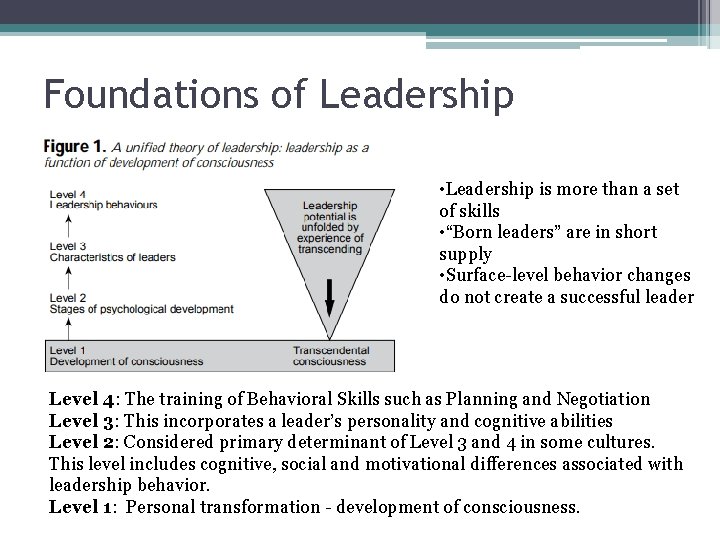
Foundations of Leadership • Leadership is more than a set of skills • “Born leaders” are in short supply • Surface-level behavior changes do not create a successful leader Level 4: The training of Behavioral Skills such as Planning and Negotiation Level 3: This incorporates a leader’s personality and cognitive abilities Level 2: Considered primary determinant of Level 3 and 4 in some cultures. This level includes cognitive, social and motivational differences associated with leadership behavior. Level 1: Personal transformation - development of consciousness.

What is Transcendent Leadership? “It suggests a radical paradigm shift in the practice of management development – from the dominant emphasis on the superficial level of behavioral skills to the deeper and more powerful level of developing consciousness” (Harung, Heaton & Alexander, 1995)

Implicit Leadership Theory “A person’s implicit leadership theory (ILT) is based on beliefs on how leaders generally behave and what is expected of them” (Eden and Leviathan, 1975) How does this theory fit in to what makes a successful leader in the eyes of others? • The outcomes of salient events, such as a successful business turnaround • The observed leader behavior(s) and one’s personal theory of leadership (Nichols, T. W. & Erakovich, R. , 2013)
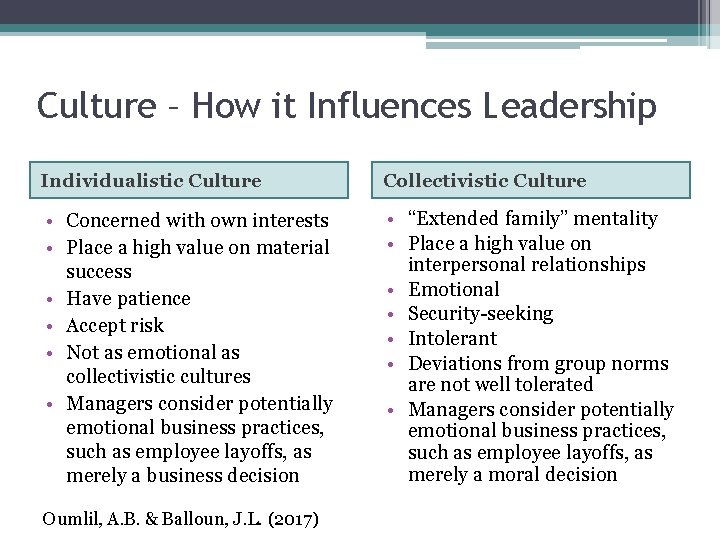
Culture – How it Influences Leadership Individualistic Culture Collectivistic Culture • Concerned with own interests • Place a high value on material success • Have patience • Accept risk • Not as emotional as collectivistic cultures • Managers consider potentially emotional business practices, such as employee layoffs, as merely a business decision • “Extended family” mentality • Place a high value on interpersonal relationships • Emotional • Security-seeking • Intolerant • Deviations from group norms are not well tolerated • Managers consider potentially emotional business practices, such as employee layoffs, as merely a moral decision Oumlil, A. B. & Balloun, J. L. (2017)
Cultural Awareness “Someone's cultural awareness is their understanding of the differences between themselves and people from other countries or other backgrounds, especially differences in attitudes and values. ” Cross-Cultural Training (CCT) Results in: • • • Greater self-confidence Better cross-cultural adjustment More accurate cross-cultural perceptions Stronger cross-cultural relational skills Better job performance (Park & Harrison, 1993)
Cultural Awareness How to Teach CCT • “Intellectual" approach in which lectures, readings, films and other multimedia presentations are used to transmit information • “Area simulation" approach which involves the simulation of future experiences and practice in functioning in the new culture • “Self-awareness" approach which is based on the assumption that understanding and acceptance of oneself will lead to a greater ability to adjust in another culture • “Cultural awareness" approach which "moves from educating individuals to recognize their own values, to analyzing contrasts with other cultures and finally to applying the insights gained to improving the effectiveness of interaction" (Park & Harrison, 1993)
Cultural Bias Cultural bias is the tendency to judge people in terms of one's own cultural assumptions. Ø Ethnocentrism means seeing the world only from one’s own cultural perspective, and believing that this one perspective is both normal and correct. Ø Cultural relativism insists that behavior can be properly understood only if the cultural context is taken into consideration. Sparks, J. (n. d. )
Creating Trust and Engagement “You can’t see the best outcomes unless you understand how cultural references influence team members’ expectations” • Work has become increasingly collaborative • There is a direct link between trust and team performance • Create simple habits, such as rewarding mutual help on teams Sawruk, C. (2017)
Tools for Success on the day to day depends on your: Ø Ø Ø ability to listen to your team ability to understand cultural triggers to ensure you can adapt your engagement plans to accommodate cultural diversity “Engagement and diversity go hand in hand, living and breathing across teams” Sawruk, C. (2017)
![References Cultural awareness [Def 1]. (n. d. ). In Collins Dictionary, Retrieved October 13,](http://slidetodoc.com/presentation_image_h2/3eec83c7a8838c74c293950d23eb329b/image-12.jpg "References Cultural awareness [Def 1]. (n. d. ). In Collins Dictionary, Retrieved October 13,")
References Cultural awareness [Def 1]. (n. d. ). In Collins Dictionary, Retrieved October 13, 2019, from https: //www. collinsdictionary. com/us/dictionary/english/culturalawareness Eden, D. , & Leviatan, U. (1975). Implicit Leadership Theory as a Determinant of the Factor Structure Underlying Supervisory Behavior Scales. Journal of Applied Psychology, 60, 736 -741. http: //dx. doi. org/10. 1037/0021 -9010. 6. 736 Harung, H. S. , Heaton, D. P. & Alexander, C. N. (1995). Leadership & Organization Development Journal. doi: 10. 1108/01437739510100946 Nichols, T. W. & Erakovich, R. (2013). Leadership & organization development journal. United Kingdom: Emerald Group Publishing Limited. doi: 10. 1108/01437731311321931
References Oumlil, A. B. & Baloun, J. L. (2017). Journal of business & industrial marketing. United Kingdom: Emerald Publishing Limited. doi: 10. 1108/JBIM-08 -2016 -0194 Park, H. & Harrison, J. K. (1993). Journal of management development. United Kingdom: Emerald Publishing Limited. doi: 10. 1108/02621719310025029 Sparks, J. (n. d. ). Issues & debates: Cultural bias. Retrieved from https: //www. tutor 2 u. net/psychology/reference/issues-debates-culture-bias Sawruk, C. (2017). How to embrace cultural diversity in team engagement. Retrieved from https: //www. achievers. com/blog/embrace-culturaldiversity-team-engagement/
- Slides: 13