
Theories of Language Acquisition Lecture V 1 Individual




- Slides: 16
Theories of Language Acquisition Lecture V 1
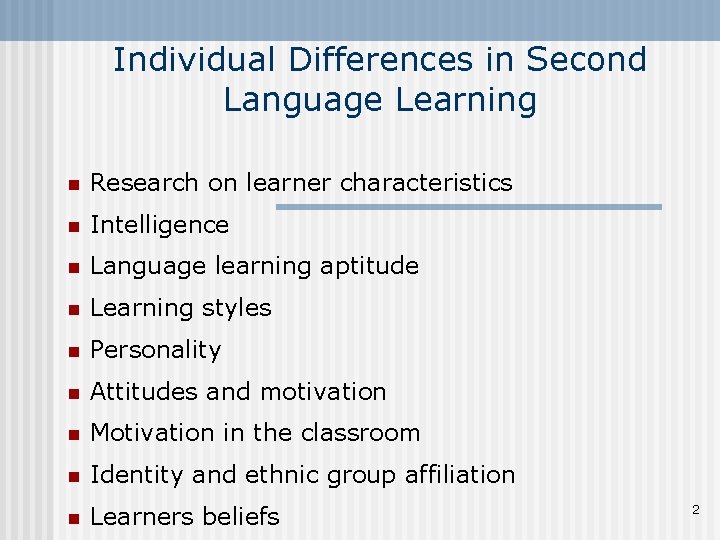
Individual Differences in Second Language Learning n Research on learner characteristics n Intelligence n Language learning aptitude n Learning styles n Personality n Attitudes and motivation n Motivation in the classroom n Identity and ethnic group affiliation n Learners beliefs 2
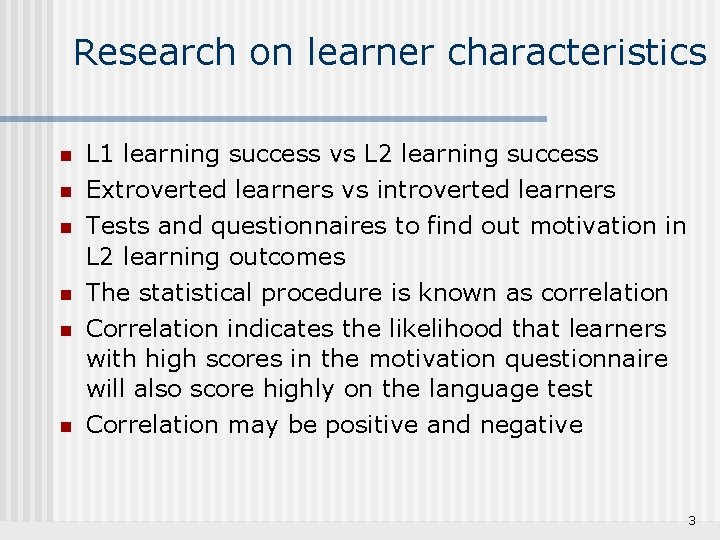
Research on learner characteristics n L 1 learning success vs L 2 learning success n Extroverted learners vs introverted learners Tests and questionnaires to find out motivation in L 2 learning outcomes n n The statistical procedure is known as correlation Correlation indicates the likelihood that learners with high scores in the motivation questionnaire will also score highly on the language test n Correlation may be positive and negative n 3
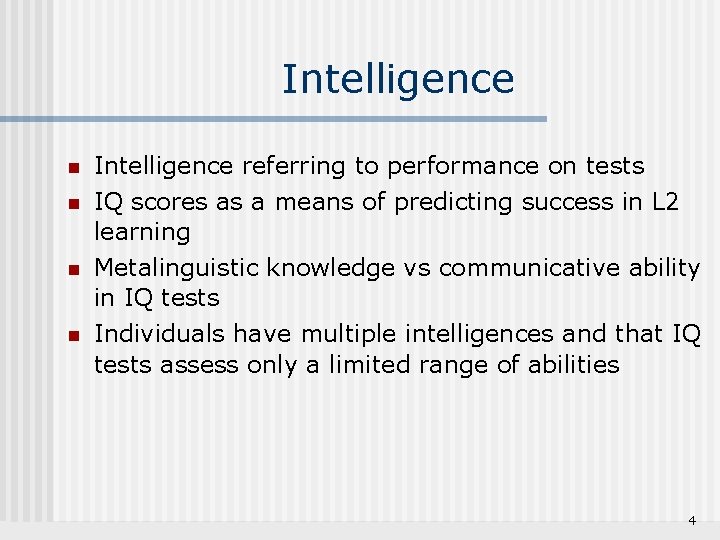
Intelligence n Intelligence referring to performance on tests n IQ scores as a means of predicting success in L 2 learning Metalinguistic knowledge vs communicative ability in IQ tests Individuals have multiple intelligences and that IQ tests assess only a limited range of abilities n n 4
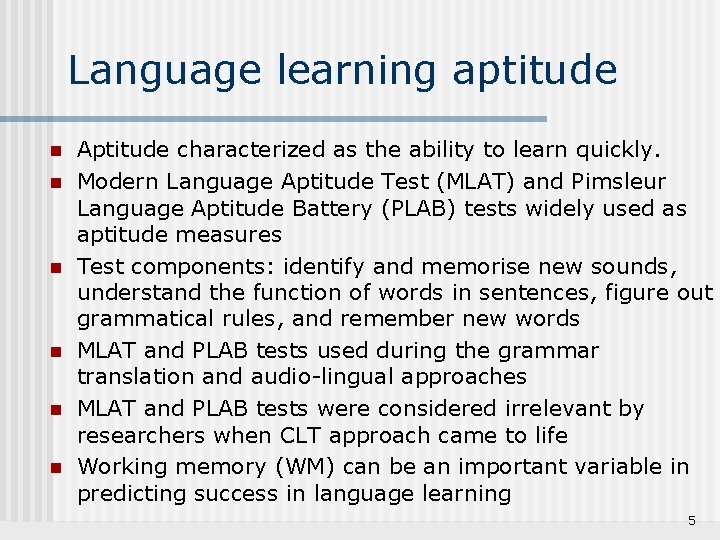
Language learning aptitude n n n Aptitude characterized as the ability to learn quickly. Modern Language Aptitude Test (MLAT) and Pimsleur Language Aptitude Battery (PLAB) tests widely used as aptitude measures Test components: identify and memorise new sounds, understand the function of words in sentences, figure out grammatical rules, and remember new words MLAT and PLAB tests used during the grammar translation and audio-lingual approaches MLAT and PLAB tests were considered irrelevant by researchers when CLT approach came to life Working memory (WM) can be an important variable in predicting success in language learning 5
Language learning aptitude n Working memory refers to the active processing of information n A single teaching approach cannot benefit all learners n Learners with different learning aptitude profiles to be offered different teaching activities n Three different types of instruction: deductive, inductive and structural (Erlam 2005) n Inductive instruction learners receiving no grammar instruction and figured out different meanings n Deductive instruction learners receiving explicit rule-based grammar instruction and practised the rules n Structured instruction learners received explicit rule-based grammar instruction but did not produce target forms 6
Language learning aptitude n n n Learners in deductive instruction benefited the most People with very good academic performance, may find foreign language learning difficult Some people have problems with certain language skills in their own language The secret to success is to find the appropriate instructional approach to meet the needs of learners with a variety of aptitude profiles There are exceptional learners who learn a foreign language within a few weeks 7
Learning styles n n n Different individual learning styles Learning styles based on natural, habitual and preferred ways of absorbing, processing and retaining information and skills Visual, auditory and kinaesthetic learners Field dependent or field independent learners depending on how they see things Embedded figures test used as a measure of cognitive learning style No single learning style will suit all learners 8
Personality n n n n Extroverted learners vs introverted learners Inhibition discourages participation in the classroom which is important for progress in language learning Inhibition as a problem among adolescents Learner anxiety (worry, stress, nervousness) as a temporary and context-specific feature of a learner’s personality Willingness to communicate (WTC) as an anxiety Communicative confidence is shaped by two variables: how relaxed L 2 learners are and how competent they feel about their L 2 ability This is down to previous experience with L 2 speakers 9
Personality n Other personality characteristics: self-esteem, empathy, dominance, talkativeness, and responsiveness n The major difficulty is in investigating the personality characteristics is that of measurement n Personality has an important influence on success in language learning 10
Attitudes and motivation n n Difficult to say whether positive attitude produces successful learning or successful learning produces positive attitudes, or both are affected by other factors Evidence that positive attitudes are associated with a willingness to learn hard Motivation is L 2 learning is seen as a complex phenomenon Motivation defined as learners’ communicative needs and also defined as learners’ attitudes towards L 2 community A process-oriented model of motivation consisting of three phases: 1. Phase one: choice motivation 2. Phase two: executive motivation 3. Phase three: motivation retrospection 11
Motivation in the classroom n Motivated students love the subject and participate actively in class n Teachers play a major role in motivating students n Cultural and age differences play a role in motivation n Teachers’ motivational strategies: 1. Teacher discourse: arousing attention 2. Participation structure: group/pair work 3. Activity design: individual/team competition 4. Encouraging positive retrospective: self-evaluation 12
Identity and ethnic group affiliation n Social factors affect motivation, attitudes and language learning success n Relationship between language: minority groups learning the majority group language and vice versa n Reluctance to speak the other’s language leading to isolation n Teachers to provide equal opportunities to all students 13
Learner beliefs n Learners know what instructional approach works best for them n This is based on learners’ previous experience and assumption n The issue of correcting errors by teachers n Students prefer to integrate grammar into communicative learning approach 14
Questions n As future English teachers, what ways would you use to motivate students to attend and participate in the class actively? n What would you do to make sure that your teaching approach is suitable to all students in the classroom 15
Task n Conduct an interview with an ELT about his/her teaching approach and the way he/she uses to motivate learners 16