
Theories of International Trade Theory of Absolute advantage
Theories of International Trade.
Theory of Absolute advantage is associated with the name of Adam Smith. In his opinion, if specialization and trade is beneficial to the individuals within the country, it must be beneficial when the same principle is extended to international trade.
Theory of Absolute advantage. According to Adam Smith, trade takes place between two countries only if one of them has an absolute advantage in producing one commodity and the other country has an absolute advantage in producing some other commodity.
Theory of Absolute advantage. Adam Smith writes; “Whether the advantage which one country has over the other, be natural or acquired is in this respect of no consequence. As long as one country has those advantages, and the other wants them, it will be always more advantageous for the latter, rather to buy of the former than to make. ’’
Theory of Absolute advantage. Thus it is obvious that a country should specialise in the production of that commodity in which it has absolute advantage. A country is said to have absolute advantage in that commodity which it can produce at the lowest cost as compared to others. Smith measured cost of production in terms of labour.
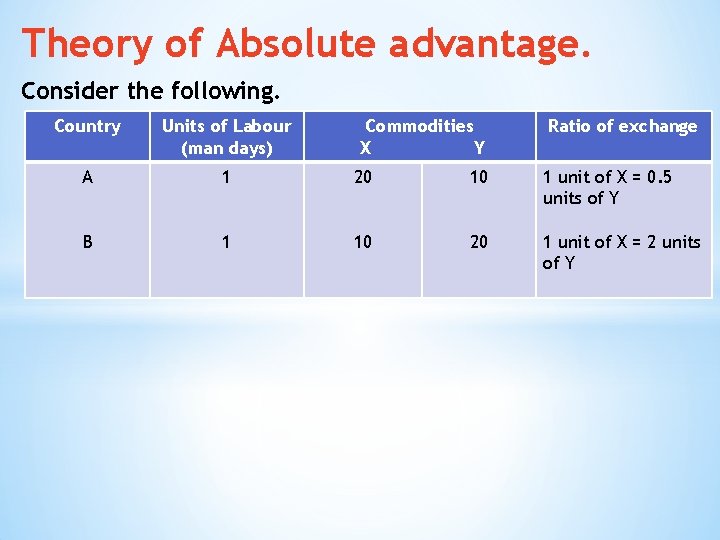
Theory of Absolute advantage. Consider the following. Country Units of Labour (man days) Commodities X Y Ratio of exchange A 1 20 10 1 unit of X = 0. 5 units of Y B 1 10 20 1 unit of X = 2 units of Y
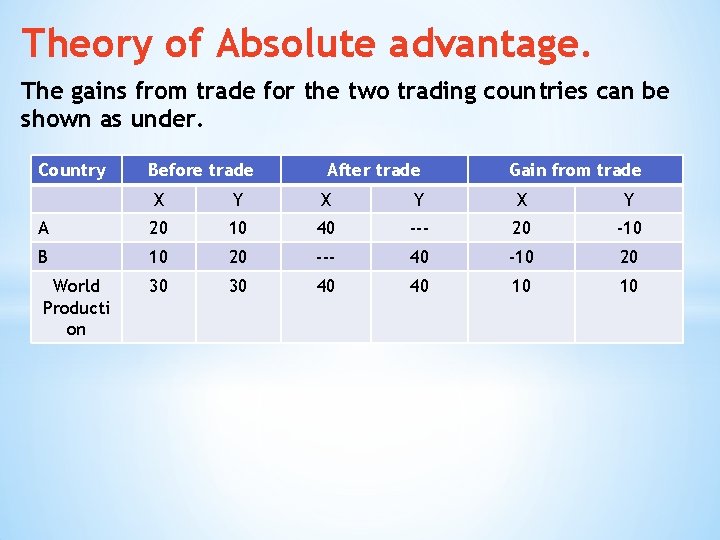
Theory of Absolute advantage. The gains from trade for the two trading countries can be shown as under. Country Before trade After trade Gain from trade X Y X Y A 20 10 40 --- 20 -10 B 10 20 --- 40 -10 20 World Producti on 30 30 40 40 10 10
Theory of Absolute advantage. Criticism. ü Based on the assumption that IT requires the producer of exports to have absolute advantage. ü Smith simply indicated the fundamental basis on which IT rests. The theory had failed to explore in the comprehensive manner. ü “Vent for Surplus” doctrine of smith is completely satisfactory. not
- Slides: 8