
Theories of Intelligence Is intelligence a single general

- Slides: 43
Theories of Intelligence • Is intelligence a single, general ability or is it a cluster of different mental abilities? • Do current IQ tests measure it or should it be more broadly defined?
Two Kinds of Intelligence • Crystallized Intelligence – learning from past experiences and learning. – Situations that require crystallized intelligence include reading comprehension and vocabulary exams. – This type of intelligence is based upon facts and rooted in experiences. – This type of intelligence becomes stronger as we age and accumulate new knowledge and understanding.
Two Kinds of Intelligence • Fluid Intelligence - the ability to think and reason abstractly and solve problems. – This ability is considered independent of learning, experience, and education. – Examples: solving puzzles and coming up with problem solving strategies. – Both types of intelligence increase throughout childhood and adolescence. – Fluid intelligence peaks in adolescence and begins to decline progressively beginning around age 30 or 40.
Theories of Intelligence • Charles Spearman—“g” factor • Louis Thurstone—intelligence as a person’s “pattern” of mental abilities • Howard Gardner—multiple intelligences • Sternberg–triarchic theory • Emotional Intelligence - ability to perceive, express, understand, and regulate emotions
Spearman’s General Intelligence
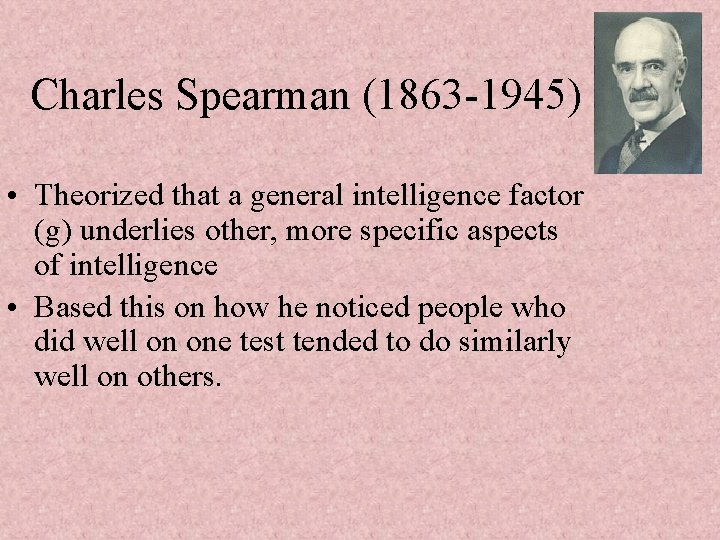
Charles Spearman (1863 -1945) • Theorized that a general intelligence factor (g) underlies other, more specific aspects of intelligence • Based this on how he noticed people who did well on one test tended to do similarly well on others.
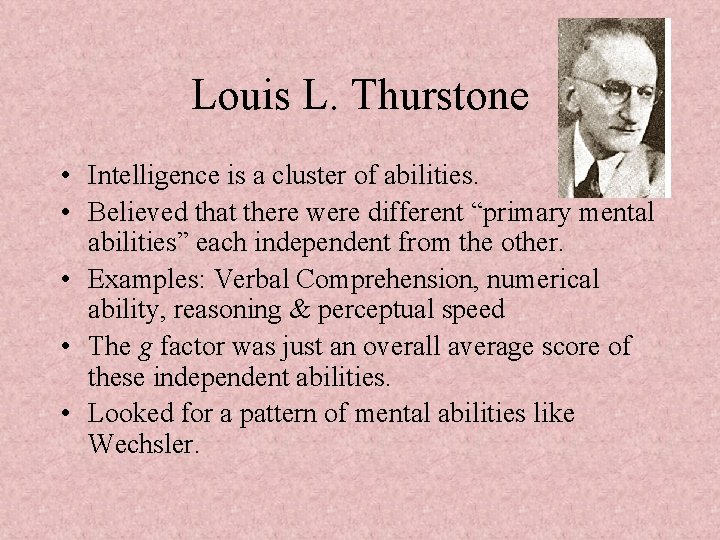
Louis L. Thurstone • Intelligence is a cluster of abilities. • Believed that there were different “primary mental abilities” each independent from the other. • Examples: Verbal Comprehension, numerical ability, reasoning & perceptual speed • The g factor was just an overall average score of these independent abilities. • Looked for a pattern of mental abilities like Wechsler.
Howard Gardner’s Multiple Intelligences
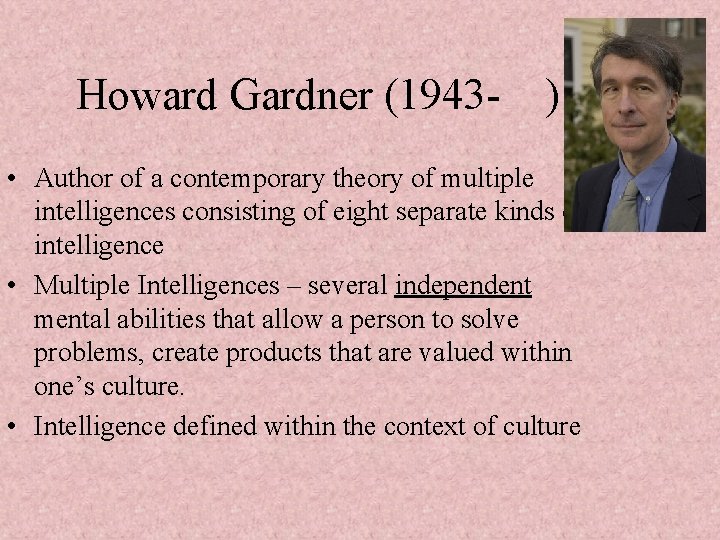
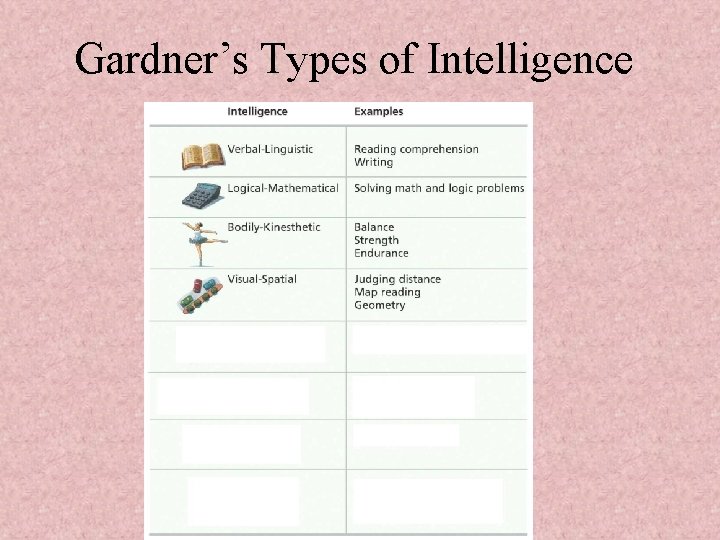
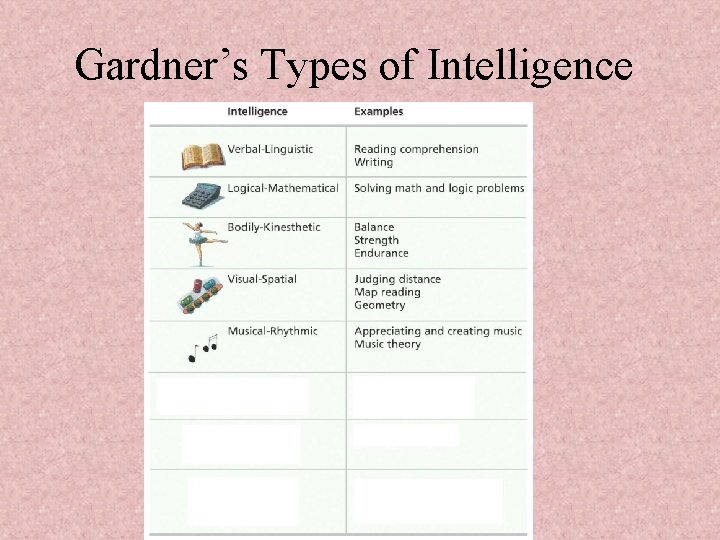
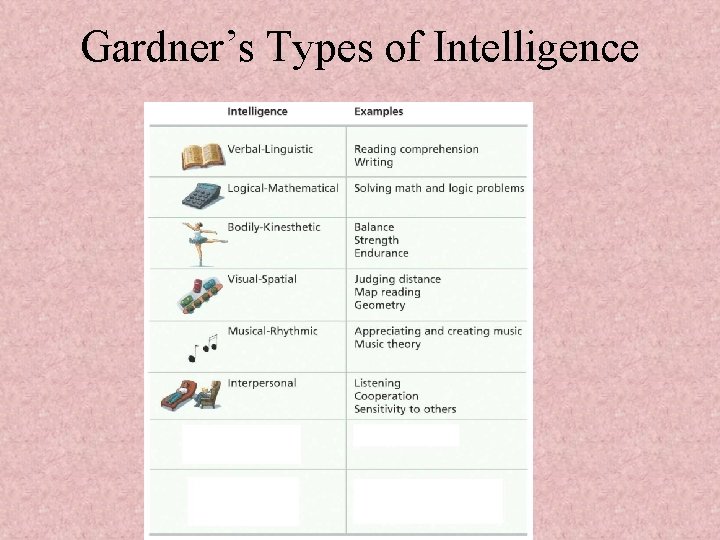
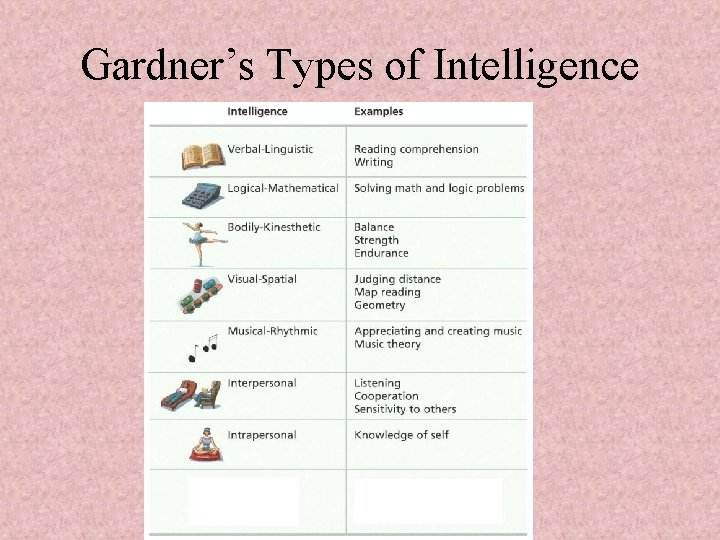
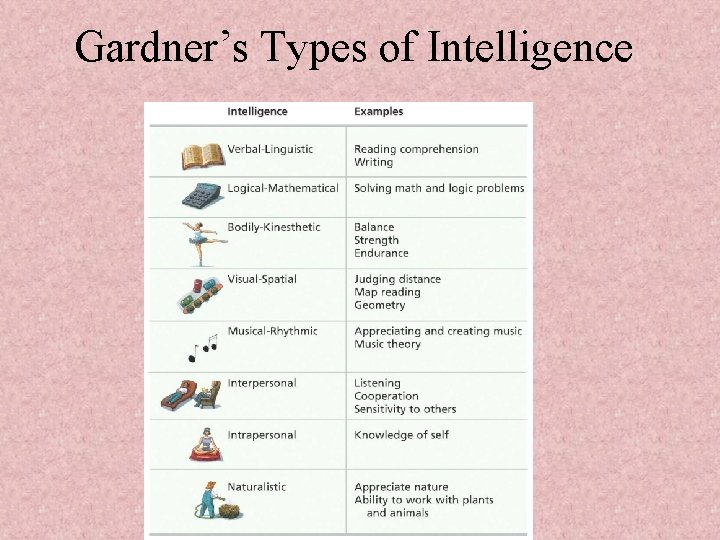
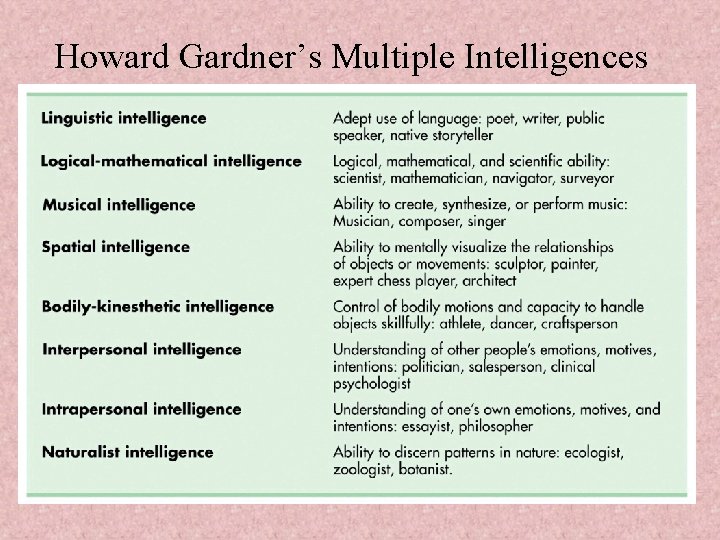
Howard Gardner (1943 - ) • Author of a contemporary theory of multiple intelligences consisting of eight separate kinds of intelligence • Multiple Intelligences – several independent mental abilities that allow a person to solve problems, create products that are valued within one’s culture. • Intelligence defined within the context of culture
Gardner’s Types of Intelligence
Gardner’s Types of Intelligence
Gardner’s Types of Intelligence
Gardner’s Types of Intelligence
Gardner’s Types of Intelligence
Gardner’s Types of Intelligence
Gardner’s Types of Intelligence
Gardner’s Types of Intelligence
Howard Gardner’s Multiple Intelligences
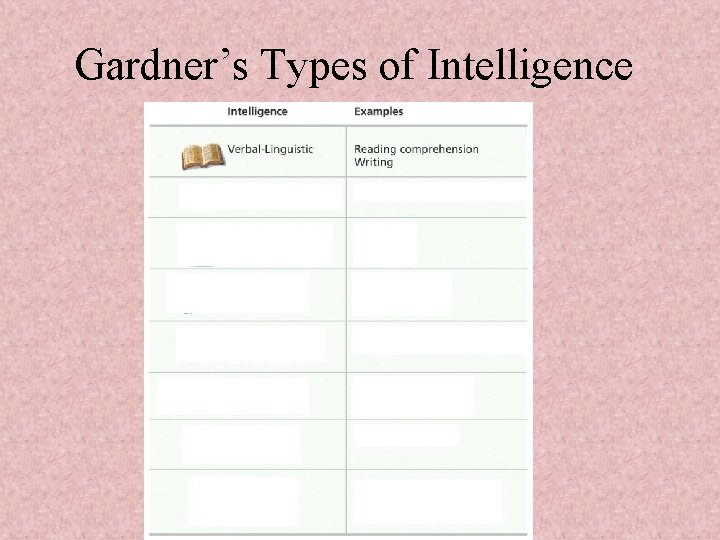
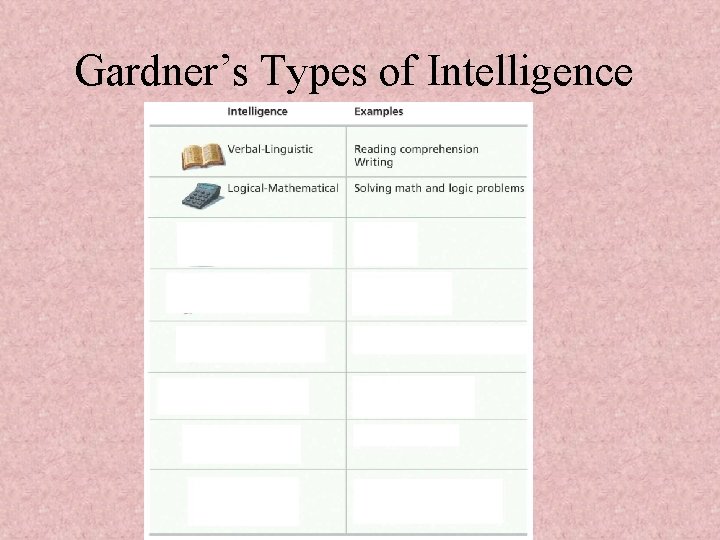
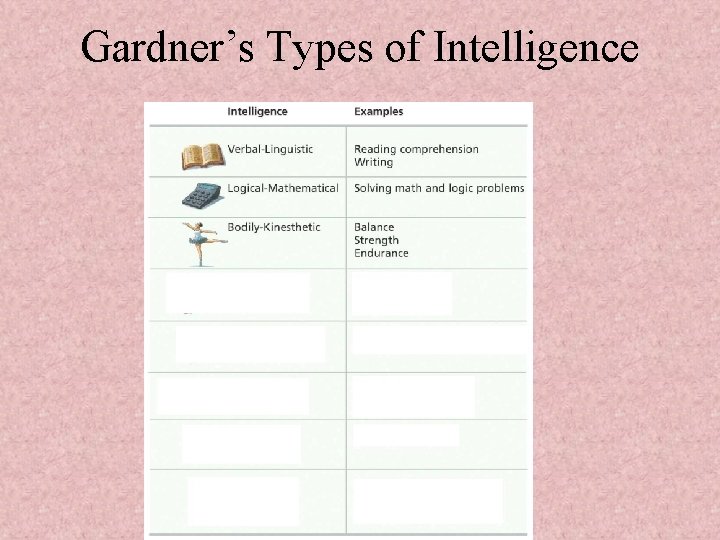
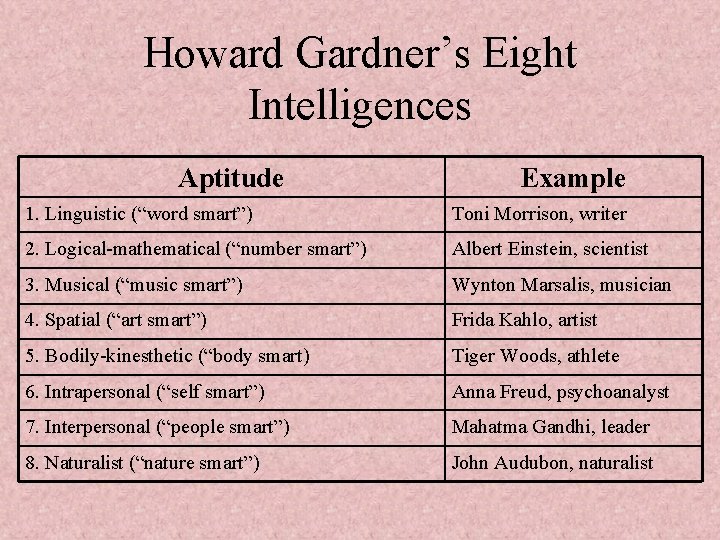
Howard Gardner’s Eight Intelligences Aptitude Example 1. Linguistic (“word smart”) Toni Morrison, writer 2. Logical-mathematical (“number smart”) Albert Einstein, scientist 3. Musical (“music smart”) Wynton Marsalis, musician 4. Spatial (“art smart”) Frida Kahlo, artist 5. Bodily-kinesthetic (“body smart) Tiger Woods, athlete 6. Intrapersonal (“self smart”) Anna Freud, psychoanalyst 7. Interpersonal (“people smart”) Mahatma Gandhi, leader 8. Naturalist (“nature smart”) John Audubon, naturalist
Robert Sternberg’s Triarchic Theory of Intelligence
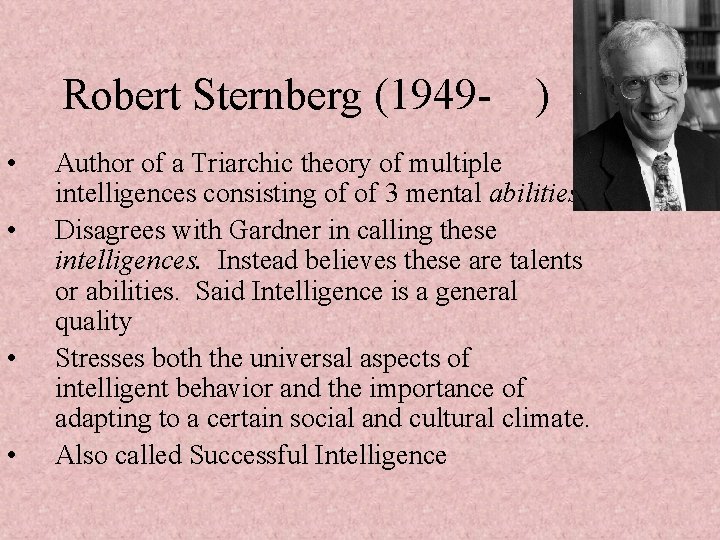
Robert Sternberg (1949 • • ) Author of a Triarchic theory of multiple intelligences consisting of of 3 mental abilities Disagrees with Gardner in calling these intelligences. Instead believes these are talents or abilities. Said Intelligence is a general quality Stresses both the universal aspects of intelligent behavior and the importance of adapting to a certain social and cultural climate. Also called Successful Intelligence
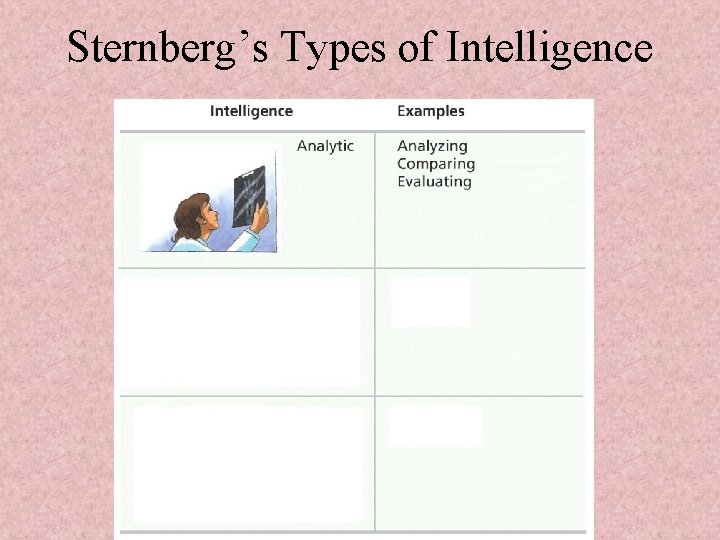
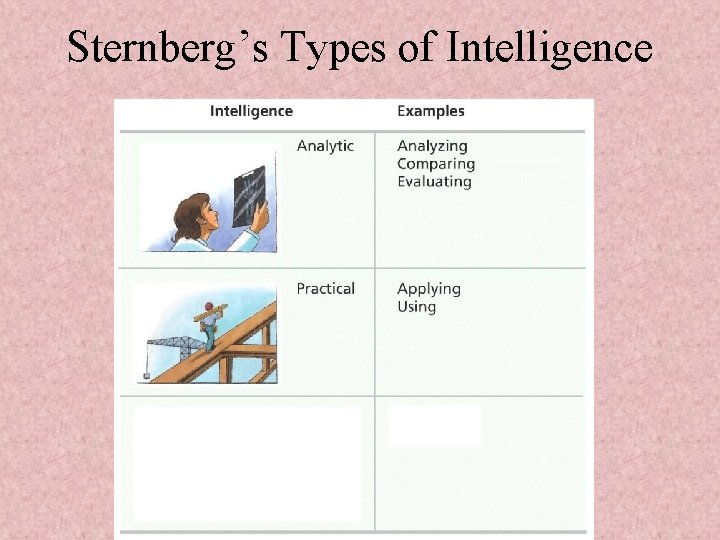
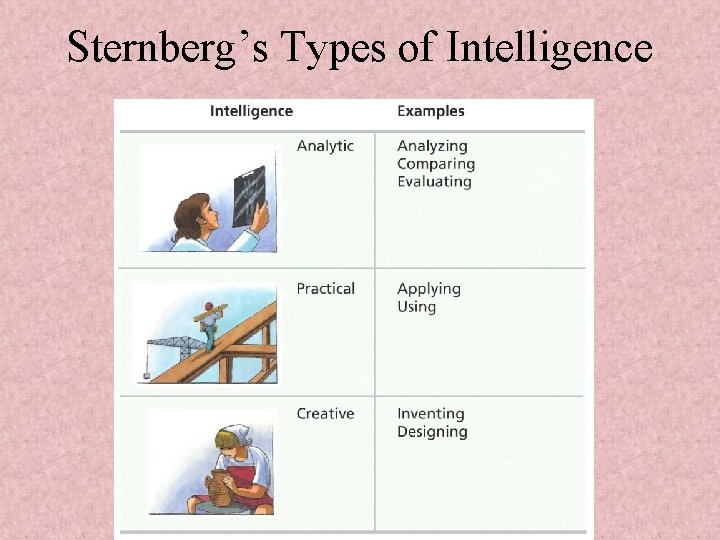
Robert Sternberg • Analytic intelligence—mental processes used in learning how to solve problems • Creative intelligence—ability to deal with novel situations by drawing on existing skills and knowledge • Practical intelligence—ability to adapt to the environment (street smarts)
Sternberg’s Types of Intelligence
Sternberg’s Types of Intelligence
Sternberg’s Types of Intelligence
Emotional Intelligence
Emotional Intelligence • The ability to perceive, express, understand, and regulate emotions • People high in emotional intelligence are more in touch with their feelings and the feelings of others.
IQ Tests do a good job measuring: – Abstract thinking – Problem solving – Capacity to acquire knowledge IQ Tests however do not measure: – Creativity – Achievement motivation – Goal-oriented behavior – Ability to adapt to one’s environment
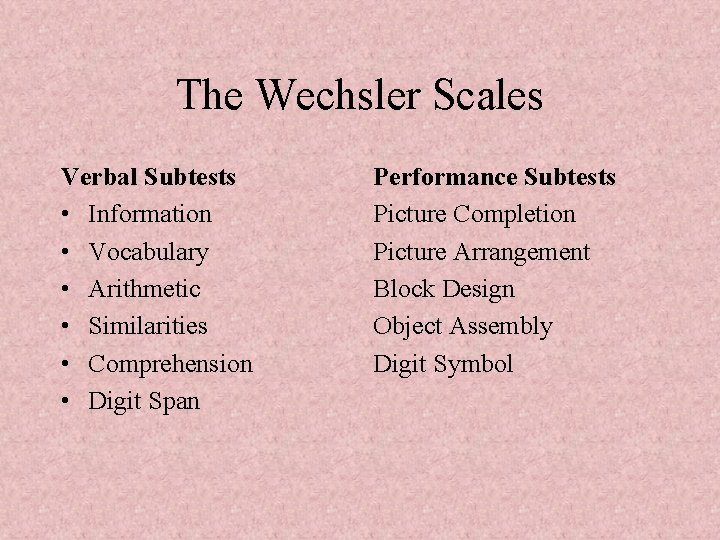
The Wechsler Scales Verbal Subtests • Information • Vocabulary • Arithmetic • Similarities • Comprehension • Digit Span Performance Subtests Picture Completion Picture Arrangement Block Design Object Assembly Digit Symbol
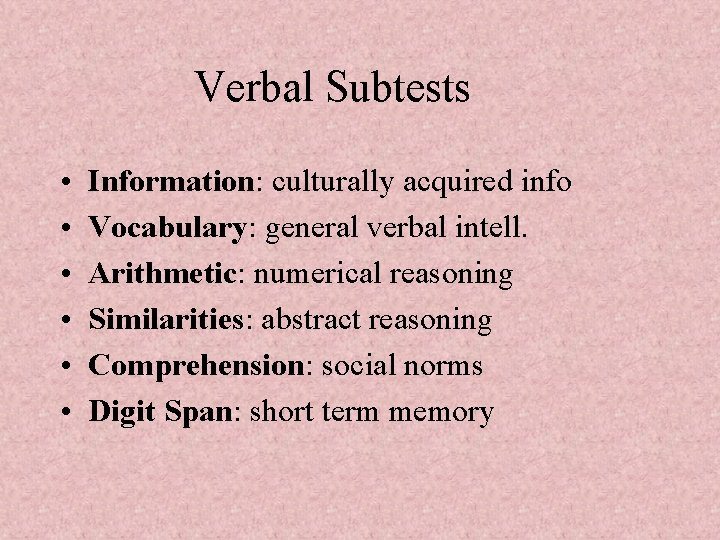
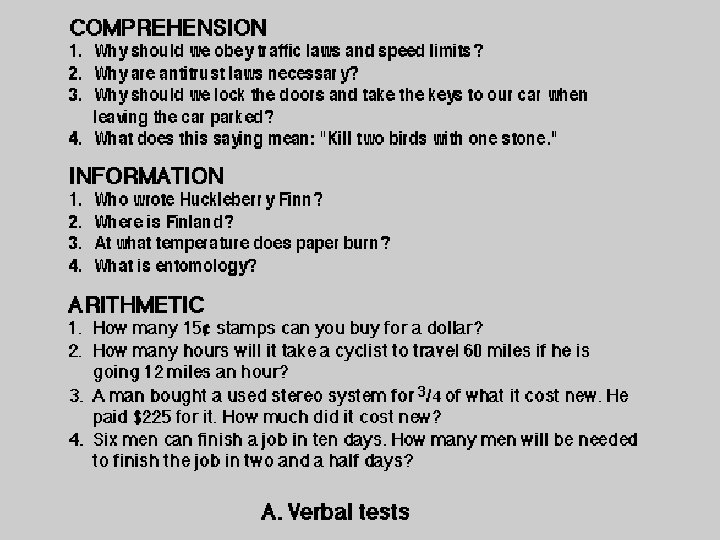
Verbal Subtests • • • Information: culturally acquired info Vocabulary: general verbal intell. Arithmetic: numerical reasoning Similarities: abstract reasoning Comprehension: social norms Digit Span: short term memory
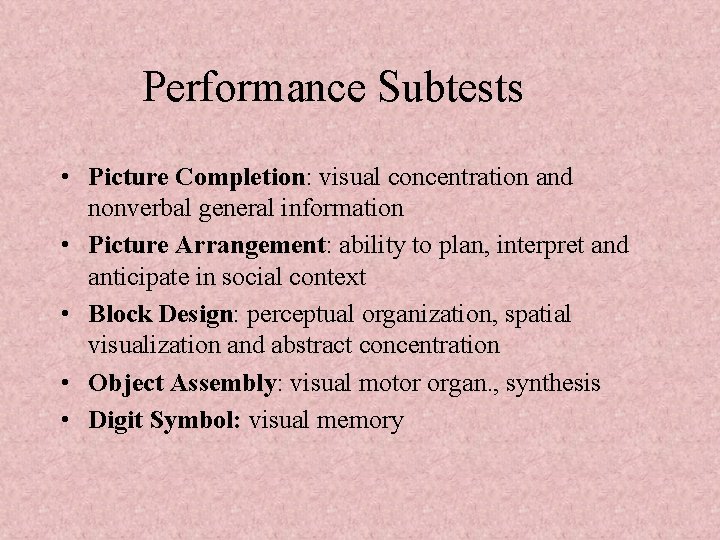
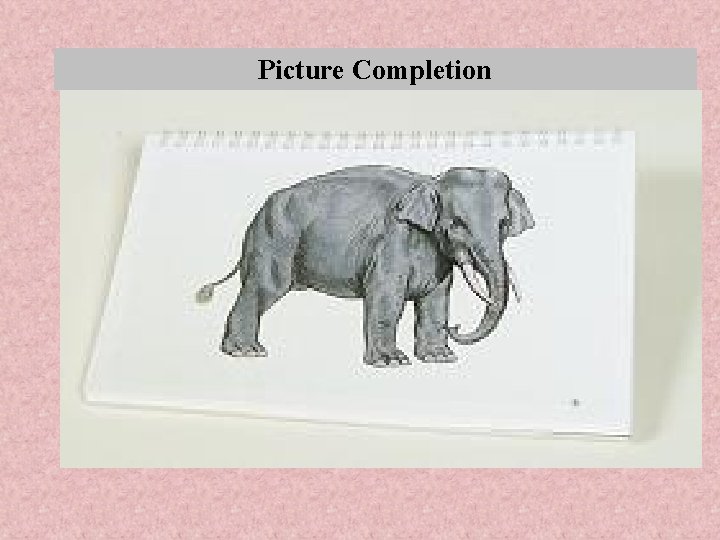
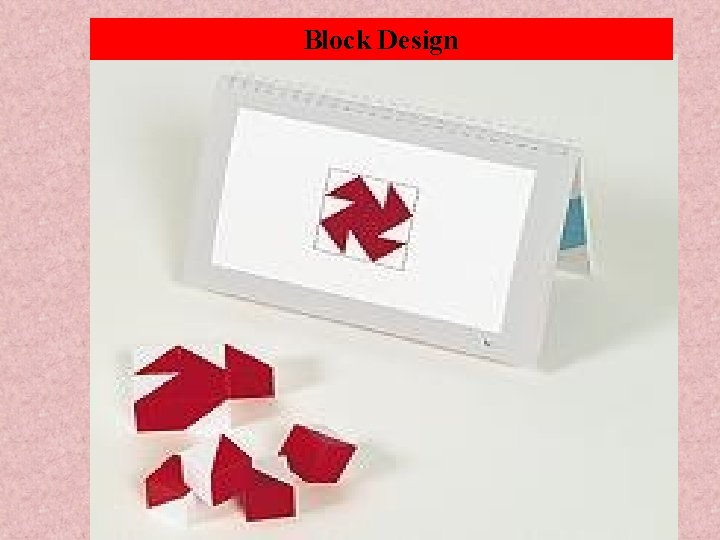
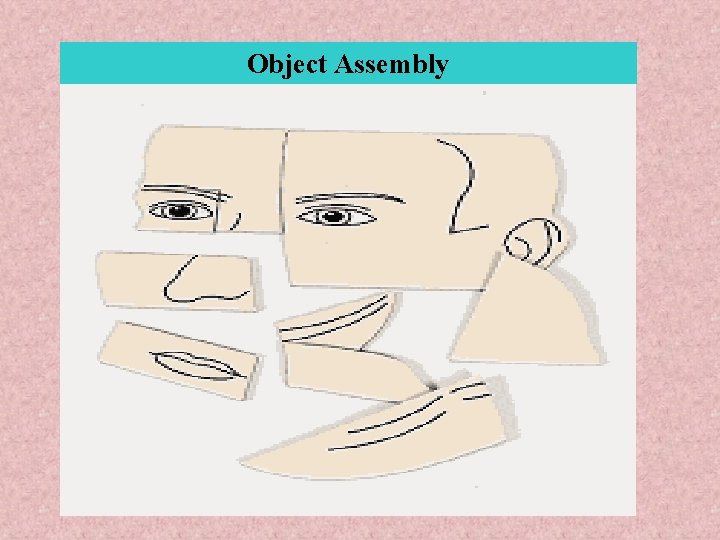
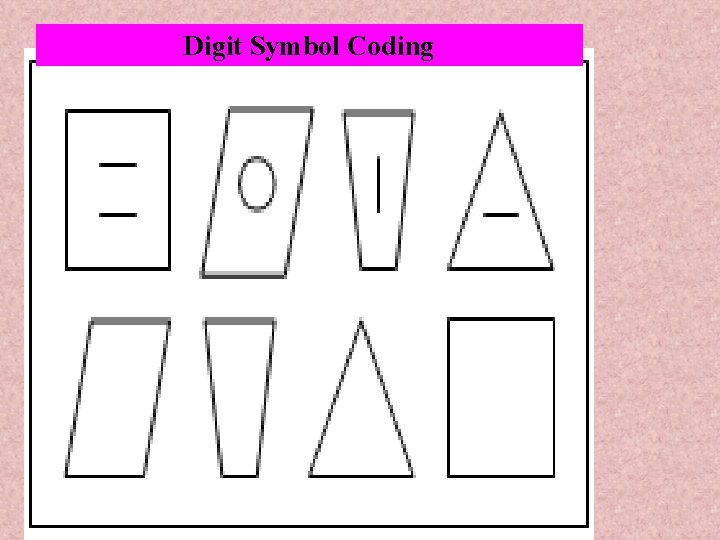
Performance Subtests • Picture Completion: visual concentration and nonverbal general information • Picture Arrangement: ability to plan, interpret and anticipate in social context • Block Design: perceptual organization, spatial visualization and abstract concentration • Object Assembly: visual motor organ. , synthesis • Digit Symbol: visual memory
Similarities • In what way are an orange and a banana alike?
Vocabulary • Bed • Ship • Penny
Digit Span • Demonstrate
Picture Completion
Block Design
Object Assembly
Digit Symbol Coding
Picture Arrangement
Wechsler Scales: Clinical Use • Estimation of general intelligence (correlates with academic success and occupational status) • Examine the discrepancy in performance between verbal and performance subtests • Examine the variability among subtests
Controversies: Race and IQ Average IQ score differ for various racial and ethnic groups • Asian Americans • Whites • Latina • African Americans
Genetics Environment • Heritability estimates for • Like other traits, IQ is about. 50 in a changeable (height for population example). • Educational experiences affect IQ • IQ scores have increased over the years (nutritional factors, increasing access to information)