
Theories of Instructional Design A Study of Psychological



- Slides: 29
Theories of Instructional Design A Study of Psychological Foundations, Learning Environments, and Learner Motivation Tram Truong Feb. 14, 2011 INST 5131: Assignment 2
PSYCHOLOGICAL FOUNDATIONS
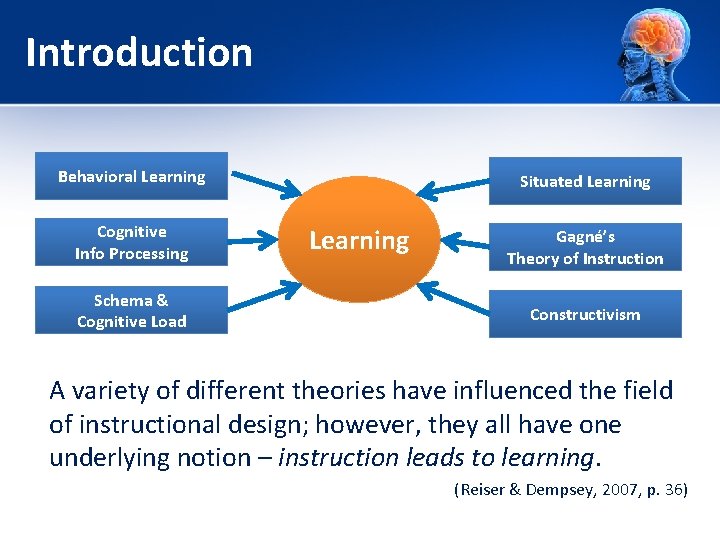
Introduction Behavioral Learning Cognitive Info Processing Schema & Cognitive Load Situated Learning Gagné’s Theory of Instruction Constructivism A variety of different theories have influenced the field of instructional design; however, they all have one underlying notion – instruction leads to learning. (Reiser & Dempsey, 2007, p. 36)
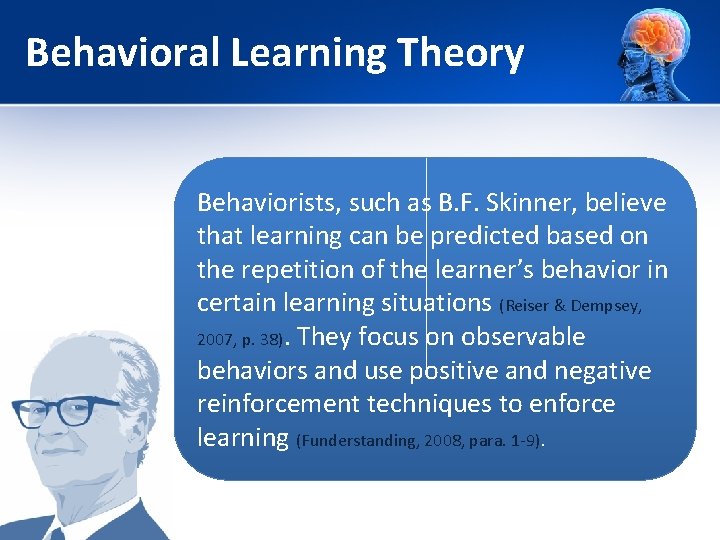
Behavioral Learning Theory Behaviorists, such as B. F. Skinner, believe that learning can be predicted based on the repetition of the learner’s behavior in certain learning situations (Reiser & Dempsey, 2007, p. 38). They focus on observable behaviors and use positive and negative reinforcement techniques to enforce learning (Funderstanding, 2008, para. 1 -9).
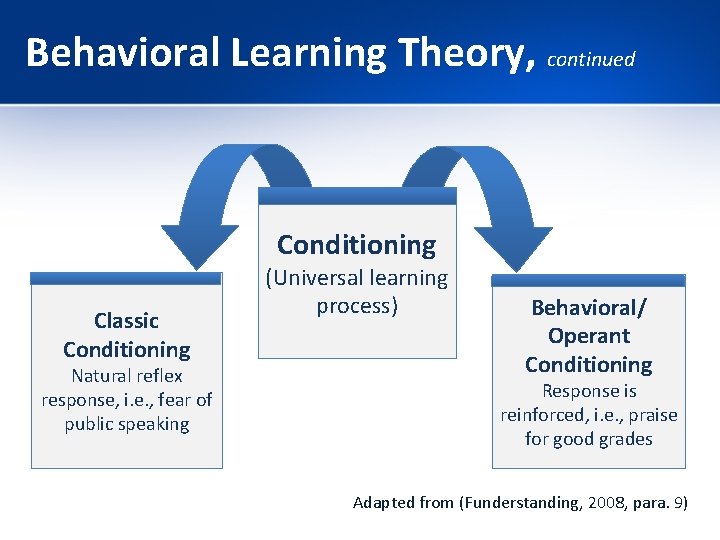
Behavioral Learning Theory, continued Conditioning Classic Conditioning Natural reflex response, i. e. , fear of public speaking (Universal learning process) Behavioral/ Operant Conditioning Response is reinforced, i. e. , praise for good grades Adapted from (Funderstanding, 2008, para. 9).
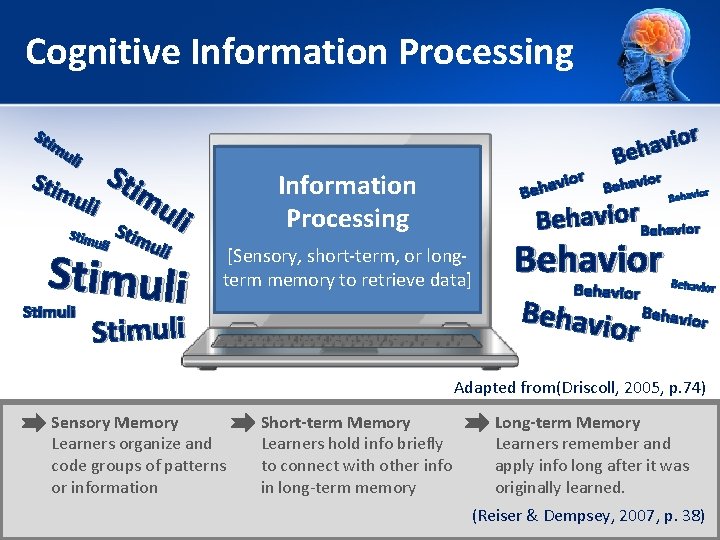
Cognitive Information Processing Sti mu li Stim uli Sti mu l Stim i Stim uli Stimuli r o i v a Beh ior Behavior v a h Be Information Processing Behavior [Sensory, short-term, or longterm memory to retrieve data] Stimuli r Behavior Behavior or Adapted from(Driscoll, 2005, p. 74) Sensory Memory Learners organize and code groups of patterns or information Short-term Memory Learners hold info briefly to connect with other info in long-term memory Long-term Memory Learners remember and apply info long after it was originally learned. (Reiser & Dempsey, 2007, p. 38)
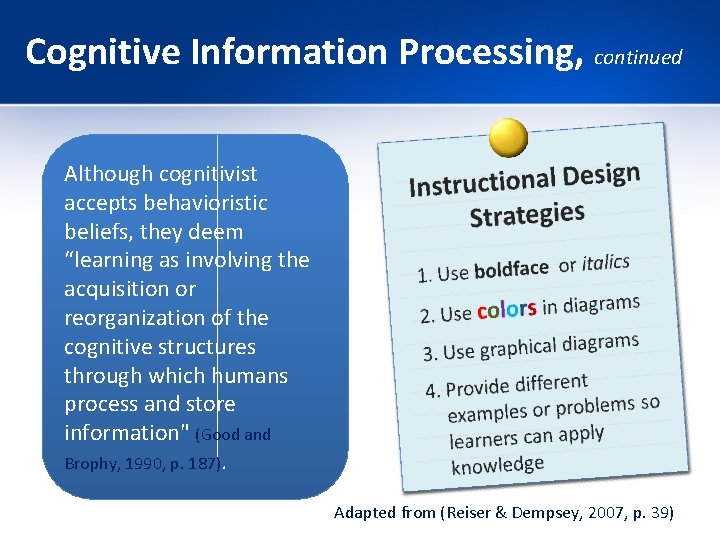
Cognitive Information Processing, continued Although cognitivist accepts behavioristic beliefs, they deem “learning as involving the acquisition or reorganization of the cognitive structures through which humans process and store information" (Good and Brophy, 1990, p. 187). Adapted from (Reiser & Dempsey, 2007, p. 39)
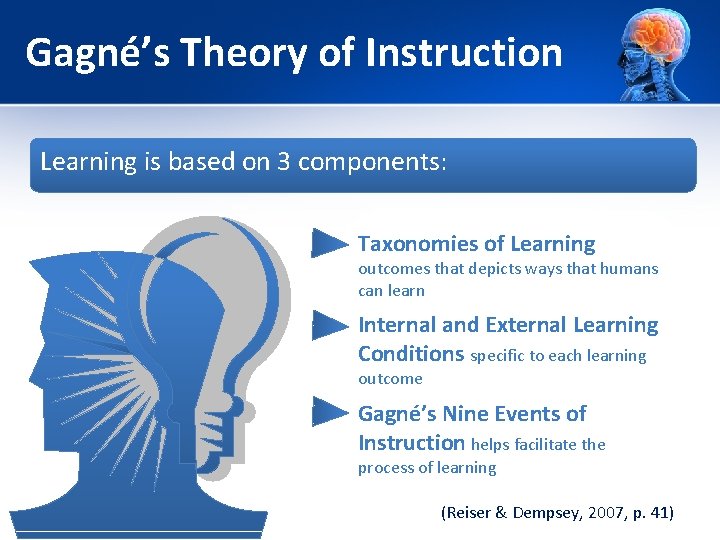
Gagné’s Theory of Instruction Learning is based on 3 components: Taxonomies of Learning outcomes that depicts ways that humans can learn Internal and External Learning Conditions specific to each learning outcome Gagné’s Nine Events of Instruction helps facilitate the process of learning (Reiser & Dempsey, 2007, p. 41)
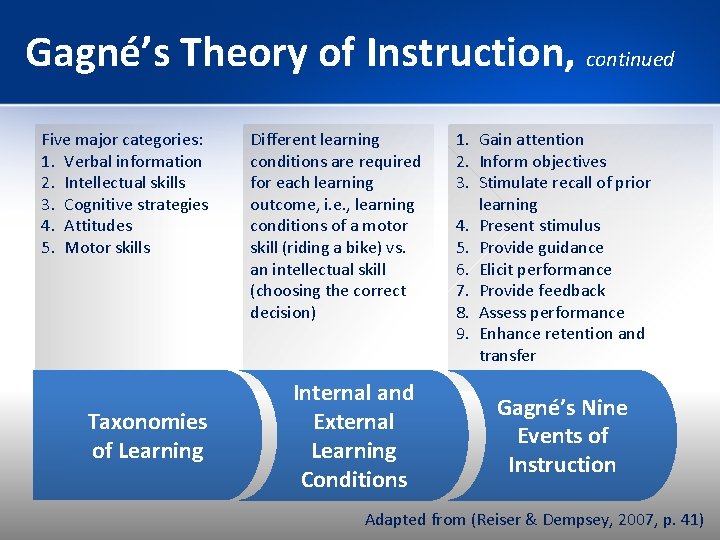
Gagné’s Theory of Instruction, continued Five major categories: 1. Verbal information 2. Intellectual skills 3. Cognitive strategies 4. Attitudes 5. Motor skills Taxonomies of Learning Different learning conditions are required for each learning outcome, i. e. , learning conditions of a motor skill (riding a bike) vs. an intellectual skill (choosing the correct decision) Internal and External Learning Conditions 1. Gain attention 2. Inform objectives 3. Stimulate recall of prior learning 4. Present stimulus 5. Provide guidance 6. Elicit performance 7. Provide feedback 8. Assess performance 9. Enhance retention and transfer Gagné’s Nine Events of Instruction Adapted from (Reiser & Dempsey, 2007, p. 41)
Constructivism Learning is about actively engaging in the surrounding environment, making sense of what is seen and experienced and then validating those ideas and understandings with friends and teachers. (Reiser & Dempsey, 2007, p. 42)
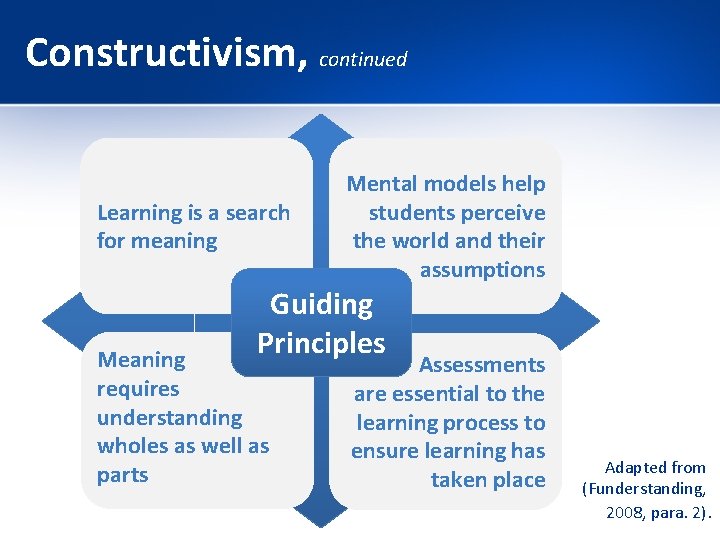
Constructivism, continued Learning is a search for meaning Mental models help students perceive the world and their assumptions Guiding Principles Meaning requires understanding wholes as well as parts Assessments are essential to the learning process to ensure learning has taken place Adapted from (Funderstanding, 2008, para. 2).
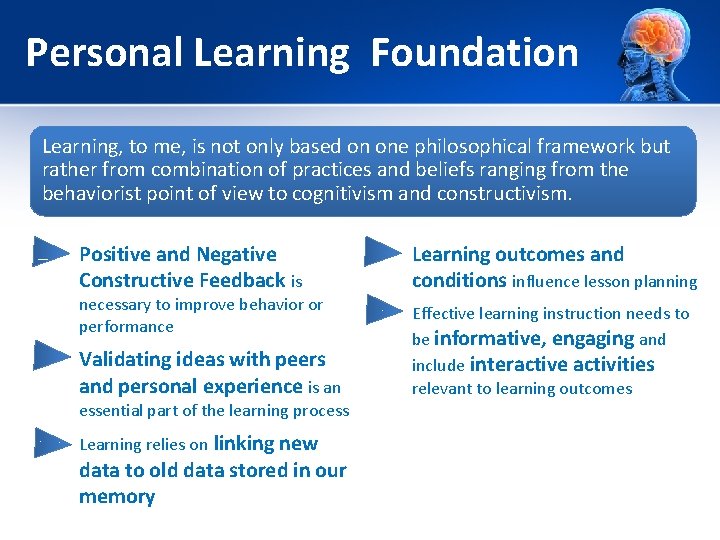
Personal Learning Foundation Learning, to me, is not only based on one philosophical framework but rather from combination of practices and beliefs ranging from the behaviorist point of view to cognitivism and constructivism. Positive and Negative Constructive Feedback is Learning outcomes and conditions influence lesson planning Validating ideas with peers and personal experience is an Effective learning instruction needs to be informative, engaging and include interactive activities relevant to learning outcomes necessary to improve behavior or performance essential part of the learning process Learning relies on linking new data to old data stored in our memory
LEARNING ENVIRONMENTS
Introduction One of the key components in designing effective instruction is taking in account the conditions and requirements of the learning environment. Whether learning takes place in the classroom or while on the job, teachers must realize the importance of adjusting their instruction in accordance to the learning environment.
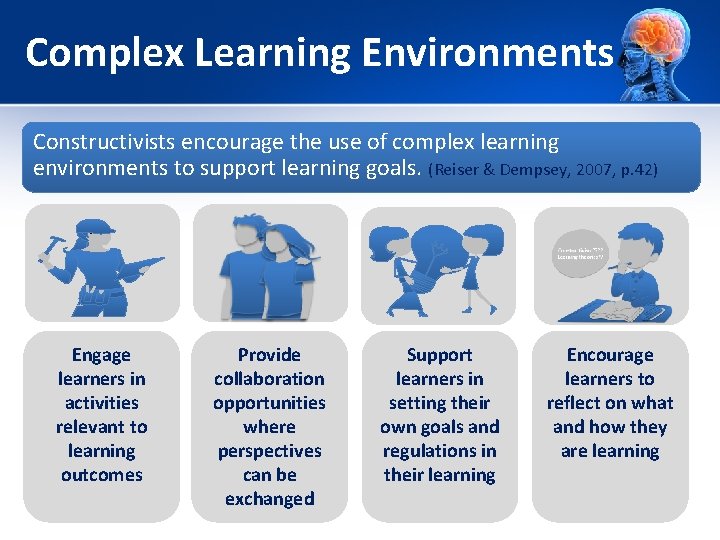
Complex Learning Environments Constructivists encourage the use of complex learning environments to support learning goals. (Reiser & Dempsey, 2007, p. 42) Engage learners in activities relevant to learning outcomes Provide collaboration opportunities where perspectives can be exchanged Support learners in setting their own goals and regulations in their learning Encourage learners to reflect on what and how they are learning
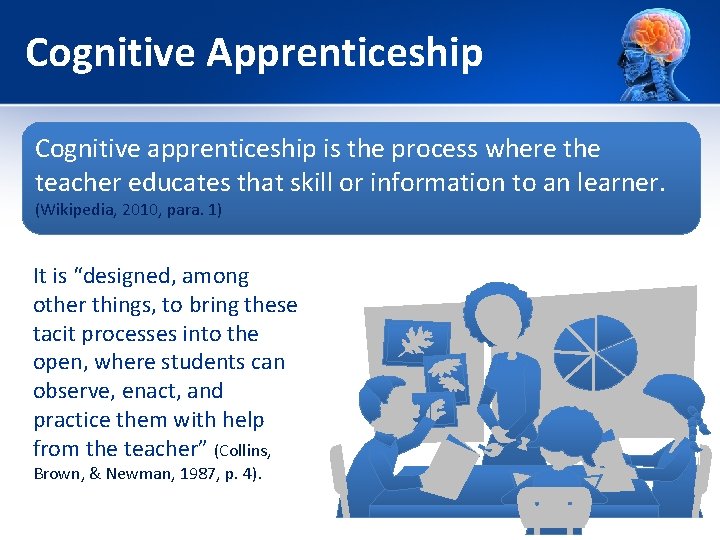
Cognitive Apprenticeship Cognitive apprenticeship is the process where the teacher educates that skill or information to an learner. (Wikipedia, 2010, para. 1) It is “designed, among other things, to bring these tacit processes into the open, where students can observe, enact, and practice them with help from the teacher” (Collins, Brown, & Newman, 1987, p. 4).
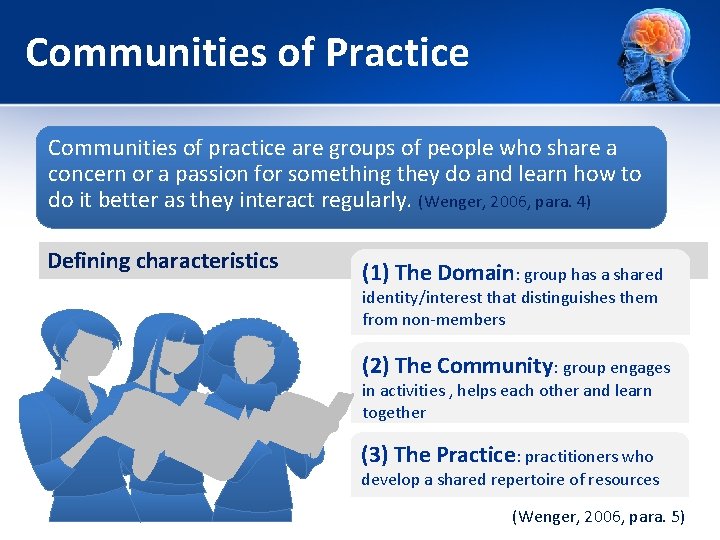
Communities of Practice Communities of practice are groups of people who share a concern or a passion for something they do and learn how to do it better as they interact regularly. (Wenger, 2006, para. 4) Defining characteristics (1) The Domain: group has a shared identity/interest that distinguishes them from non-members (2) The Community: group engages in activities , helps each other and learn together (3) The Practice: practitioners who develop a shared repertoire of resources (Wenger, 2006, para. 5)
Technology Enabled “Perhaps it is time for us to take a much closer look at the technology we have available and find new and innovative ways of building a curriculum around it” (Halocha, 2007, p. 125). Encourages blended learning Pedagogic audience Benefits online learners Ease of using multimedia Evolved from museum schools to online LMS
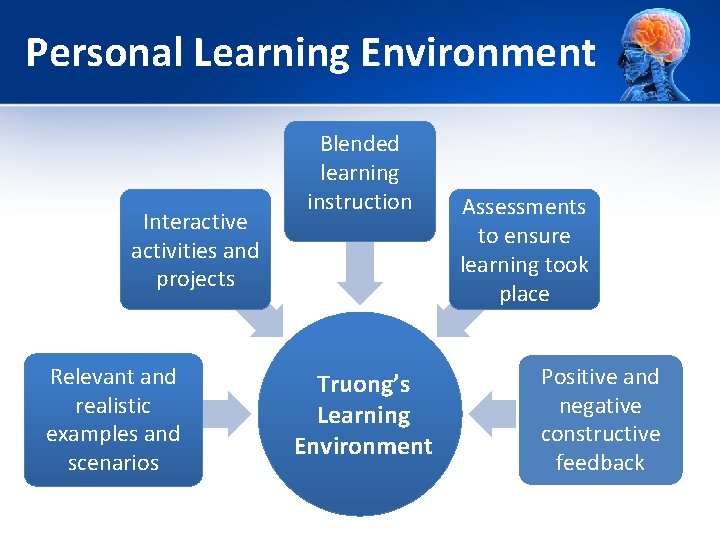
Personal Learning Environment Interactive activities and projects Relevant and realistic examples and scenarios Blended learning instruction Truong’s Learning Environment Assessments to ensure learning took place Positive and negative constructive feedback
LEARNER MOTIVATION
Introduction Even if the instruction may be interactive, filled with relevant information, and engaging, without learner motivation the materials developed may just be another boring course to the learner. Therefore, understanding learner motivation is an important aspect when designing sound training.
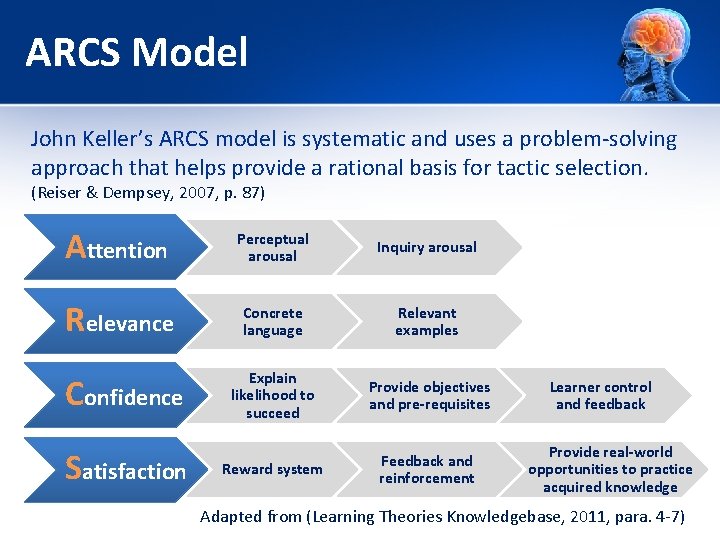
ARCS Model John Keller’s ARCS model is systematic and uses a problem-solving approach that helps provide a rational basis for tactic selection. (Reiser & Dempsey, 2007, p. 87) Attention Perceptual arousal Inquiry arousal Relevance Concrete language Relevant examples Explain likelihood to succeed Provide objectives and pre-requisites Reward system Feedback and reinforcement Confidence Satisfaction Learner control and feedback Provide real-world opportunities to practice acquired knowledge Adapted from (Learning Theories Knowledgebase, 2011, para. 4 -7)
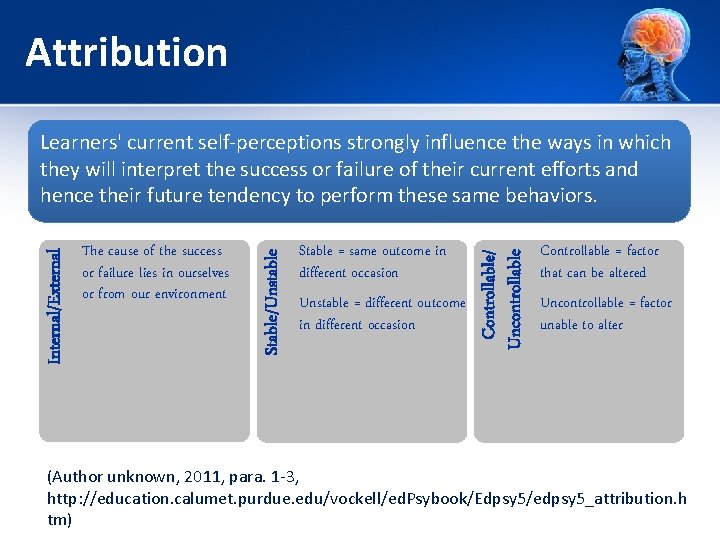
Attribution Stable = same outcome in different occasion Unstable = different outcome in different occasion Controllable/ Uncontrollable The cause of the success or failure lies in ourselves or from our environment Stable/Unstable Internal/External Learners' current self-perceptions strongly influence the ways in which they will interpret the success or failure of their current efforts and hence their future tendency to perform these same behaviors. Controllable = factor that can be altered Uncontrollable = factor unable to alter (Author unknown, 2011, para. 1 -3, http: //education. calumet. purdue. edu/vockell/ed. Psybook/Edpsy 5/edpsy 5_attribution. h tm)
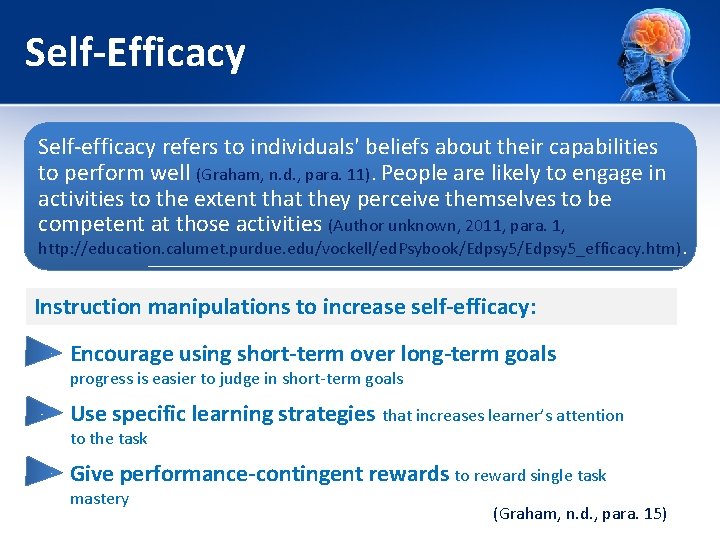
Self-Efficacy Self-efficacy refers to individuals' beliefs about their capabilities to perform well (Graham, n. d. , para. 11). People are likely to engage in activities to the extent that they perceive themselves to be competent at those activities (Author unknown, 2011, para. 1, http: //education. calumet. purdue. edu/vockell/ed. Psybook/Edpsy 5_efficacy. htm). Instruction manipulations to increase self-efficacy: Encourage using short-term over long-term goals progress is easier to judge in short-term goals Use specific learning strategies that increases learner’s attention to the task Give performance-contingent rewards to reward single task mastery (Graham, n. d. , para. 15)
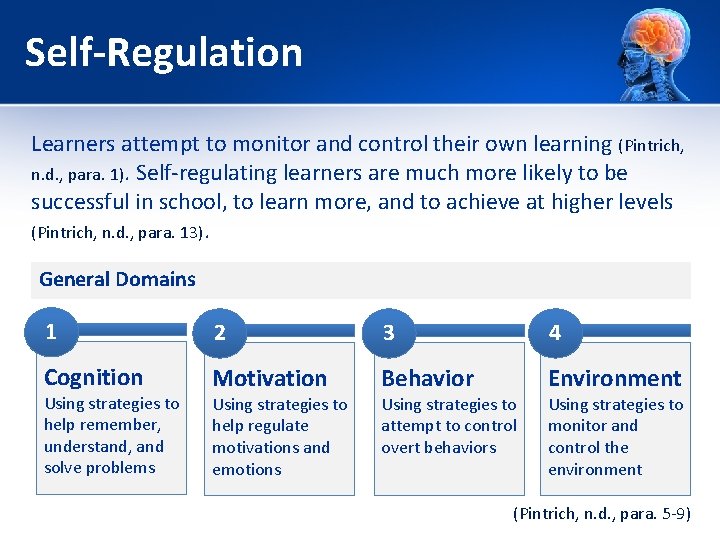
Self-Regulation Learners attempt to monitor and control their own learning (Pintrich, n. d. , para. 1). Self-regulating learners are much more likely to be successful in school, to learn more, and to achieve at higher levels (Pintrich, n. d. , para. 13). General Domains 1 2 3 4 Cognition Motivation Behavior Environment Using strategies to help remember, understand, and solve problems Using strategies to help regulate motivations and emotions Using strategies to attempt to control overt behaviors Using strategies to monitor and control the environment (Pintrich, n. d. , para. 5 -9)
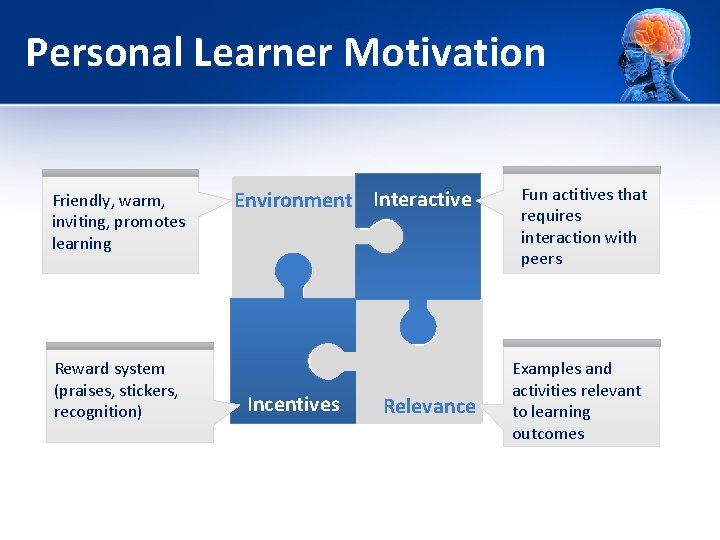
Personal Learner Motivation Friendly, warm, inviting, promotes learning Reward system (praises, stickers, recognition) Environment Interactive Incentives Relevance Fun actitives that requires interaction with peers Examples and activities relevant to learning outcomes
REFERENCES
References • • • Attribution Theory. (2011). Retrieved February, 10, 2011 from http: //education. calumet. purdue. edu/vockell/ed. Psybook/Edpsy 5/edpsy 5_attribution. h tm Collins, A. , Brown, J. S. , & Newman, S. E. (1987). Cognitive apprenticeship: Teaching the craft of reading, writing and mathematics (Technical Report No. 403). BBN Laboratories, Cambridge, MA. Centre for the Study of Reading, University of Illinois. January, 1987. Driscoll, M. P. (2005). Psychology of learning for instruction (3 rd ed. ). Needham Heights, MA: Allyn & Bacon. Funderstanding (2008). Funderstanding constructivism. Retrieved February 10, 2011 from http: //www. funderstanding. com/content/constructivism Funderstanding (2008). Funderstanding behaviorism. Retrieved February 10, 2011 from http: //www. funderstanding. com/content/behaviorism Graham, Sandra (n. d). Motivation - Instruction, Self-regulated Learning – OVERVIEW. Retrieved February 10, 2011 from http: //education. stateuniversity. com/pages/2250/Motivation. html
References • • • Halocha, J. (2007). Using ICT in Teaching. In J. Johnston, J. Halocha & M. Chater (Eds. ), Developing Teaching Skills in the Primary School (pp. 119– 134). Maidenhead, UK: Open University Press. Learning Theories Knowledgebase (2011). ARCS Model of Motivational Design (Keller). Retrieved February 13 th, 2011 from http: //www. learning-theories. com/kellers-arcsmodel-of-motivational-design. html Pintrich, Paul R. (n. d). Motivation - Self-regulated Learning. Retrieved February 10, 2011 from http: //education. stateuniversity. com/pages/2249/Motivation-SELF-REGULATEDLEARNING. html Reiser, R. A. & Dempsey, J. V. (2007). Trends and issues in instructional design and technology (2 nd Edition). Upper Saddle River, New Jersey: Merrill Prentice Hall. Self-Efficacy. (2011). Retrieved February 10, 2011 from http: //education. calumet. purdue. edu/vockell/ed. Psybook/Edpsy 5_efficacy. htm Wenger, Etienne (2006). Communities of practice a brief introduction. Retrieved February, 11, 2011 from http: //www. ewenger. com/theory/