
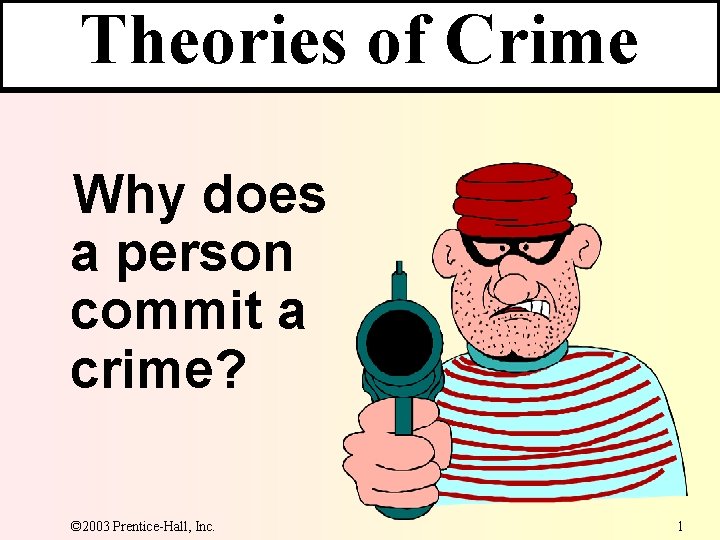
Theories of Crime Why does a person commit













- Slides: 50
Theories of Crime Why does a person commit a crime? © 2003 Prentice-Hall, Inc. 1
Categories of Theory • Classical and Neoclassical • Biological • Psychobiological • Psychological • Sociological © 2003 Prentice-Hall, Inc. 14
Classical School Theory Basic Assumptions: • Crime is caused by the individual exercise of “free will. ” 2. Pain and pleasure are the two central determinants of human behavior. 3. Punishment is sometimes required to deter law violators. • Crime prevention is possible through swift and certain punishment, which offsets any gains to be had through criminal behavior. © 2003 Prentice-Hall, Inc. 15
Biological Theories Basic Assumptions: • Human behavior is constitutionally or genetically determined. 2. Basic determinants of human behavior may be passed from generation to generation. • Some behavior is the result of propensities inherited from more primitive developmental stages in the evolutionary process. © 2003 Prentice-Hall, Inc. 16
Psychological Theories Basic Assumptions: • The individual is the main unit of analysis. 2. Personality is the major motivational element. 3. Crimes result from inappropriately conditioned behavior. • Abnormal mental processes may have a number of causes. • diseased mind • inappropriate learning • improper conditioning © 2003 Prentice-Hall, Inc. 17
Psychopathology and Crime • psychopathic personality - several theories of causation • psychotic offender - mental disorder organic or functional • psychological profiling - attempt to categorize, understand, and predict the behavior of certain types of offenders, based upon behavioral clues they provide © 2003 Prentice-Hall, Inc. 18
Sociological Theories Basic Assumptions: 1. Social groups, social institutions, the arrangement of society, and social roles are all appropriate for study. 2. Group dynamics, group organization, and subgroup relationships form the causal basis of criminality. • The structure of society and the relative degree of social organization or social disorganization are important factors contributing to criminal behavior. © 2003 Prentice-Hall, Inc. 19
Sociological Theories Social Ecology School Robert Park and Ernest Burgess a. • 1. 2. They began mapping city of Chicago based on social characteristics of city. They developed the concentric zone theory. Concentric zones are likened to a bull’s eye with the center of the city being the target. Theory found at the University of Chicago in the 1920 s. © 2003 Prentice-Hall, Inc. 20
Conflict Theory Radical Perspective • A perspective of the broader conflict approach that sees crime as engendered by the unequal distribution of wealth, power, and other resources. • It has also been called “critical” or “Marxist” criminology. © 2003 Prentice-Hall, Inc. 21
Conflict Theory Radical Criminology Austin Turk (1934 -) • He wrote Criminality and the Legal Order, (1969). • Radical criminology recognized that the struggle to control resources is central to society, and it encompassed the notion that law itself is a tool of the powerful. © 2003 Prentice-Hall, Inc. 22
Phenomenological School Labeling Edwin Lemert • • He wrote Social Pathology (1951). He believed that there were two delinquencies, primary and secondary. primary deviance – An individual commits deviant act, but does not view him or herself as deviant. secondary deviance – An individual commits a deviant act and sees him or herself as a deviant. © 2003 Prentice-Hall, Inc. 23
경찰활동의 효과성-2 Response time - discovery time * - reporting time - processing time - travel time 주민 만족도 – 도착시간 15분 도착시간 예고
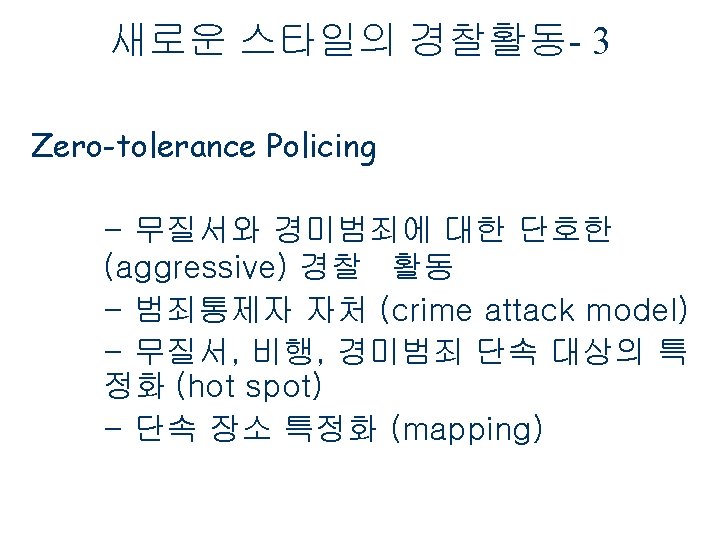
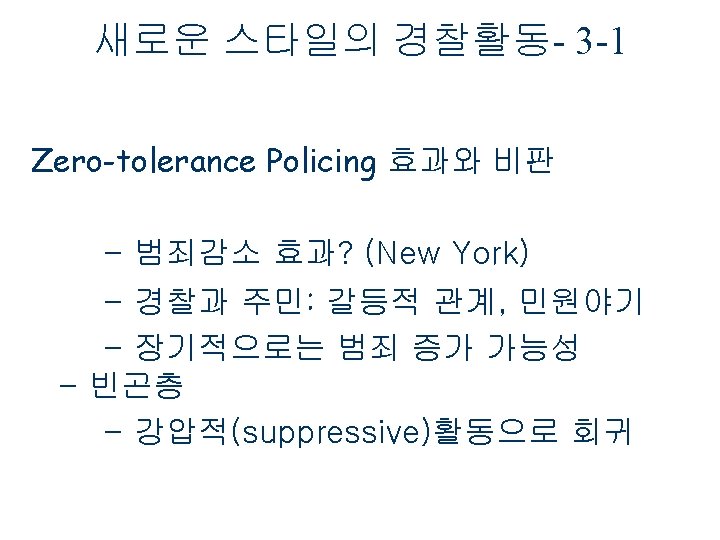
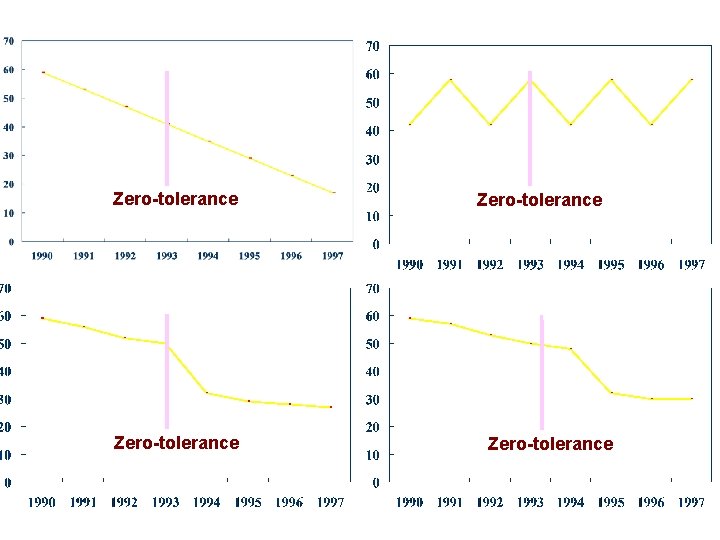
Zero-tolerance