
Theories of CMC Deficit Approaches and Models Impersonal


- Slides: 12
Theories of CMC
Deficit Approaches and Models – Impersonal Perspective o Social Presence Theory o Social Context Cues Theory o Cuelessness Model o Media Richness Model
Response to Deficit/Impersonal o SIDE Model o SIP Model
Social Presence Theory o o Degree to which we as individuals perceive another as a real person and any interaction between the two as a relationship Different media convey different degrees of perceived substance to an interaction Internet not functional alternative to Ft. F – rather specialized channel People prefer Ft. F to meet most communication needs
Social Context Cues Theory o o o Social context cues are indicators of appropriate behavior. Some social cues include geographic, organizational, and situational variables. Lack of social cues affects on the nature of human behavior in mediated contexts (Wood and Smith 81).
Cuelessness Model o o o Absence of all nonverbal cues and identity markers (e. g. , status, occupational role) Psychological distance increases resulting in more impersonal communication (Criticism) High in cuelessness can still be psychologically close (Thurlow, Lengel, and Tomic 49)
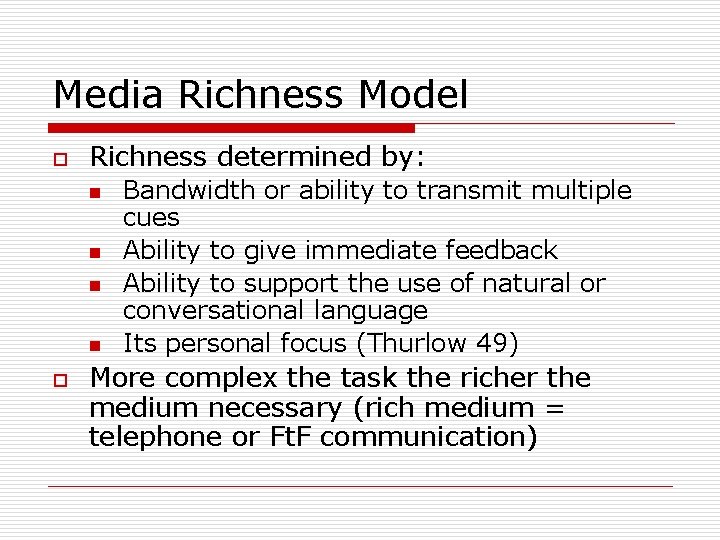
Media Richness Model o Richness determined by: n n o Bandwidth or ability to transmit multiple cues Ability to give immediate feedback Ability to support the use of natural or conversational language Its personal focus (Thurlow 49) More complex the task the richer the medium necessary (rich medium = telephone or Ft. F communication)
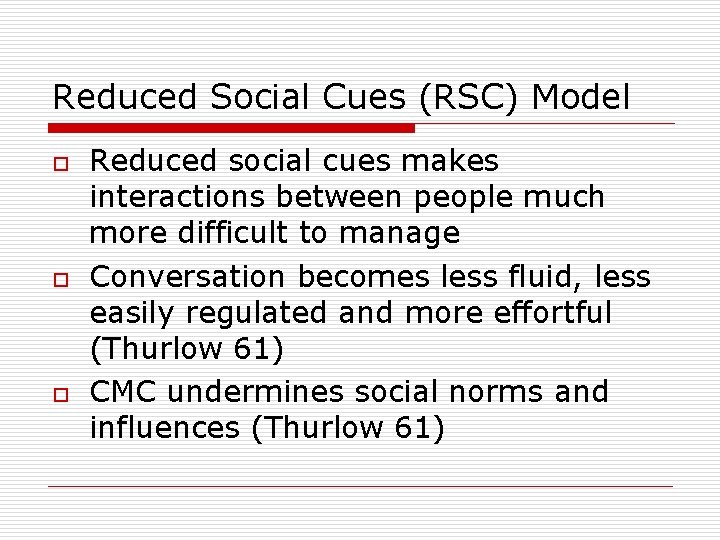
Reduced Social Cues (RSC) Model o o o Reduced social cues makes interactions between people much more difficult to manage Conversation becomes less fluid, less easily regulated and more effortful (Thurlow 61) CMC undermines social norms and influences (Thurlow 61)
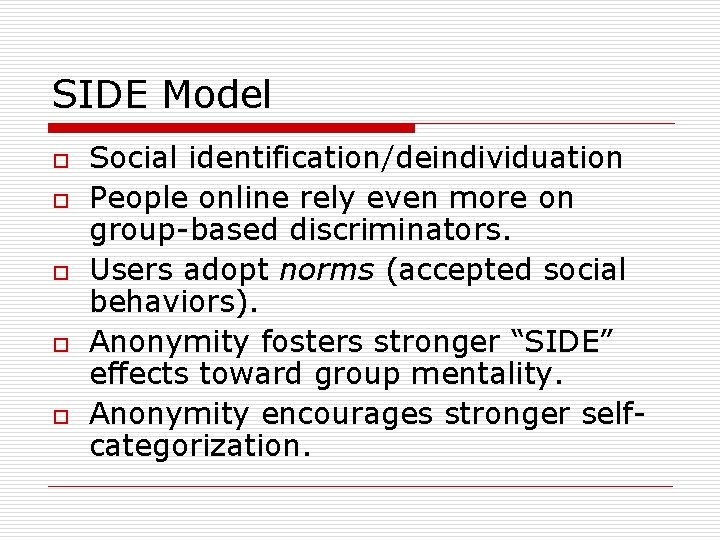
SIDE Model o o o Social identification/deindividuation People online rely even more on group-based discriminators. Users adopt norms (accepted social behaviors). Anonymity fosters stronger “SIDE” effects toward group mentality. Anonymity encourages stronger selfcategorization.
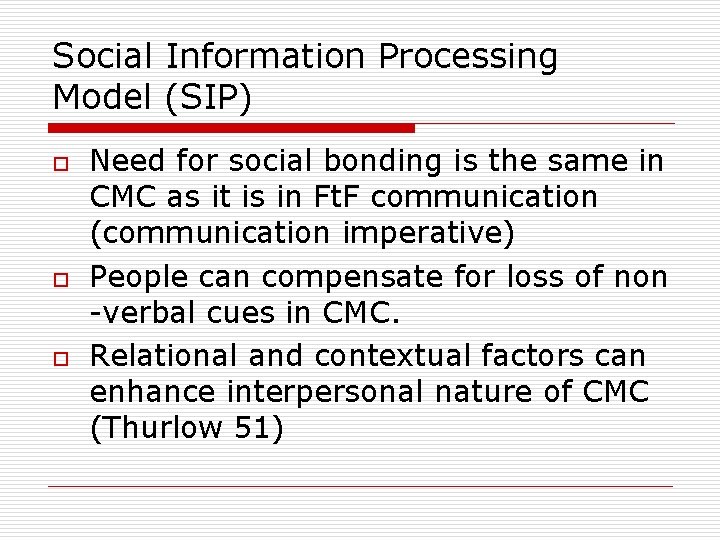
Social Information Processing Model (SIP) o o o Need for social bonding is the same in CMC as it is in Ft. F communication (communication imperative) People can compensate for loss of non -verbal cues in CMC. Relational and contextual factors can enhance interpersonal nature of CMC (Thurlow 51)
Social Influence Model o o Media use results from negotiation between features of medium and social conditions (Wood and Smith 97) Example: flaming – both behavior and interpretation of behavior
Thurlow, Crispin, Lengel, Laura, and Tomic, Alice. Computer Mediated Communication: Social Interaction and the Internet. Sage Publications, 2005. Wood, Andrew F. and Matthew J. Smith. Online Communication: Linking Technology, Identity, and Culture. Second Edition. Lawrence Erlbaum Associates, 2005. Chapter 4, “Relating Online” (78 -100)