
THEORIES OF AUDIENCE THE TWO STEP FLOW THEORY
- Slides: 16
THEORIES OF AUDIENCE
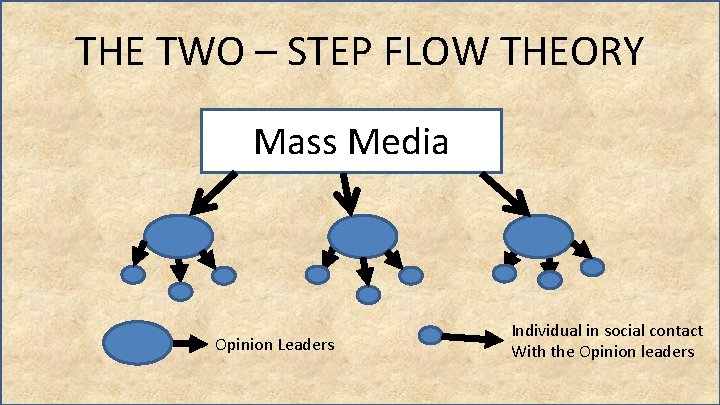
THE TWO – STEP FLOW THEORY Mass Media Opinion Leaders Individual in social contact With the Opinion leaders
AGENDA SETTING THEORY • ASSUMPTIONS OF THEORY – Media does not reflect reality, they filter and shape it – Media concentration on particular topic makes the people think only those topics as important ones.
3 AGENDAS • MEDIA AGENDA • PUBLIC AGENDA • POLICY AGENDA
NARCOTISING DYSFUNCTION • As news about an issue inundates people, they become apathetic to it, substitution action on that issue for knowing about it.
HYPODERMIC NEEDLE THEORY • LINEAR COMMUNICATION THEORY • PASSIVE AUDIENCE • NO INDIVIDUAL DIFFERENCE
MAGIC BULLET THEORY • Known as propaganda theory • The human action was a result of or response to external environmental stimuli.
FREUDIANISM • Human action has three parts – ID: PLEASURE SEEKING PART OF THE MIND – EGO: RATIONAL MIND – SUPER EGO: INTERNALISED SET OF CULTURAL RULES
CULTIVATION THEORY • Audience are classified as Heavy Viewers and Light Viewers • First order effects – general beliefs about everyday world • Second order effects – specific attitudes towards law and order / personal safety. TV VIEWING learning INCIDENTAL INFORMATION construction SOCIAL REALITY
SPIRAL OF SILENCE THEORY • Terms associated with spiral of silence – Double opinion climates – media opinion is different from audience opinion. – Silent majority – dominance of the minority opinion over the majority – Pluralistic ignorance – feeling of belonging to the minority when opposite is the case – Bandwagon – tendency to belong where the majority belong. – Snob effect – decrease in popularity of opinion cause its believed to be cheap
USES AND GRATIFICATION THEORY • Information: • Finding for relevant events. • Seeking advice to solve the matters and make decisions. • Satisfying curiosity and general interest. • Self-education. • Gaining a sense of security through knowledge.
• • USES AND GRATIFICATION THEORY • Personal Identity: Finding reinforcement for personal values. Finding models of behavior. Identifying with valued other (in the media). Gaining insight into one’s self.
USES AND GRATIFICATION THEORY • Integration & Social Interaction • • • Social empathy. Gaining a sense of belonging. Finding a basis for conversation & social interaction. Clarifying social roles. Enabling connection with family, friends and society.
USES AND GRATIFICATION THEORY • Entertainment • • Free tension. Getting aesthetic enjoyment. Filling time. Emotional release.
DISSONANCE THEORY • Selective Exposure : people expose themselves to those media messages that are in accord with their attitudes, interest and belief. • Selective attention: people are attentive towards a few media that complement our pre held attitudes and beliefs
DISSONANCE THEORY • Selective perception: psychological way of understanding the message so that its meaning is in line with a person’s belief or attitude. • Selective pretention: process by which people tend to remember best and longest information that is consistent with their existing attitudes, interest and beliefs.