
Theories of Atonement Many ancient religions practiced sacrifice
- Slides: 7
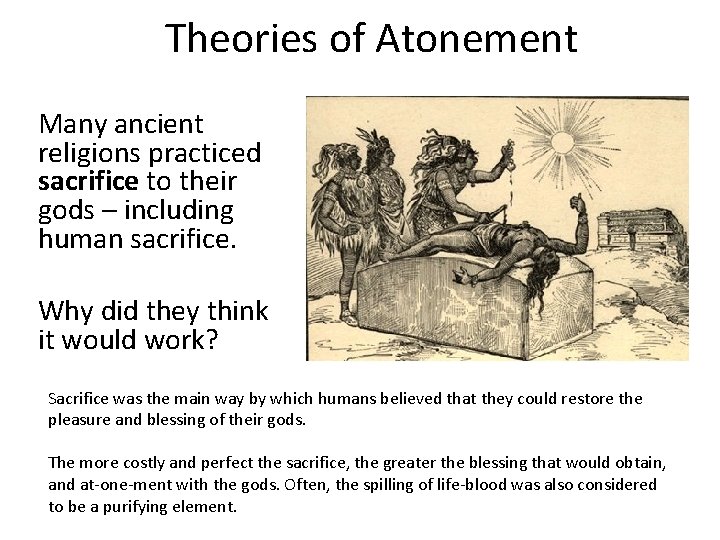
Theories of Atonement Many ancient religions practiced sacrifice to their gods – including human sacrifice. Why did they think it would work? Sacrifice was the main way by which humans believed that they could restore the pleasure and blessing of their gods. The more costly and perfect the sacrifice, the greater the blessing that would obtain, and at-one-ment with the gods. Often, the spilling of life-blood was also considered to be a purifying element.
Atonement & Sacrifice Atonement = at-one-ment - To reconcile humanity with God by means of an action. - Usually by sacrifice – of a live animal, or offerings of harvest, food and wine - In modern times, by the sacrifice of prayer, charity, fasting and moral effort – defeat of sin. The most effective atonement was won by Christ, who obtained the possibility of forgiveness of sin and eternal life for all humanity. How did he do this? By what actions? 1. List the different reasons that sacrifice was offered in the OT. 2. Which of these sacrifices were propitiatory (to please God, so as to obtain favour)? 3. Which were expiatory (to expiate/ purify from sin)? • Which categories do you think Jesus’ sacrifice on the cross would come under? Atonement in the OT as Precedent Several OT figures were required by God to offer sacrifice, for thanksgiving, or for sealing a covenant – Noah after the flood, Abraham & Isaac, the Passover lamb, Moses on Mount Sinai. Jewish OT law stipulated that individuals could be purified from sin, offer thanksgiving, invoke blessing, by sacrifice – of wheat, bread, wine, harvest produce, birds, lamb/ goats. Every year, on the Day of Atonement, the whole Jewish community would purify itself of sin, by driving out a goat into the desert, (the “scapegoat”), having ritually laid all sins upon its head, while the blood of a second sacrificed goat would be spilt over the altar in the Holy of Holies, for purification by its life-blood.
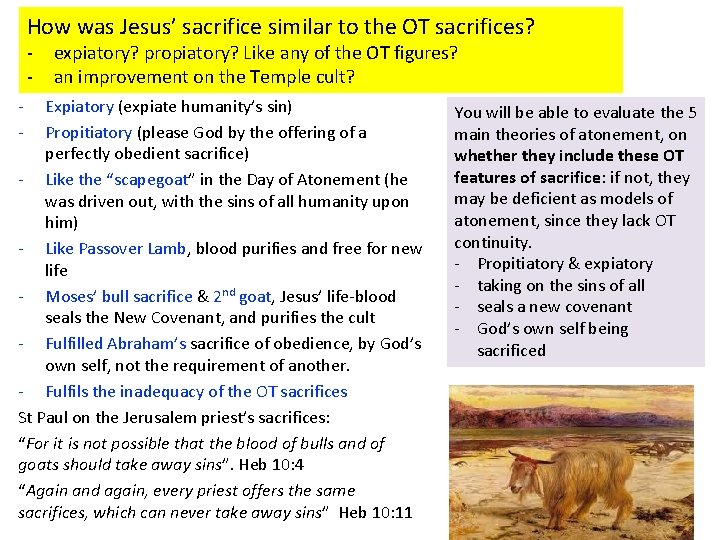
How was Jesus’ sacrifice similar to the OT sacrifices? - expiatory? propiatory? Like any of the OT figures? an improvement on the Temple cult? Expiatory (expiate humanity’s sin) Propitiatory (please God by the offering of a perfectly obedient sacrifice) - Like the “scapegoat” in the Day of Atonement (he was driven out, with the sins of all humanity upon him) - Like Passover Lamb, blood purifies and free for new life - Moses’ bull sacrifice & 2 nd goat, Jesus’ life-blood seals the New Covenant, and purifies the cult - Fulfilled Abraham’s sacrifice of obedience, by God’s own self, not the requirement of another. - Fulfils the inadequacy of the OT sacrifices St Paul on the Jerusalem priest’s sacrifices: “For it is not possible that the blood of bulls and of goats should take away sins”. Heb 10: 4 “Again and again, every priest offers the same sacrifices, which can never take away sins” Heb 10: 11 You will be able to evaluate the 5 main theories of atonement, on whether they include these OT features of sacrifice: if not, they may be deficient as models of atonement, since they lack OT continuity. - Propitiatory & expiatory - taking on the sins of all - seals a new covenant - God’s own self being sacrificed
Which type of sacrifice is it? Expiatory – e. Xpels the sin Propitiatory – Pleases God
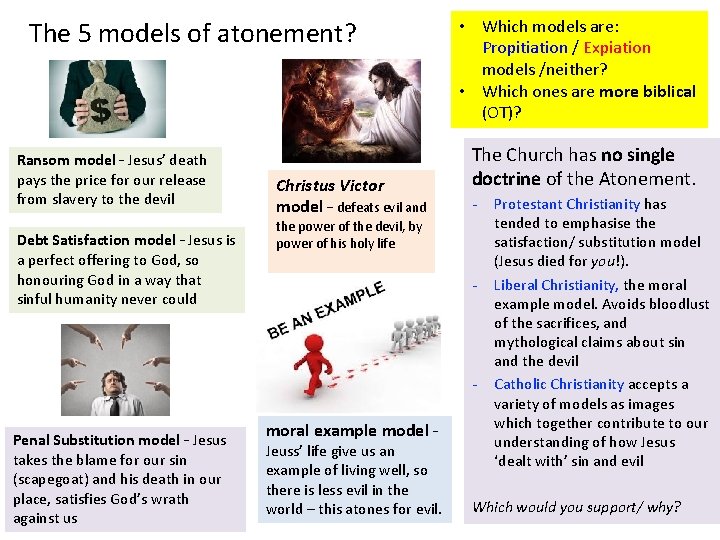
The 5 models of atonement? Ransom model – Jesus’ death pays the price for our release from slavery to the devil Debt Satisfaction model – Jesus is a perfect offering to God, so honouring God in a way that sinful humanity never could Christus Victor model – defeats evil and • Which models are: Propitiation / Expiation models /neither? • Which ones are more biblical (OT)? The Church has no single doctrine of the Atonement. - the power of the devil, by power of his holy life - Penal Substitution model – Jesus takes the blame for our sin (scapegoat) and his death in our place, satisfies God’s wrath against us moral example model – Jeuss’ life give us an example of living well, so there is less evil in the world – this atones for evil. Protestant Christianity has tended to emphasise the satisfaction/ substitution model (Jesus died for you!). Liberal Christianity, the moral example model. Avoids bloodlust of the sacrifices, and mythological claims about sin and the devil Catholic Christianity accepts a variety of models as images which together contribute to our understanding of how Jesus ‘dealt with’ sin and evil Which would you support/ why?
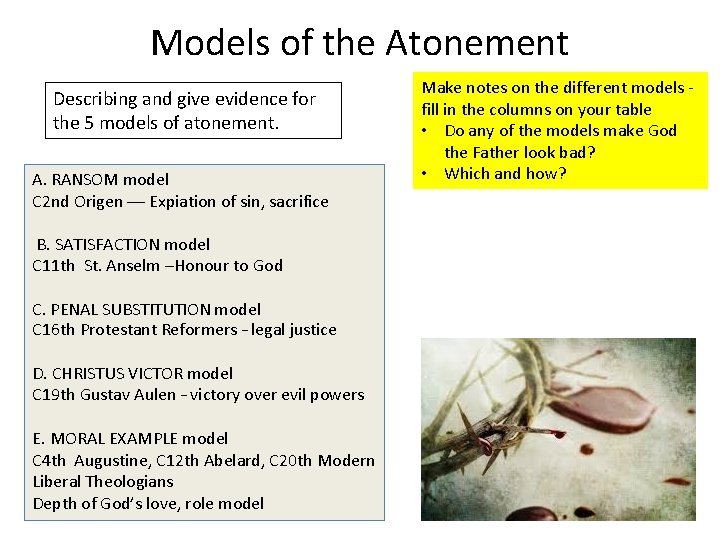
Models of the Atonement Describing and give evidence for the 5 models of atonement. A. RANSOM model C 2 nd Origen –– Expiation of sin, sacrifice B. SATISFACTION model C 11 th St. Anselm –Honour to God C. PENAL SUBSTITUTION model C 16 th Protestant Reformers – legal justice D. CHRISTUS VICTOR model C 19 th Gustav Aulen – victory over evil powers E. MORAL EXAMPLE model C 4 th Augustine, C 12 th Abelard, C 20 th Modern Liberal Theologians Depth of God’s love, role model Make notes on the different models - fill in the columns on your table • Do any of the models make God the Father look bad? • Which and how?
Atonement • How did atonement happen in the OT? • What are 5 ideas about how Jesus carried out atonement? • Which of them seem better/ worse explanations?