
THEORIES OF AGING Psychological Theories Maslow Human Needs









- Slides: 32
THEORIES OF AGING
Psychological Theories �Maslow Human Needs � Five basic needs �Erickson’s Personality � Life stages relate to life tasks Grossman and Lange, 2006
Social Theories Based on social order, balance and harmony �Activity Theory � Necessary for satisfaction with life �Disengagement theory � Natural process � Gradual withdrawal Phelan, 2010
Biological Theories �Non-stochastic � Predicted damage �Stochastic � Random damage Grossman and Lange, 2006
Ageism “stereotypical, dehumanizing, negative constructions” (Phelan, 2010) Three domains �Cognitive �Beliefs and stereotypes �Affective �prejudice �Behavioral �Direct discriminatory practices �Indirect discriminatory practices Phelan, 2010
Assessment of Geriatric Needs �health history �physical assessment �laboratory studies �radiological testing �functional assessment of activities of daily living �cognitive assessment �skin assessment �social assessment �financial assessment
RISK ASSESSMENT TOOLS �needs assessment �fall risk assessment �pressure ulcer assessment �pain assessment �nutritional screening Toofany, S. 2007
SPICES �S is for Sleep Disorders �P is for Problems with Eating or Feeding �I is for Incontinence �C is for Confusion �E is for Evidence of Falls �S is for Skin Breakdown Fulmer, M. 2007
Research Study Geriatric Workforce Enhancement Program �Train the trainer �Basic course �Advanced course �Outcomes �Participants impacted change Barba and Fay (2009)
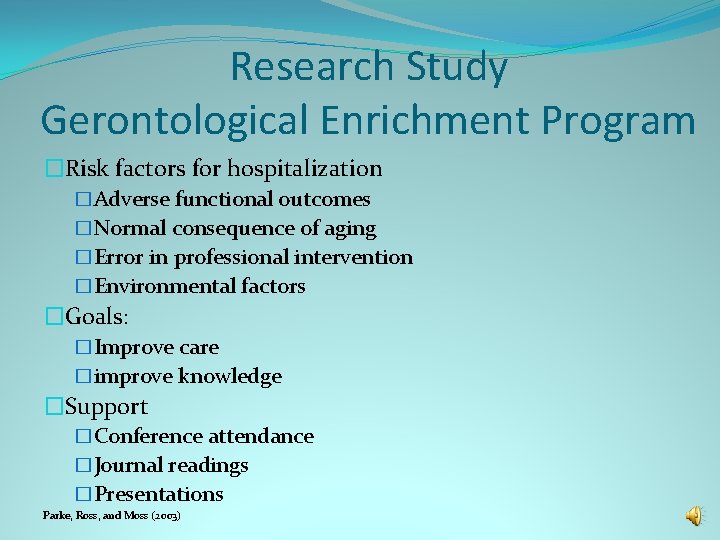
Research Study Gerontological Enrichment Program �Risk factors for hospitalization �Adverse functional outcomes �Normal consequence of aging �Error in professional intervention �Environmental factors �Goals: �Improve care �improve knowledge �Support �Conference attendance �Journal readings �Presentations Parke, Ross, and Moss (2003)
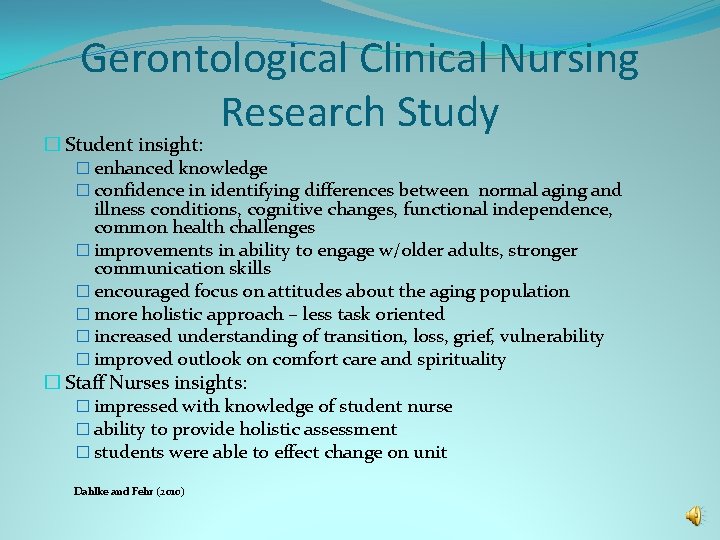
Gerontological Clinical Nursing Research Study � Student insight: � enhanced knowledge � confidence in identifying differences between normal aging and illness conditions, cognitive changes, functional independence, common health challenges � improvements in ability to engage w/older adults, stronger communication skills � encouraged focus on attitudes about the aging population � more holistic approach – less task oriented � increased understanding of transition, loss, grief, vulnerability � improved outlook on comfort care and spirituality � Staff Nurses insights: � impressed with knowledge of student nurse � ability to provide holistic assessment � students were able to effect change on unit Dahlke and Fehr (2010)
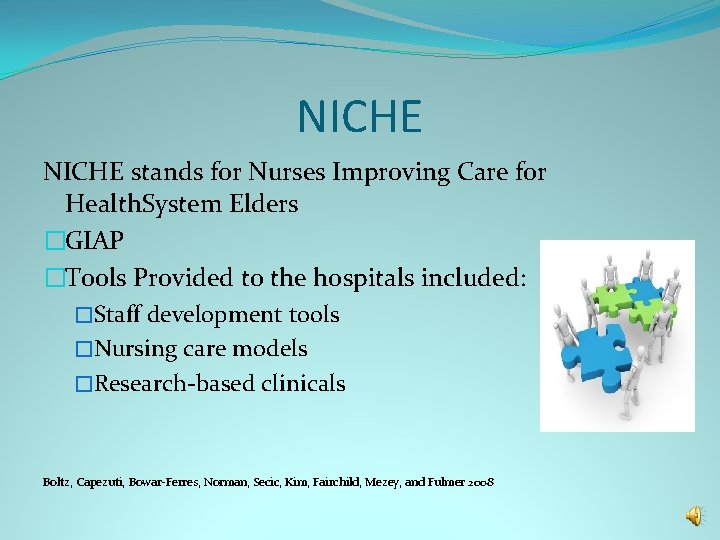
NICHE stands for Nurses Improving Care for Health. System Elders �GIAP �Tools Provided to the hospitals included: �Staff development tools �Nursing care models �Research-based clinicals Boltz, Capezuti, Bowar-Ferres, Norman, Secic, Kim, Fairchild, Mezey, and Fulmer 2008
Interpretation of information Quality geriatric care is: • evidenced based • ensures best practices • includes a holistic assessment • individualized to patient needs • promotes patient decision making
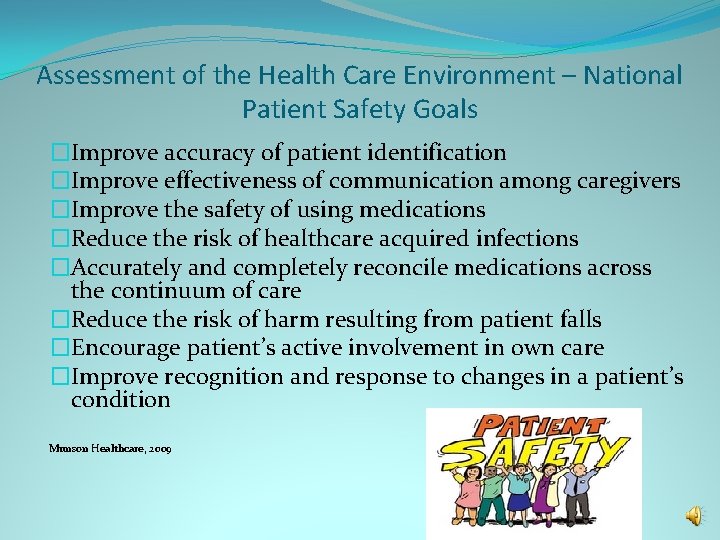
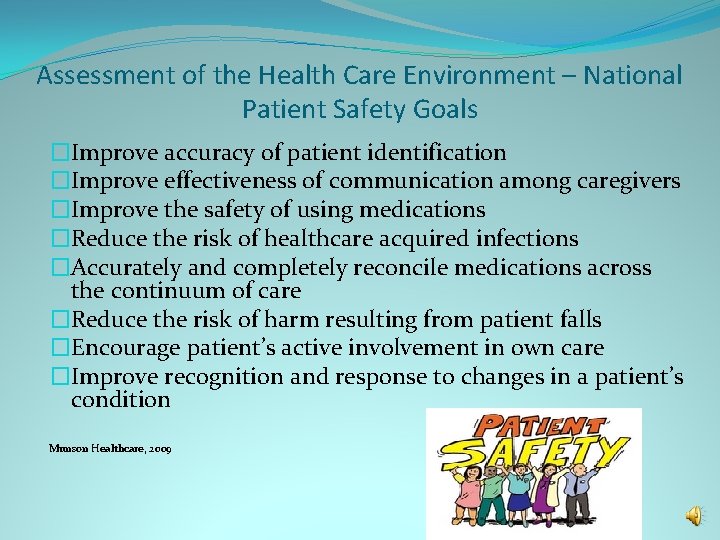
Assessment of the Health Care Environment – National Patient Safety Goals �Improve accuracy of patient identification �Improve effectiveness of communication among caregivers �Improve the safety of using medications �Reduce the risk of healthcare acquired infections �Accurately and completely reconcile medications across the continuum of care �Reduce the risk of harm resulting from patient falls �Encourage patient’s active involvement in own care �Improve recognition and response to changes in a patient’s condition Munson Healthcare, 2009
Assessment of the Health Care Environment – National Patient Safety Goals �Improve accuracy of patient identification �Improve effectiveness of communication among caregivers �Improve the safety of using medications �Reduce the risk of healthcare acquired infections �Accurately and completely reconcile medications across the continuum of care �Reduce the risk of harm resulting from patient falls �Encourage patient’s active involvement in own care �Improve recognition and response to changes in a patient’s condition Munson Healthcare, 2009
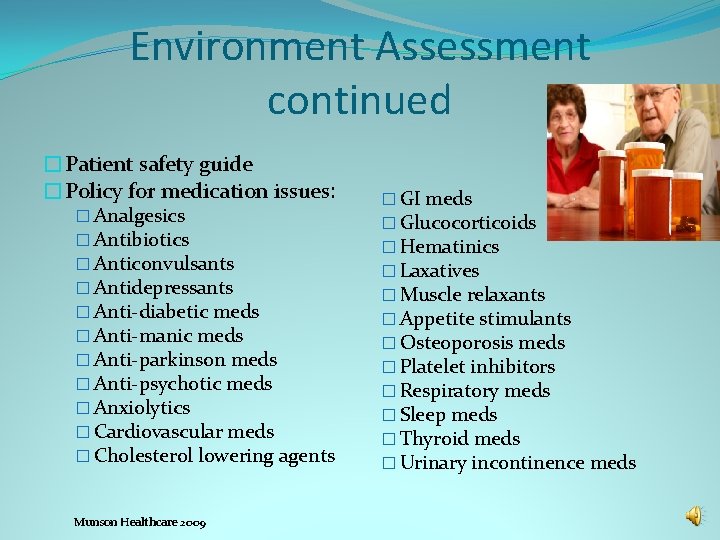
Environment Assessment continued �Patient safety guide �Policy for medication issues: � Analgesics � Antibiotics � Anticonvulsants � Antidepressants � Anti-diabetic meds � Anti-manic meds � Anti-parkinson meds � Anti-psychotic meds � Anxiolytics � Cardiovascular meds � Cholesterol lowering agents Munson Healthcare 2009 � GI meds � Glucocorticoids � Hematinics � Laxatives � Muscle relaxants � Appetite stimulants � Osteoporosis meds � Platelet inhibitors � Respiratory meds � Sleep meds � Thyroid meds � Urinary incontinence meds
Iatrogenesis Common iatrogenic events can occur as a result of: �“Adverse reactions to medications �Adverse reactions to diagnostic, therapeutic and prophylactic procedures �Nosocomial conditions such as hospital-acquired infections, delirium, deconditioning, malnutrition, fecal impaction, incontinence and pressure ulcers �Falls or other accidental and environmentally-induced accidents, and �Harmful effects to patients related to the values, beliefs, prejudices, fears and attitudes of well intentioned, but ignorant providers ” Information quoted from Hartford Institute for Geriatric Nursing, Francis, 2 oo 8
Root Cause Analysis Fall risk assessment �Reasons why falls occur �Identification of high risk patients �Interventions �ARTT
Prevention of poor outcomes • Improve knowledge base • Continuing education in geriatrics • Nurses trained in geriatrics • Institution of National Patient Safety Goals especially those that focus on the elderly population • CLABSI • CAUTI • SSI • VAP • Those associated with increase use of antibiotics Munson Healthcare, 2009
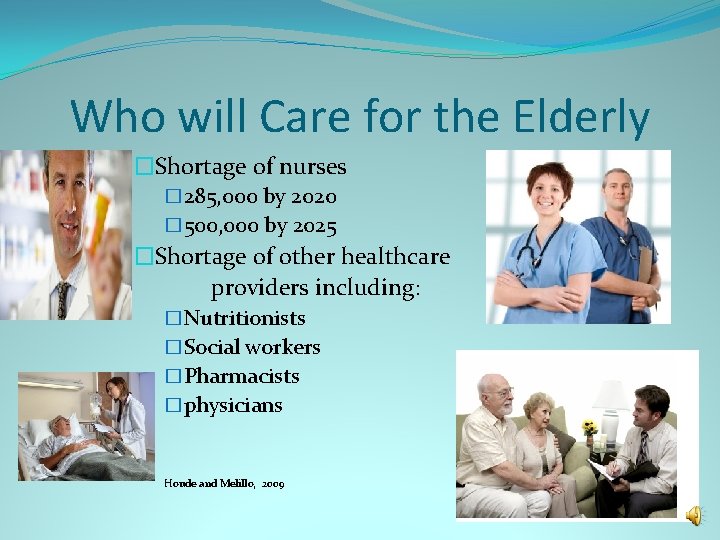
Who will Care for the Elderly �Shortage of nurses � 285, 000 by 2020 � 500, 000 by 2025 �Shortage of other healthcare providers including: �Nutritionists �Social workers �Pharmacists �physicians Houde and Melillo, 2009
Providing Quality Care for the Elderly: Statistics Current training in geriatrics � 30 of 670 BSN programs meet criteria for best educational courses in geriatrics � 23% required geriatrics course � 24% had an elective available to take � 49% integrate geriatrics with other courses This reflects less than 1% of the nation’s nurses having a certification in geriatrics Kovner, Mezey, and Harrington, 2002
Competence in Care for the Elderly Population �Nurses are trained for pediatrics, shouldn’t they also be for geriatrics? �Recommendations for staff trained in geriatrics at colleges, universities �Continuing education for nurses currently working with the elderly population �Some states already have mandates or policies in place regarding care of the elderly population �Arizona example
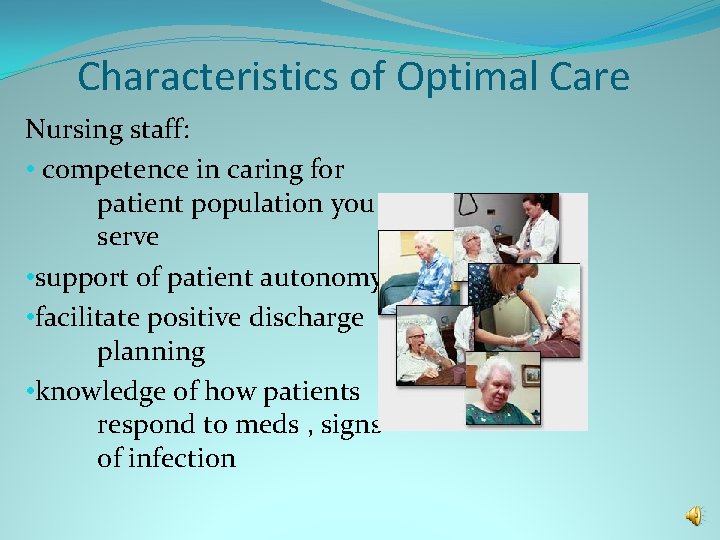
Characteristics of Optimal Care Nursing staff: • competence in caring for patient population you serve • support of patient autonomy • facilitate positive discharge planning • knowledge of how patients respond to meds , signs of infection
Recommendations • CMS (Centers for Medicare and Medicaid Services) • Survey studies • incentives • Institute of Medicine • Home health aides • Family members �Economist Intelligence Unit �Change the mindset about the elderly �Continue preventative care �Medication studies on the elderly �Continued training for health care professionals
Preventative Health care for the Elderly �Smoking cessation �Screening for health issues �High blood pressure �Importance of exercise �High cholesterol �Healthy Nutrition �Osteoporosis �Vision and hearing �Cardiovascular care screening �Cancer screening �Dental health �Immunizations Takahashi, Okhravi, Lim, and Kasten , 2004
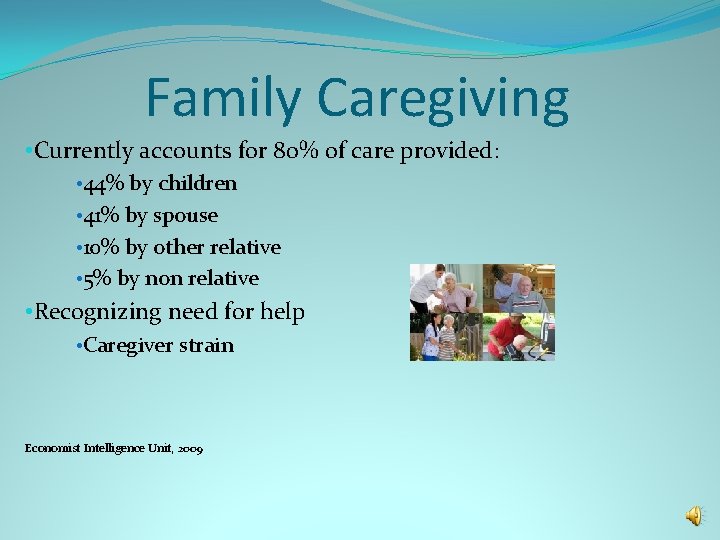
Family Caregiving • Currently accounts for 80% of care provided: • 44% by children • 41% by spouse • 10% by other relative • 5% by non relative • Recognizing need for help • Caregiver strain Economist Intelligence Unit, 2009
Community or Home-Based Care �Illinois study �$117/day for ECF �$650/month for home care �Use of telemedicine �Community day cares Economist Intelligence Unit, 2009
Resources to Care for the Elderly �Commission on Aging �Chore services �Meals on Wheels �Area agency on aging �MI choice waiver program �Nursing home transition program �Care management �Care respite �Information on help with medications and co-pays �Dementia coalition �Medicare. gov website
Hartford Institute e-learning website www. hartfordign. org/Spotlight/e. Learning �consult. Geri. RN �NICHE �Nursing home modules �Case studies
References � Ahlich, B. and Spinniken, K. (2010). Medication Issues of particular Relevance in Older Adults. Retrieved September 30, 2011 from http: //mmcv-sms 01. ad. mhc. net � Barba, B. & Fay, V. (2009). Does continuing education in gerontology lead to changes in nursing practice? Journal of Gerontological Nursing 35(4). Retrieved September 12, 2011 from CINAHL database. � Boltz, M. , Capesuti, E. , Bowar-Ferres, S. , Norman, R. , Secic, M. , Kim, H. , Fairchild, S. , Mezey M. , and Fulmer, T. (2008). Changes in geriatric care environment associated with NICHE (nurses improving care for Health. System elders). Geriatric Nursing 29(3). Retrieved September 13, 2011 from CINAHL database � Boyce, P. (2003). Lighting for the elderly. Technology & Disability, 15 (3). Retrieved September 26, 2011 from CINAHL database � Center on an Aging Society. (2005). Adult Children: The likelihood of providing care for an older parent. Retrieved October 2, 2011 from ihcrp. georgetown. edu/agingsociety/pdfs/ CAREGIVERS 2. pdf � Dahlke, S. & Fehr, C. (2010). Implementing a gerontological clinical nursing practice with an interdisciplinary focus: lessons learned. Gerontology and Geriatrics Education 31(2). Retrieved September 13, 2011 from CINAHL database � Ebersole, P. , Hess, P. , Touhy, T. , Jett, K. , and Luggen, A. , (2008). Toward Healthy Aging (7 th ed. ). Mosby Elsevier: St. Louis, MO. /
References continued � Economist Intelligence Unit (2009). Healthcare strategies for an aging society. The Economist. Retrieved October 2, 2011 from graphics. eiu. com/upload/. . . /Philips_Healthcare_ageing_ 3011 WEB. pdf � Francis, D. (2008). Iatrogenesis. Retrieved from www. hartfordign. org/Spotlight/e. Learning � Fulmer, T. (2007). How to try this: Fulmer SPICES. American Journal of Nursing. 107(10). Retrieved September 6, 2011 from consultgerirn. org/uploads/File/trythis/try_this_1. pdf � Garm, A. (2006). Promoting excellence in gerontological nursing. Nursing 2. Retrieved September 13, 2011 from CINAHL database � Grossman, S. , and Lange, J. (2006). Theories of aging as basis for assessment. Medsurg Nursing 15(2). Retrieved September 24, 2011 from CINAHL database. � Hansen, Linda (2010). Analysis of Geriatric Needs. FSU Gerontological Nursing. � Hartford Institute for Geriatric Nursing (2008). E-learning center, retrieved September 6, 2011 from www. hartfordign. org/Spotlight/e. Learning/ � Houde, S. & Melillo, K. (2009). Caring for an aging population. Journal of Gerontological Nursing 35(12). Retrieved 13, 2011 from CINAHL database � Kovner, C. , Mezey, M. , and Harrington, C. (2002). Who cares for older adults? Workforce implications of an aging society. Health Affairs 21(5). Retrieved September 6, 2011 from CINAHL database.
References continued � Messecar, D. (2008). Family Caregiving. Retrieved September 28, 2011 from www. hartfordign. org/Spotlight/e. Learning/ � National Patient Safety Goals at Munson Medical Center. (2009). Retrieved September 30, 2011 from http: //mmcwebsrv. mhc. net � Nursing Scope and Standards of Practice (2004). American Nurses Association: Washington, DC � Parke, B. , Ross, D. and Moss, L. (2003). Creating a cultural shift: a gerontological enrichment program for acute care. Journal for Nurses in Staff Development 19(6). Retrieved September 13, 2011 from CINAHL database � Phelan, A. (2010). Socially constructing older people: examining discourses which can shape nurses’ understanding and practice. Journal of Advanced Nursing. Retrieved September 13, 2011 from CINAHL database � Smith, C. and Cotter, V. (2008). Age-related changes in health. National guideline clearing house. Retrieved September 24, 2011 from Hartford Institute for Geriatric Learning www. hartfordign. org/Spotlight/e. Learning/ � Starns, M. (2011). Aging 2020 - Arizona Plan for an Aging Population. Retrieved September 25, 2011 from azgovernor. gov/aging/Documents/Aging 2020 Report. pdf � Stolte, K. (1996). Wellness Nursing Diagnosis for Health Promotion. J. B. Lippincott Co. : Philadelphia, PA � Takahashi, P. , Okhravi, H. , Lim, L. , and Kasten, M. (2004). Preventative health care in the elderly population: a guide for practicing physicians. Mayo Clinic Proc. 79: 416 -427. Retrieved September 28, 2001 from CINAHL database � Toofany, S. (2007). Tools to care. Nursing Older People 19(10). Retrieved September 13, 2011 from CINAHL database.