
Theories and Practices of Counseling Psychotherapy Humanistic Existential


- Slides: 28
Theories and Practices of Counseling & Psychotherapy Humanistic Existential Approach
Existential Therapy A Philosophical/Intellectual Approach to Therapy DEFINITION: - a philosophical approach that emphasizes our freedom to choose what to make of our circumstances - a concept of being free & therefore responsible for our choices and actions
Existential Humanistic Approach l. Focus on Human Experience l. Client Centered l. Relationship Centered l. Non-Diagnostic
Existential Philosophers l. Kierkegaard l. Nietzsche l. Husserl l. Heidegger l. Sartre
Existential Humanistic Psychologists l. Binswanger l. Frankl l. Rogers l. May l. Perls
Key concepts Being in the World 4 Ways of being n. Biological n. Relationship with Others n. Relationship with Self n. Relationship with the Spiritual
Key concepts l. Time and Being l. Living and Dying l. Freedom, Responsibility and Choice l. Isolation and Loving
Key concepts l. Meaning & Meaninglessness l. Self-Transcendence l. Authenticity l. Presence
Schools of therapy l. Person-Centered l. Gestalt l. Logotherapy l. Bugental
Gestalt
Basic Concept Gestalt Therapy is a phenomenologicalexistential therapy that focuses on awareness and insight. l Phenomenology is a discipline that helps people stand from their usual way of thinking so that they can tell the difference between what is actually being perceived and felt in the current situation and what is residue from the past.
History l. Fritz Perls (1893 -1970) l. German Jewish l. Reich’s influence l. Lewin’s Field Theory
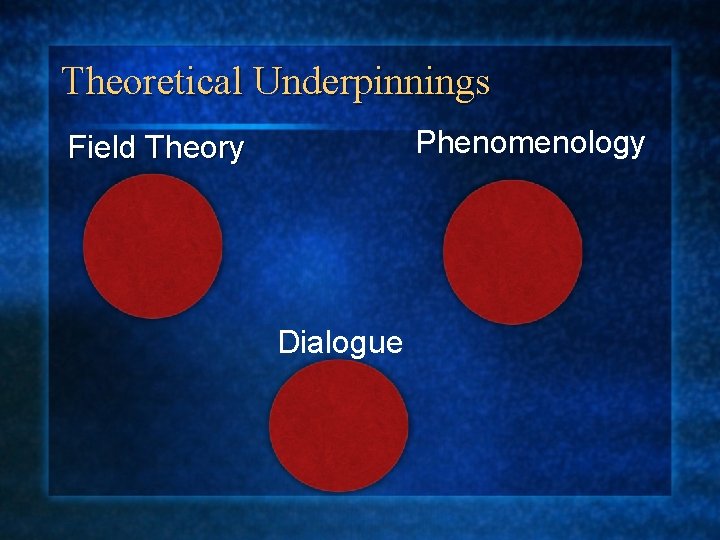
Theoretical Underpinnings Phenomenology Field Theory Dialogue
Field Theory l. Everything that exists is dynamic and interrelated. l. Everything is changing and in constant flux. l. Everything is of the field and cannot be separated from it. l. Relationship between client and therapist is holographic.
phenomenology l. How individuals make meaning of their experiences as part of the field. l. Focus on our sensory apparatus. l. All experience is subjective. l. Importance of differentiation of self and other for survival.
Contact-withdrawal Rhythm of contact and withdrawal allows us to maintain awareness of the field.
Sensory awareness l. How we use our senses is crucial to how we take in data from the world. l. All experience is partial and subjective. l. The therapist collaborates with the client in mutually expanding awareness of the field.
dialogue l. All real living is meeting. (Buber. 1878 -1965) l. Dialogue occurs when two people are mutually impacting each other. l. The I-Thou stance is “the between” a moment that happens in dialogue.
Goals for therapy To develop fuller awareness of our bodies, feelings and environments. To increase comfort of being inside one’s own skin. Help individuals mature and grow with an emphasis on self responsibility. Integration of a person’s feelings perceptions thoughts and body processes into a larger whole.
Gestalt therapist’s goals l. Living the relationship in the here and now l. Horizontal relationship l. Client as expert l. Therapist’s presence and authenticity
Gestalt therapist’s attributes l. Strong self-awareness. l. Ability to walk in the client’s shoes. l. Ability to help client track experience and make meaning. l. Ability to swing back and forth between awareness of the client and self (contact withdrawal).
Gestalt therapist’s attributes. l. Acceptance of lack of control over “the between. ” l. Commitment to working through differences without need for agreement l. Courage
Techniques l. Here and Now Experience l. Directive l. Magnification/Exaggeration l. Language Changes l. Empty Chair l. Talking to Parts of Oneself
Techniques l. Staying with Feelings l. Polarities l. Top Dog & Underdog l. Hot Seat
Gestalt prayer I do my thing and you do your thing. I am not in this world to live up to your expectations, And you are not in this world to live up to mine. You are you, and I am I, and if by chance we find each other, it's beautiful. If not, it can't be helped. (Fritz Perls, 1969)
Gender issues l Men and women apt to respond differently l Facilitates a sense of power within women l Provides opportunity for men to become aware of repressed emotions l Strong potential for facilitating deep, somatic gender awareness
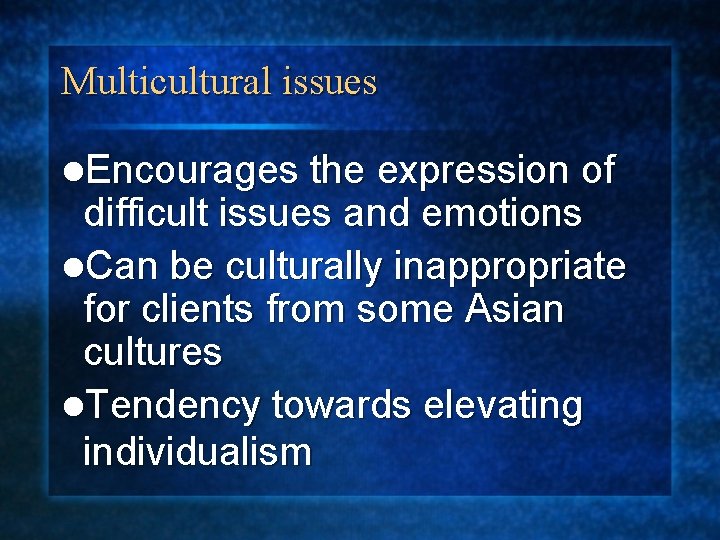
Multicultural issues l. Encourages the expression of difficult issues and emotions l. Can be culturally inappropriate for clients from some Asian cultures l. Tendency towards elevating individualism
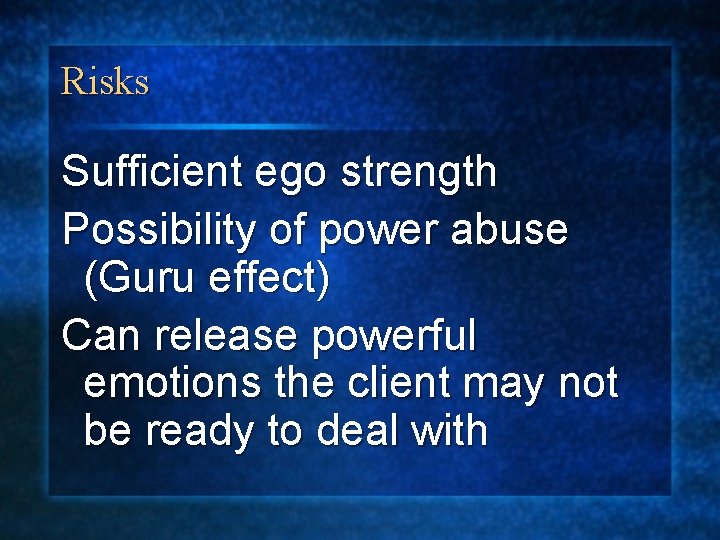
Risks Sufficient ego strength Possibility of power abuse (Guru effect) Can release powerful emotions the client may not be ready to deal with