
Theories and Methods of Family Therapy PostModern Models
- Slides: 40
Theories and Methods of Family Therapy: Post-Modern Models University of Guelph Centre for Open Learning and Educational Support William Corrigan, MTS, RMFT AAMFT Approved Supervisor (519) 265 -3599 williamcorrigan@rogers. com
Day One 1. Introductions 2. Overview 3. Goals 4. Assignments 5. Historical context 6. Exercise: Professional genogram 7. Introduction to Social Construction 8. Exercise: Alien 9. Group time 10. Evaluations
Introductions • Name • Where are you from • Where do you work/what do you do • Any experience with collaborative, narrative or solution-focused?
Overview Historical Context, Introduction to Social Construction Solution-Focused Therapy Narrative Therapy Collaborative Therapy Integration, Review, Critique & Applications
Goals for Course Close your eyes and imagine that we • are going into the future. It is now the beginning of March and we are at the end of the class. Imagine what this class has been like for you – everything you’ve learned, all the meaningful discussions we’ve had. Now imagine: what is different for you? What has made this a successful class for you? What do you know that you didn’t before that will make you a better therapist?
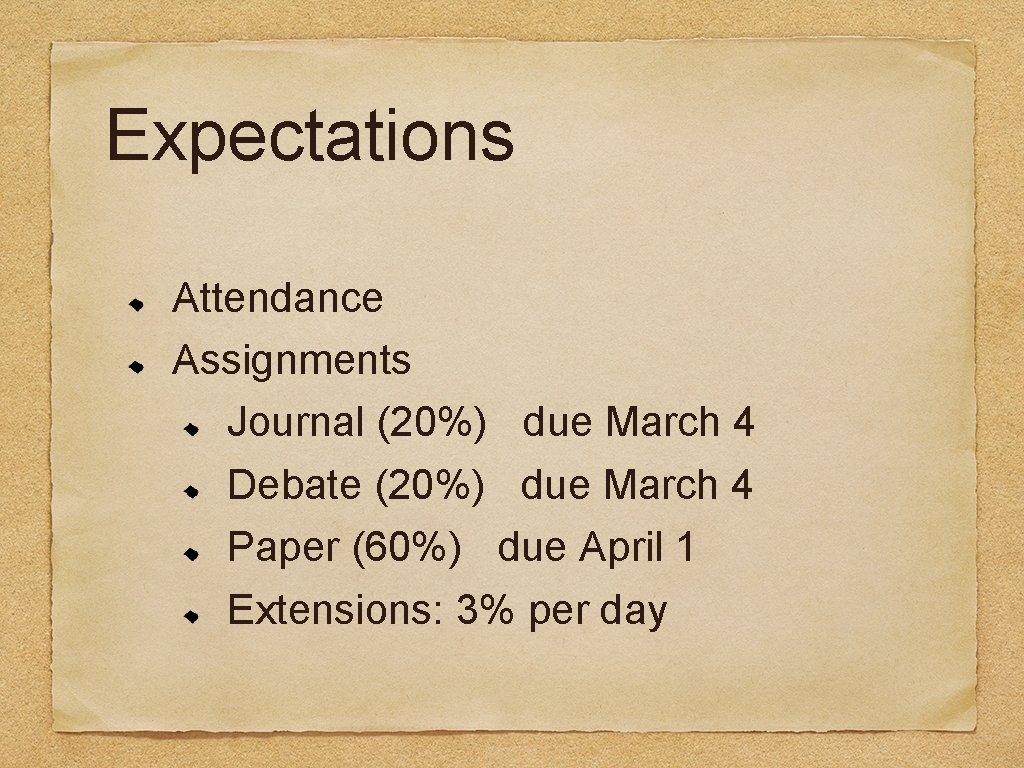
Expectations Attendance Assignments Journal (20%) due March 4 Debate (20%) due March 4 Paper (60%) due April 1 Extensions: 3% per day
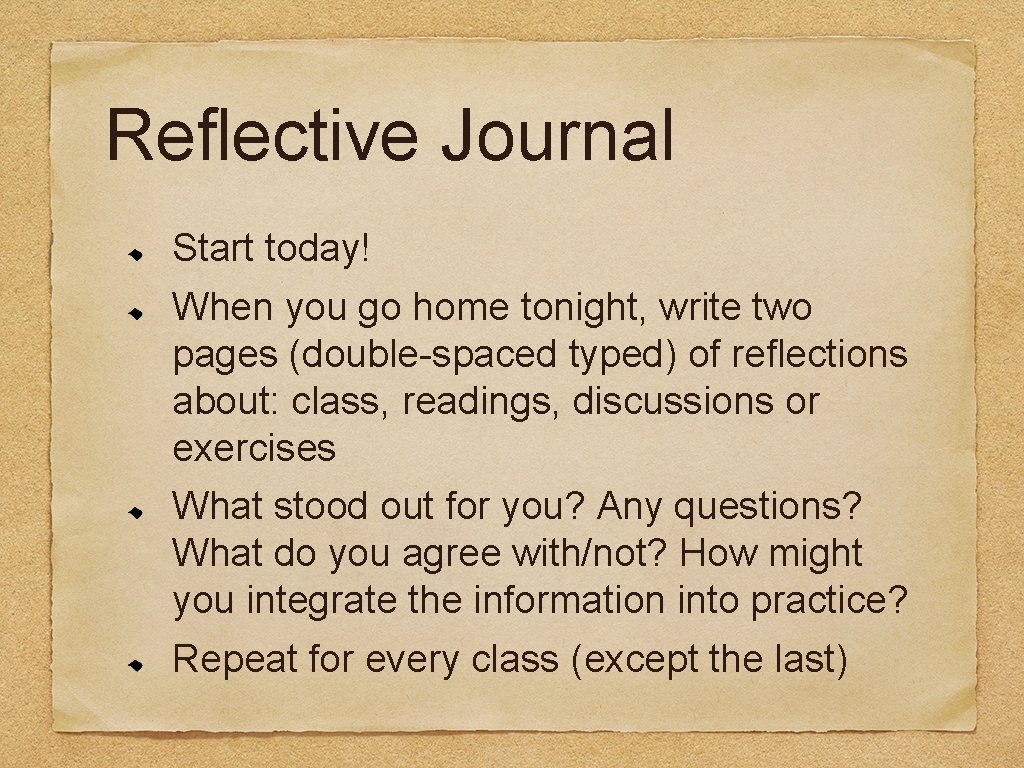
Reflective Journal Start today! When you go home tonight, write two pages (double-spaced typed) of reflections about: class, readings, discussions or exercises What stood out for you? Any questions? What do you agree with/not? How might you integrate the information into practice? Repeat for every class (except the last)
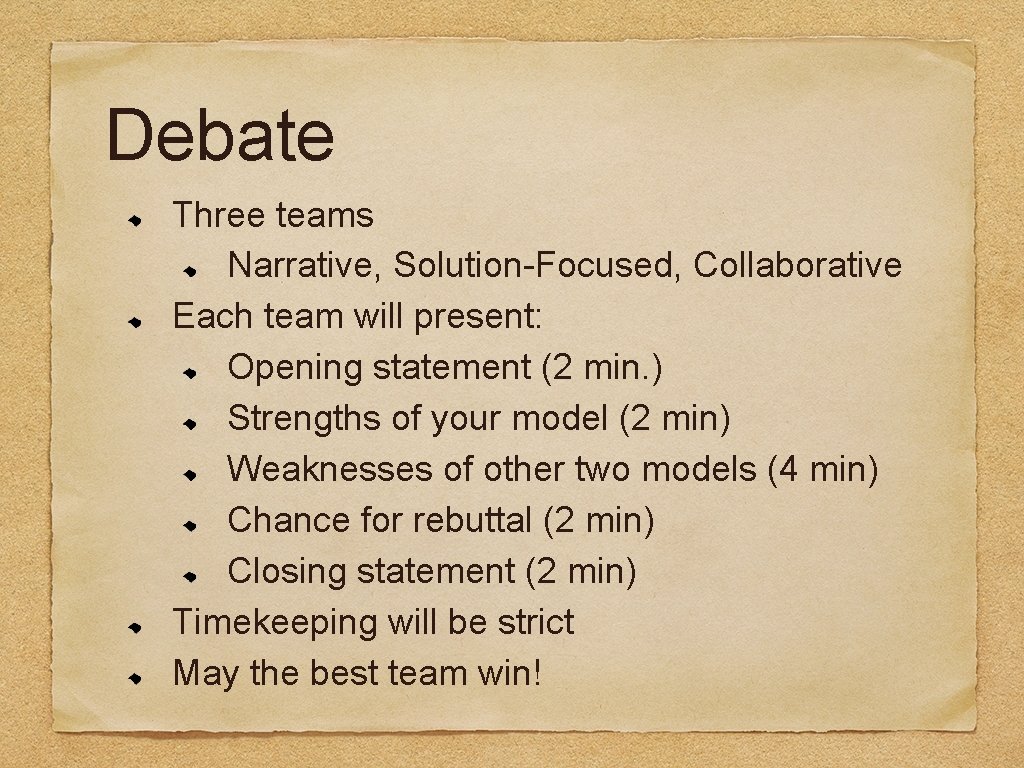
Debate Three teams Narrative, Solution-Focused, Collaborative Each team will present: Opening statement (2 min. ) Strengths of your model (2 min) Weaknesses of other two models (4 min) Chance for rebuttal (2 min) Closing statement (2 min) Timekeeping will be strict May the best team win!
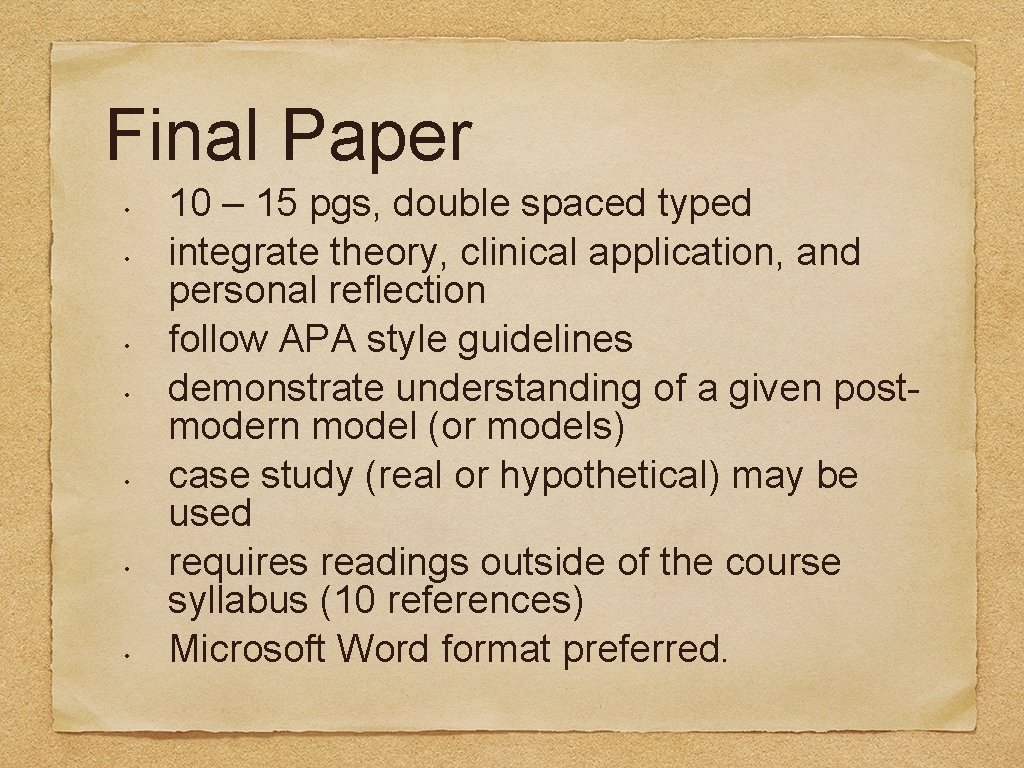
Final Paper • • 10 – 15 pgs, double spaced typed integrate theory, clinical application, and personal reflection follow APA style guidelines demonstrate understanding of a given postmodern model (or models) case study (real or hypothetical) may be used requires readings outside of the course syllabus (10 references) Microsoft Word format preferred.
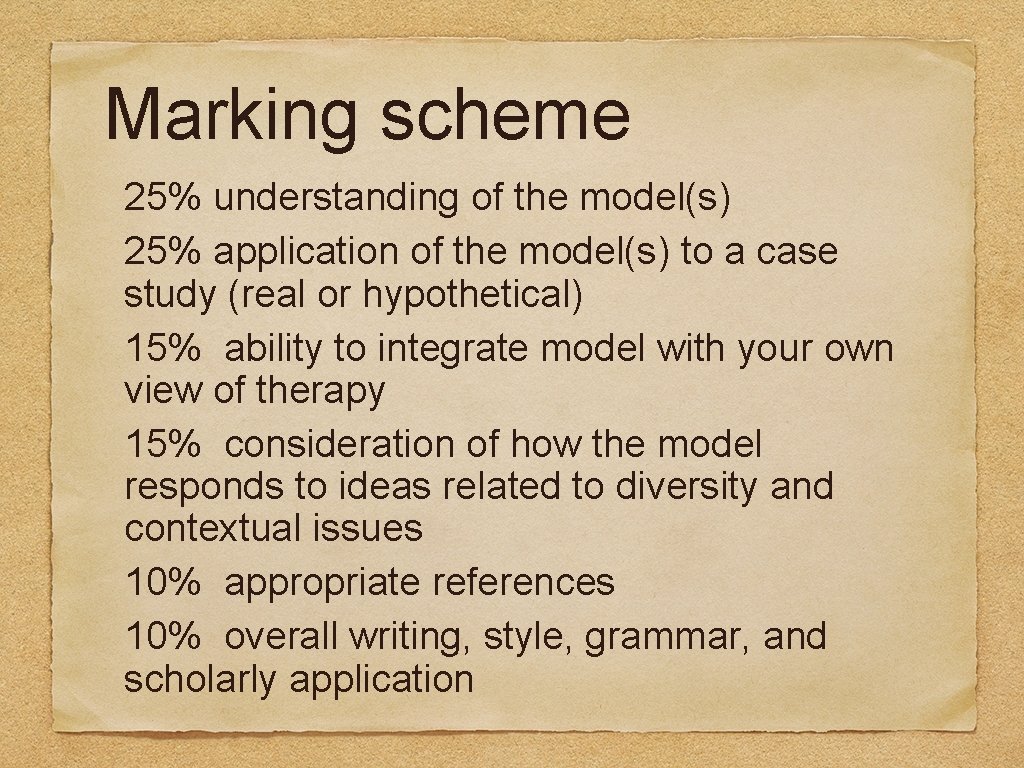
Marking scheme 25% understanding of the model(s) 25% application of the model(s) to a case study (real or hypothetical) 15% ability to integrate model with your own view of therapy 15% consideration of how the model responds to ideas related to diversity and contextual issues 10% appropriate references 10% overall writing, style, grammar, and scholarly application
Don’t Be Late Course deadlines are not constructs. They are real.
Historical Context
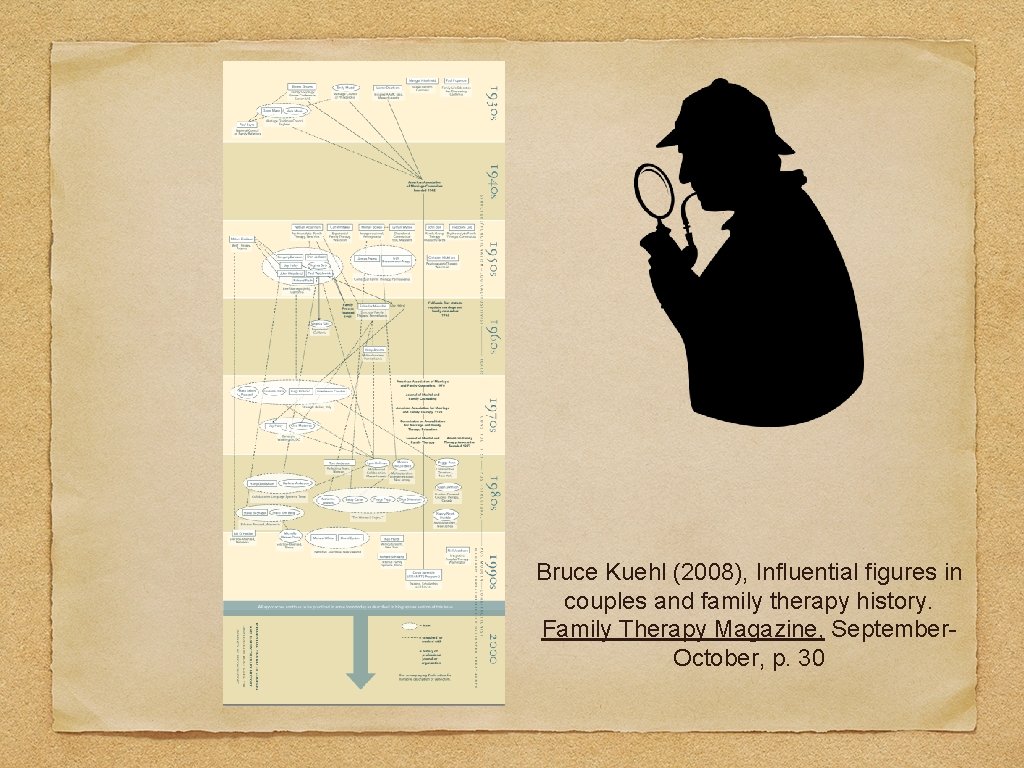
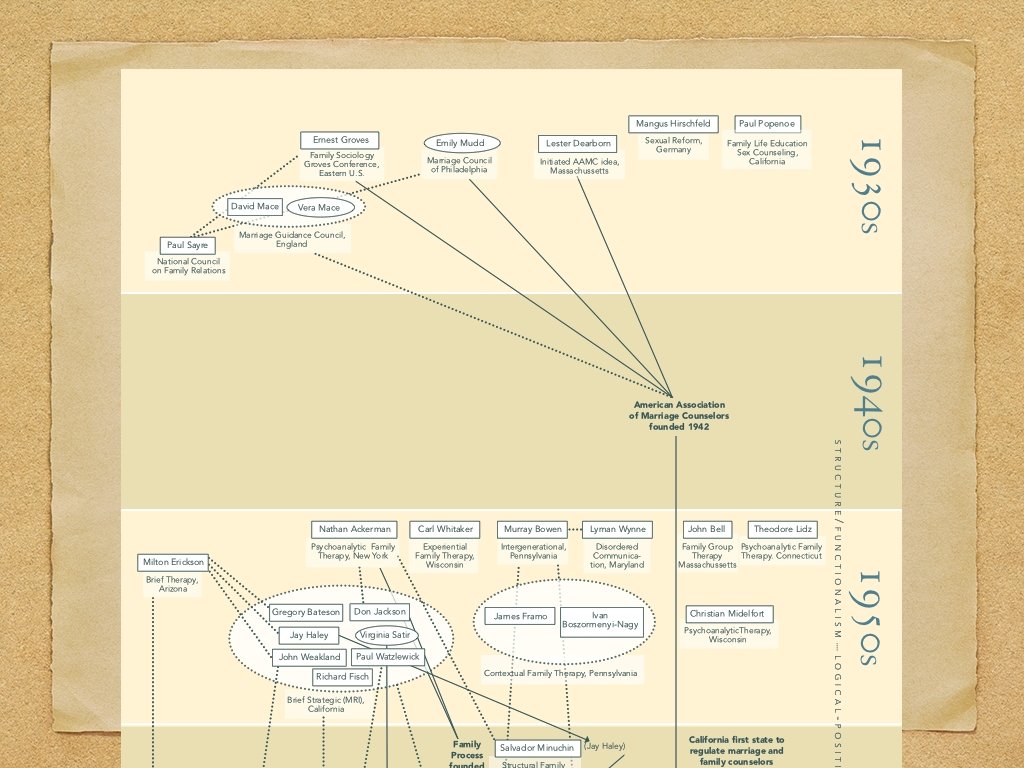
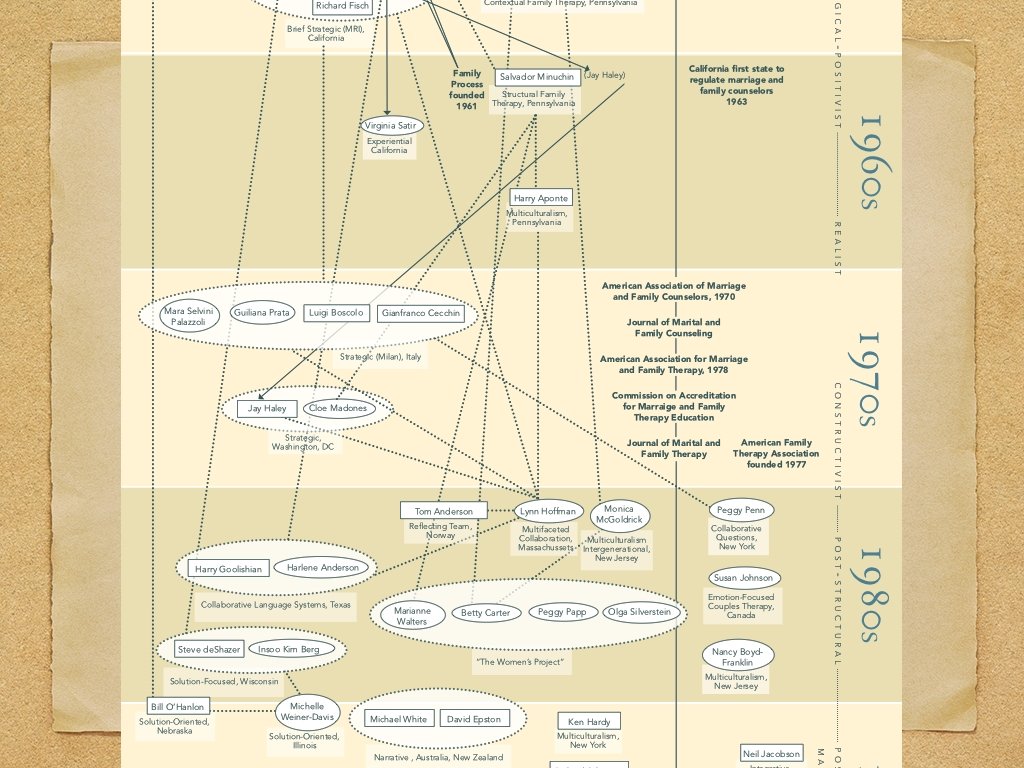
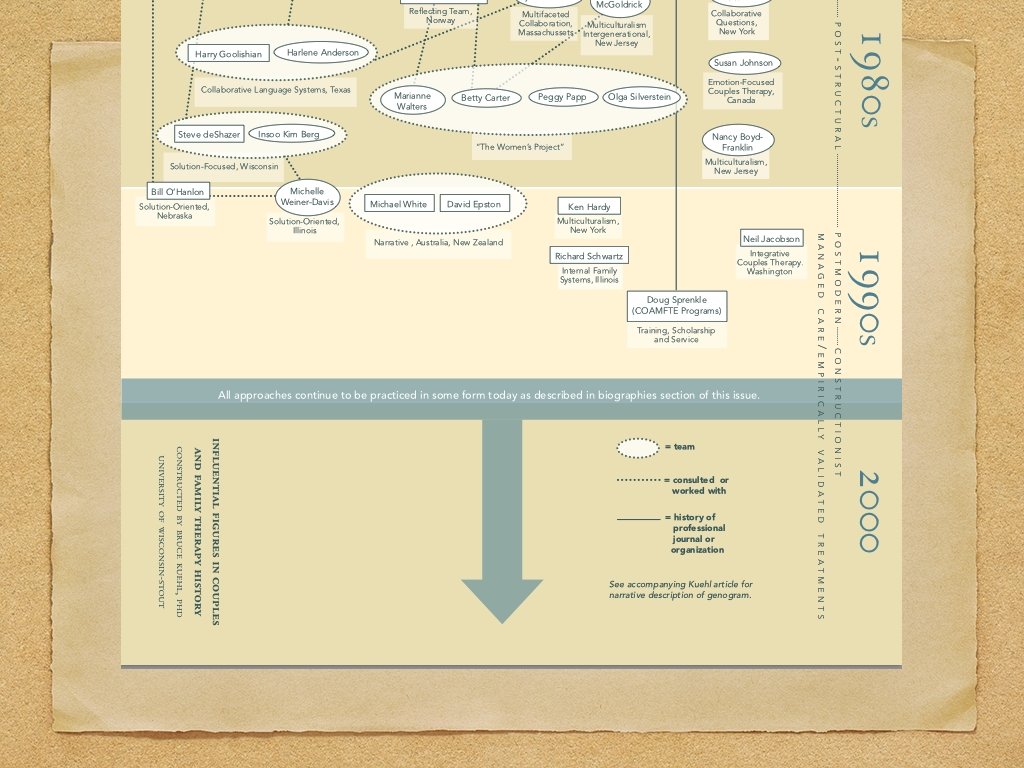
Bruce Kuehl (2008), Influential figures in couples and family therapy history. Family Therapy Magazine, September. October, p. 30
Professional Genogram What if you made a genogram of the people who have influenced you as a therapist?
Show us yours • Write down the names of mentors, teachers, authors, therapists – anyone who has had an influence on your professional identity
Share • Take your professional genogram around the room and share it with a few others
Reflect • • • Who has had the most profound influence on you? Who else would you like to ‘adopt’ into your professional family? How do you imagine yourself as a parent or grandparent to future professional generations?
LUNCH (45 min. )
THE MATRIX (Want to see how far the rabbit hole goes? )
An Invitation to Social Construction The work of Kenneth Gergen
Ken Gergen • You. Tube video on Social Construction
Ken Gergen • American Psychologist • 35+ years in the area of social construction • Co-founded the Taos Institute in 1996 • Non-profit dedicated to exploring social constructionist ideas • Relational view of Self – not individual mind but relational process from which rationality and morality emerge
Social Construction • • Worldwide influence An idea that doesn’t belong to any one Not a fixed or frozen concept Enormously controversial • Unsettles ideas about: • Truth • Objectivity • Value neutrality • The Self
Social Construction • Proposition #1 • Whatever there is makes no demands on us about how we talk about it • Could talk about it as a lot of different things • Most people of the world will want to center in on something which this is and that is what is true about it • There is a strong tendency to delimit and narrow the range of what it is we could call that
Social Construction • Proposition #2 • Whatever we call a thing will grow from a set of relationships in which we’re involved in, the traditions or community to which we belong e. g. physics, chemistry, art historian, etc. • Each community has a language unto itself • Meaning is found through the language applied to a thing by a community • Everything that is real for us comes out of some sort of communal relationship • We socially construct this for what it is
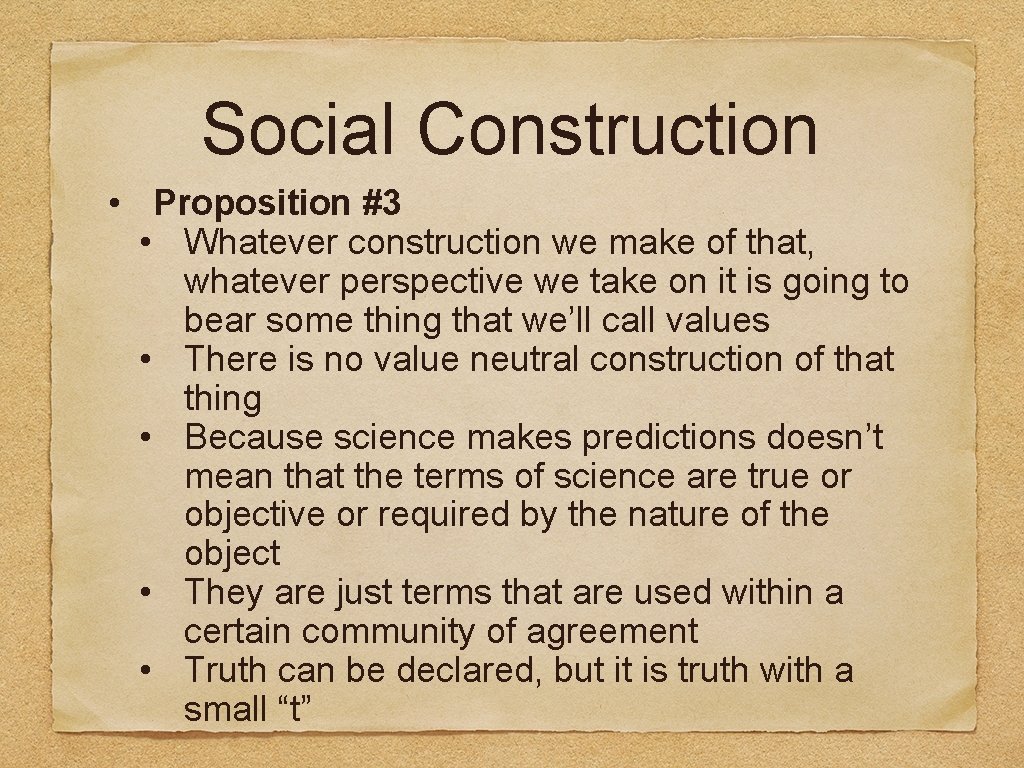
Social Construction • Proposition #3 • Whatever construction we make of that, whatever perspective we take on it is going to bear some thing that we’ll call values • There is no value neutral construction of that thing • Because science makes predictions doesn’t mean that the terms of science are true or objective or required by the nature of the object • They are just terms that are used within a certain community of agreement • Truth can be declared, but it is truth with a small “t”
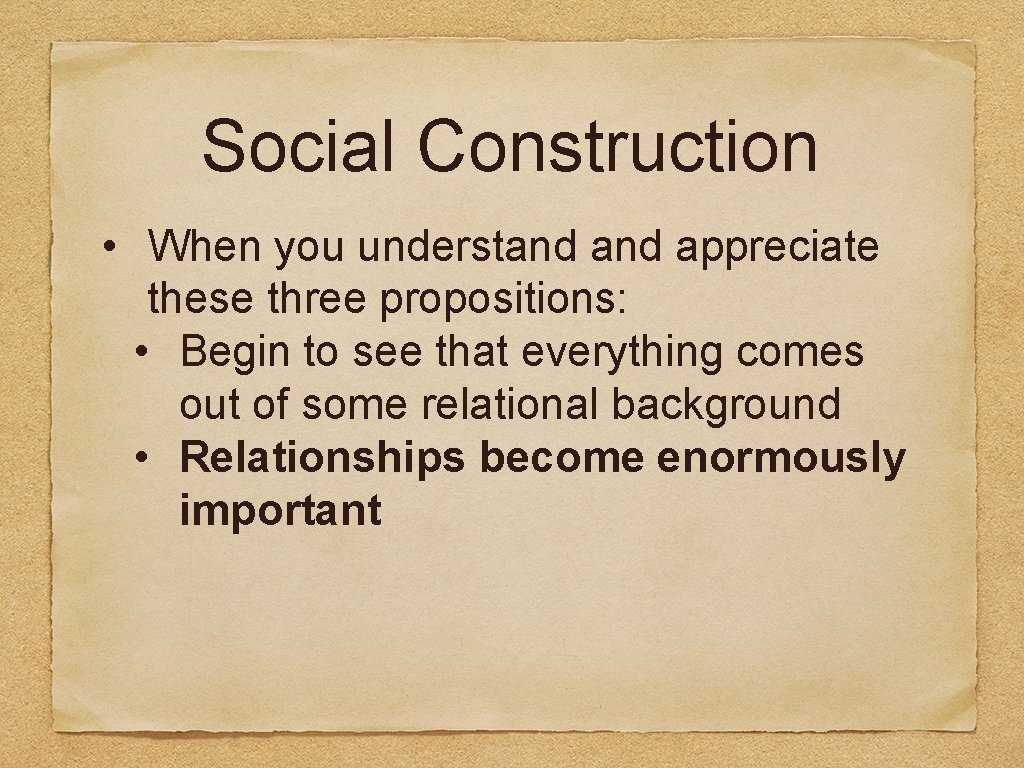
Social Construction • When you understand appreciate these three propositions: • Begin to see that everything comes out of some relational background • Relationships become enormously important
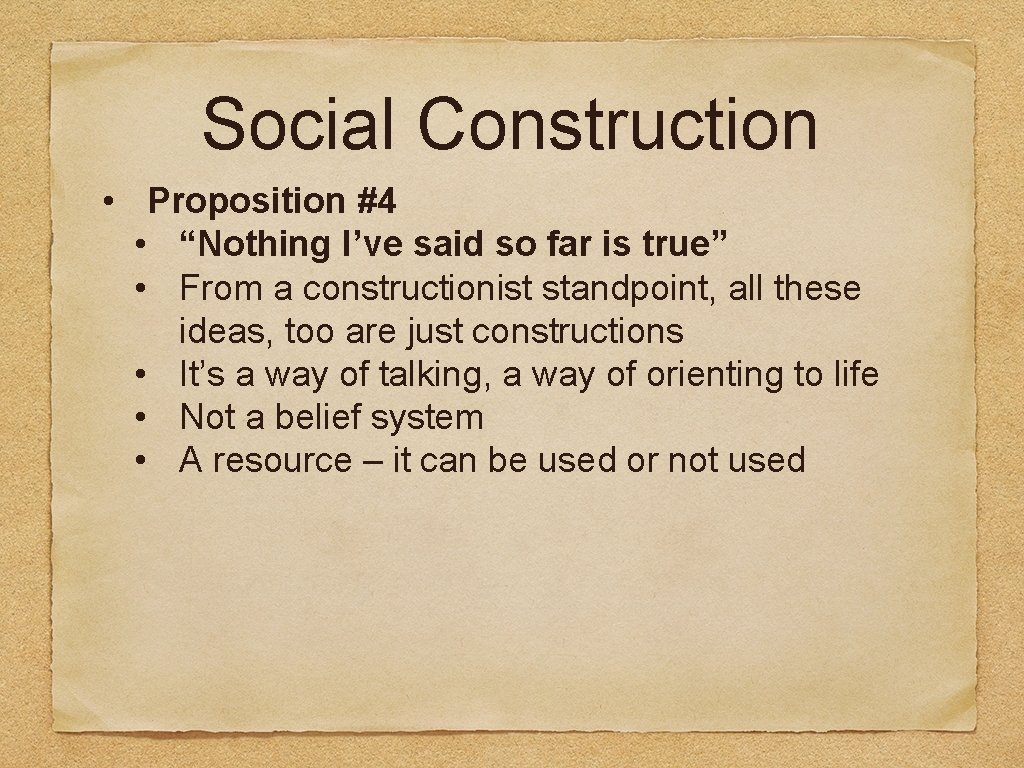
Social Construction • Proposition #4 • “Nothing I’ve said so far is true” • From a constructionist standpoint, all these ideas, too are just constructions • It’s a way of talking, a way of orienting to life • Not a belief system • A resource – it can be used or not used
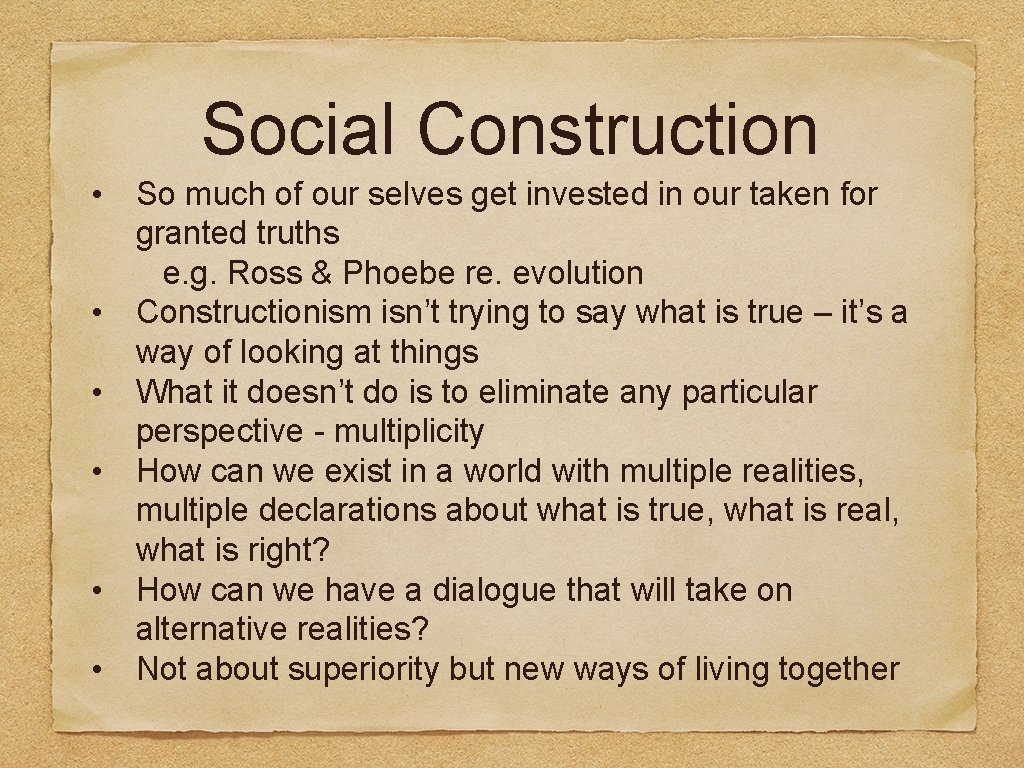
Social Construction • So much of our selves get invested in our taken for granted truths e. g. Ross & Phoebe re. evolution • Constructionism isn’t trying to say what is true – it’s a way of looking at things • What it doesn’t do is to eliminate any particular perspective - multiplicity • How can we exist in a world with multiple realities, multiple declarations about what is true, what is real, what is right? • How can we have a dialogue that will take on alternative realities? • Not about superiority but new ways of living together
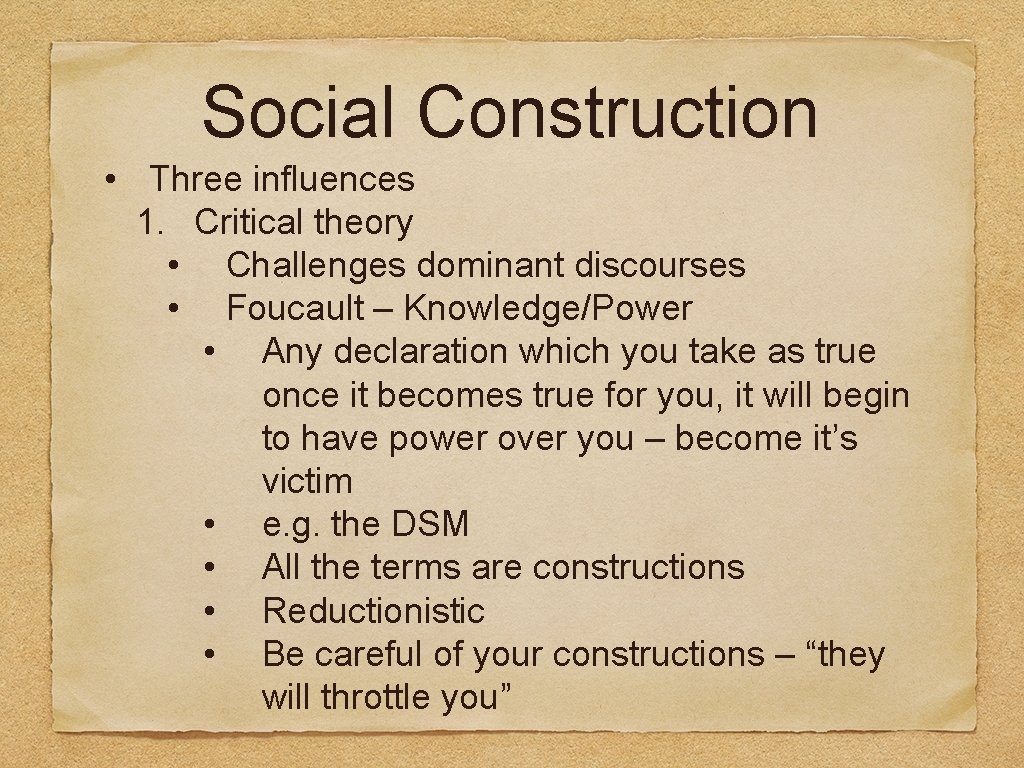
Social Construction • Three influences 1. Critical theory • Challenges dominant discourses • Foucault – Knowledge/Power • Any declaration which you take as true once it becomes true for you, it will begin to have power over you – become it’s victim • e. g. the DSM • All the terms are constructions • Reductionistic • Be careful of your constructions – “they will throttle you”
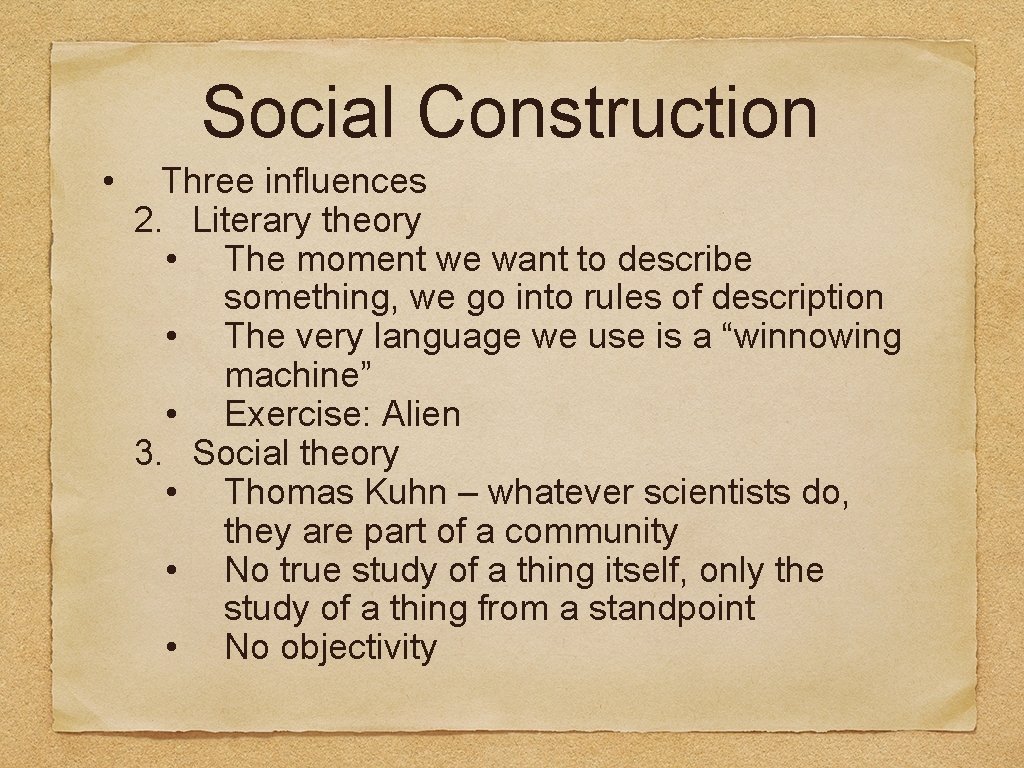
Social Construction • Three influences 2. Literary theory • The moment we want to describe something, we go into rules of description • The very language we use is a “winnowing machine” • Exercise: Alien 3. Social theory • Thomas Kuhn – whatever scientists do, they are part of a community • No true study of a thing itself, only the study of a thing from a standpoint • No objectivity
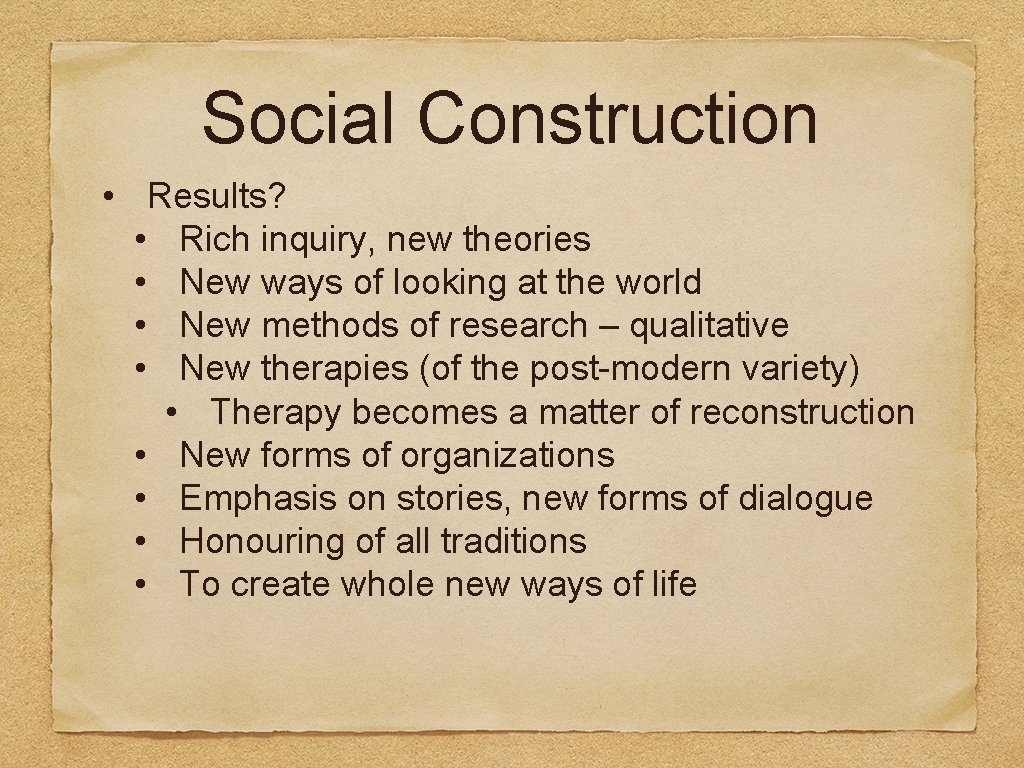
Social Construction • Results? • Rich inquiry, new theories • New ways of looking at the world • New methods of research – qualitative • New therapies (of the post-modern variety) • Therapy becomes a matter of reconstruction • New forms of organizations • Emphasis on stories, new forms of dialogue • Honouring of all traditions • To create whole new ways of life
Exercise: Alien
Group time
Introduction to the Session Rating Scale
Please rate today’s session… Email list of participants Review class assignments, readings for next week Questions Comments See you tomorrow!
Slides and information are posted Wednesday afternoon before class: http: //www. mftsolutions. ca/Pages/Post modern. html