
Theories and intervening variables What is a theory

Theories and intervening variables
What is a theory?
Characteristics of scientific knowledge/theories Empirical Rational Testable (falsifiable; avoid tautologies) Parsimonious General Tentative Rigorously (and publically) evaluated
What do theories do? Classify/describe things Predict Explain Guide research
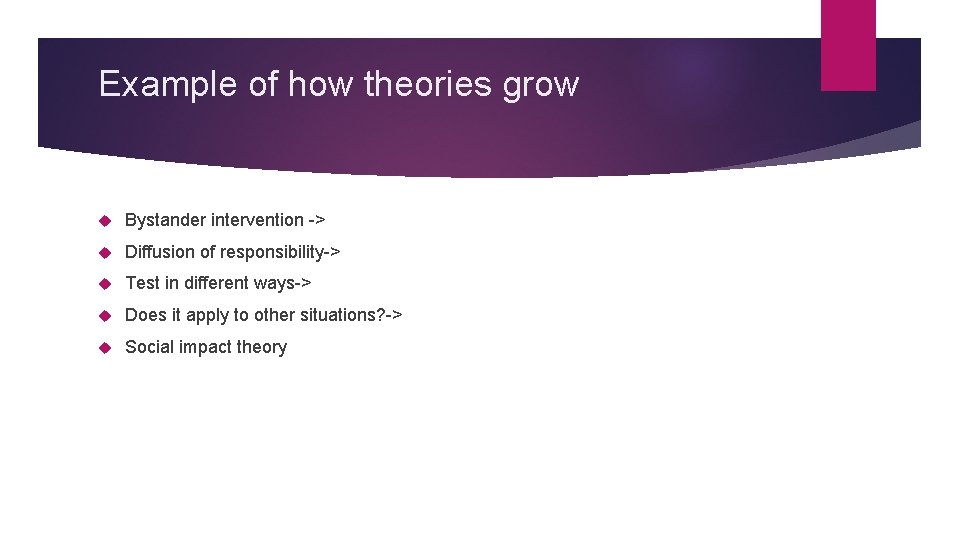
Example of how theories grow Bystander intervention -> Diffusion of responsibility-> Test in different ways-> Does it apply to other situations? -> Social impact theory
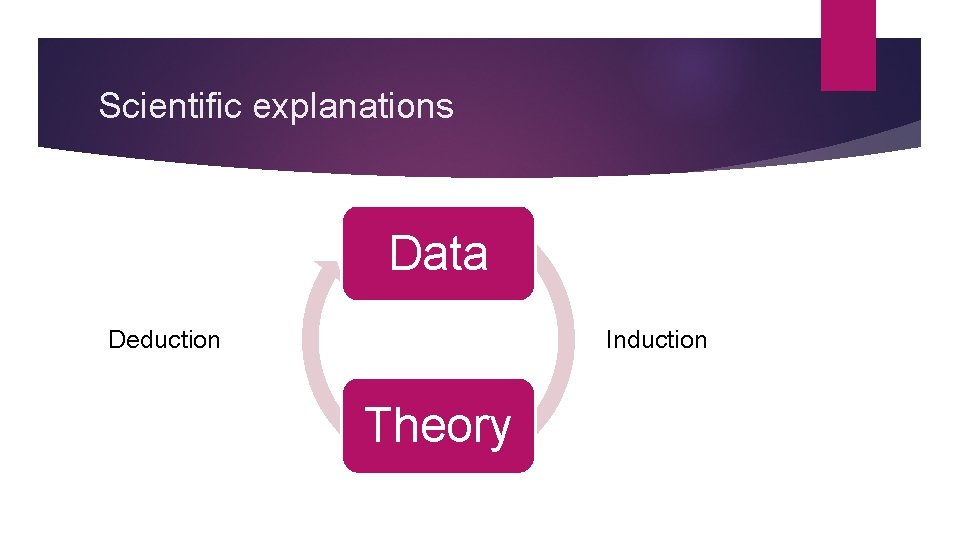
Scientific explanations Data Deduction Induction Theory
Intervening variables Concepts that link the IV and DV Mediator—accounts for the relationship between the IV and DV; tells “why” Moderator—affects the direction or strength of the relationship: tells “when” or “how”
Mediator/Moderator practice Research on the fundamental attribution error shows that Americans tend to attribute their own behaviors to the situation and other’s behaviors to their personality. This seems to be because Americans focus on what they can see (so they see the situation when it’s them, but they are looking at the person when they judge others). In the example above, researchers find much less difference between attributions for self and others in Taiwan. Women who are primed with benevolent sexism report less desire to engage in activism. This seems to be because thinking about benevolent sexism causes women to self-objectify.
For each, identify the mediator or moderator and say which it is 1. A study finds that convicted criminals are more likely than noncriminals to score low (negatively) on the Attitudes toward Women Scale. Further research shows, however, that this is only true for violent criminals. There is no relationship between nonviolent criminal activity and negative attitudes toward women. 2. A researcher finds that by increasing self-focus in children, she can decrease their likelihood of cheating on a test. By decreasing cheating, in turn, she finds that academic self-efficacy increases. 3. Dr. Laylor finds a relationship between physical attractiveness and self-confidence. He later determines that the primary cause of this relationship is the positive feedback physically attractive people receive from others. 4. Boys who are popular with other boys tend to also be popular with girls, whereas girls who are popular with the girls tend to be less popular with boys. 5. Researchers found that people who had more contact with Syrian refugees reported less prejudice toward the group. Part of the reason why was that people who had more contact tended to see the group as less threatening. 6. When adjusting for age, gender, and nation-level economic development, researchers found that hedonism, which they defined as valuing pleasure, was more related to reported happiness in individualist countries than in collectivist countries.
- Slides: 9