
Theoretical Perspectives Historically focus of literacy instruction drill
- Slides: 27
Theoretical Perspectives • Historically, focus of literacy instruction: » drill and practice • Prevailing theory: – Learning is a matter of shaping behaviour • Current instructional approaches have changed.
Approaches to literacy instruction • Bottom-up – Instruction in literacy should begin with sound/symbol relationships • Top-Down – Instruction in literacy should begin with whole stories and making educated guesses
How did we come to know … • Different sources of knowledge: – – – Experience Authority Deductive reasoning Inductive reasoning Scientific approach
How did we come to know … • Experience: – Based on what a person has done • Authority – Based on an expert in the field
How did we come to know … • Deductive reasoning – A systematic way of knowing – Established by Greek philosophers • Knowing through use of logical arguments to arrive at a conclusion • Each statement is called a “premise”; the premises result in a conclusion
How did we come to know … • Deductive reasoning – E. g. • Premise #1: All men are mortal • Premise #2 The King is a man • Conclusion: The King is mortal • Usefulness: provides a means for linking theory and observation • Limitation: You must begin with a true premise
How did we come to know … • Inductive reasonsing – Francis Bacon first referred to inductive learning – Belief that investigators should establish general conclusions on the basis of facts from direct observation
How did we come to know … • Inductive reasonsing – draws inferences from observations in order to make generalizations. • Inference can be done in four stages: – Observation: collect facts, without bias. – Analysis: classify the facts, identifying patterns o of regularity. – Inference: From the patterns, infer generalizations about the relations between the facts. – Confirmation: Testing the inference through further observation.
• Which is which? – Every rabbit that has ever been observed has lungs. Therefore, every rabbit had lungs. – Every mammal has lungs. All rabbits are mammals. All rabbits have lungs
How did we come to know … • Scientific approach – Came into being because of limitations of other approaches to knowing • Authority – it has always been done like this. . • Experience – differ person – More consistent gathering and analysis of data – Knits together results of obervation that allows researchers to make general statements about variables
How did we come to know … • We raise issues everyday • E. g. what is if put Jane to sit beside Paul for two weeks? Will she talk less? Will she do more work? Will she distract Paul? Will they cooperate? – Do we systematically collect and record this information?
Research methodologies: … also referred to as research design
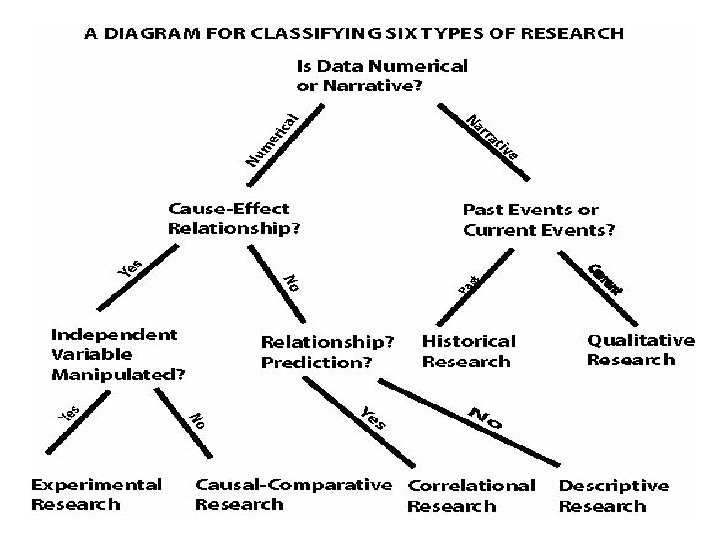
• Causal-comparative research – attempts to establish cause-effect relationships among the variables of the study – in causal-comparative research the independent variable is not under the experimenters control • E. g. What is the effect of gender on math achievement?
• Experimental research – It is like causal-comparative research in that it tries to establish cause-effect relationship among the groups of subjects that make up the independent variable of the study – in the case of experimental research, the cause (the independent variable) is under the control of the experimenter. • E. g. What is the effect of positive reinforcement on attitude toward school?
• Correlational research – attempts to determine whether and to what degree, a relationship exists between two or more quantifiable (numerical) variables – Correlation implies prediction but not causation e. g. Is there a relationship between intelligence and selfesteem?
• Survey – Attempts to determine specific characteristics of a group. It involves asking the same set of questions to a large number of persons e. g. What are teachers’ feelings about the new Minister of Education?
• Historical – is involved with the study of past events – Aspects of the past is studied by perusing documents within a particular period or by interviewing persons who lived during that time period e. g. What decisions led to the replacement of the Common Entrance Exam with GSAT?
Ethnographic/case study – This is the study of current events (rather than past events) and involves the collection of narrative data (non-numerical data) – Data are usually collected over a period of time in natural settings – The emphasis is on documenting or portraying the everyday experiences of individuals by observing and interviewing them • E. g. A case study of how a grade one teacher interacts with her students.
• Action Research – Differs from all the previously mentioned types • • • The results are not generalized to other persons situations or settings; Purpose usually is to focus on getting information to change a particular situation that the researcher is personally involved in (e. g. a classroom teacher) Participants are actively involved in this type of research
Classifying the types of research • Types of research can be classified as either – Qualitative; or – Quantitative
Qualitative approaches • involve narrative data • purpose - gain insights into phenomena of interest • data analysis include the coding of the data and inductive process (verbal explanations) – E. g. Historical, ethnographic
Quantitative approaches • involve the collection of numerical data • Numbers used to explain, predict, and/or control phenomena of interest, • data analyses are mainly through deductive processes (statistics) • the researcher reports the numerical results for one or more variables on the subjects of the study
Quantitative approaches (cont’d) – Correlational research – Causal-comparative research – Experimental Research
Why do we need to conduct research in literacy? • • Build knowledge Find solutions (provide insights) To inform practice To improve practice To help in decision making Change policies Review current state of knowledge Others …. .
Activity 1 For each research question, specify what methodology you think would be the most appropriate to investigate each: • Is there a relationship between students’ level of social skills and their academic performance? • How do students with physical disabilities view themselves in art and craft? • Does a literature-based curriculum lead to higher student achievement than a phonics curriculum does? • How do magazines that target teenagers present information on safe-sex practices? • What do high school teachers in Clarendon think about an extended month of the academic school year?
Activity 2: Home Work • In research, what are “variables”? • What are the different types of variables used in research? • What is the research process?