
Theoretical Models of Counseling and Psychotherapy 2 nd

- Slides: 22
Theoretical Models of Counseling and Psychotherapy, 2 nd Edition Chapter 11: Reality Therapy and Choice Theory Mario De La Garza, M. Ed. University of North Texas
Historical Context • 1950 s: mental health professionals began honoring people’s ability to choose and control thoughts, feelings, and behavior • Free will accepted more than determinism • Mental health professionals began being more active in therapeutic relationship
William Glasser • Mother was extremely controlling; father epitomized choice theory • Studied engineering and psychology • Eventually entered medical school at Case Western Reserve • Trained in psychoanalysis, but disagreed with Freud’s theory
William Glasser • Had no interest in clients’ past • Worked at a residential facility for delinquent girls; began treating them with kindness and respect and emphasized personal responsibility for behavior. • Reality Therapy → Control Theory → Choice Theory
Philosophical Underpinnings • Glasser has not identified underlying ideas that may have contributed to his viewpoint, notwithstanding Powers (1973). • He developed his theory based upon his work with clients. • Shares philosophy with Adler, Existential and Person-Centered approaches
Function of the Psyche • Five basic needs: – – – Survival Love and belonging Power Fun Freedom • All individuals seek to fulfill needs to avoid pain of not having them met. • Strength of needs varies among people
Function of the Psyche • People translate needs into specific wants. • Total behavior: thinking, doing, feeling, and physiology – Responsible or irresponsible – Effective or ineffective • A person’s behavior represents one’s best effort to get a need met.
Structure of the Psyche • Brain is the controlling system for the organism • Automobile metaphor: – Engine – basic needs – Steering – unique wants – Front wheels – thinking and doing – Back wheels – feeling and physiology
Structure of the Psyche • Quality world (inner picture album) – what a person perceives will fulfill and continue to fulfill the basic needs – People – Things – Ideas/beliefs
Role of the Environment • Family factors supply initial need fulfilling opportunities for a growing child • Family has a significant impact on individual’s quality world • Church, school, neighborhood, culture, and geographic location also influence need satisfaction
Healthy Functioning • Behaving responsibly – meeting one’s own needs without preventing others from meeting theirs – Form and maintain connections with others – There is a balance of need fulfillment • Effective life direction – “I Want to Change and I Want to Grow” – “Effective Behaviors” – “Positive Addictions”
Unhealthy Functioning • • The lack of satisfying present relationships Disconnection between individuals and others NOT mental illness People choose behaviors to deal with their loneliness and isolation
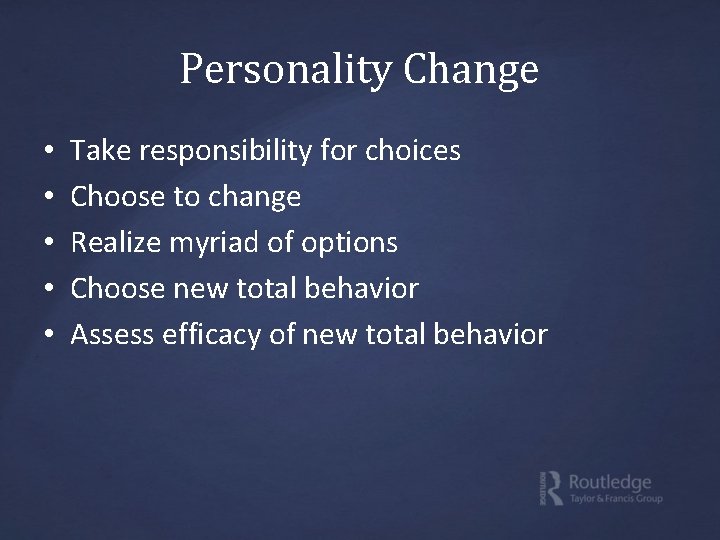
Personality Change • • • Take responsibility for choices Choose to change Realize myriad of options Choose new total behavior Assess efficacy of new total behavior
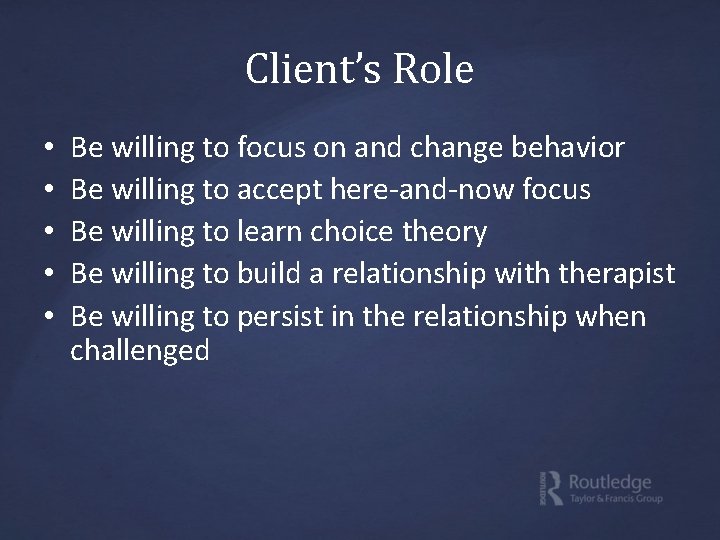
Client’s Role • • • Be willing to focus on and change behavior Be willing to accept here-and-now focus Be willing to learn choice theory Be willing to build a relationship with therapist Be willing to persist in the relationship when challenged
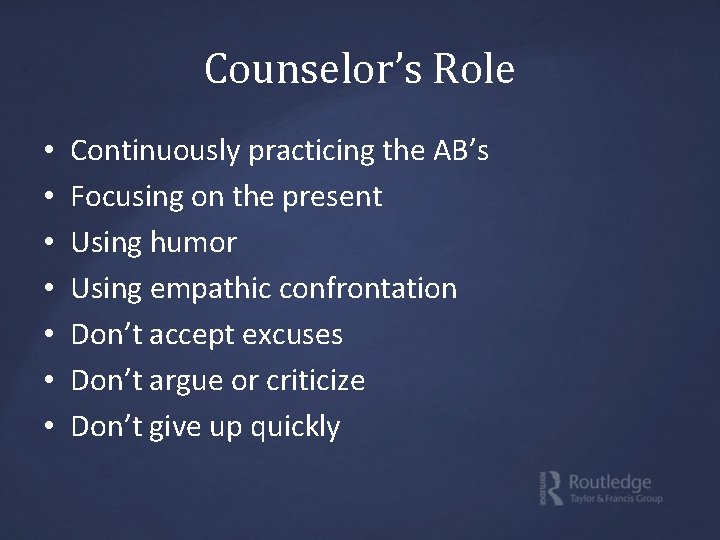
Counselor’s Role • • Continuously practicing the AB’s Focusing on the present Using humor Using empathic confrontation Don’t accept excuses Don’t argue or criticize Don’t give up quickly
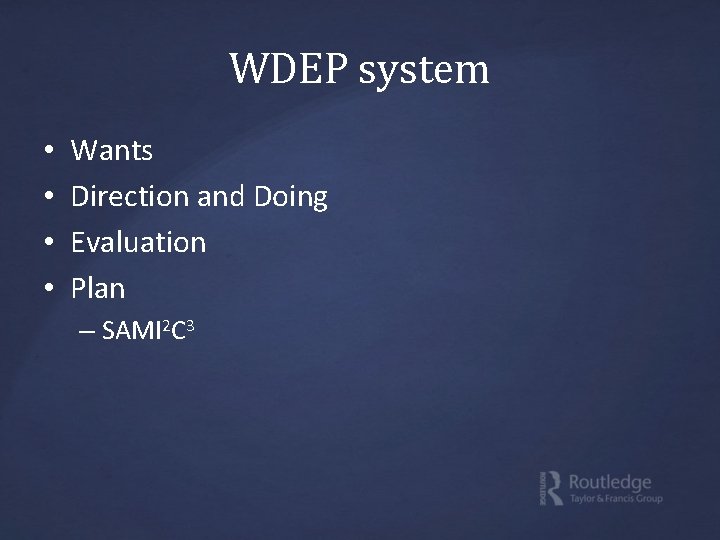
WDEP system • • Wants Direction and Doing Evaluation Plan – SAMI 2 C 3
Interface with Recent Developments in Mental Health • Nature/Nurture – Genes and environment impact but DO NOT dictate behavior; choice dictates behavior • DSM 5 Diagnosis – Diagnostic labeling is inappropriate or unnecessary – Can be used for insurance purposes (practicality) • Pharmacotherapy – Glasser has consistently and adamantly opposed the use of medication for mental problems
Interface with Recent Developments in Mental Health • Managed Care and Brief Therapy – Diagnosing and medication are antithetical to the pure version of reality therapy – Therapy seems well suited for brief work • Technical Eclecticism – By design, a flexible system – Draws heavily from the philosophy of other theories so can use other techniques and remain congruent
Interface with Recent Developments in Mental Health • Diversity Issues – A significant effort has been made to adapt reality therapy to a wide range of cultures. – Choice theory is flexible and should be modified to incorporate the client’s cultural worldview. • Spirituality – Spirituality can help a person meet his/her needs as defined by his/her quality world • Effectiveness of Psychotherapy – Research has shown a medium effect
Contributions • Significant contributions to education • Formulation of basic genetic needs and quality world as well as WDEP system
Limitations • Lacks comprehensive evidence based research support on effectiveness • Glasser’s hard line stance that mental illness does not exist is difficult to conceptualize in today’s society
References Fall, K. A. , Holden, J. M. , & Marquis, A. (2016). Theoretical models of counseling and psychotherapy (3 rd ed. ). New York, NY: Routledge.