
Theoretical modeling for thermal stability of solid targets
Theoretical modeling for thermal stability of solid targets in LEMMA muon collider Gianmario Cesarini for the LEMMA Team
Outline § Introduction of the LEMMA project § Features of the Positron beam § Numerical simulation of the deposited energy onto the target § Temperature behaviour of thermal parameters of Beryllium and Carbon § Temperature field after a single bunch – temperature temporal evolution § Target steady state temperature § Thermal stability of the target in case of rotating system § Conclusions Hi. Rad. Mat Workshop 10/09/2021 Page 2
Introduction of the LEMMA project Low EMittance Muon Accelerator INFN institutions involved: LNF, Roma 1, Pd, Pi, Ts, Fe Universities: Sapienza, Padova, Insubria Contributions from: CERN, ESRF, LAL, SLAC • A µ+µ- collider offers an ideal technology to extend lepton high energy frontier in the multi-Te. V range: § No synchrotron radiation (limit of e+e- circular colliders) § No beamstrahlung (limit of e+e- linear colliders) § but muon lifetime is 2. 2 ms (at rest) Hi. Rad. Mat Workshop 10/09/2021 Page 3
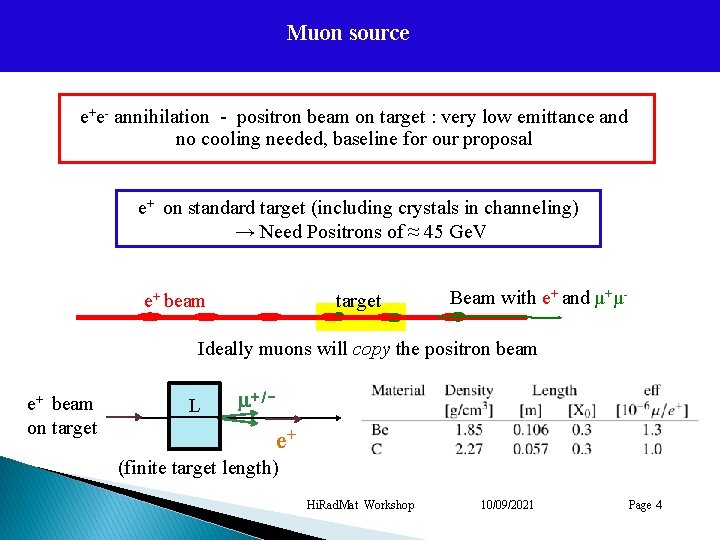
Muon source e+e- annihilation - positron beam on target : very low emittance and no cooling needed, baseline for our proposal e+ on standard target (including crystals in channeling) → Need Positrons of ≈ 45 Ge. V e+ beam target Beam with e+ and µ+µ- Ideally muons will copy the positron beam e+ beam on target L m+/- e+ (finite target length) Hi. Rad. Mat Workshop 10/09/2021 Page 4
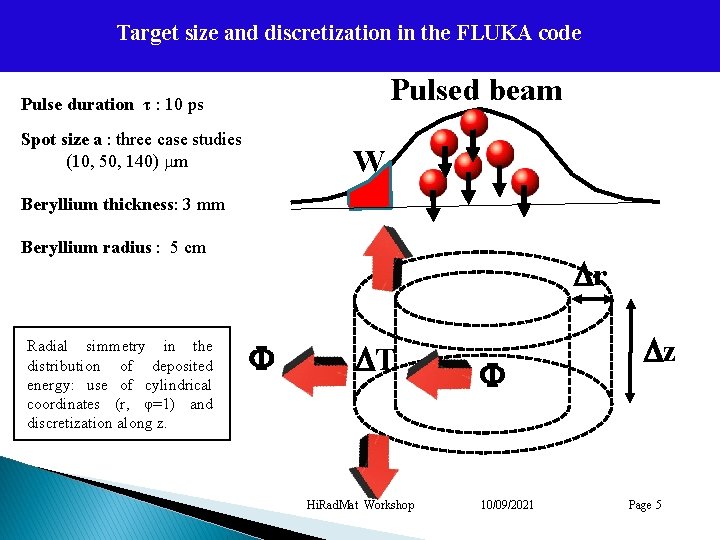
Target size and discretization in the FLUKA code Pulsed beam Pulse duration τ : 10 ps Spot size a : three case studies (10, 50, 140) mm W Beryllium thickness: 3 mm Beryllium radius : 5 cm Radial simmetry in the distribution of deposited energy: use of cylindrical coordinates (r, φ=1) and discretization along z. Dr F DT Hi. Rad. Mat Workshop F 10/09/2021 Dz Page 5

Energy density deposited for the three case studies Heat density, J/m 3 Npart = 3· 1011 positrons Spo t 50 z =0 mm z =3 mm µm Spot 1 4 0 µm Spot 10 µ m Theoretical Gaussian beam Radial axis, mm Hi. Rad. Mat Workshop 10/09/2021 Page 6
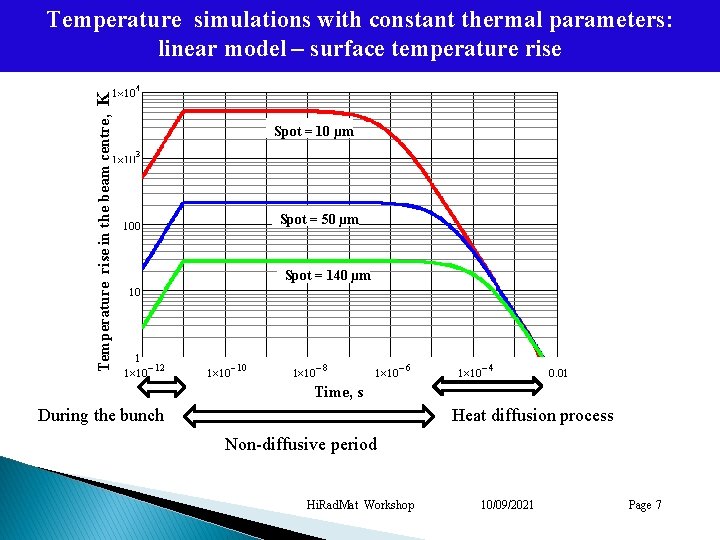
Temperature rise in the beam centre, K Temperature simulations with constant thermal parameters: linear model – surface temperature rise Spot = 10 µm Spot = 50 µm Spot = 140 µm Time, s During the bunch Heat diffusion process Non-diffusive period Hi. Rad. Mat Workshop 10/09/2021 Page 7
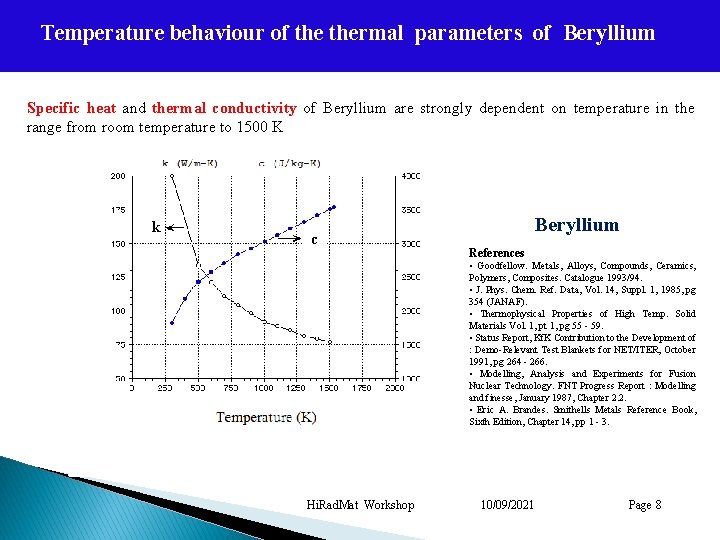
Temperature behaviour of thermal parameters of Beryllium Specific heat and thermal conductivity of Beryllium are strongly dependent on temperature in the range from room temperature to 1500 K k c Beryllium References • Goodfellow. Metals, Alloys, Compounds, Ceramics, Polymers, Composites. Catalogue 1993/94. • J. Phys. Chem. Ref. Data, Vol. 14, Suppl. 1, 1985, pg 354 (JANAF). • Thermophysical Properties of High Temp. Solid Materials Vol. 1, pt 1, pg 55 - 59. • Status Report, Kf. K Contribution to the Development of : Demo-Relevant Test Blankets for NET/ITER, October 1991, pg 264 - 266. • Modelling, Analysis and Experiments for Fusion Nuclear Technology. FNT Progress Report : Modelling and finesse, January 1987, Chapter 2. 2. • Eric A. Brandes. Smithells Metals Reference Book, Sixth Edition, Chapter 14, pp 1 - 3. Hi. Rad. Mat Workshop 10/09/2021 Page 8
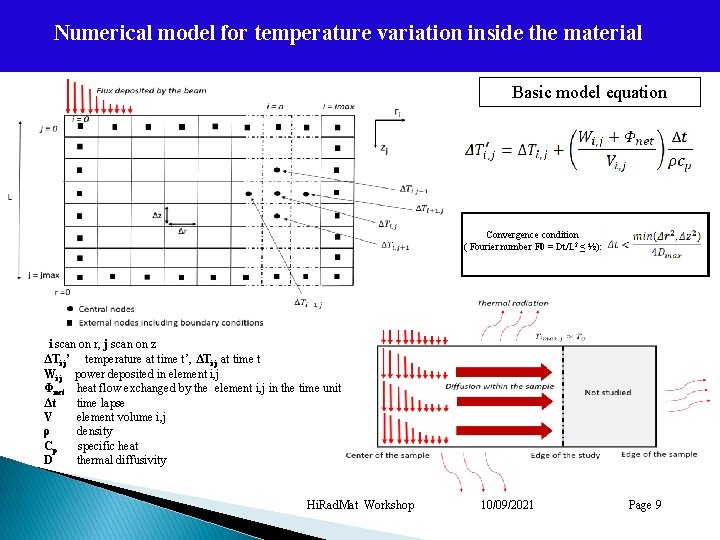
Numerical model for temperature variation inside the material Basic model equation Convergence condition ( Fourier number F 0 = Dt/L 2 ≤ ½): i scan on r, j scan on z ΔTi, j’ temperature at time t’, ΔTi, j at time t Wi, j power deposited in element i, j Φnet heat flow exchanged by the element i, j in the time unit Δt time lapse V element volume i, j ρ density Cp specific heat D thermal diffusivity Hi. Rad. Mat Workshop 10/09/2021 Page 9
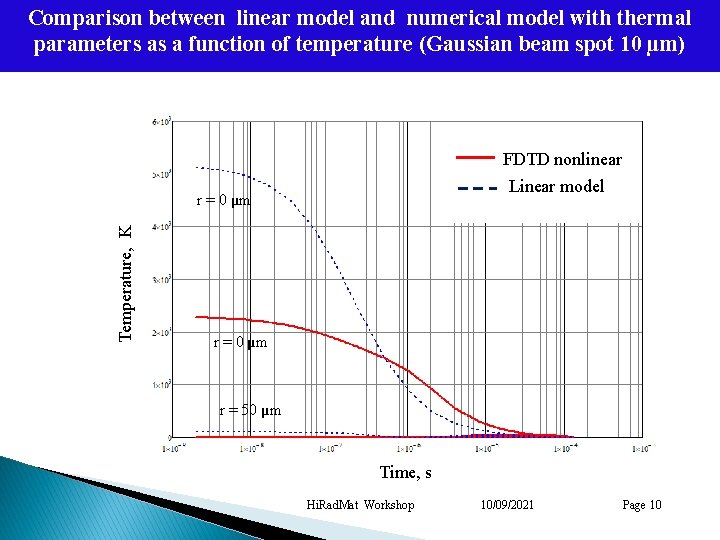
Comparison between linear model and numerical model with thermal parameters as a function of temperature (Gaussian beam spot 10 µm) FDTD nonlinear Linear model Temperature, K r = 0 µm r = 50 µm Time, s Hi. Rad. Mat Workshop 10/09/2021 Page 10
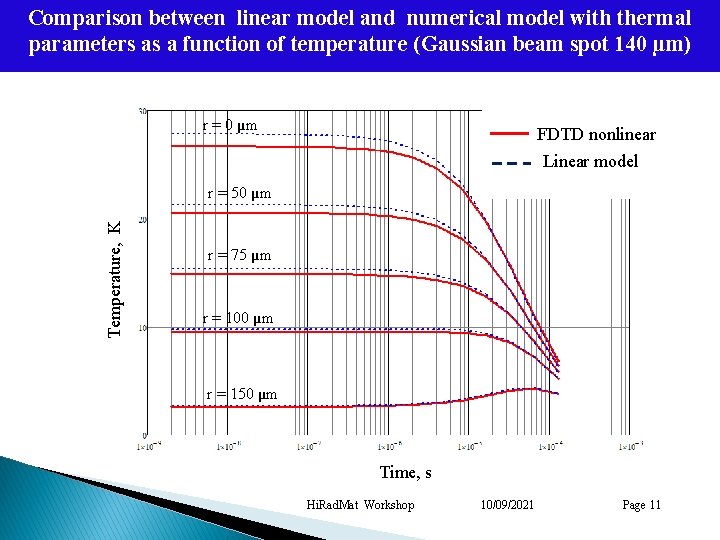
Comparison between linear model and numerical model with thermal parameters as a function of temperature (Gaussian beam spot 140 µm) r = 0 µm FDTD nonlinear Linear model Temperature, K r = 50 µm r = 75 µm r = 100 µm r = 150 µm Time, s Hi. Rad. Mat Workshop 10/09/2021 Page 11
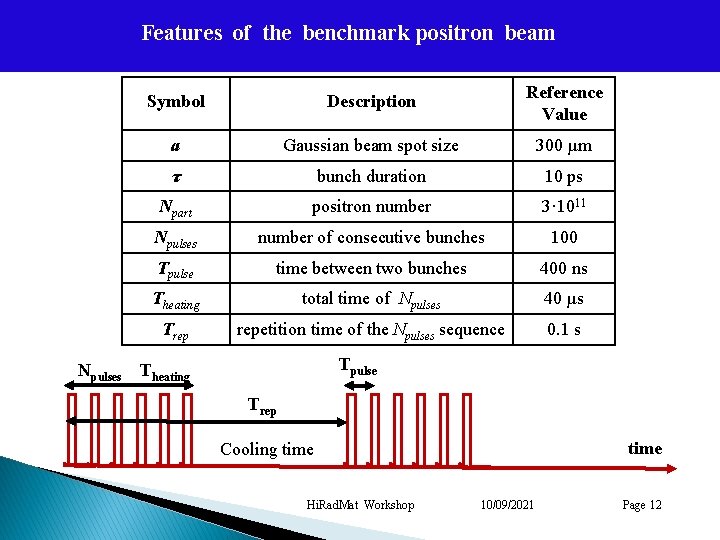
Features of the benchmark positron beam Npulses Symbol Description Reference Value a Gaussian beam spot size 300 µm τ bunch duration 10 ps Npart positron number 3· 1011 Npulses number of consecutive bunches 100 Tpulse time between two bunches 400 ns Theating total time of Npulses 40 µs Trep repetition time of the Npulses sequence 0. 1 s Tpulse Theating Trep time Cooling time Hi. Rad. Mat Workshop 10/09/2021 Page 12
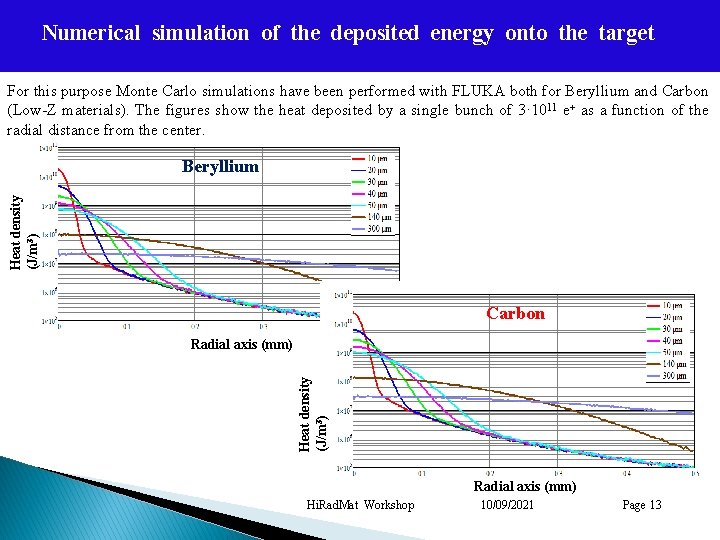
Numerical simulation of the deposited energy onto the target For this purpose Monte Carlo simulations have been performed with FLUKA both for Beryllium and Carbon (Low-Z materials). The figures show the heat deposited by a single bunch of 3· 1011 e+ as a function of the radial distance from the center. Heat density (J/m 3) Beryllium Carbon Heat density (J/m 3) Radial axis (mm) Hi. Rad. Mat Workshop 10/09/2021 Page 13
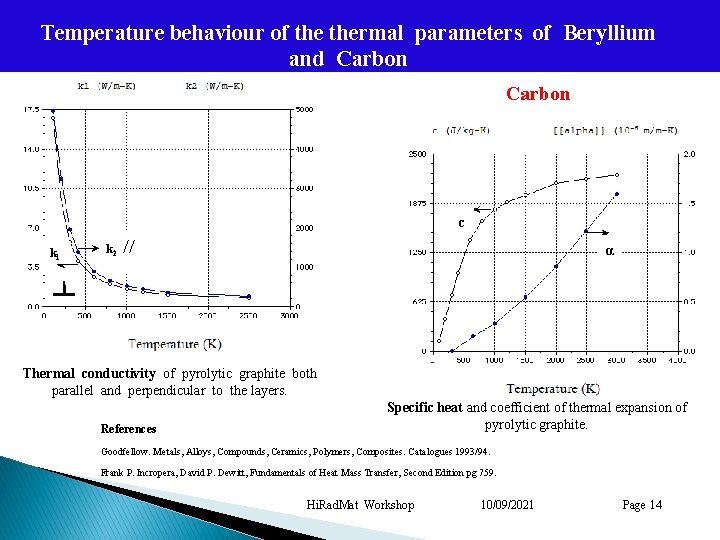
Temperature behaviour of thermal parameters of Beryllium and Carbon c k 1 k 2 // α Thermal conductivity of pyrolytic graphite both parallel and perpendicular to the layers. References Specific heat and coefficient of thermal expansion of pyrolytic graphite. Goodfellow. Metals, Alloys, Compounds, Ceramics, Polymers, Composites. Catalogues 1993/94. Frank P. Incropera, David P. Dewitt, Fundamentals of Heat Mass Transfer, Second Edition pg 759. Hi. Rad. Mat Workshop 10/09/2021 Page 14
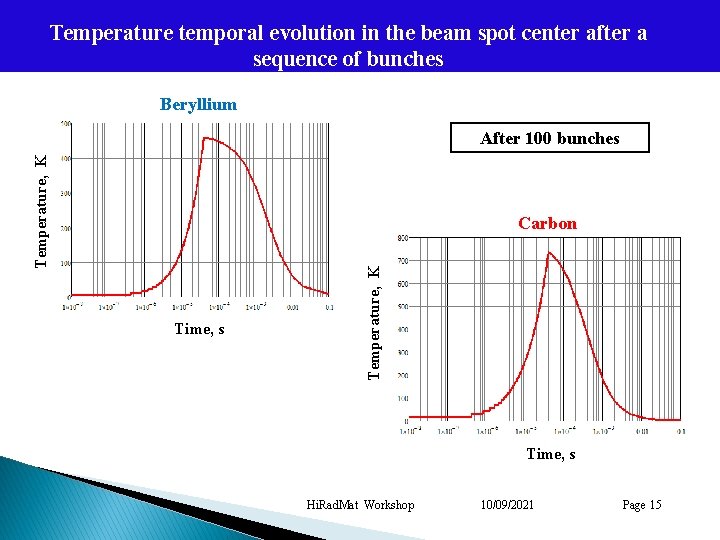
Temperature temporal evolution in the beam spot center after a sequence of bunches Beryllium Temperature, K After 100 bunches Time, s Temperature, K Carbon Time, s Hi. Rad. Mat Workshop 10/09/2021 Page 15
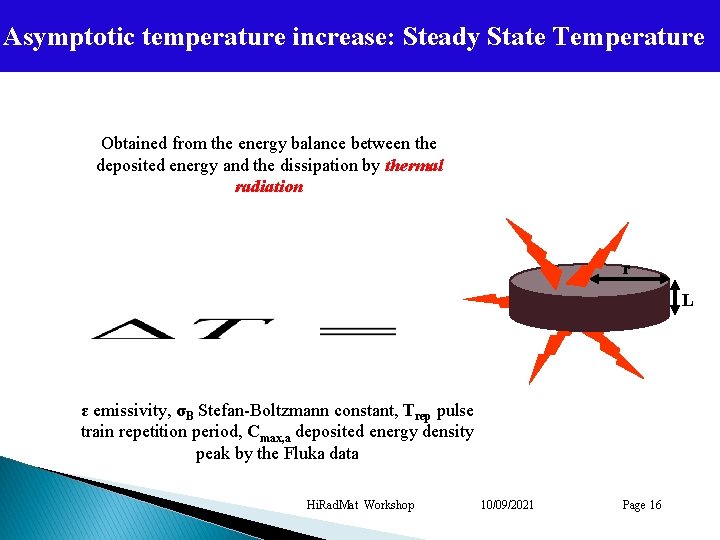
Asymptotic temperature increase: Steady State Temperature Obtained from the energy balance between the deposited energy and the dissipation by thermal radiation r L ɛ emissivity, σB Stefan-Boltzmann constant, Trep pulse train repetition period, Cmax, a deposited energy density peak by the Fluka data Hi. Rad. Mat Workshop 10/09/2021 Page 16
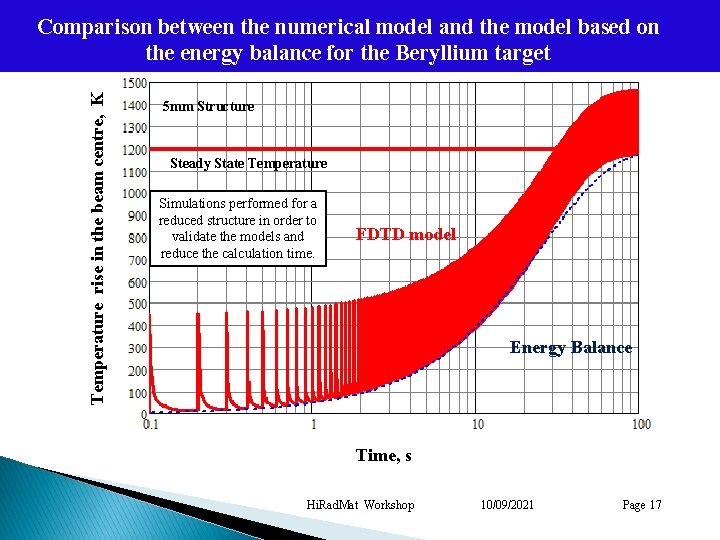
Temperature rise in the beam centre, K Comparison between the numerical model and the model based on the energy balance for the Beryllium target 5 mm Structure Steady State Temperature Simulations performed for a reduced structure in order to validate the models and reduce the calculation time. FDTD model Energy Balance Time, s Hi. Rad. Mat Workshop 10/09/2021 Page 17
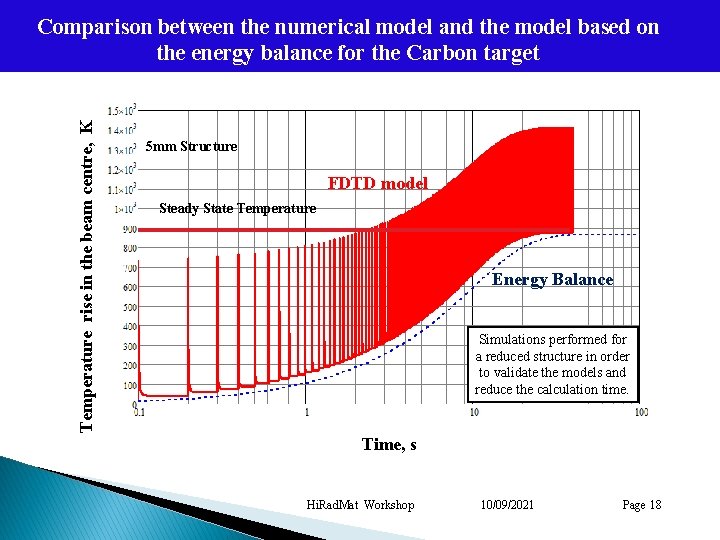
Temperature rise in the beam centre, K Comparison between the numerical model and the model based on the energy balance for the Carbon target 5 mm Structure FDTD model Steady State Temperature Energy Balance Simulations performed for a reduced structure in order to validate the models and reduce the calculation time. Time, s Hi. Rad. Mat Workshop 10/09/2021 Page 18
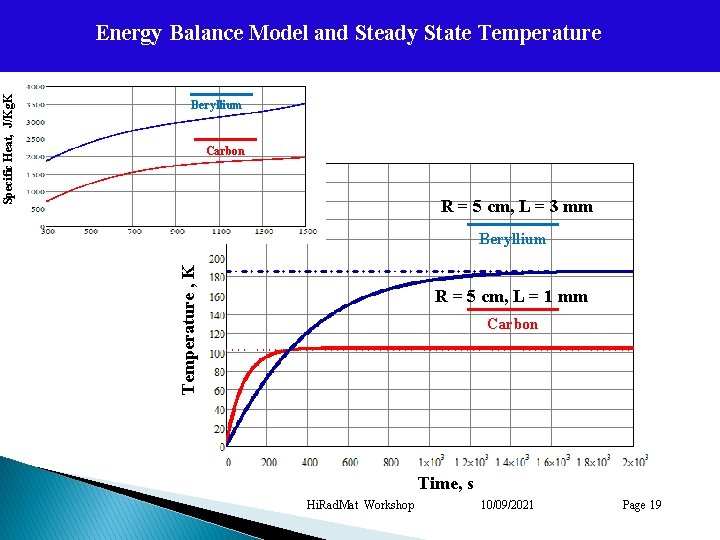
Beryllium Carbon R = 5 cm, L = 3 mm Beryllium Temperature , K Specific Heat, J/Kg. K Energy Balance Model and Steady State Temperature R = 5 cm, L = 1 mm Carbon Time, s Hi. Rad. Mat Workshop 10/09/2021 Page 19 Pa gi na 19
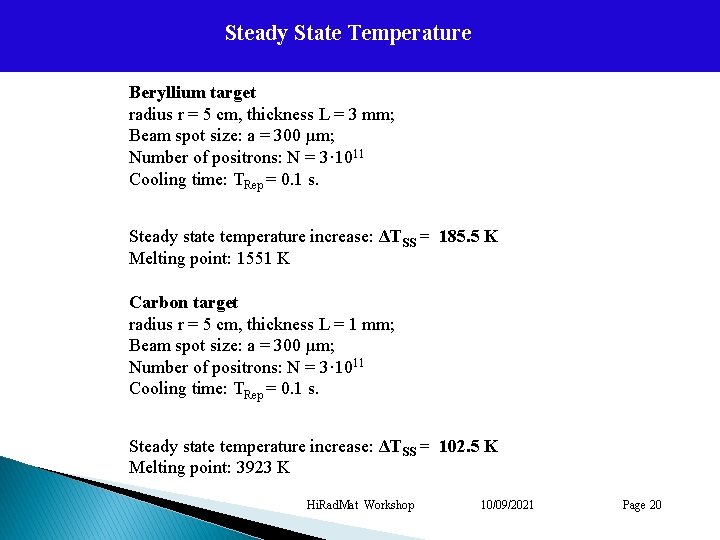
Steady State Temperature Beryllium target radius r = 5 cm, thickness L = 3 mm; Beam spot size: a = 300 µm; Number of positrons: N = 3· 1011 Cooling time: TRep = 0. 1 s. Steady state temperature increase: ΔTSS = 185. 5 K Melting point: 1551 K Carbon target radius r = 5 cm, thickness L = 1 mm; Beam spot size: a = 300 µm; Number of positrons: N = 3· 1011 Cooling time: TRep = 0. 1 s. Steady state temperature increase: ΔTSS = 102. 5 K Melting point: 3923 K Hi. Rad. Mat Workshop 10/09/2021 Page 20
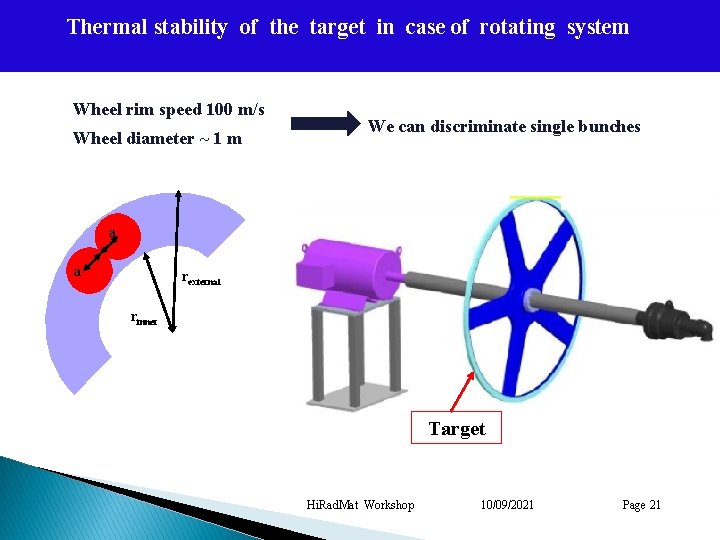
Thermal stability of the target in case of rotating system Wheel rim speed 100 m/s Wheel diameter ~ 1 m We can discriminate single bunches a a rexternal rinner Target Hi. Rad. Mat Workshop 10/09/2021 Page 21
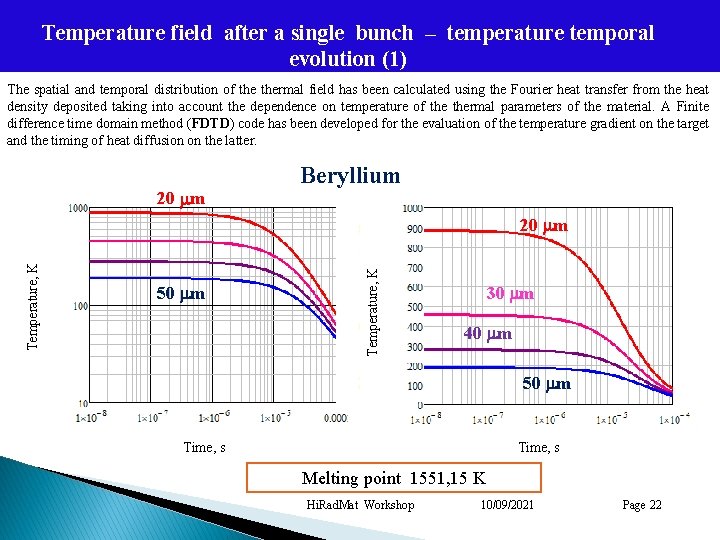
Temperature field after a single bunch – temperature temporal evolution (1) The spatial and temporal distribution of thermal field has been calculated using the Fourier heat transfer from the heat density deposited taking into account the dependence on temperature of thermal parameters of the material. A Finite difference time domain method (FDTD) code has been developed for the evaluation of the temperature gradient on the target and the timing of heat diffusion on the latter. 20 mm Beryllium 50 mm Temperature, K 20 mm 30 mm 40 mm 50 mm Time, s Melting point 1551, 15 K Hi. Rad. Mat Workshop 10/09/2021 Page 22
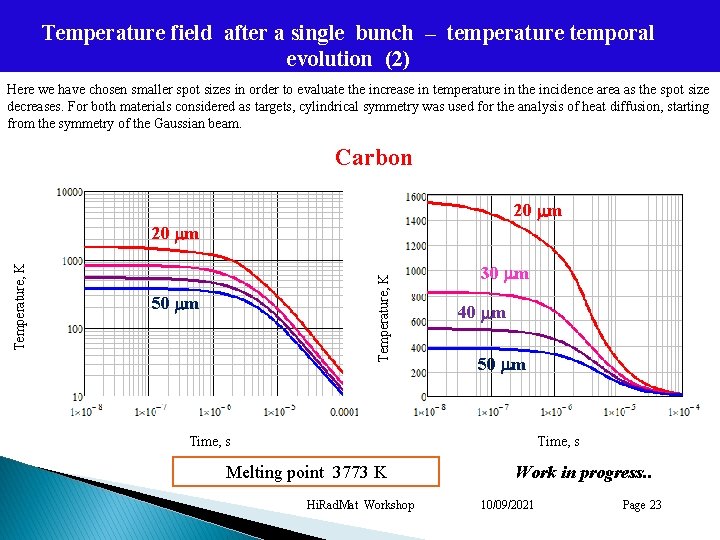
Temperature field after a single bunch – temperature temporal evolution (2) Here we have chosen smaller spot sizes in order to evaluate the increase in temperature in the incidence area as the spot size decreases. For both materials considered as targets, cylindrical symmetry was used for the analysis of heat diffusion, starting from the symmetry of the Gaussian beam. Carbon 20 mm Temperature, K 20 mm 50 mm 30 mm 40 mm 50 mm Time, s Melting point 3773 K Hi. Rad. Mat Workshop Work in progress. . 10/09/2021 Page 23
Conclusions We can use a two-way approach: q use the numerical model (FDTD) in order to evaluate the spatial and temporal gradients of temperature due to a single bunch or to sequence of bunches that can cause thermomechanical stresses and therefore damage or fractures of the target; q use the model based on the energy balance to obtain the steady state temperature and evaluate its sustainability both for a static configuration of the target and for an application on a rotating support. Hi. Rad. Mat Workshop 10/09/2021 Page 24
Acknowledgments Special thanks to A. Variola, M. Antonelli, M. Boscolo, O. Blanco, A. Ciarma (INFN – LNF), G. Cavoto, F. Anulli, F. Collamati, M. Bauce (INFN – Sezione di Roma), R. Li Voti (Sapienza – Università di Roma) Hi. Rad. Mat Workshop 10/09/2021 Page 25

Thanks for your attention Hi. Rad. Mat Workshop 10/09/2021 Page 26
- Slides: 26