
Theoretical Issues in Psychology Philosophy of Science and





- Slides: 18
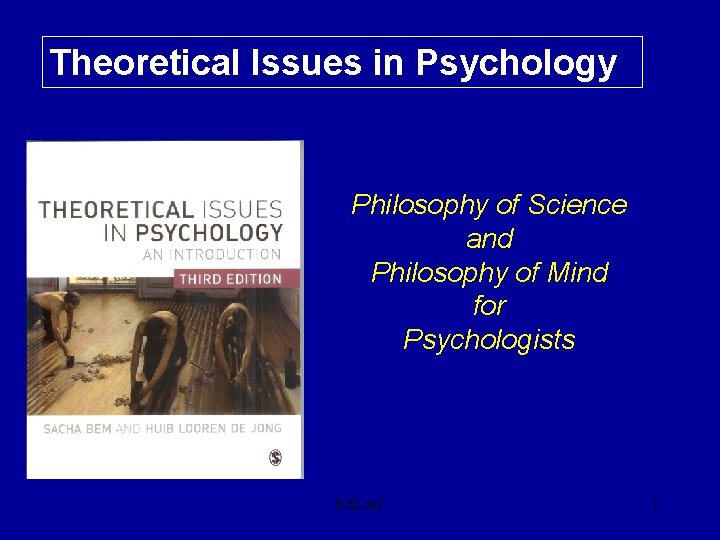
Theoretical Issues in Psychology Philosophy of Science and Philosophy of Mind for Psychologists B&Lde. J 1
Aims of the book Review of basic ideas and problems in philosophy of science and philosophy of mind, relevant for psychologists. Psychology as science of mind: • what is science? Chapters 1– 5. • what is mind? Chapters 6– 10. B&Lde. J 2
Chapter 1 Science: why and how? • Why science? • Knowledge • Arguments • Laws, theories, models and causes B&Lde. J 3
Why and how? Demarcating science: • science as arbiter of objectivity and truth; • demarcating science from pseudoscience; • science as safeguard against propaganda and superstition. Objectivity vs subjectivity or human construction: • realism, foundationalism, objectivism (positivism Ch. 3). • relativism (social constructionism, sociology of science Ch. 4 and 5). But what defines science? B&Lde. J 4
What defines science? • Reduction: underlying causal structure explains macro-phenomena; this research produces … • Unification; and promotes … • Systematicity. • Critical attitude: against authority and dogma; inspires freedom of thought, advances enlightenment and … • Open-mindedness. B&Lde. J 5
Theories of truth Traditional theories of truth: Correspondence theory of truth Coherence theory of truth ‘Recent’ theories of truth: Consensus theory of truth Pragmatic theory of truth B&Lde. J 6
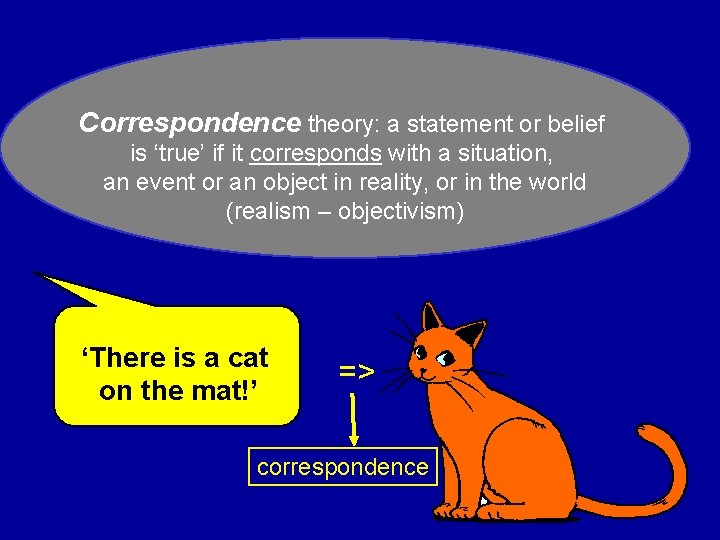
Correspondence theory: a statement or belief is ‘true’ if it corresponds with a situation, an event or an object in reality, or in the world (realism – objectivism) ‘There is a cat on the mat!’ => correspondence
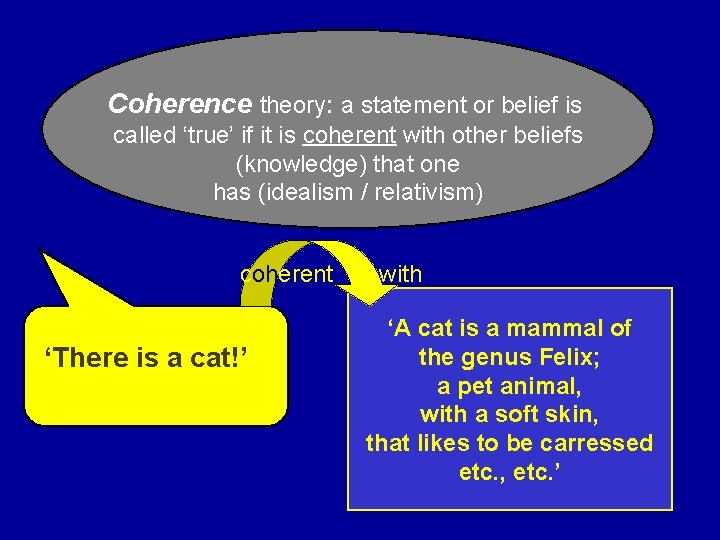
Coherence theory: a statement or belief is called ‘true’ if it is coherent with other beliefs (knowledge) that one has (idealism / relativism) coherent ‘There is a cat!’ with ‘A cat is a mammal of the genus Felix; a pet animal, with a soft skin, that likes to be carressed etc. , etc. ’
‘Recent’ theories of truth • Consensus theory: ‘truth’ is a social or cultural consent or approval (relativism / social-constructionism) • Pragmatic theory: a belief or theory is ‘true’ or reliable if it has success in practice; if it can be established by experience (experiments)
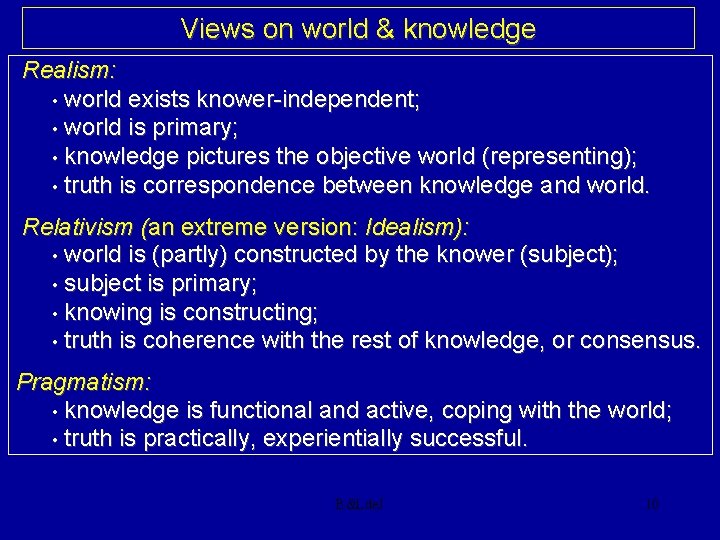
Views on world & knowledge Realism: • world exists knower-independent; • world is primary; • knowledge pictures the objective world (representing); • truth is correspondence between knowledge and world. Relativism (an extreme version: Idealism): • world is (partly) constructed by the knower (subject); • subject is primary; • knowing is constructing; • truth is coherence with the rest of knowledge, or consensus. Pragmatism: • knowledge is functional and active, coping with the world; • truth is practically, experientially successful. B&Lde. J 10
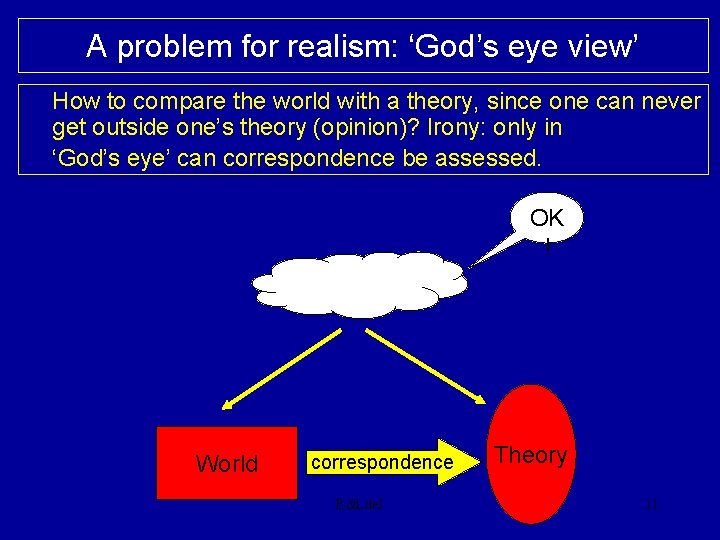
A problem for realism: ‘God’s eye view’ How to compare the world with a theory, since one can never get outside one’s theory (opinion)? Irony: only in ‘God’s eye’ can correspondence be assessed. OK ! World correspondence B&Lde. J Theory 11
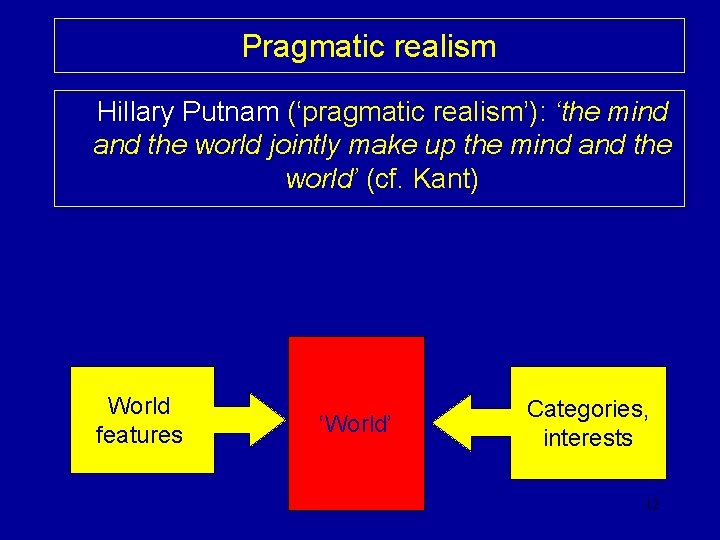
Pragmatic realism Hillary Putnam (‘pragmatic realism’): ‘the mind and the world jointly make up the mind and the world’ (cf. Kant) World features ‘World’ B&Lde. J Categories, interests 12
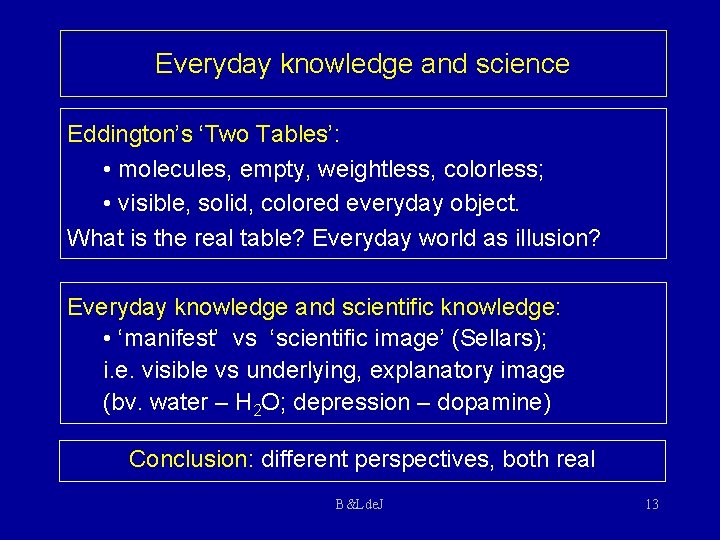
Everyday knowledge and science Eddington’s ‘Two Tables’: • molecules, empty, weightless, colorless; • visible, solid, colored everyday object. What is the real table? Everyday world as illusion? Everyday knowledge and scientific knowledge: • ‘manifest’ vs ‘scientific image’ (Sellars); i. e. visible vs underlying, explanatory image (bv. water – H 2 O; depression – dopamine) Conclusion: different perspectives, both real B&Lde. J 13
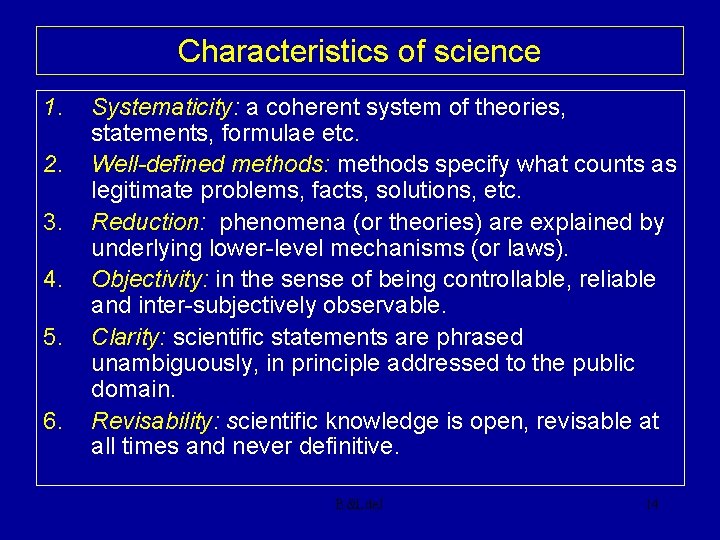
Characteristics of science 1. 2. 3. 4. 5. 6. Systematicity: a coherent system of theories, statements, formulae etc. Well-defined methods: methods specify what counts as legitimate problems, facts, solutions, etc. Reduction: phenomena (or theories) are explained by underlying lower-level mechanisms (or laws). Objectivity: in the sense of being controllable, reliable and inter-subjectively observable. Clarity: scientific statements are phrased unambiguously, in principle addressed to the public domain. Revisability: scientific knowledge is open, revisable at all times and never definitive. B&Lde. J 14
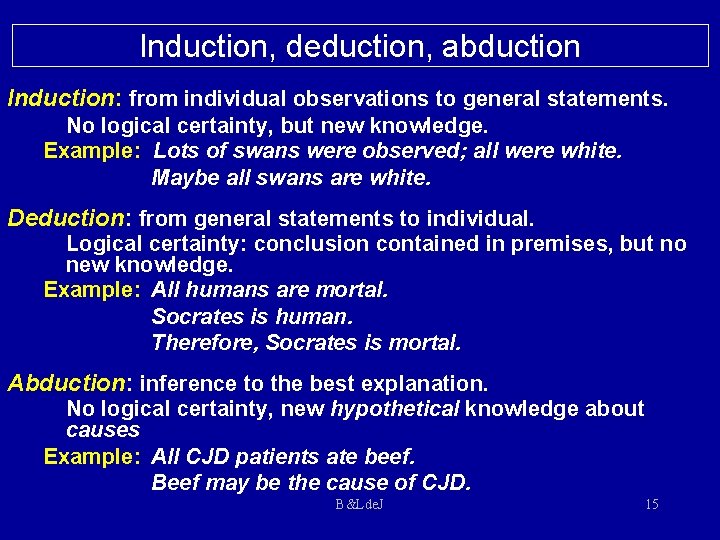
Induction, deduction, abduction Induction: from individual observations to general statements. No logical certainty, but new knowledge. Example: Lots of swans were observed; all were white. Maybe all swans are white. Deduction: from general statements to individual. Logical certainty: conclusion contained in premises, but no new knowledge. Example: All humans are mortal. Socrates is human. Therefore, Socrates is mortal. Abduction: inference to the best explanation. No logical certainty, new hypothetical knowledge about causes Example: All CJD patients ate beef. Beef may be the cause of CJD. B&Lde. J 15
The problem of induction • Every generalisation can be disconfirmed by an unexpected observation (‘black swan’). • Confirmation cannot, unlike deduction, be formalised; no logical certainty. • Inducing requires classification; one has to start with concepts and criteria (e. g. for similarity). B&Lde. J 16
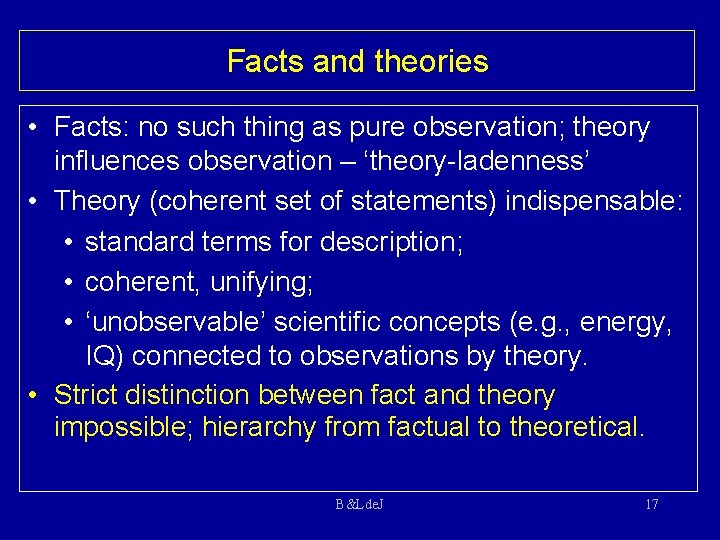
Facts and theories • Facts: no such thing as pure observation; theory influences observation – ‘theory-ladenness’ • Theory (coherent set of statements) indispensable: • standard terms for description; • coherent, unifying; • ‘unobservable’ scientific concepts (e. g. , energy, IQ) connected to observations by theory. • Strict distinction between fact and theory impossible; hierarchy from factual to theoretical. B&Lde. J 17
‘Justification’ vs ‘discovery’ Context of justification: normative, focus on method; prescribing criteria for holding a theory true, acceptable or justified, logically or empirically ( positivism). Context of discovery: description of the historical, social and psychological circumstances and influences that were relevant to the invention or discovery of scientific theories: who, where and when? ( more or less relativistic views of science). B&Lde. J 18