
Theoretical Foundations of Group Counseling and Group Work



- Slides: 24
Theoretical Foundations of Group Counseling and Group Work Daniel E. Reyes Liberty University
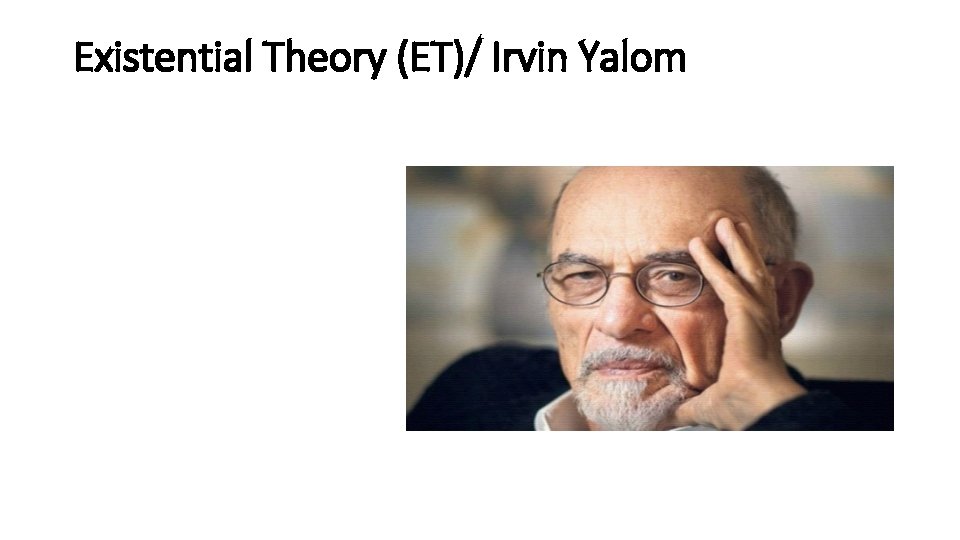
Existential Theory (ET)/ Irvin Yalom
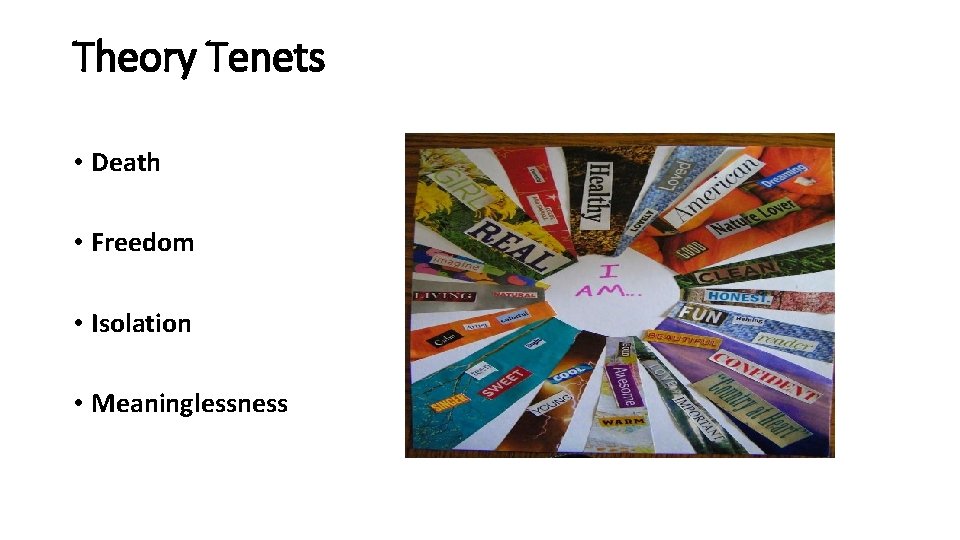
Theory Tenets • Death • Freedom • Isolation • Meaninglessness
Goals How this theory is integrated into group work • Helping clients to become honest with themselves • Expanding clients’ perspectives on themselves and the world around • Discovering what gives meaning to the clients present and future lives (Corey, 2009)
Leader Role How this theory is integrated into group work • Being present in the “here-and-now” • Using empathetic listening skills • Remaining nonjudgmental • Confronting existential issues in own life (Somov, 2007)
Existential Group Techniques How this theory is integrated into group work • Meaning of Adversity Approaches/ What is the meaning of pain and suffering? • Meaning of Self/Who/What am I? • Meaning of Presence/Being alive right now • Meaning of Death/Where am I going? (Somov, 2007)
Strengths & Limitations Strengths: • Otherapeutic approaches • The focus on spirituality and meaning in life • Can be encouraging to members • Opposes any dehumanizing approaches that objectifies Limitations: • Began as a philosophical movement • No direction from therapist • Biological and sociocultural factors • Doesn’t benefit those seeking problem solving methods or relief from specific symptom • Therapist must be wise and capable of profound and wide ranging understanding (Oliver, 2018)
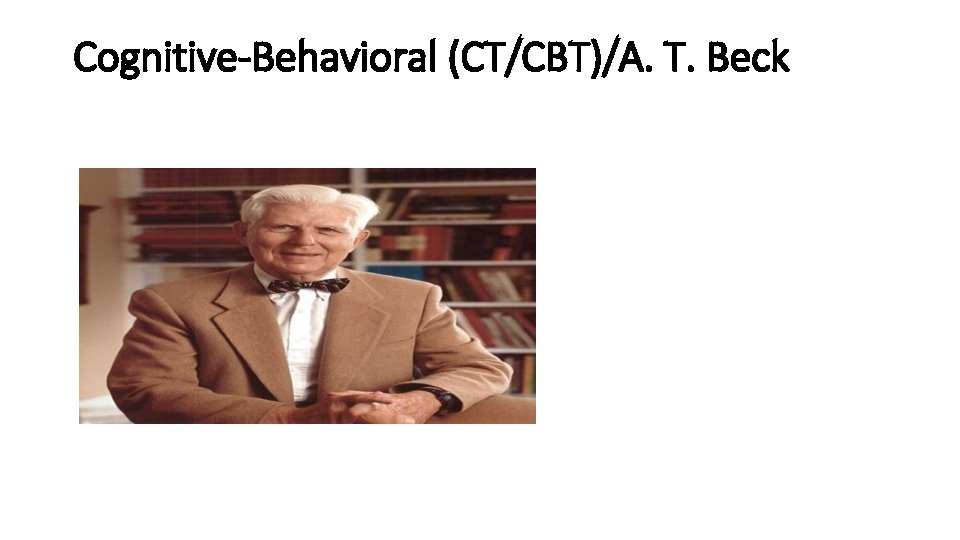
Cognitive-Behavioral (CT/CBT)/A. T. Beck
Theory Tenets • Human simply as organisms adapting to the environment • Assumes an external/objective reality and a personal/subjective phenomenological approach • A theory of psychological dysfunction. Focuses on the dynamics of psychological maladjustment rather than on healthy functioning (Murdock, 2009)
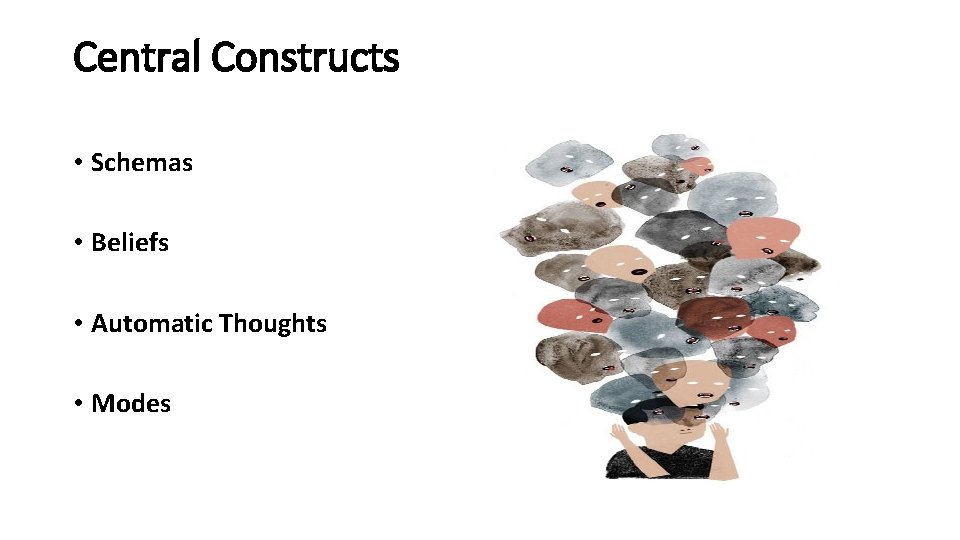
Central Constructs • Schemas • Beliefs • Automatic Thoughts • Modes
Goals How this theory is integrated into group work • Promoting self-awareness and emotional intelligence by teaching clients to “read” their emotions and distinguish healthy from unhealthy feelings • Helping clients understand how distorted perceptions and thoughts contribute to painful feelings • Pointing to reduction of symptoms with an emphasis on examining the client’s current situation and solving current problems • Through development of self-control by teaching clients specific techniques to identify and challenge distorted thinking • Helping clients to change core beliefs that are often at the heart of their suffering (Greenwood, 2018)
Leader Role How this theory is integrated into group work • Teaching skills to encourage members to learn and practice social skills applied in everyday life • Modeling active participation and appropriate behaviors • Observing and assessing behaviors that are related to problems and facilitate change • Through reinforcement even for small behavioral change • Emphasizing an active plan for change—insight is not enough (Weber, 2013)
Techniques How this theory is integrated into group work • • • • Self-monitoring (e. g. Thought Record) Descending Arrow Technique Socratic Questioning Techniques Advantages and Disadvantages Relaxation Acting “as if” Behavioral Experiments Homework Exposure Skills Reconstructing Personal History Psychoeducation Mindfulness Self-disclosure Core Belief Worksheet (Drab, 2010)
Strengths & Limitations Strengths: • Equivalence between group and individual therapy for depression • Efficacy and cost-effectiveness • Numerous protocols are available, many based on carefully designed efficacy studies • Collection of approaches for specific disorders, including depression, panic, obesity, eating disorders, and work in specific populations Limitations: • Lack of progress on outcome variables • Low rate of homework completion • Lack of cohesion (Bieling, Mc. Cabe, & Antony, 2006)
Family Systems (FS)/Virginia Satir
Theory Tenets • Self-Esteem • Self Mandala • Communication • Primary Triad • Family Rules
Goals How this theory is integrated into group work • Helping each group member deal with his/her family reality • Focusing on action instead of discussion • Improving communication between family members • Changing how the group members’ family works • Sharing group leadership skills/experience with peers (co-therapists), trainees and families (Brodsky, 1999)
Leader Role How this theory is integrated into group work • Therapist is described as a coach (does not stress exploration nor insight) • Helping group members to get started and cheer them through the process of differentiation from the family of origin • Supporting group members without becoming triangled (from the emotional process) into the group members family’s system (Murdock, 2009)
Techniques How this theory is integrated into group work • Genogram • Role-Play • Narrative Therapy • Mapping • “Go on Journey” • Person-to-Person Relationships • Detriangling
Strengths & Limitations Strengths: • FS considered empirically valid • Found to be effective • Instills trust in family members • Addresses specific family age groups (conjoin & group therapy) • Reduces sources of tension and stress within the family • Conflict resolution for family members • • Limitations: Feminist therapist critics FS theory saying it reinforces traditional family dysfunctional structures Susceptible to the charge of cultural bias High involvement on emotional interactions/conflicts among group members (Murdock, 2009)
Summary • To live is to find meaning • To live is to change life core beliefs • Life is the fulfilment of healthy relationships
References Berry-Smith, S. (2012). Death, freedom, isolation and meaninglessness, and the existential psychotherapy of Irvin D. Yalom. A literature review (Master’s thesis). Retrieved from http: //aut. researchgateway. ac. nz/handle/10292/4611 Bieling, P. J. , Mc. Cabe, R. E. , & Antony, M. M. (2006). Cognitive-Behavioral therapy in groups. New York, NY: Guilford Publications. Brodsky, G. K. (1999). The hidden method. Multiple Family Group Therapy (MFGT). Retrieved from http: //www. multiplefamilygrouptherapy. com/The%20 Hidden%20 Method. htm Corey, G. (2009). Theory and practice of counseling and psychotherapy (8 ed. ). Belmont, CA: Brooks/Cole, Cengage Learning. Drab, K. J. (2010). Applications of CBT in group therapies. Retrieved from https: //www. slideshare. net/kjdrab/appl ications-of-cbt-in-group-therapies Greenwood, V. (2018). Goals of cognitive therapy. Center for Cognitive Therapy. Retrieved from http: //www. washingtoncenterforcognitivetherapy. com/philosophy-of-treatment/cognitive-therapy/goals-of-cognitive-therapy/ Murdock, N. (2009). Theories of counseling and Psychotherapy (2 nd ed. ). New York, NY: Person Oliver, M. (2018). Existential approach to group therapy. Retrieved from https: //learning. hccs. edu/faculty/mark. oliver/lectures-for-lifespanpsychology/powerpoint-on-existential-group-therapy Somov, P. (2007). Meaning of life group: Group application of logotherapy for substance use treatment. Journal for Specialists in Group Work, 32(4), 316 - 345. doi: 10. 1080/01933920701476664. Weber, L. (2013). CBT group therapy. Prezi. Retrieved from https: //prezi. com/dmce 6 o_o 7 vlc/cbt-group-therapy/ Yalom, I. D. (1980). Existential psychotherapy. New York, NY: Basic Books.