
Theoretical and Experimental Probability LESSON 10 1 Course
Theoretical and Experimental Probability LESSON 10 -1 Course 3 Problem of the Day If the lengths of the sides of a square increase by 10%, by what percent does the area increase? 21% Lesson Main Lesson 10 -1 Feature
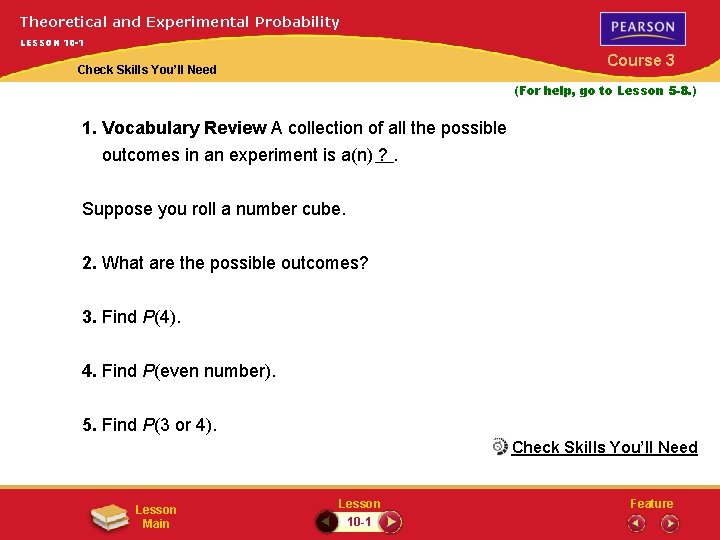
Theoretical and Experimental Probability LESSON 10 -1 Course 3 Check Skills You’ll Need (For help, go to Lesson 5 -8. ) 1. Vocabulary Review A collection of all the possible outcomes in an experiment is a(n) ? . Suppose you roll a number cube. 2. What are the possible outcomes? 3. Find P(4). 4. Find P(even number). 5. Find P(3 or 4). Check Skills You’ll Need Lesson Main Lesson 10 -1 Feature
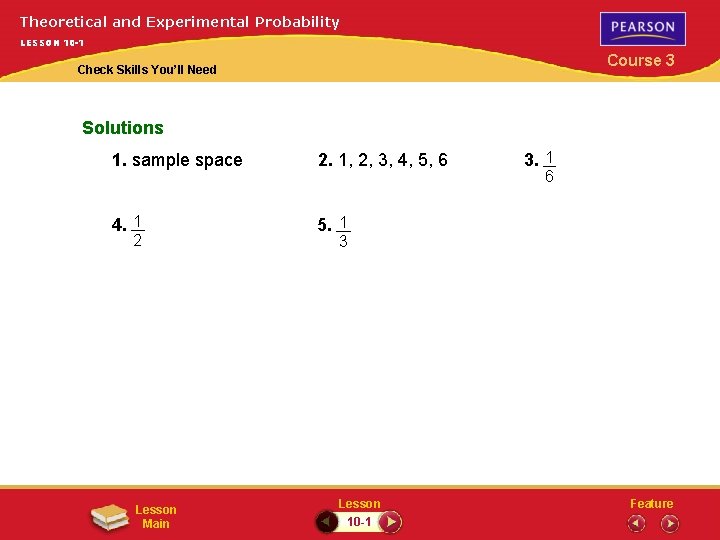
Theoretical and Experimental Probability LESSON 10 -1 Course 3 Check Skills You’ll Need Solutions 1. sample space 2. 1, 2, 3, 4, 5, 6 4. 1 5. 1 2 Lesson Main 3. 1 6 3 Lesson 10 -1 Feature
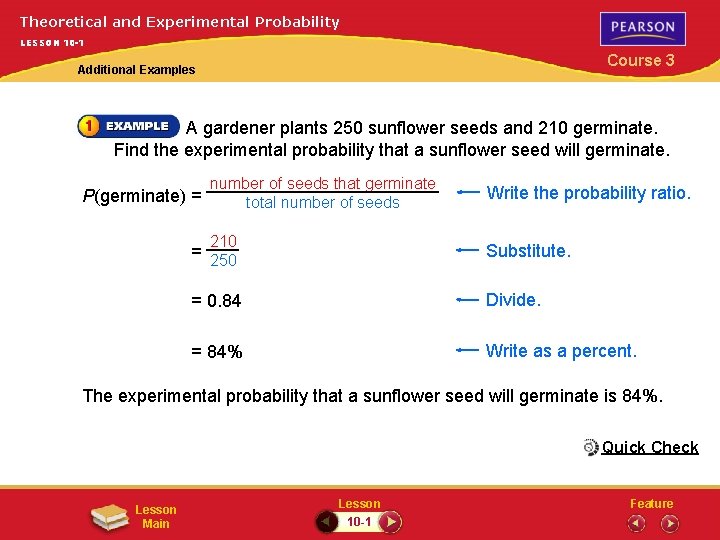
Theoretical and Experimental Probability LESSON 10 -1 Course 3 Additional Examples A gardener plants 250 sunflower seeds and 210 germinate. Find the experimental probability that a sunflower seed will germinate. P(germinate) = number of seeds that germinate total number of seeds 210 Write the probability ratio. = 250 Substitute. = 0. 84 Divide. = 84% Write as a percent. The experimental probability that a sunflower seed will germinate is 84%. Quick Check Lesson Main Lesson 10 -1 Feature
Theoretical and Experimental Probability LESSON 10 -1 Course 3 Additional Examples The probability of tossing one six-sided number cube and getting a 5 is 1 , or about 17%. Is this experimental or theoretical 6 probability? You can calculate this probability without doing any trials because each of the six possible outcomes are equally likely. This is theoretical probability. Quick Check Lesson Main Lesson 10 -1 Feature
Theoretical and Experimental Probability LESSON 10 -1 Course 3 Additional Examples Suppose you select a pen at random from 3 red ones and 4 blue ones. What are the odds in favor of selecting a red pen? Since 3 pens are red and 4 are blue, the odds of selecting a red pen at random are 3 : 4. Quick Check Lesson Main Lesson 10 -1 Feature

Theoretical and Experimental Probability LESSON 10 -1 Course 3 Lesson Quiz Use this information to solve the problems: You toss two nickels 50 times. You get one head and one tail 38 times, and two heads 8 times. 1. Find the probability of getting one head and one tail. 76% 2. Find the probability of getting two heads. 16% 3. What kind of probability do your answers to 1 and 2 represent? experimental Lesson Main Lesson 10 -1 Feature
Theoretical and Experimental Probability LESSON 10 -1 Course 3 Lesson Quiz 4. What are the odds in favor of getting exactly one head and one tail? 38 : 12 or 19 : 6 Lesson Main Lesson 10 -1 Feature
Making Predictions LESSON 10 -2 Course 3 Problem of the Day Suppose a cricket jumps a distance of 12 in. and a grasshopper jumps 16 in. If they start at the same point, how far away will be the first spot they both land on? 48 in. Lesson Main Lesson 10 -2 Feature
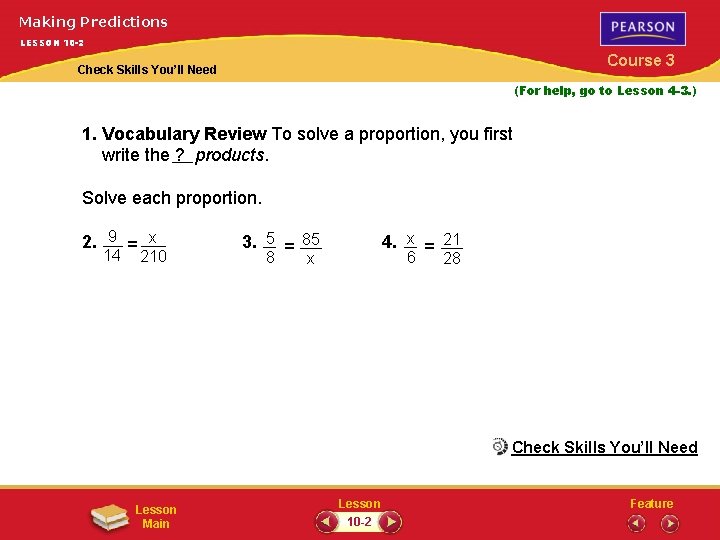
Making Predictions LESSON 10 -2 Course 3 Check Skills You’ll Need (For help, go to Lesson 4 -3. ) 1. Vocabulary Review To solve a proportion, you first write the ? products. Solve each proportion. 2. 9 = x 14 210 3. 5 = 85 8 4. x = 21 6 x 28 Check Skills You’ll Need Lesson Main Lesson 10 -2 Feature
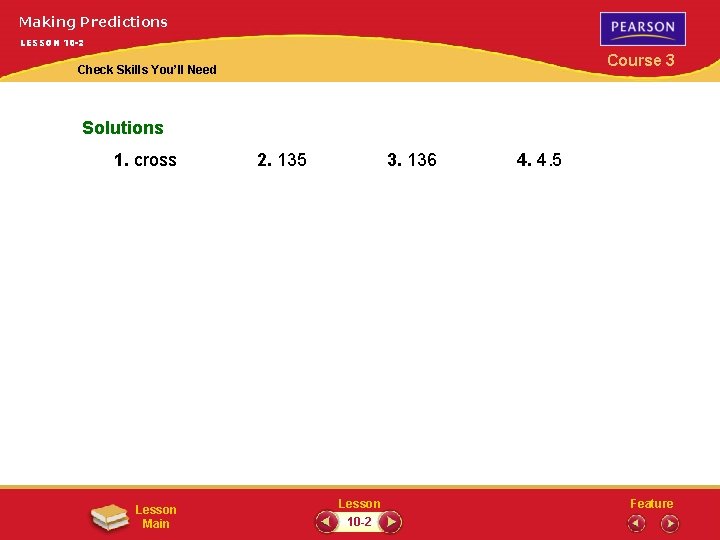
Making Predictions LESSON 10 -2 Course 3 Check Skills You’ll Need Solutions 1. cross Lesson Main 2. 135 3. 136 Lesson 10 -2 4. 4. 5 Feature
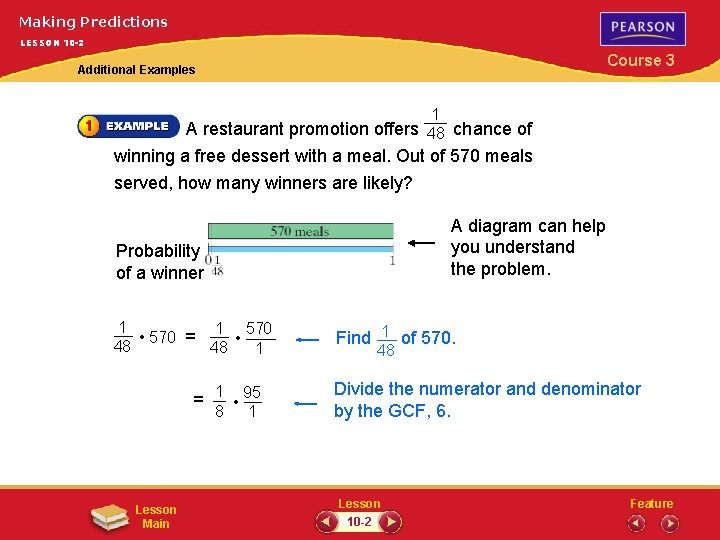
Making Predictions LESSON 10 -2 Course 3 Additional Examples 1 A restaurant promotion offers 48 chance of winning a free dessert with a meal. Out of 570 meals served, how many winners are likely? A diagram can help you understand the problem. Probability of a winner 1 1 570 • 570 = • 48 48 1 = Lesson Main 1 95 • 8 1 Find 1 of 570. 48 Divide the numerator and denominator by the GCF, 6. Lesson 10 -2 Feature
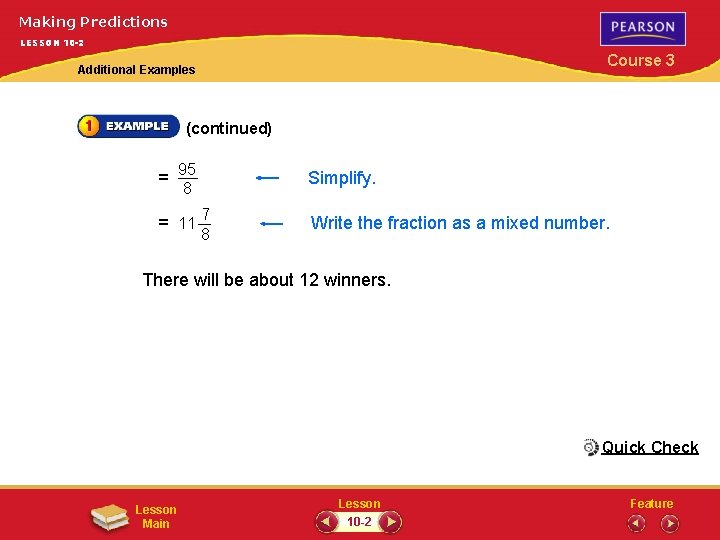
Making Predictions LESSON 10 -2 Course 3 Additional Examples (continued) = 95 8 = 11 Simplify. 7 8 Write the fraction as a mixed number. There will be about 12 winners. Quick Check Lesson Main Lesson 10 -2 Feature
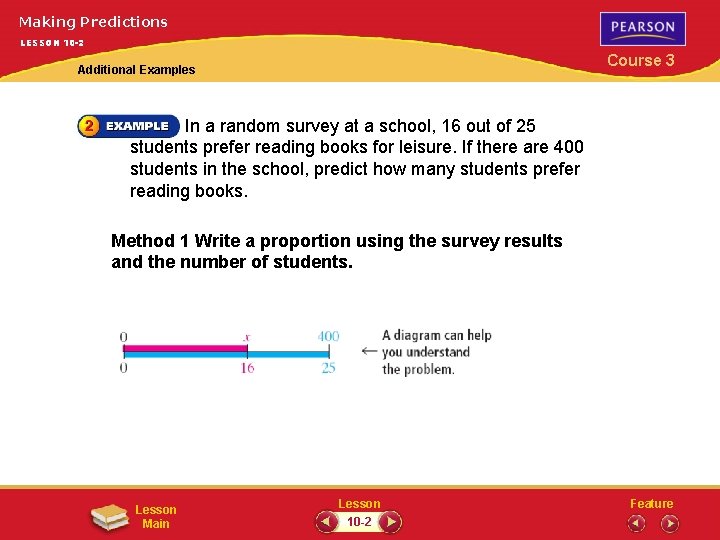
Making Predictions LESSON 10 -2 Course 3 Additional Examples In a random survey at a school, 16 out of 25 students prefer reading books for leisure. If there are 400 students in the school, predict how many students prefer reading books. Method 1 Write a proportion using the survey results and the number of students. Lesson Main Lesson 10 -2 Feature
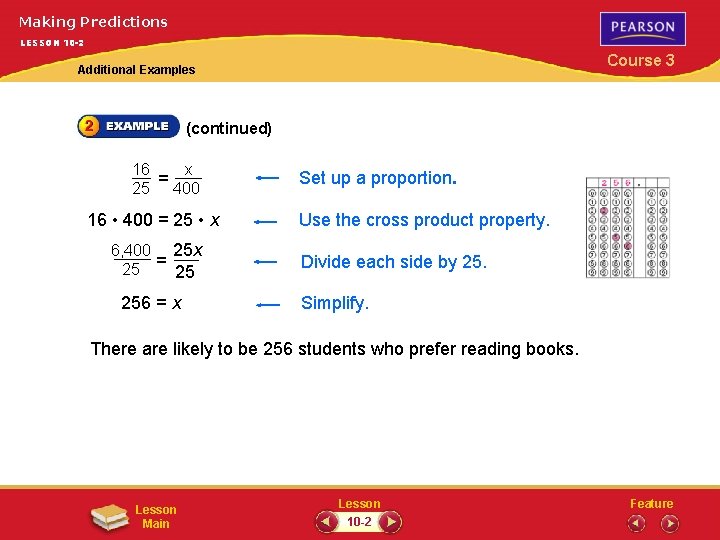
Making Predictions LESSON 10 -2 Course 3 Additional Examples (continued) 16 x = 25 400 16 • 400 = 25 • x 6, 400 25 x 25 = 25 256 = x Set up a proportion. Use the cross product property. Divide each side by 25. Simplify. There are likely to be 256 students who prefer reading books. Lesson Main Lesson 10 -2 Feature
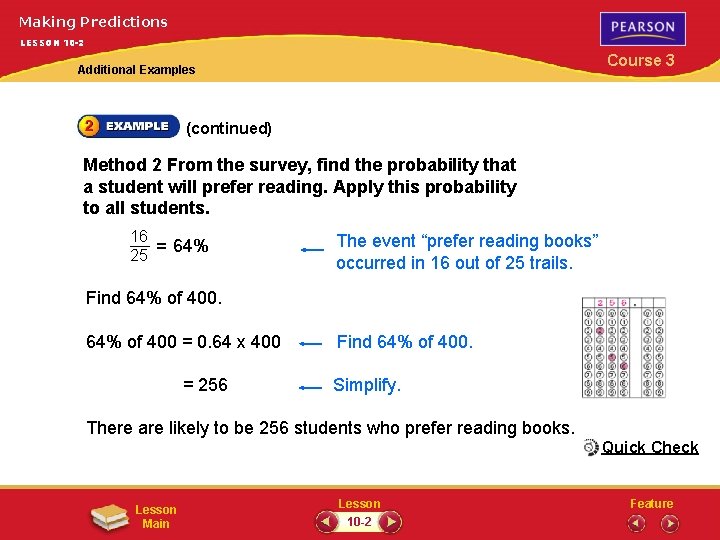
Making Predictions LESSON 10 -2 Course 3 Additional Examples (continued) Method 2 From the survey, find the probability that a student will prefer reading. Apply this probability to all students. 16 = 64% 25 The event “prefer reading books” occurred in 16 out of 25 trails. Find 64% of 400 = 0. 64 x 400 = 256 Find 64% of 400. Simplify. There are likely to be 256 students who prefer reading books. Quick Check Lesson Main Lesson 10 -2 Feature
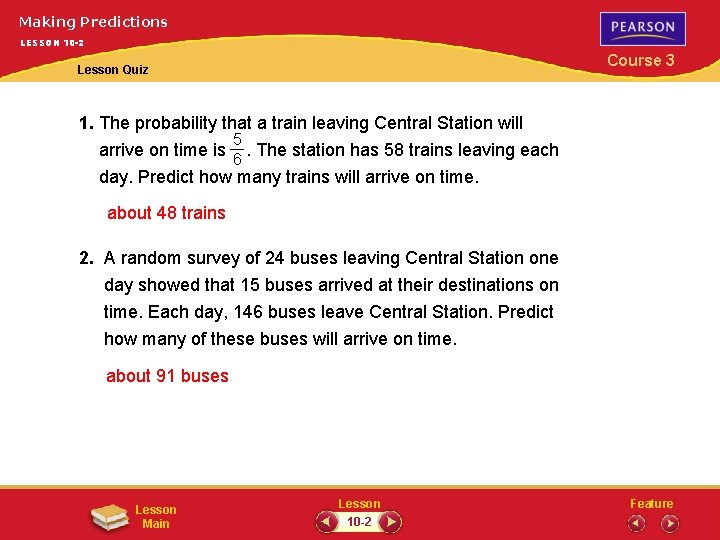
Making Predictions LESSON 10 -2 Course 3 Lesson Quiz 1. The probability that a train leaving Central Station will 5 arrive on time is 6. The station has 58 trains leaving each day. Predict how many trains will arrive on time. about 48 trains 2. A random survey of 24 buses leaving Central Station one day showed that 15 buses arrived at their destinations on time. Each day, 146 buses leave Central Station. Predict how many of these buses will arrive on time. about 91 buses Lesson Main Lesson 10 -2 Feature
Making Predictions LESSON 10 -2 Course 3 Lesson Quiz 3. A spinner is divided into different colored sections. The probability of the spinner landing on the purple section is 2. Predict how many times the spinner lands on the 7 purple section if it spins 98 times. about 28 times 4. In a random survey of voters in a small town, 52% of the people plan to vote for Mrs. Teller for state representative. If 1, 500 people vote, predict the number of votes Mrs. Teller will receive. about 780 Lesson Main Lesson 10 -2 Feature
Conducting a Survey LESSON 10 -3 Course 3 Problem of the Day Find three whole numbers whose sum is 14 and whose product is 84. 3, 4, 7 Lesson Main Lesson 10 -3 Feature
Conducting a Survey LESSON 10 -3 Course 3 Check Skills You’ll Need (For help, go to Lesson 10 -1. ) 1. Vocabulary Review How do theoretical and experimental probability differ? There are 9 blue, 5 red, and 4 green pencils in a bag. Find the probability of randomly selecting each color. 2. P(blue) 3. P(green) 4. P(red) Check Skills You’ll Need Lesson Main Lesson 10 -3 Feature
Conducting a Survey LESSON 10 -3 Course 3 Check Skills You’ll Need Solutions 1. Experimental probability is based on running numerous trials or experiments, whereas theoretical probability is based on the mathematical likelihood of events. 2. 1 2 3. 2 9 4. 5 18 Lesson Main Lesson 10 -3 Feature
Conducting a Survey LESSON 10 -3 Course 3 Additional Examples Tell whether the survey uses a random sample. Describe the population of the sample. To find out how often students in your school go to movies, you select names at random from the school directory to interview. This is a random sample. The population is the students in your school. Quick Check Lesson Main Lesson 10 -3 Feature
Conducting a Survey LESSON 10 -3 Course 3 Additional Examples Determine whether the question is biased or not. Explain your answer. Do you enjoy modern songs or old songs? This question is biased. “Modern” and “old” are not neutral and descriptive terms. They are terms that may make one answer choice seem better than the other. Quick Check Lesson Main Lesson 10 -3 Feature
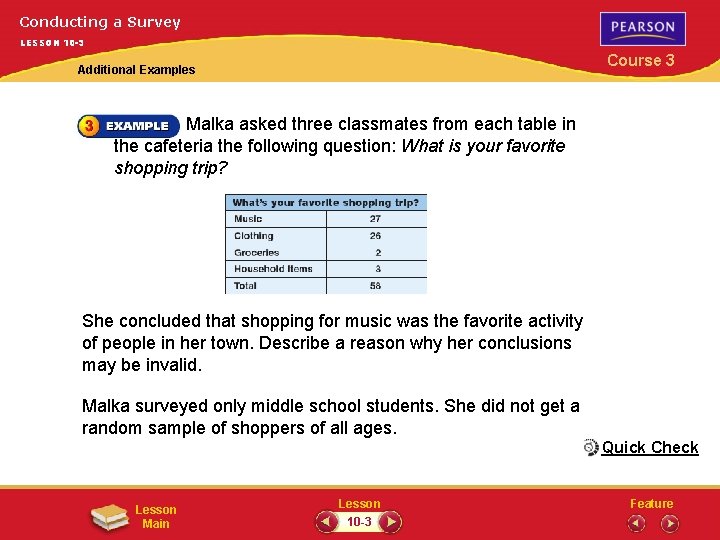
Conducting a Survey LESSON 10 -3 Course 3 Additional Examples Malka asked three classmates from each table in the cafeteria the following question: What is your favorite shopping trip? She concluded that shopping for music was the favorite activity of people in her town. Describe a reason why her conclusions may be invalid. Malka surveyed only middle school students. She did not get a random sample of shoppers of all ages. Quick Check Lesson Main Lesson 10 -3 Feature
Conducting a Survey LESSON 10 -3 Course 3 Lesson Quiz For Exercises 1– 3, use this situation: You want to find out how many people plan to attend the school pep rally. 1. You survey all students in your science class. Explain why this is not a good sample. Sample: The sample does not include students from the other grades. 2. Explain why this is a biased question: Wouldn't you rather stay home the night of the pep rally? Sample: The question implies that staying home might be more acceptable. Lesson Main Lesson 10 -3 Feature
Conducting a Survey LESSON 10 -3 Course 3 Lesson Quiz 3. You survey the members of the football team. Explain how your conclusions will be affected. Sample: The conclusions may not be valid. Students who are on the football team may be more likely to attend the pep rally than students in general. 4. The owner of a fitness center wants to increase the number of members. She mails a questionnaire to current members, asking them to indicate their satisfaction with the center. Is this a good sample? Explain. Sample: No. Recipients of the questionnaire are current members who are more likely to be satisfied with the facility than any ex-members. Lesson Main Lesson 10 -3 Feature
Independent and Dependent Events LESSON 10 -4 Course 3 Problem of the Day If the population of the United States is approximately 250 million and the median age is 33 yr, roughly how many people in the United States are younger than 33 yr? 125 million Lesson Main Lesson 10 -4 Feature
Independent and Dependent Events LESSON 10 -4 Course 3 Check Skills You’ll Need (For help, go to Lesson 10 -2. ) 1. Vocabulary Review How can you use theoretical probability to make predictions? You roll a number cube 50 times. Predict how many times the given outcome will occur. 2. 2 3. 5 4. 8 5. odd Check Skills You’ll Need Lesson Main Lesson 10 -4 Feature
Independent and Dependent Events LESSON 10 -4 Course 3 Check Skills You’ll Need Solutions 1. You can set up a proportion to solve, or you can multiply theoretical probability by the population size. 2. about 8 Lesson Main 3. about 8 Lesson 10 -4 4. 0 5. about 25 Feature
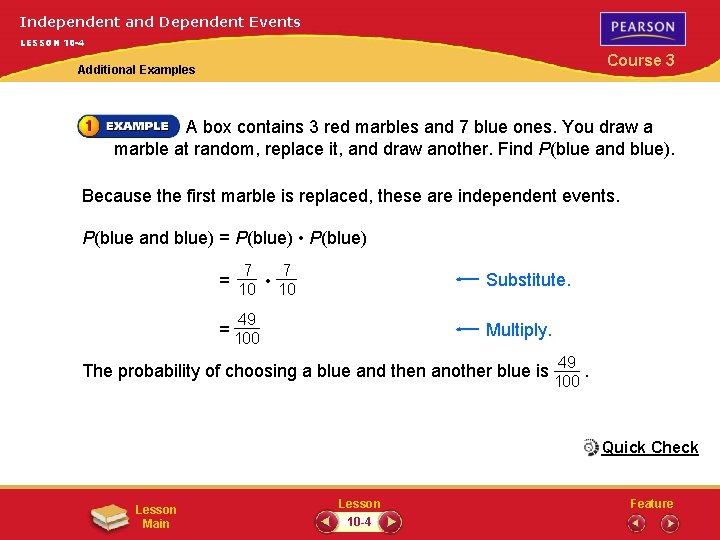
Independent and Dependent Events LESSON 10 -4 Course 3 Additional Examples A box contains 3 red marbles and 7 blue ones. You draw a marble at random, replace it, and draw another. Find P(blue and blue). Because the first marble is replaced, these are independent events. P(blue and blue) = P(blue) • P(blue) 7 7 Substitute. = 10 • 10 49 = 100 Multiply. The probability of choosing a blue and then another blue is 49. 100 Quick Check Lesson Main Lesson 10 -4 Feature
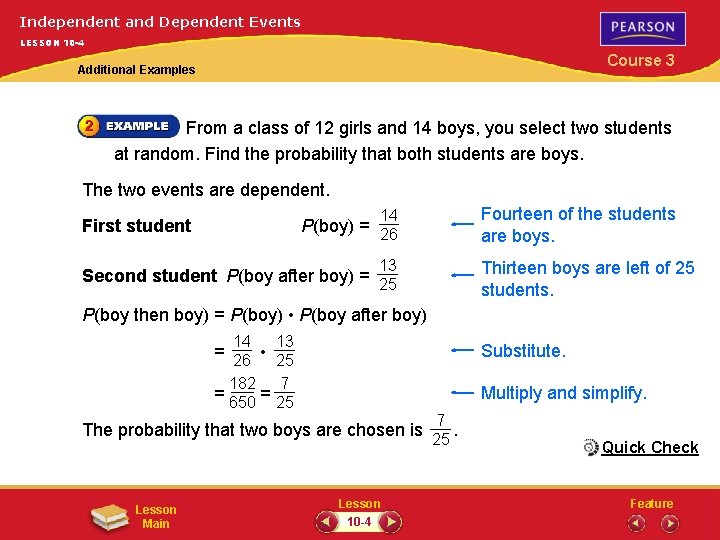
Independent and Dependent Events LESSON 10 -4 Course 3 Additional Examples From a class of 12 girls and 14 boys, you select two students at random. Find the probability that both students are boys. The two events are dependent. 14 Fourteen of the students are boys. 13 Thirteen boys are left of 25 students. P(boy) = 26 First student Second student P(boy after boy) = 25 P(boy then boy) = P(boy) • P(boy after boy) 14 13 182 7 Substitute. = 26 • 25 Multiply and simplify. = 650 = 25 The probability that two boys are chosen is Lesson Main Lesson 10 -4 7. 25 Quick Check Feature
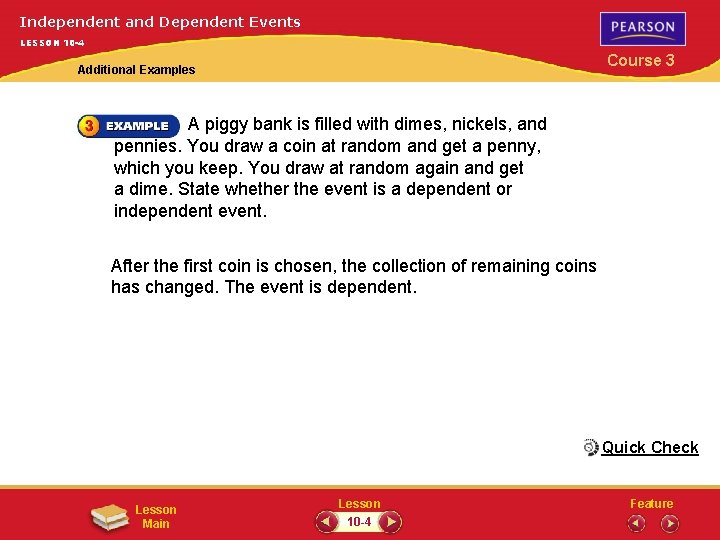
Independent and Dependent Events LESSON 10 -4 Course 3 Additional Examples A piggy bank is filled with dimes, nickels, and pennies. You draw a coin at random and get a penny, which you keep. You draw at random again and get a dime. State whether the event is a dependent or independent event. After the first coin is chosen, the collection of remaining coins has changed. The event is dependent. Quick Check Lesson Main Lesson 10 -4 Feature
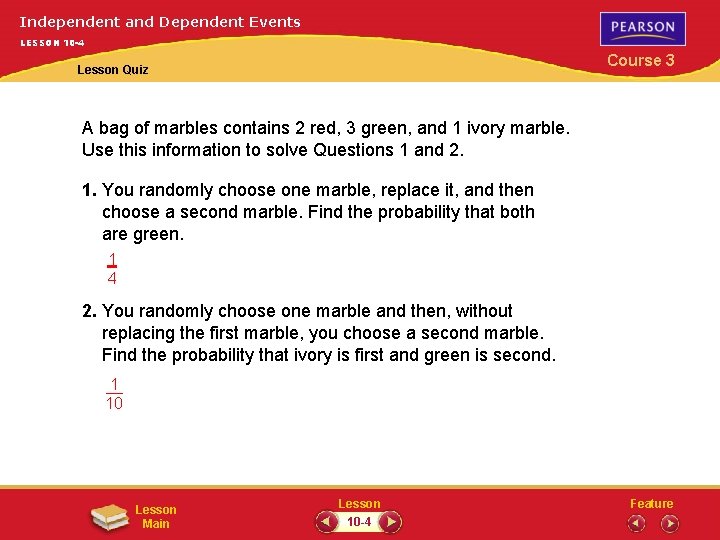
Independent and Dependent Events LESSON 10 -4 Course 3 Lesson Quiz A bag of marbles contains 2 red, 3 green, and 1 ivory marble. Use this information to solve Questions 1 and 2. 1. You randomly choose one marble, replace it, and then choose a second marble. Find the probability that both are green. 1 4 2. You randomly choose one marble and then, without replacing the first marble, you choose a second marble. Find the probability that ivory is first and green is second. 1 10 Lesson Main Lesson 10 -4 Feature
Independent and Dependent Events LESSON 10 -4 Course 3 Lesson Quiz 3. What kind of event is described in Question 1? independent 4. What kind of event is described in Question 2? dependent Lesson Main Lesson 10 -4 Feature
Permutations LESSON 10 -5 Course 3 Problem of the Day Jan tosses two coins. What is the probability that there will be no tails? 1 4 Lesson Main Lesson 10 -5 Feature
Permutations LESSON 10 -5 Course 3 Check Skills You’ll Need (For help, go to Lesson 5 -8. ) 1. Vocabulary Review What is a sample space? Find the number of possible outcomes in each situation. 2. Roll a number cube and toss a coin. 3. Roll two number cubes. 4. Toss two coins. Check Skills You’ll Need Lesson Main Lesson 10 -5 Feature
Permutations LESSON 10 -5 Course 3 Check Skills You’ll Need Solutions 1. a collection of all possible outcomes 2. 12 Lesson Main 3. 36 4. 4 Lesson 10 -5 Feature
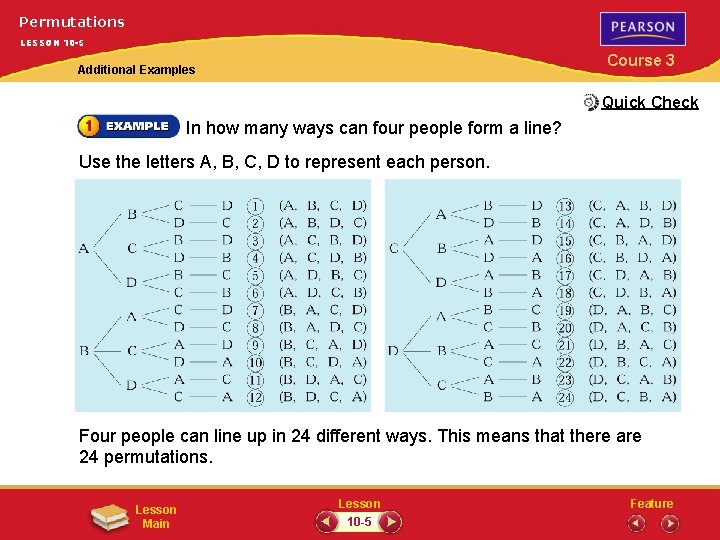
Permutations LESSON 10 -5 Course 3 Additional Examples Quick Check In how many ways can four people form a line? Use the letters A, B, C, D to represent each person. Four people can line up in 24 different ways. This means that there are 24 permutations. Lesson Main Lesson 10 -5 Feature
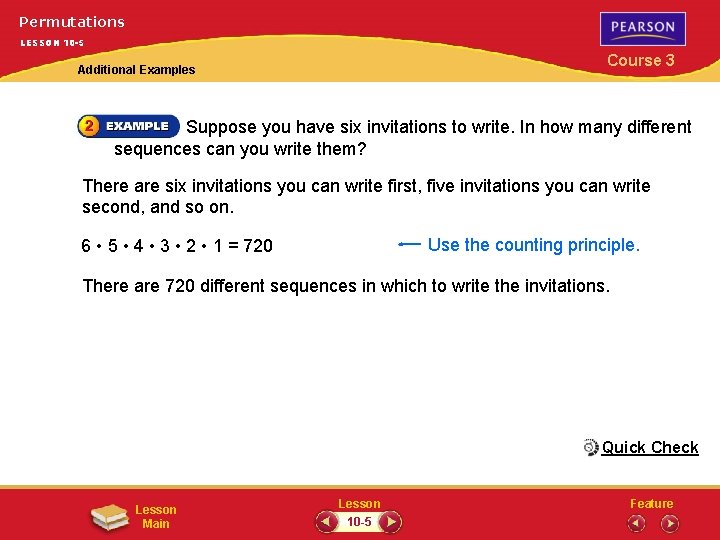
Permutations LESSON 10 -5 Course 3 Additional Examples Suppose you have six invitations to write. In how many different sequences can you write them? There are six invitations you can write first, five invitations you can write second, and so on. Use the counting principle. 6 • 5 • 4 • 3 • 2 • 1 = 720 There are 720 different sequences in which to write the invitations. Quick Check Lesson Main Lesson 10 -5 Feature
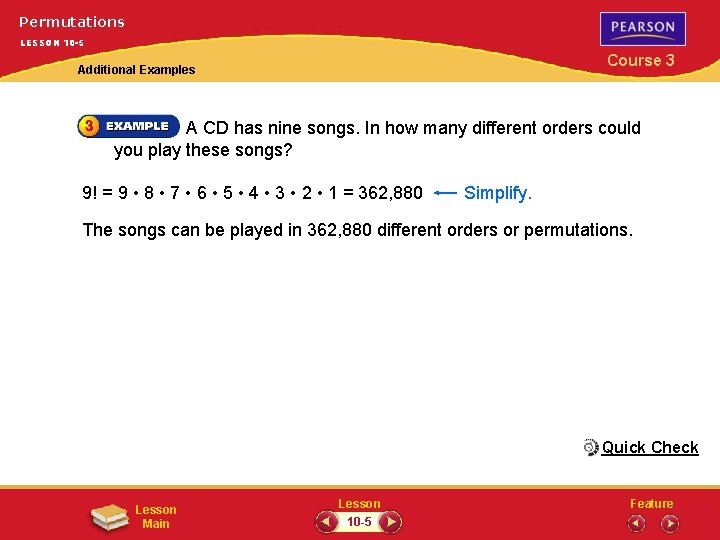
Permutations LESSON 10 -5 Course 3 Additional Examples A CD has nine songs. In how many different orders could you play these songs? 9! = 9 • 8 • 7 • 6 • 5 • 4 • 3 • 2 • 1 = 362, 880 Simplify. The songs can be played in 362, 880 different orders or permutations. Quick Check Lesson Main Lesson 10 -5 Feature
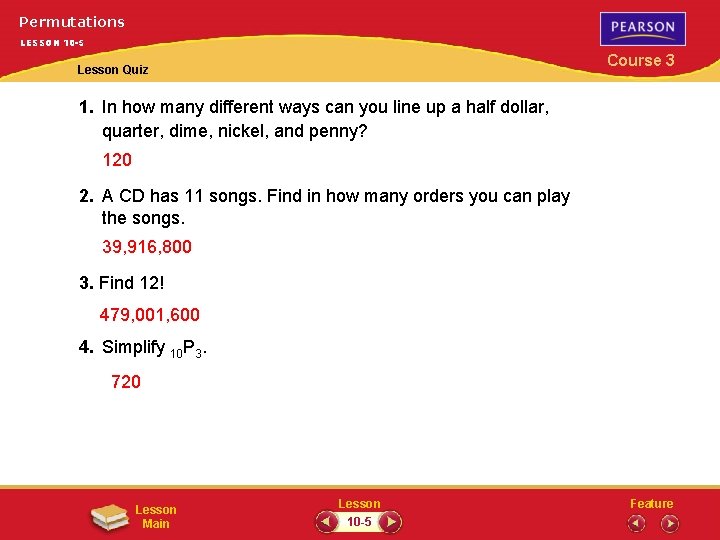
Permutations LESSON 10 -5 Course 3 Lesson Quiz 1. In how many different ways can you line up a half dollar, quarter, dime, nickel, and penny? 120 2. A CD has 11 songs. Find in how many orders you can play the songs. 39, 916, 800 3. Find 12! 479, 001, 600 4. Simplify 10 P 3. 720 Lesson Main Lesson 10 -5 Feature
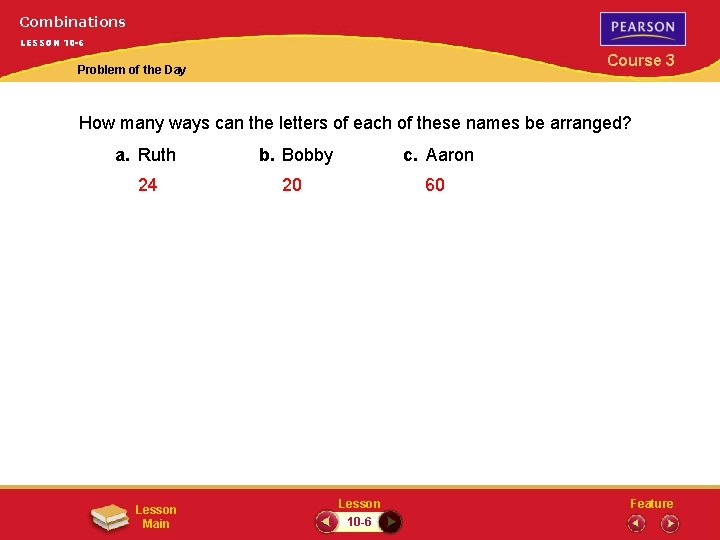
Combinations LESSON 10 -6 Course 3 Problem of the Day How many ways can the letters of each of these names be arranged? a. Ruth b. Bobby c. Aaron 24 20 60 Lesson Main Lesson 10 -6 Feature
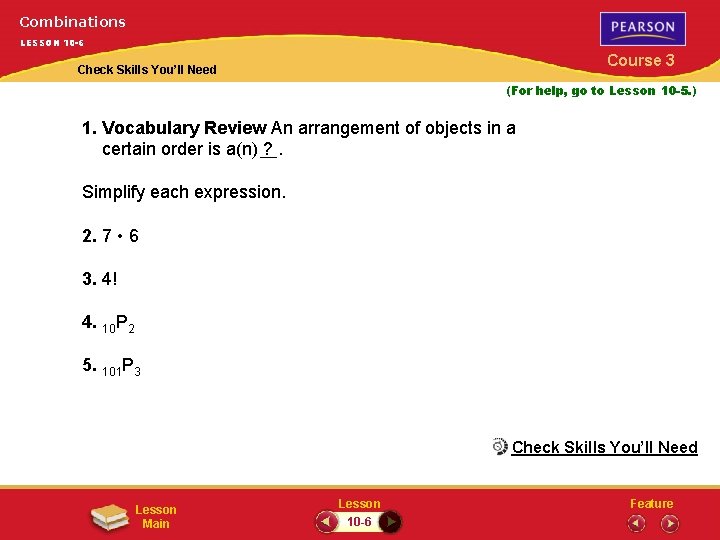
Combinations LESSON 10 -6 Course 3 Check Skills You’ll Need (For help, go to Lesson 10 -5. ) 1. Vocabulary Review An arrangement of objects in a certain order is a(n) ? . Simplify each expression. 2. 7 • 6 3. 4! 4. 10 P 2 5. 101 P 3 Check Skills You’ll Need Lesson Main Lesson 10 -6 Feature
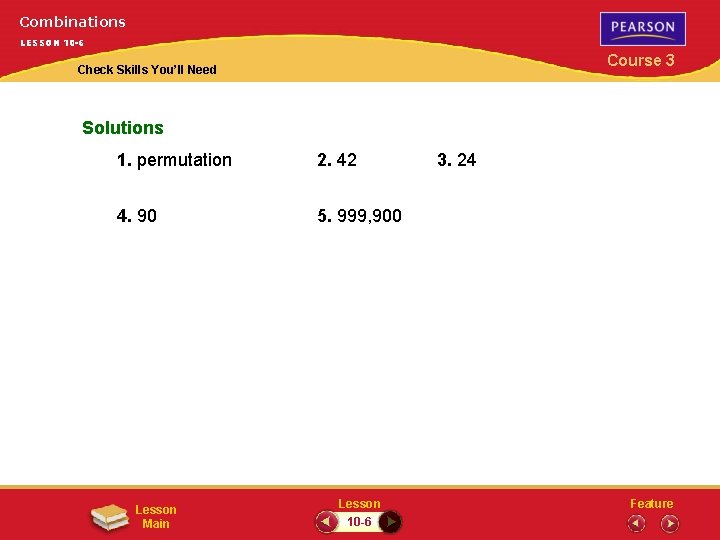
Combinations LESSON 10 -6 Course 3 Check Skills You’ll Need Solutions 1. permutation 2. 42 4. 90 5. 999, 900 Lesson Main Lesson 10 -6 3. 24 Feature
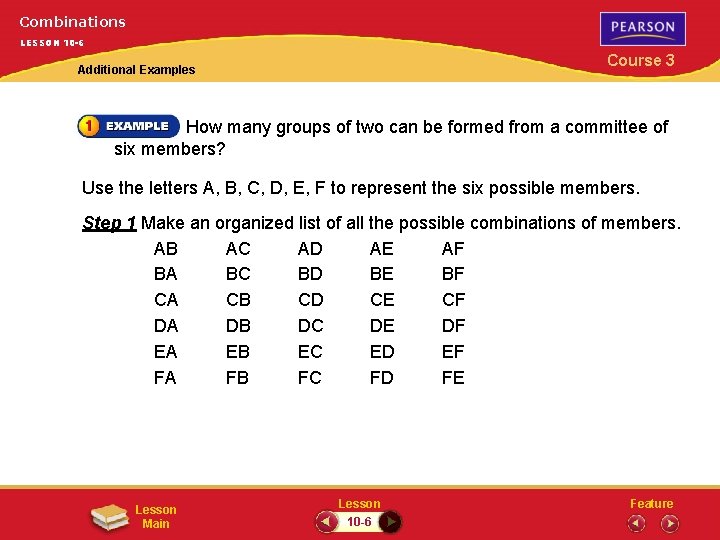
Combinations LESSON 10 -6 Course 3 Additional Examples How many groups of two can be formed from a committee of six members? Use the letters A, B, C, D, E, F to represent the six possible members. Step 1 Make an organized list of all the possible combinations of members. AB AC AD AE AF BA BC BD BE BF CA CB CD CE CF DA DB DC DE DF EA EB EC ED EF FA FB FC FD FE Lesson Main Lesson 10 -6 Feature
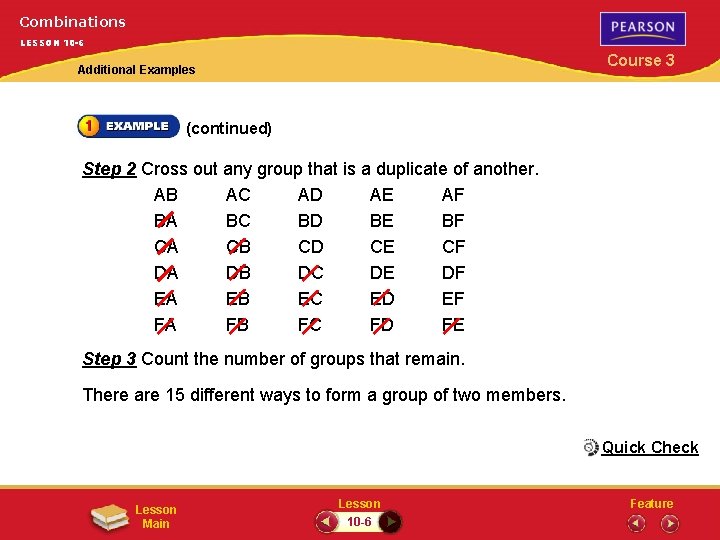
Combinations LESSON 10 -6 Course 3 Additional Examples (continued) Step 2 Cross out any group that is a duplicate of another. AB AC AD AE AF BA BC BD BE BF CA CB CD CE CF DA DB DC DE DF EA EB EC ED EF FA FB FC FD FE Step 3 Count the number of groups that remain. There are 15 different ways to form a group of two members. Quick Check Lesson Main Lesson 10 -6 Feature
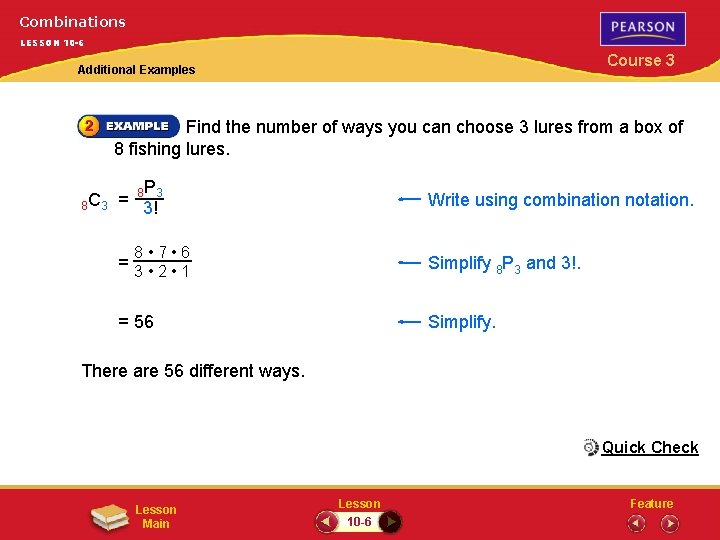
Combinations LESSON 10 -6 Course 3 Additional Examples Find the number of ways you can choose 3 lures from a box of 8 fishing lures. 8 P 3 C = 8 3 3! Write using combination notation. 8 • 7 • 6 =3 • 2 • 1 Simplify 8 P 3 and 3!. = 56 Simplify. There are 56 different ways. Quick Check Lesson Main Lesson 10 -6 Feature
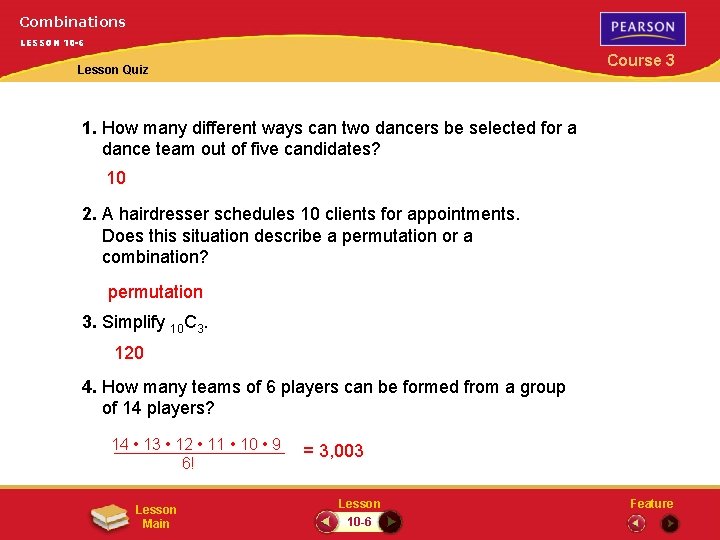
Combinations LESSON 10 -6 Course 3 Lesson Quiz 1. How many different ways can two dancers be selected for a dance team out of five candidates? 10 2. A hairdresser schedules 10 clients for appointments. Does this situation describe a permutation or a combination? permutation 3. Simplify 10 C 3. 120 4. How many teams of 6 players can be formed from a group of 14 players? 14 • 13 • 12 • 11 • 10 • 9 6! Lesson Main = 3, 003 Lesson 10 -6 Feature
- Slides: 48