
Theorems About Roots of Polynomial Equations Rational Roots
Theorems About Roots of Polynomial Equations Rational Roots
POLYNOMIALS and THEOREMS Theorems of Polynomial Equations • 1) 2) 3) 4) 5) There are 5 BIG Theorems to know about Polynomials Rational Root Theorem Fundamental Theorem of Algebra Irrational Root Theorem Imaginary Root Theorem Descartes Rule
• All the mentioned theorems give some clues about the roots of a function that is the form of a polynomial. • In advance Algebra we study only the first two. You will see the other theorems in Pre calculus. • The first theorem… which is the, Fundamental Theorem of Algebra state:
For f(x) where n > 0, there is at least one zero in the complex number system Complex → real and imaginary f(x) of degree n will have exactly n zeros (real and imaginary) As a reminder: Real zeros → can see on graph Imaginary → cannot see on graph
Next • THE Rational Root Theorem is explained by the next few slides.
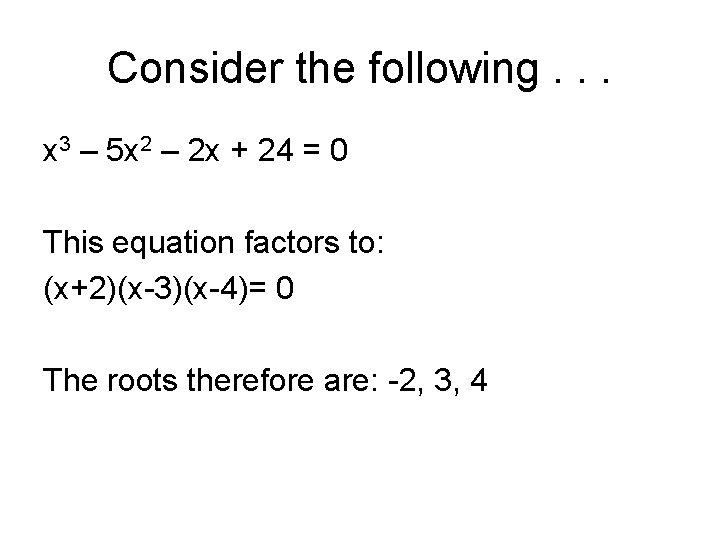
Consider the following. . . x 3 – 5 x 2 – 2 x + 24 = 0 This equation factors to: (x+2)(x-3)(x-4)= 0 The roots therefore are: -2, 3, 4
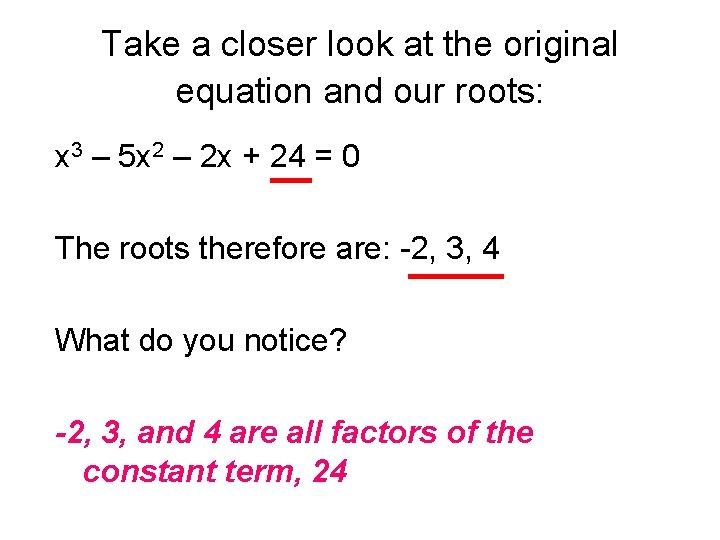
Take a closer look at the original equation and our roots: x 3 – 5 x 2 – 2 x + 24 = 0 The roots therefore are: -2, 3, 4 What do you notice? -2, 3, and 4 are all factors of the constant term, 24
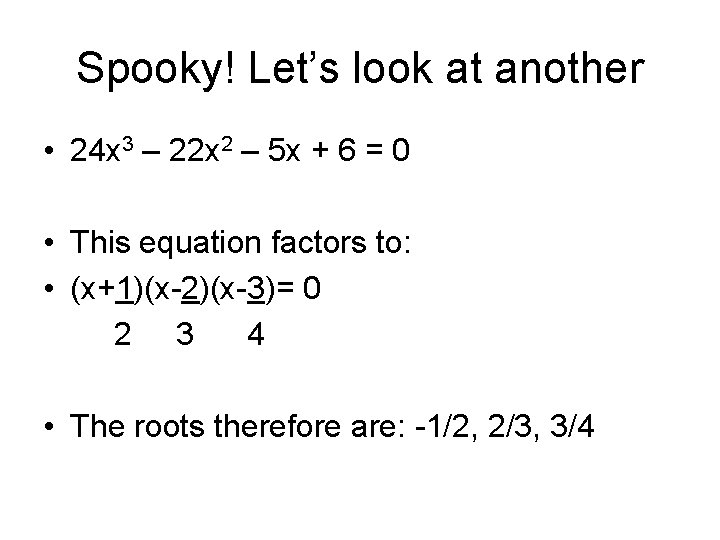
Spooky! Let’s look at another • 24 x 3 – 22 x 2 – 5 x + 6 = 0 • This equation factors to: • (x+1)(x-2)(x-3)= 0 2 3 4 • The roots therefore are: -1/2, 2/3, 3/4
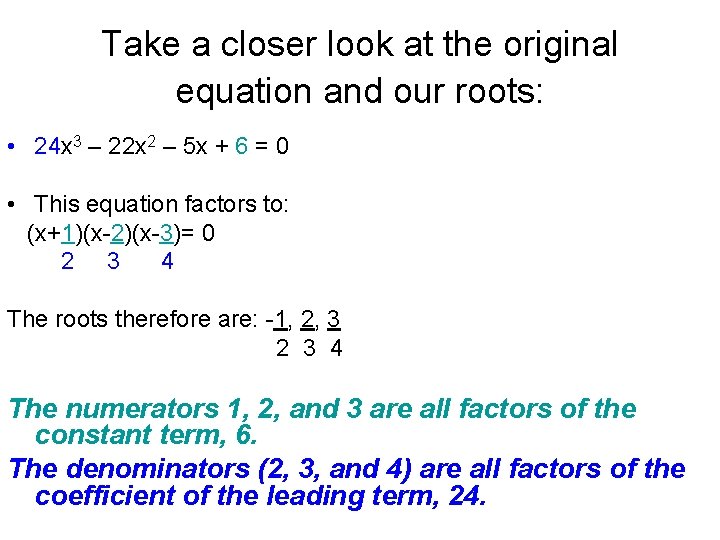
Take a closer look at the original equation and our roots: • 24 x 3 – 22 x 2 – 5 x + 6 = 0 • This equation factors to: (x+1)(x-2)(x-3)= 0 2 3 4 The roots therefore are: -1, 2, 3 2 3 4 The numerators 1, 2, and 3 are all factors of the constant term, 6. The denominators (2, 3, and 4) are all factors of the coefficient of the leading term, 24.

This leads us to the Rational Root Theorem •
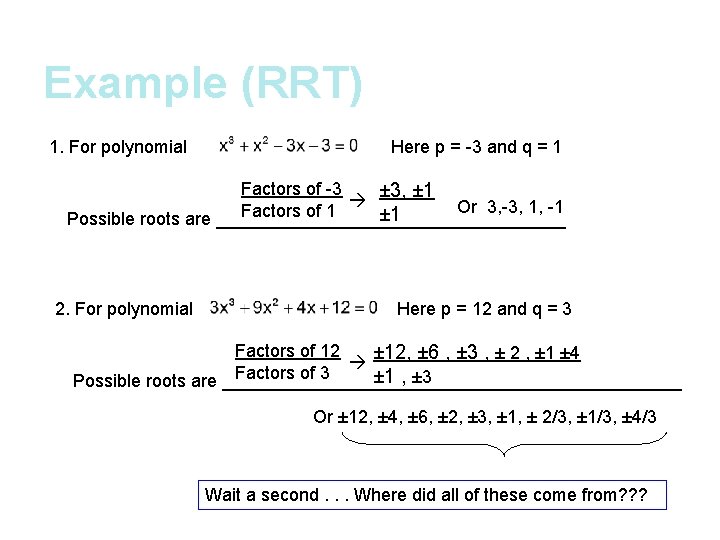
Example (RRT) 1. For polynomial Here p = -3 and q = 1 Factors of -3 ± 3, ± 1 Or 3, -3, 1, -1 Factors of 1 ± 1 Possible roots are __________________ 2. For polynomial Here p = 12 and q = 3 Factors of 12 ± 12, ± 6 , ± 3 , ± 2 , ± 1 ± 4 Factors of 3 ± 1 , ± 3 Possible roots are _______________________ Or ± 12, ± 4, ± 6, ± 2, ± 3, ± 1, ± 2/3, ± 1/3, ± 4/3 Wait a second. . . Where did all of these come from? ? ?
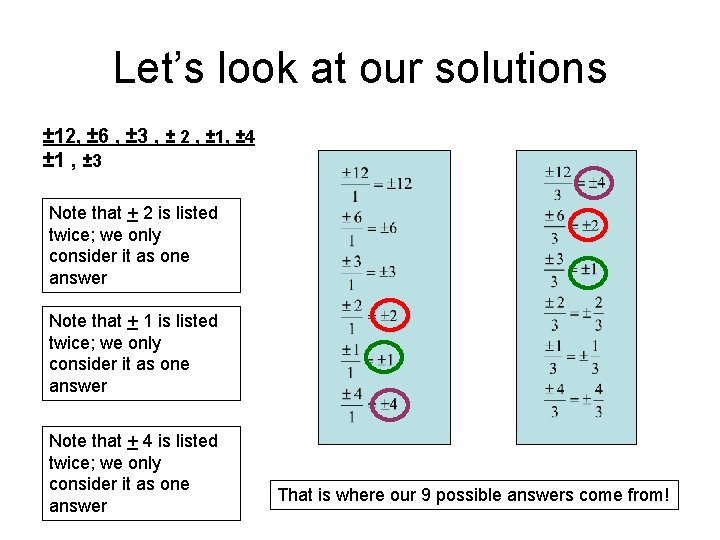
Let’s look at our solutions ± 12, ± 6 , ± 3 , ± 2 , ± 1, ± 4 ± 1 , ± 3 Note that + 2 is listed twice; we only consider it as one answer Note that + 1 is listed twice; we only consider it as one answer Note that + 4 is listed twice; we only consider it as one answer That is where our 9 possible answers come from!
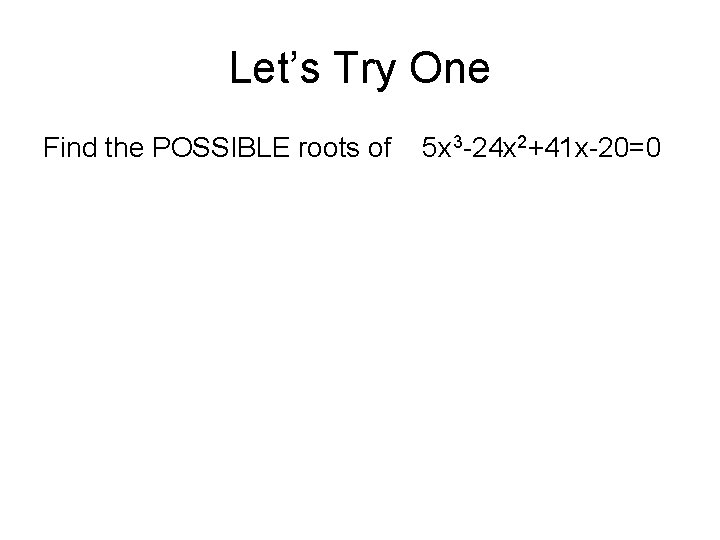
Let’s Try One Find the POSSIBLE roots of 5 x 3 -24 x 2+41 x-20=0
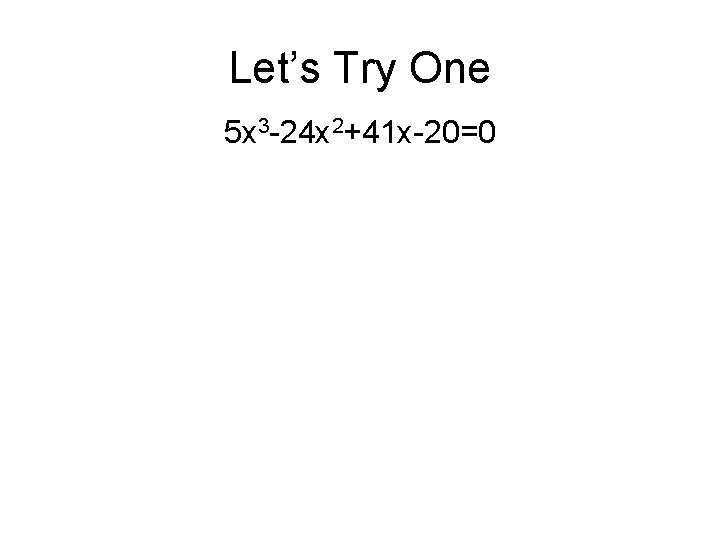
Let’s Try One 5 x 3 -24 x 2+41 x-20=0
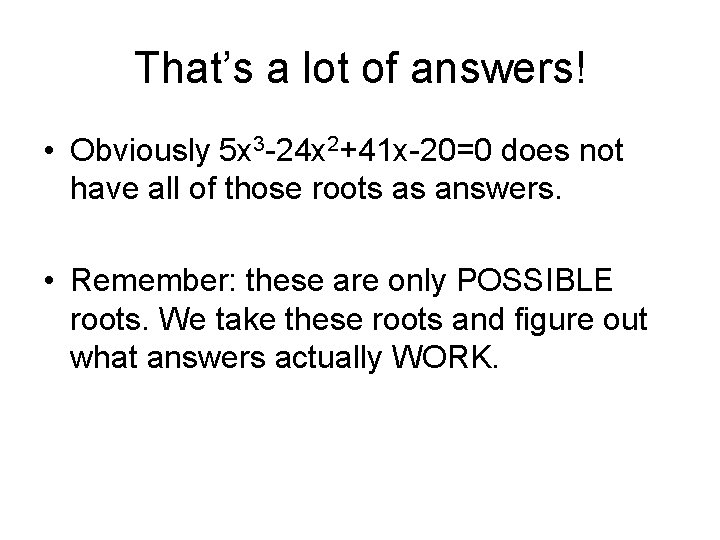
That’s a lot of answers! • Obviously 5 x 3 -24 x 2+41 x-20=0 does not have all of those roots as answers. • Remember: these are only POSSIBLE roots. We take these roots and figure out what answers actually WORK.
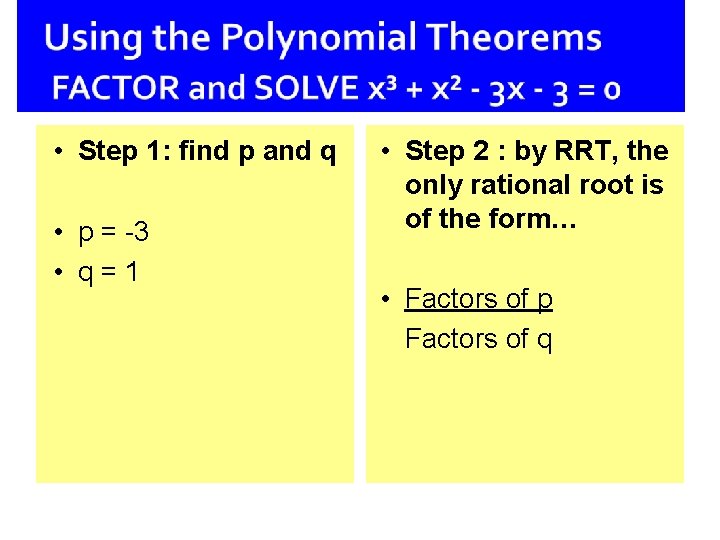
• Step 1: find p and q • p = -3 • q=1 • Step 2 : by RRT, the only rational root is of the form… • Factors of p Factors of q
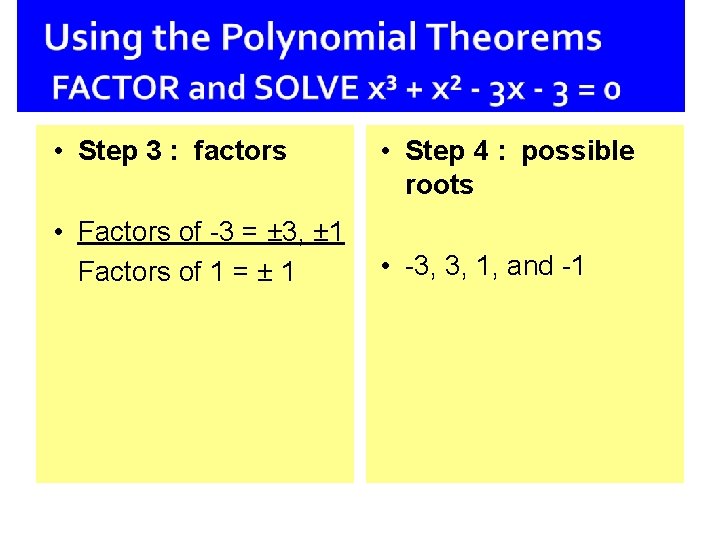
• Step 3 : factors • Factors of -3 = ± 3, ± 1 Factors of 1 = ± 1 • Step 4 : possible roots • -3, 3, 1, and -1
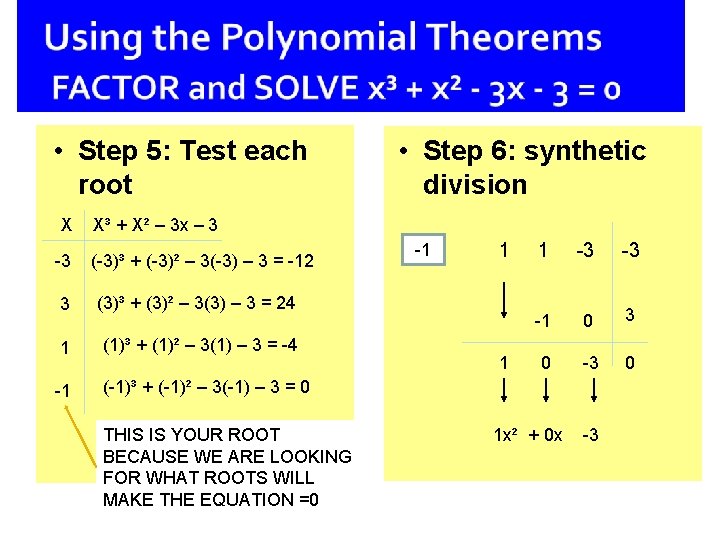
• Step 5: Test each root X -3 • Step 6: synthetic division X³ + X² – 3 x – 3 (-3)³ + (-3)² – 3(-3) – 3 = -12 3 (3)³ + (3)² – 3(3) – 3 = 24 1 (1)³ + (1)² – 3(1) – 3 = -4 -1 (-1)³ + (-1)² – 3(-1) – 3 = 0 THIS IS YOUR ROOT BECAUSE WE ARE LOOKING FOR WHAT ROOTS WILL MAKE THE EQUATION =0 -1 1 -3 -3 -1 0 3 0 -3 0 1 x² + 0 x -3
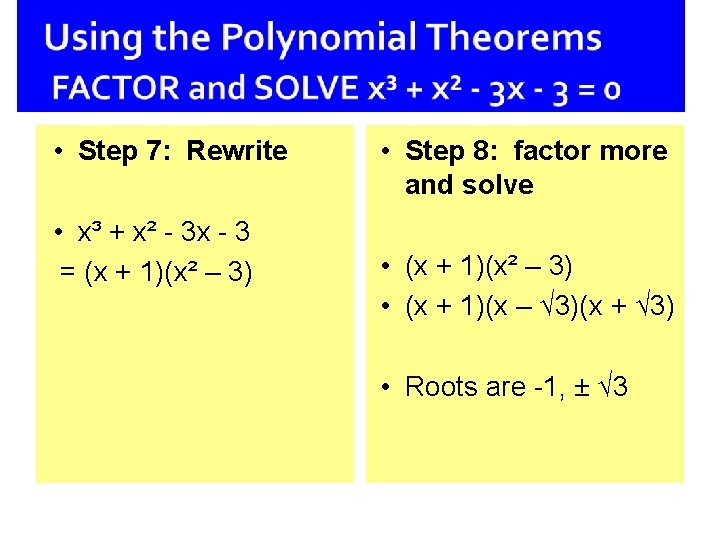
• Step 7: Rewrite • x³ + x² - 3 x - 3 = (x + 1)(x² – 3) • Step 8: factor more and solve • (x + 1)(x² – 3) • (x + 1)(x – √ 3)(x + √ 3) • Roots are -1, ± √ 3
Notes • You may also use the synthetic division/ substitution to evaluate the polynomial. • You may also use the graph of the polynomial to find the first root.
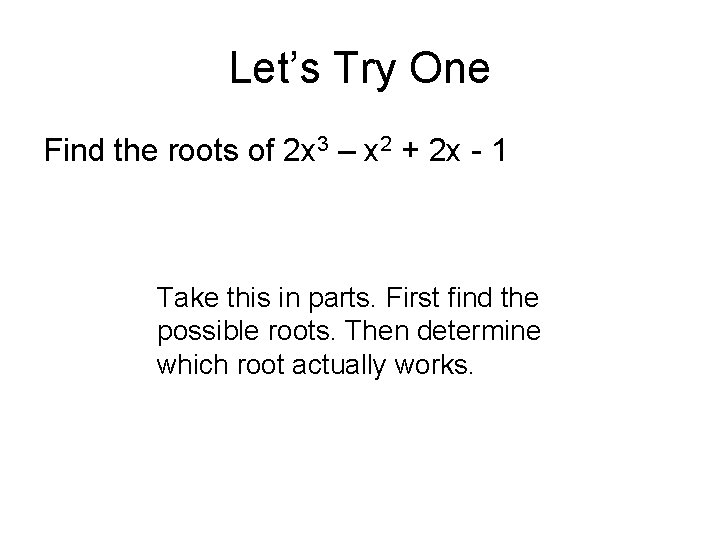
Let’s Try One Find the roots of 2 x 3 – x 2 + 2 x - 1 Take this in parts. First find the possible roots. Then determine which root actually works.
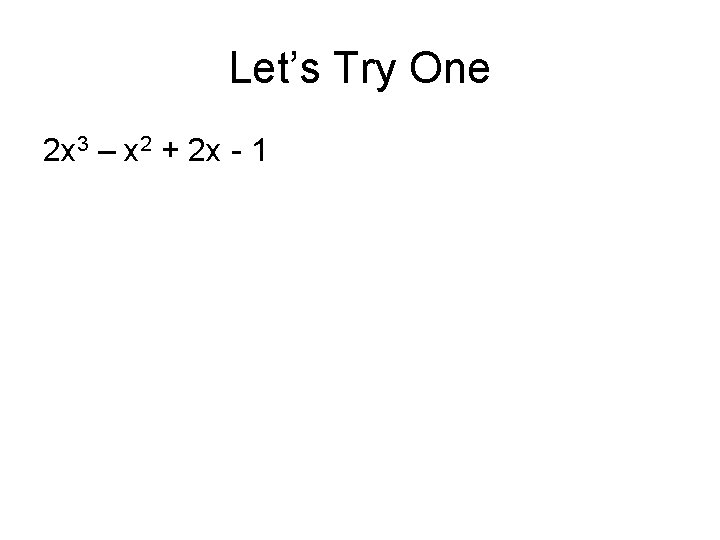
Let’s Try One 2 x 3 – x 2 + 2 x - 1

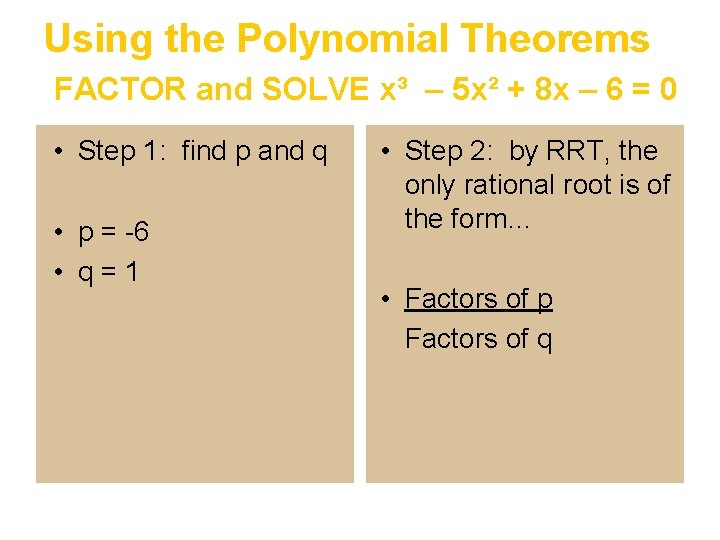
Using the Polynomial Theorems FACTOR and SOLVE x³ – 5 x² + 8 x – 6 = 0 • Step 1: find p and q • p = -6 • q=1 • Step 2: by RRT, the only rational root is of the form… • Factors of p Factors of q
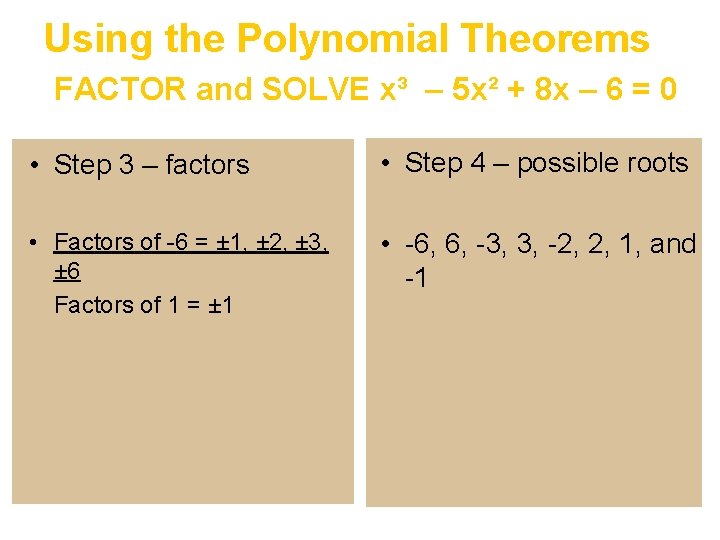
Using the Polynomial Theorems FACTOR and SOLVE x³ – 5 x² + 8 x – 6 = 0 • Step 3 – factors • Step 4 – possible roots • Factors of -6 = ± 1, ± 2, ± 3, ± 6 Factors of 1 = ± 1 • -6, 6, -3, 3, -2, 2, 1, and -1
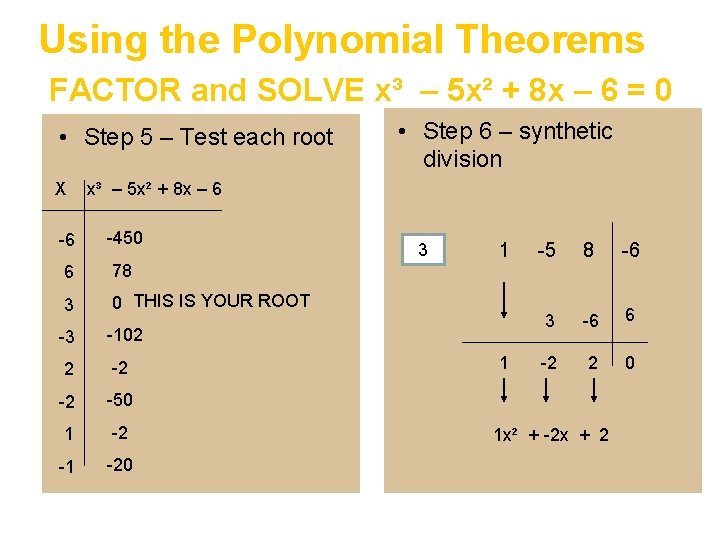
Using the Polynomial Theorems FACTOR and SOLVE x³ – 5 x² + 8 x – 6 = 0 • Step 5 – Test each root X • Step 6 – synthetic division x³ – 5 x² + 8 x – 6 -6 -450 6 78 3 0 THIS IS YOUR ROOT -3 -102 2 -2 -2 -50 1 -2 -1 -20 3 1 1 -5 8 -6 3 -6 6 -2 2 0 1 x² + -2 x + 2
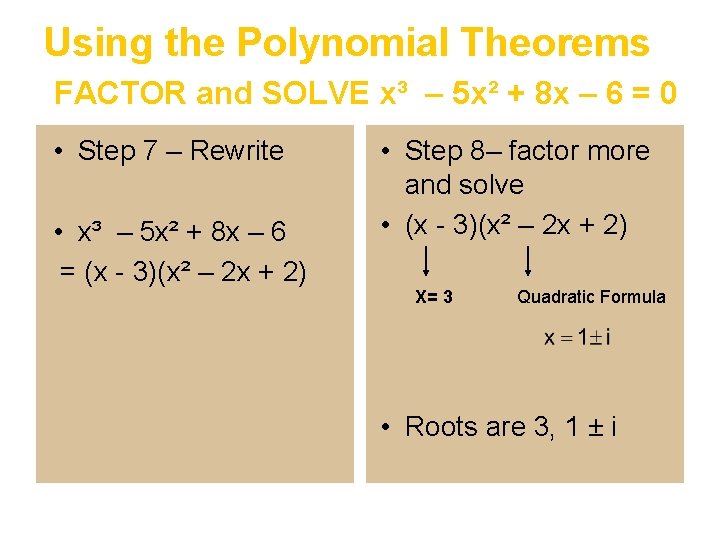
Using the Polynomial Theorems FACTOR and SOLVE x³ – 5 x² + 8 x – 6 = 0 • Step 7 – Rewrite • x³ – 5 x² + 8 x – 6 = (x - 3)(x² – 2 x + 2) • Step 8– factor more and solve • (x - 3)(x² – 2 x + 2) X= 3 Quadratic Formula • Roots are 3, 1 ± i
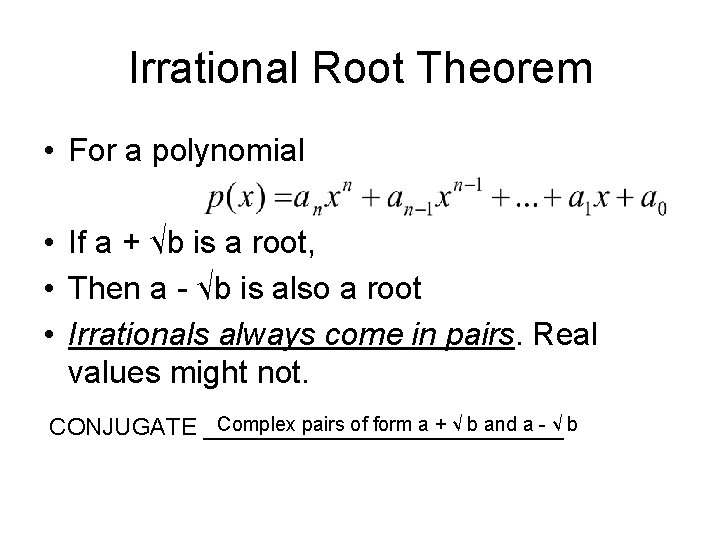
Irrational Root Theorem • For a polynomial • If a + √b is a root, • Then a - √b is also a root • Irrationals always come in pairs. Real values might not. Complex pairs of form a + √ b and a - √ b CONJUGATE ______________
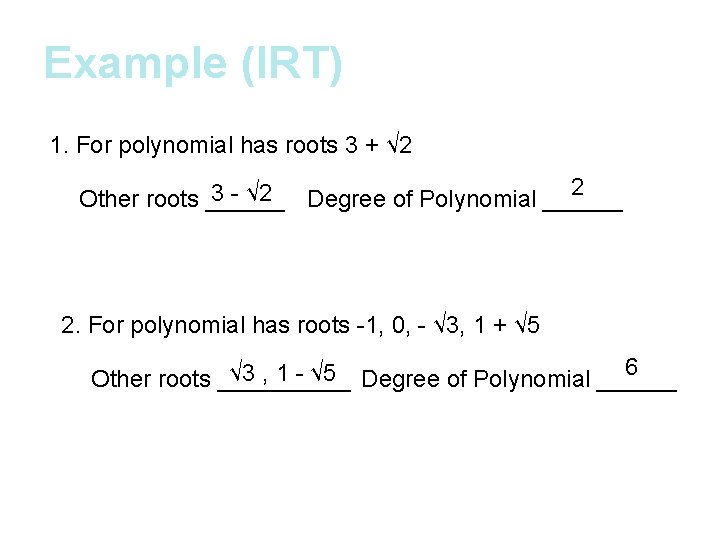
Example (IRT) 1. For polynomial has roots 3 + √ 2 2 3 - √ 2 Degree of Polynomial ______ Other roots ______ 2. For polynomial has roots -1, 0, - √ 3, 1 + √ 5 6 √ 3 , 1 - √ 5 Degree of Polynomial ______ Other roots _____
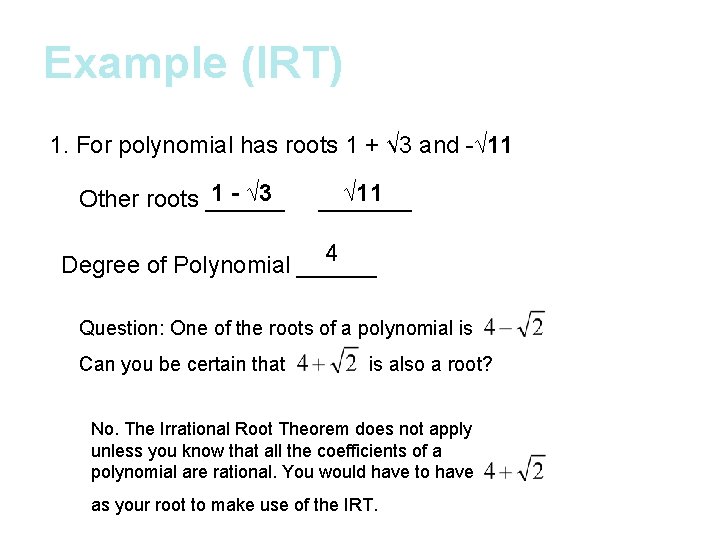
Example (IRT) 1. For polynomial has roots 1 + √ 3 and -√ 11 1 - √ 3 Other roots ______ √ 11 _______ 4 Degree of Polynomial ______ Question: One of the roots of a polynomial is Can you be certain that is also a root? No. The Irrational Root Theorem does not apply unless you know that all the coefficients of a polynomial are rational. You would have to have as your root to make use of the IRT.
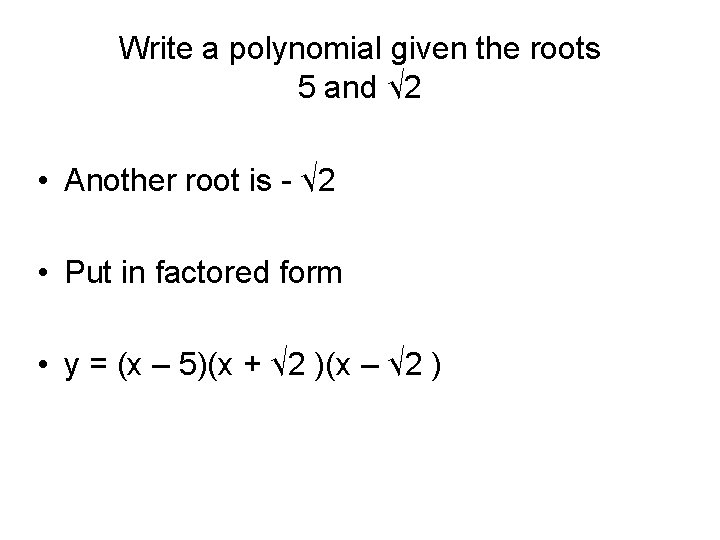
Write a polynomial given the roots 5 and √ 2 • Another root is - √ 2 • Put in factored form • y = (x – 5)(x + √ 2 )(x – √ 2 )
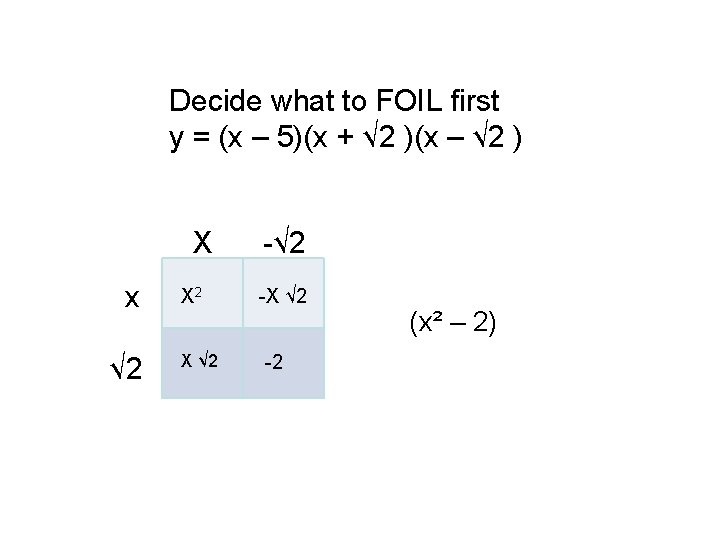
Decide what to FOIL first y = (x – 5)(x + √ 2 )(x – √ 2 ) X x √ 2 X √ 2 -X √ 2 -2 (x² – 2)
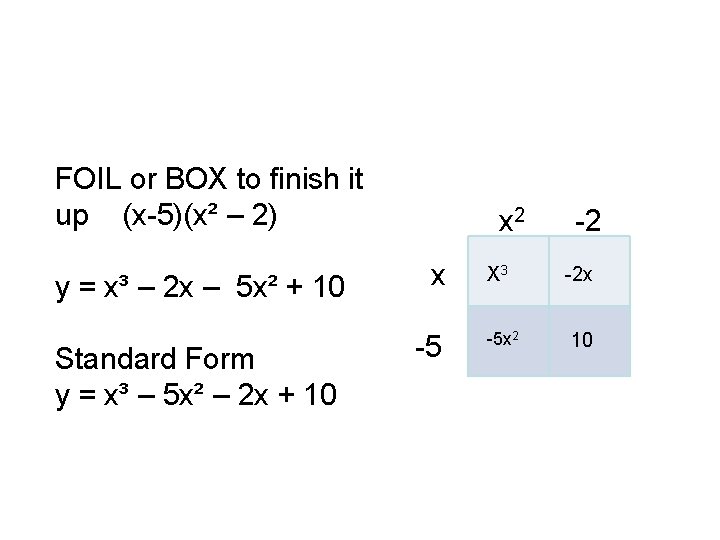
FOIL or BOX to finish it up (x-5)(x² – 2) y = x³ – 2 x – 5 x² + 10 Standard Form y = x³ – 5 x² – 2 x + 10 x 2 x -5 X 3 -5 x 2 -2 -2 x 10
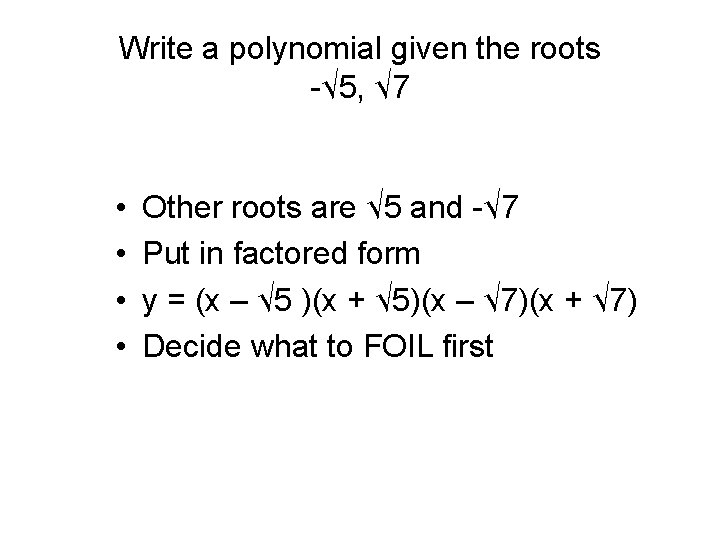
Write a polynomial given the roots -√ 5, √ 7 • • Other roots are √ 5 and -√ 7 Put in factored form y = (x – √ 5 )(x + √ 5)(x – √ 7)(x + √ 7) Decide what to FOIL first
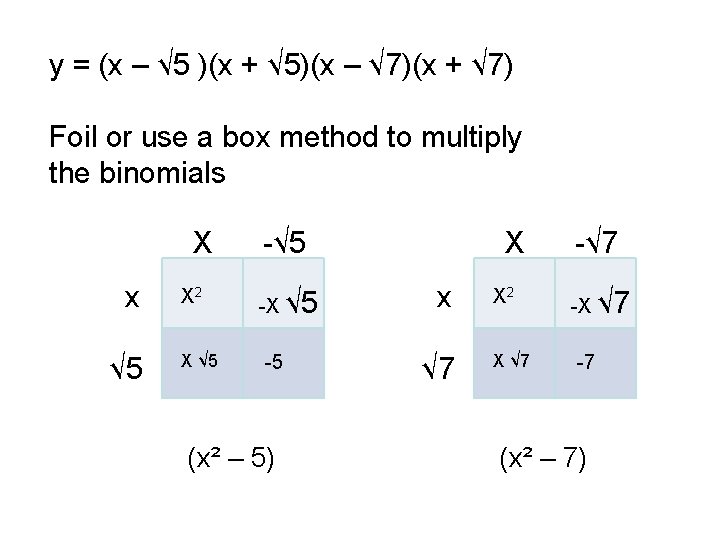
y = (x – √ 5 )(x + √ 5)(x – √ 7)(x + √ 7) Foil or use a box method to multiply the binomials X x √ 5 X 2 X √ 5 -X √ 5 -5 (x² – 5) X x √ 7 X 2 X √ 7 -X √ 7 -7 (x² – 7)
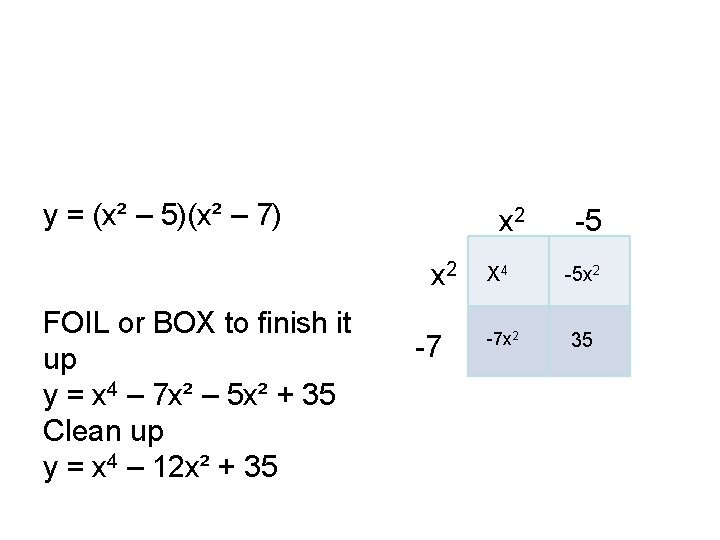
y = (x² – 5)(x² – 7) x 2 FOIL or BOX to finish it up y = x 4 – 7 x² – 5 x² + 35 Clean up y = x 4 – 12 x² + 35 -7 X 4 -7 x 2 -5 -5 x 2 35
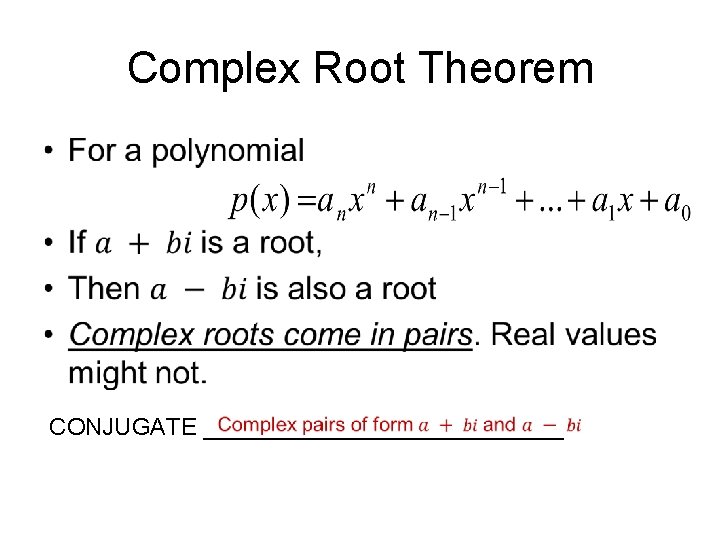
Complex Root Theorem • CONJUGATE ______________
Descartes Rule
- Slides: 38