
Theorem Proving and Model Checking in PVS 15
- Slides: 35
Theorem Proving and Model Checking in PVS 15 -820 A Proving Software with PVS Edmund Clarke Daniel Kroening Carnegie Mellon University 1
Theorem Proving and Model Checking in PVS Outline • Modeling Software with PVS – Complete Example for Sequential Software, including proof – The Magic GRIND – Modularization 2
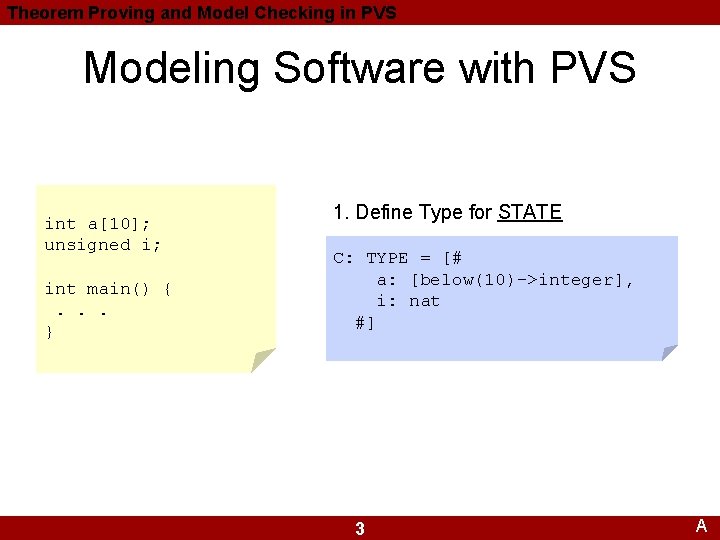
Theorem Proving and Model Checking in PVS Modeling Software with PVS int a[10]; unsigned i; int main() {. . . } 1. Define Type for STATE C: TYPE = [# a: [below(10)->integer], i: nat #] 3 A
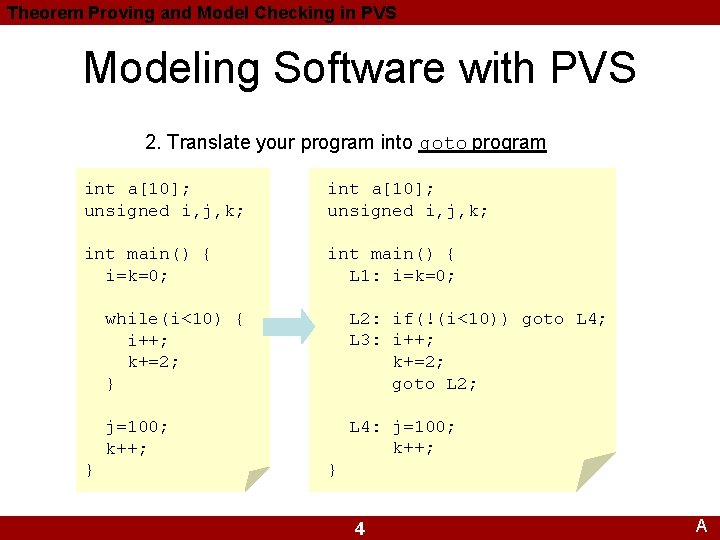
Theorem Proving and Model Checking in PVS Modeling Software with PVS 2. Translate your program into goto program int a[10]; unsigned i, j, k; int main() { i=k=0; int main() { L 1: i=k=0; } while(i<10) { i++; k+=2; } L 2: if(!(i<10)) goto L 4; L 3: i++; k+=2; goto L 2; j=100; k++; L 4: j=100; k++; } 4 A
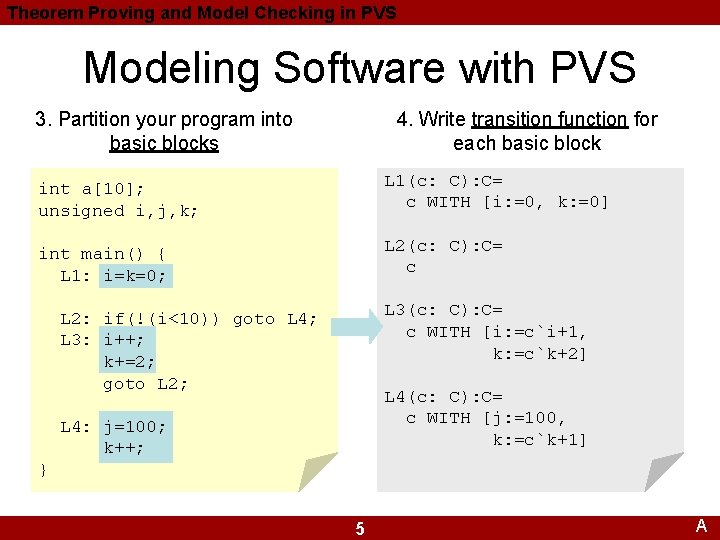
Theorem Proving and Model Checking in PVS Modeling Software with PVS 3. Partition your program into basic blocks 4. Write transition function for each basic block int a[10]; unsigned i, j, k; L 1(c: C): C= c WITH [i: =0, k: =0] int main() { L 1: i=k=0; L 2(c: C): C= c L 3(c: C): C= c WITH [i: =c`i+1, k: =c`k+2] L 2: if(!(i<10)) goto L 4; L 3: i++; k+=2; goto L 2; L 4(c: C): C= c WITH [j: =100, k: =c`k+1] L 4: j=100; k++; } 5 A
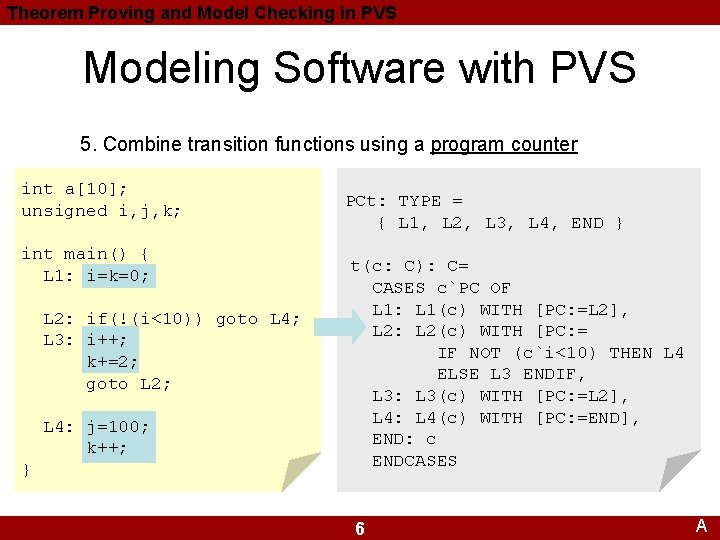
Theorem Proving and Model Checking in PVS Modeling Software with PVS 5. Combine transition functions using a program counter int a[10]; unsigned i, j, k; int main() { L 1: i=k=0; L 2: if(!(i<10)) goto L 4; L 3: i++; k+=2; goto L 2; L 4: j=100; k++; } PCt: TYPE = { L 1, L 2, L 3, L 4, END } t(c: C): C= CASES c`PC OF L 1: L 1(c) WITH [PC: =L 2], L 2: L 2(c) WITH [PC: = IF NOT (c`i<10) THEN L 4 ELSE L 3 ENDIF, L 3: L 3(c) WITH [PC: =L 2], L 4: L 4(c) WITH [PC: =END], END: c ENDCASES 6 A
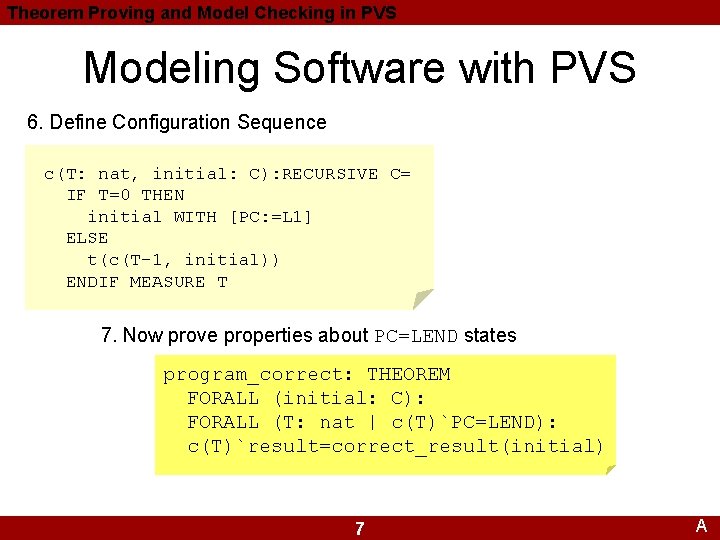
Theorem Proving and Model Checking in PVS Modeling Software with PVS 6. Define Configuration Sequence c(T: nat, initial: C): RECURSIVE C= IF T=0 THEN initial WITH [PC: =L 1] ELSE t(c(T-1, initial)) ENDIF MEASURE T 7. Now prove properties about PC=LEND states program_correct: THEOREM FORALL (initial: C): FORALL (T: nat | c(T)`PC=LEND): c(T)`result=correct_result(initial) 7 A
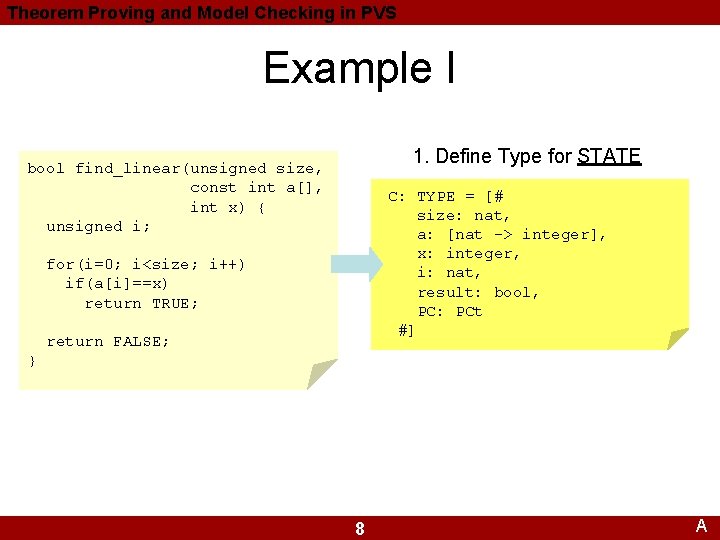
Theorem Proving and Model Checking in PVS Example I 1. Define Type for STATE bool find_linear(unsigned size, const int a[], int x) { unsigned i; C: TYPE = [# size: nat, a: [nat -> integer], x: integer, i: nat, result: bool, PC: PCt #] for(i=0; i<size; i++) if(a[i]==x) return TRUE; return FALSE; } 8 A
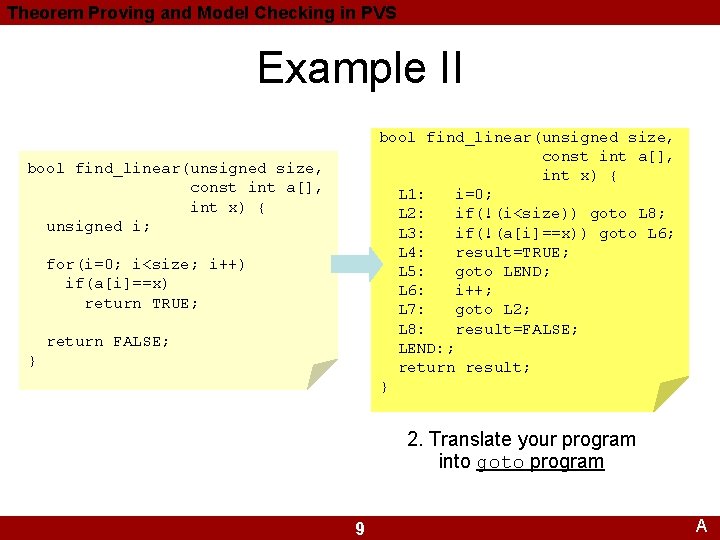
Theorem Proving and Model Checking in PVS Example II bool find_linear(unsigned size, const int a[], int x) { L 1: i=0; L 2: if(!(i<size)) goto L 8; L 3: if(!(a[i]==x)) goto L 6; L 4: result=TRUE; L 5: goto LEND; L 6: i++; L 7: goto L 2; L 8: result=FALSE; LEND: ; return result; } bool find_linear(unsigned size, const int a[], int x) { unsigned i; for(i=0; i<size; i++) if(a[i]==x) return TRUE; return FALSE; } 2. Translate your program into goto program 9 A
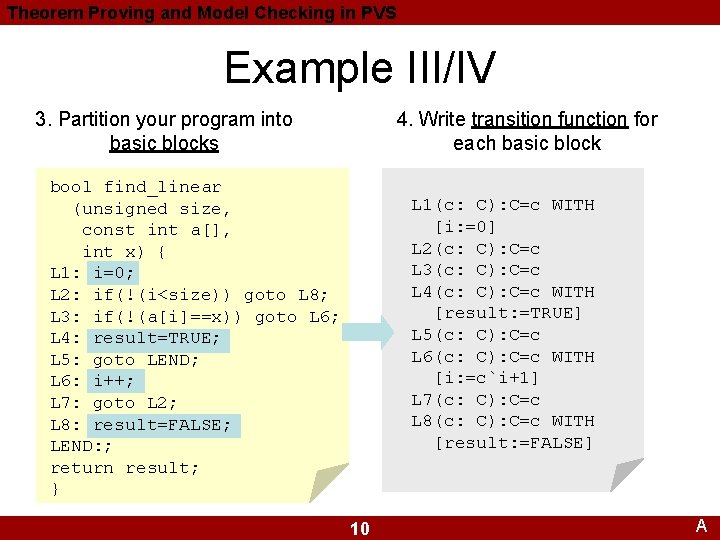
Theorem Proving and Model Checking in PVS Example III/IV 3. Partition your program into basic blocks 4. Write transition function for each basic block bool find_linear (unsigned size, const int a[], int x) { L 1: i=0; L 2: if(!(i<size)) goto L 8; L 3: if(!(a[i]==x)) goto L 6; L 4: result=TRUE; L 5: goto LEND; L 6: i++; L 7: goto L 2; L 8: result=FALSE; LEND: ; return result; } L 1(c: C): C=c WITH [i: =0] L 2(c: C): C=c L 3(c: C): C=c L 4(c: C): C=c WITH [result: =TRUE] L 5(c: C): C=c L 6(c: C): C=c WITH [i: =c`i+1] L 7(c: C): C=c L 8(c: C): C=c WITH [result: =FALSE] 10 A
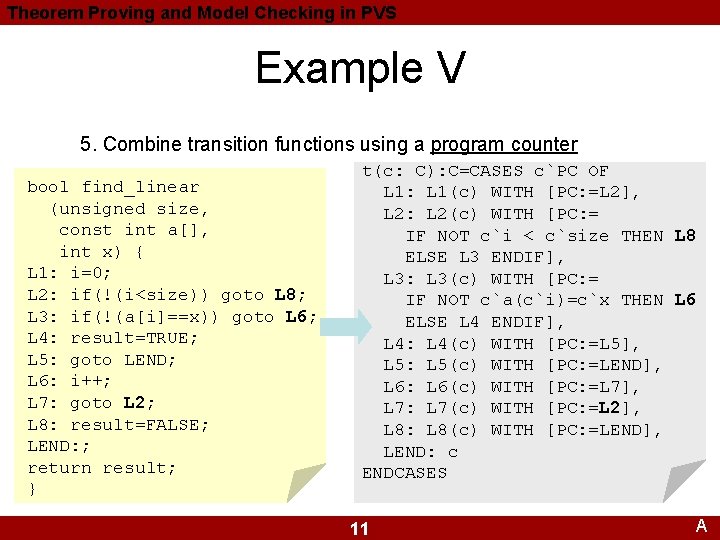
Theorem Proving and Model Checking in PVS Example V 5. Combine transition functions using a program counter bool find_linear (unsigned size, const int a[], int x) { L 1: i=0; L 2: if(!(i<size)) goto L 8; L 3: if(!(a[i]==x)) goto L 6; L 4: result=TRUE; L 5: goto LEND; L 6: i++; L 7: goto L 2; L 8: result=FALSE; LEND: ; return result; } t(c: C): C=CASES c`PC OF L 1: L 1(c) WITH [PC: =L 2], L 2: L 2(c) WITH [PC: = IF NOT c`i < c`size THEN L 8 ELSE L 3 ENDIF], L 3: L 3(c) WITH [PC: = IF NOT c`a(c`i)=c`x THEN L 6 ELSE L 4 ENDIF], L 4: L 4(c) WITH [PC: =L 5], L 5: L 5(c) WITH [PC: =LEND], L 6: L 6(c) WITH [PC: =L 7], L 7: L 7(c) WITH [PC: =L 2], L 8: L 8(c) WITH [PC: =LEND], LEND: c ENDCASES 11 A
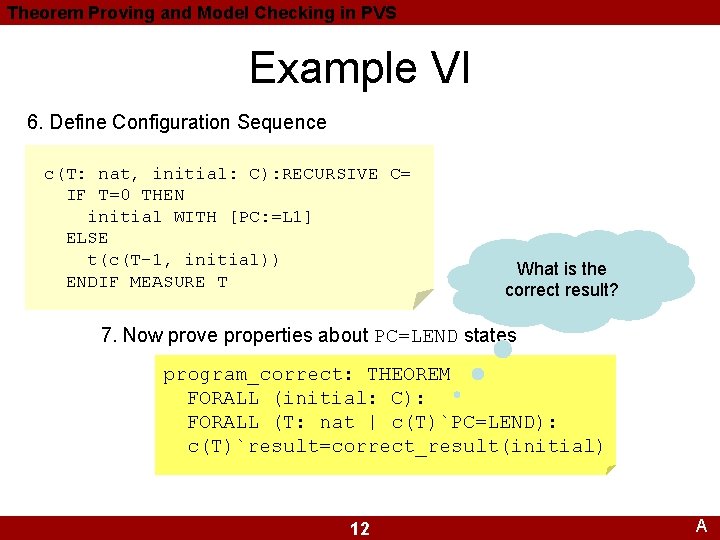
Theorem Proving and Model Checking in PVS Example VI 6. Define Configuration Sequence c(T: nat, initial: C): RECURSIVE C= IF T=0 THEN initial WITH [PC: =L 1] ELSE t(c(T-1, initial)) ENDIF MEASURE T What is the correct result? 7. Now prove properties about PC=LEND states program_correct: THEOREM FORALL (initial: C): FORALL (T: nat | c(T)`PC=LEND): c(T)`result=correct_result(initial) 12 A
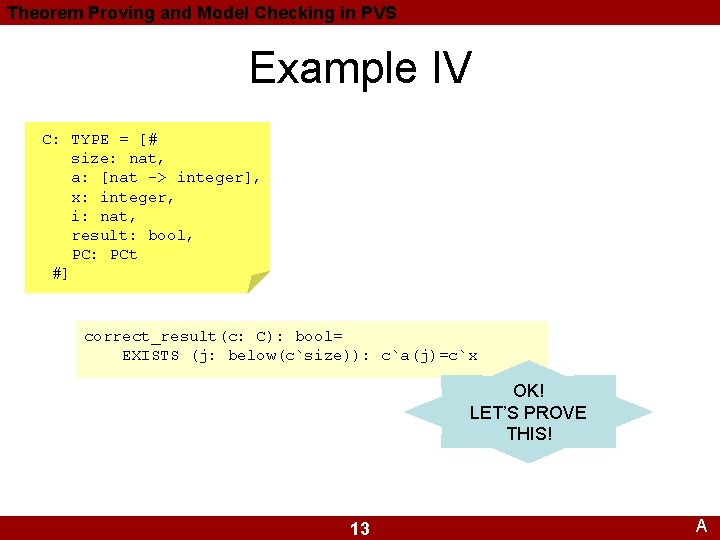
Theorem Proving and Model Checking in PVS Example IV C: TYPE = [# size: nat, a: [nat -> integer], x: integer, i: nat, result: bool, PC: PCt #] correct_result(c: C): bool= EXISTS (j: below(c`size)): c`a(j)=c`x OK! LET’S PROVE THIS! 13 A
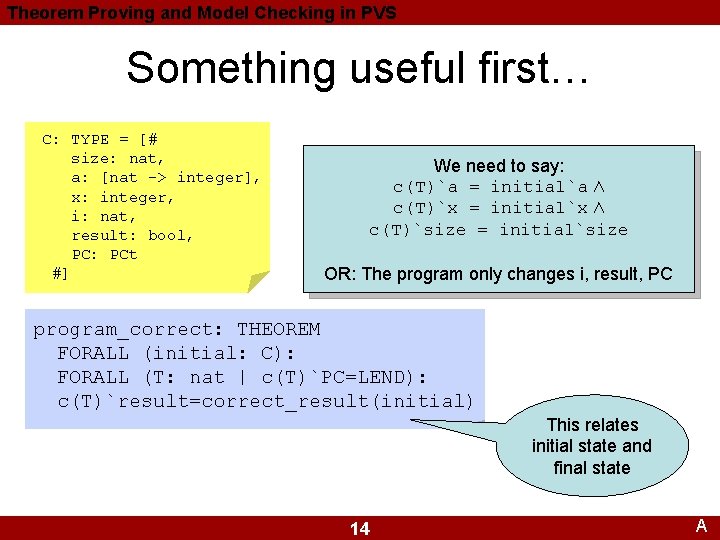
Theorem Proving and Model Checking in PVS Something useful first… C: TYPE = [# size: nat, a: [nat -> integer], x: integer, i: nat, result: bool, PC: PCt #] We need to say: c(T)`a = initial`a Æ c(T)`x = initial`x Æ c(T)`size = initial`size OR: The program only changes i, result, PC program_correct: THEOREM FORALL (initial: C): FORALL (T: nat | c(T)`PC=LEND): c(T)`result=correct_result(initial) This relates initial state and final state 14 A
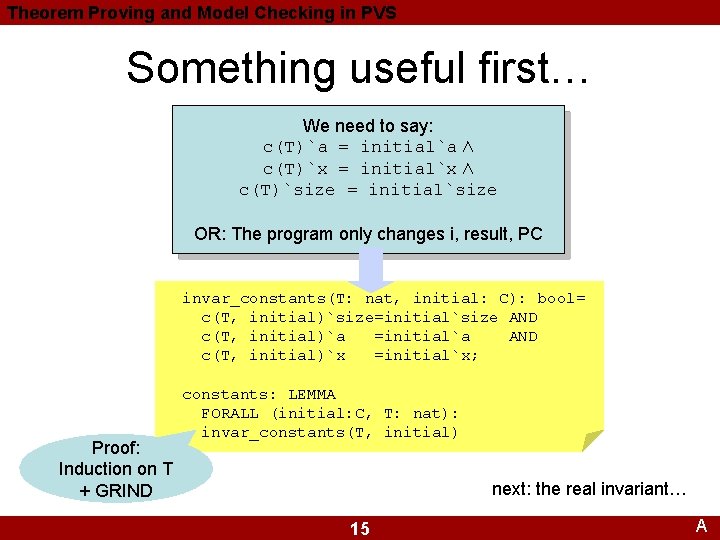
Theorem Proving and Model Checking in PVS Something useful first… We need to say: c(T)`a = initial`a Æ c(T)`x = initial`x Æ c(T)`size = initial`size OR: The program only changes i, result, PC invar_constants(T: nat, initial: C): bool= c(T, initial)`size=initial`size AND c(T, initial)`a =initial`a AND c(T, initial)`x =initial`x; Proof: Induction on T + GRIND constants: LEMMA FORALL (initial: C, T: nat): invar_constants(T, initial) next: the real invariant… 15 A
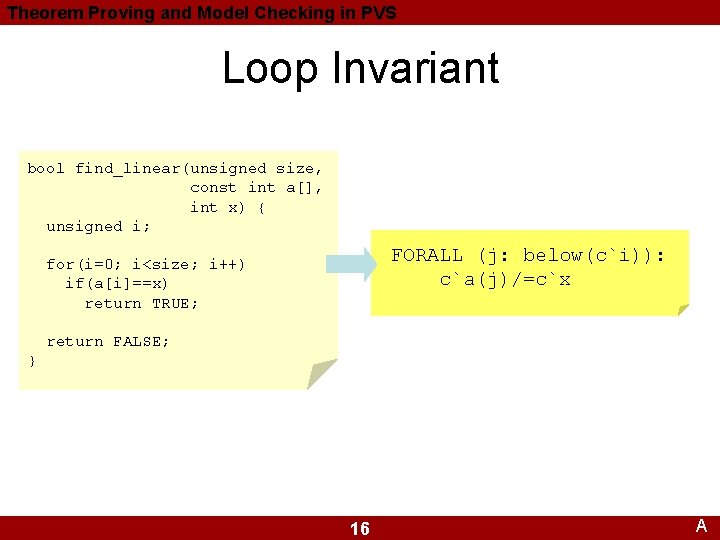
Theorem Proving and Model Checking in PVS Loop Invariant bool find_linear(unsigned size, const int a[], int x) { unsigned i; FORALL (j: below(c`i)): c`a(j)/=c`x for(i=0; i<size; i++) if(a[i]==x) return TRUE; return FALSE; } 16 A
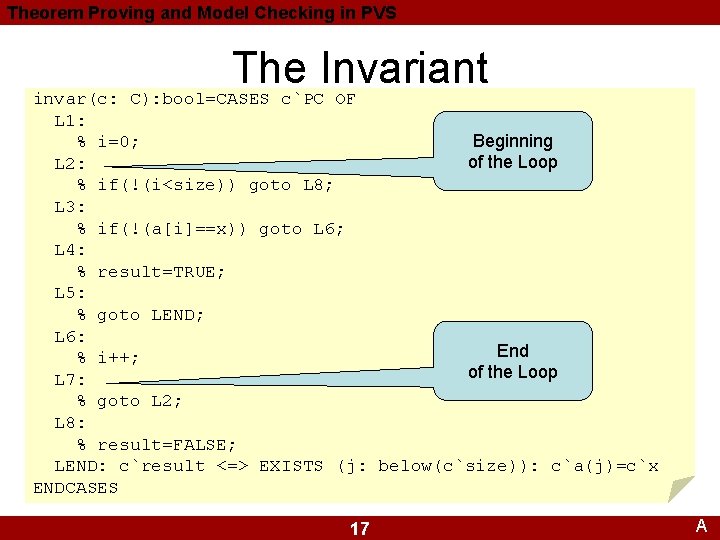
Theorem Proving and Model Checking in PVS The Invariant invar(c: C): bool=CASES c`PC OF L 1: Beginning % i=0; of the Loop L 2: % if(!(i<size)) goto L 8; L 3: % if(!(a[i]==x)) goto L 6; L 4: % result=TRUE; L 5: % goto LEND; L 6: End % i++; of the Loop L 7: % goto L 2; L 8: % result=FALSE; LEND: c`result <=> EXISTS (j: below(c`size)): c`a(j)=c`x ENDCASES 17 A
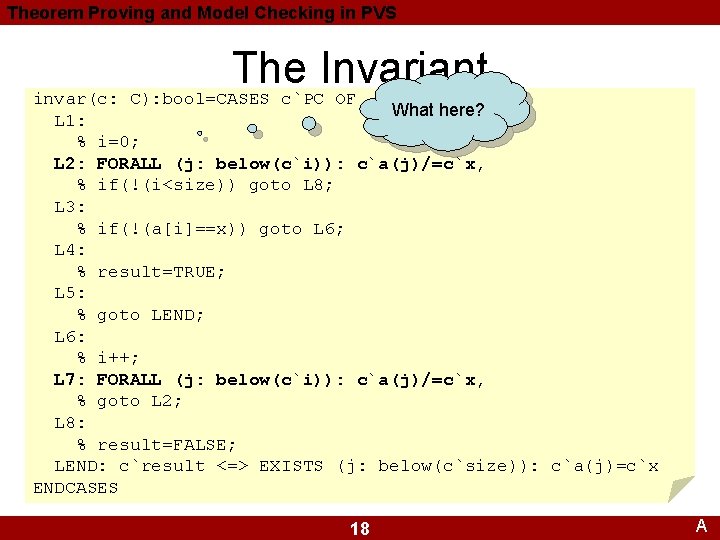
Theorem Proving and Model Checking in PVS The Invariant invar(c: C): bool=CASES c`PC OF What here? L 1: % i=0; L 2: FORALL (j: below(c`i)): c`a(j)/=c`x, % if(!(i<size)) goto L 8; L 3: % if(!(a[i]==x)) goto L 6; L 4: % result=TRUE; L 5: % goto LEND; L 6: % i++; L 7: FORALL (j: below(c`i)): c`a(j)/=c`x, % goto L 2; L 8: % result=FALSE; LEND: c`result <=> EXISTS (j: below(c`size)): c`a(j)=c`x ENDCASES 18 A
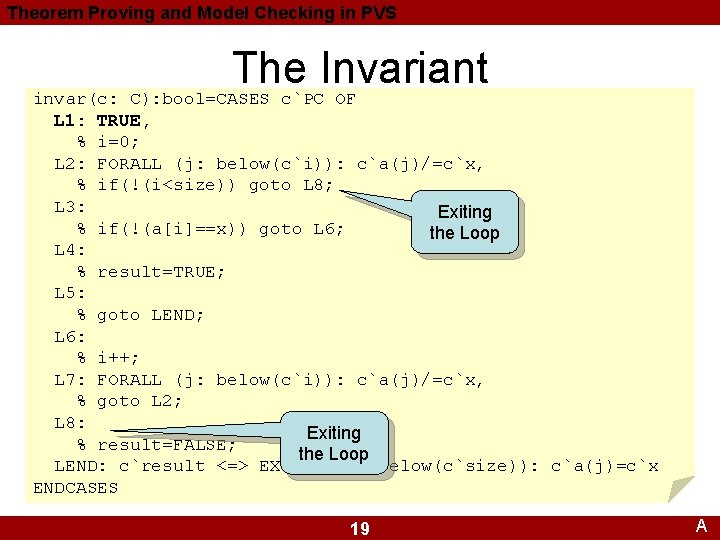
Theorem Proving and Model Checking in PVS The Invariant invar(c: C): bool=CASES c`PC OF L 1: TRUE, % i=0; L 2: FORALL (j: below(c`i)): c`a(j)/=c`x, % if(!(i<size)) goto L 8; L 3: Exiting % if(!(a[i]==x)) goto L 6; the Loop L 4: % result=TRUE; L 5: % goto LEND; L 6: % i++; L 7: FORALL (j: below(c`i)): c`a(j)/=c`x, % goto L 2; L 8: Exiting % result=FALSE; the Loop LEND: c`result <=> EXISTS (j: below(c`size)): c`a(j)=c`x ENDCASES 19 A
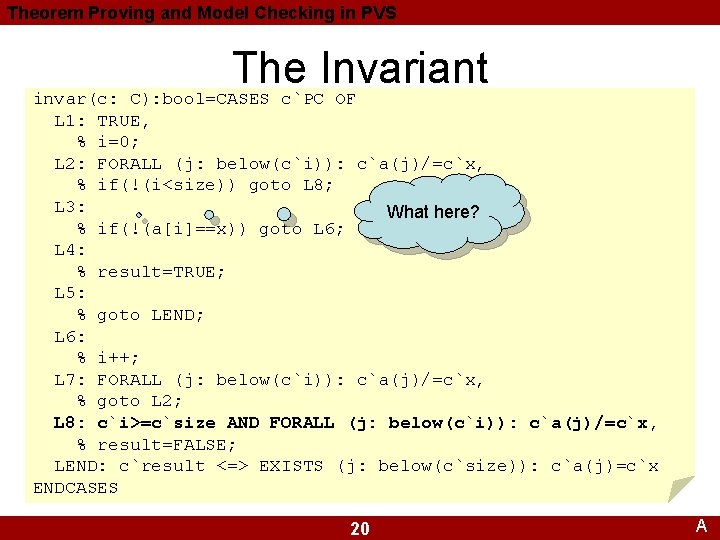
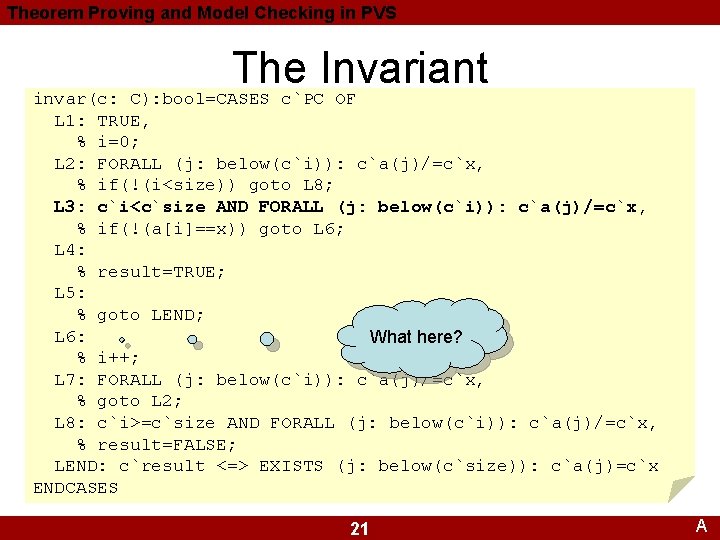
Theorem Proving and Model Checking in PVS The Invariant invar(c: C): bool=CASES c`PC OF L 1: TRUE, % i=0; L 2: FORALL (j: below(c`i)): c`a(j)/=c`x, % if(!(i<size)) goto L 8; L 3: What here? % if(!(a[i]==x)) goto L 6; L 4: % result=TRUE; L 5: % goto LEND; L 6: % i++; L 7: FORALL (j: below(c`i)): c`a(j)/=c`x, % goto L 2; L 8: c`i>=c`size AND FORALL (j: below(c`i)): c`a(j)/=c`x, % result=FALSE; LEND: c`result <=> EXISTS (j: below(c`size)): c`a(j)=c`x ENDCASES 20 A
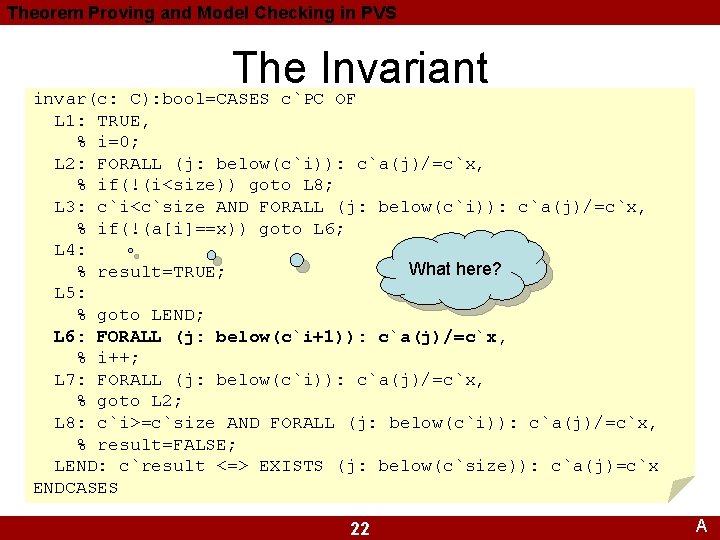
Theorem Proving and Model Checking in PVS The Invariant invar(c: C): bool=CASES c`PC OF L 1: TRUE, % i=0; L 2: FORALL (j: below(c`i)): c`a(j)/=c`x, % if(!(i<size)) goto L 8; L 3: c`i<c`size AND FORALL (j: below(c`i)): c`a(j)/=c`x, % if(!(a[i]==x)) goto L 6; L 4: % result=TRUE; L 5: % goto LEND; L 6: What here? % i++; L 7: FORALL (j: below(c`i)): c`a(j)/=c`x, % goto L 2; L 8: c`i>=c`size AND FORALL (j: below(c`i)): c`a(j)/=c`x, % result=FALSE; LEND: c`result <=> EXISTS (j: below(c`size)): c`a(j)=c`x ENDCASES 21 A
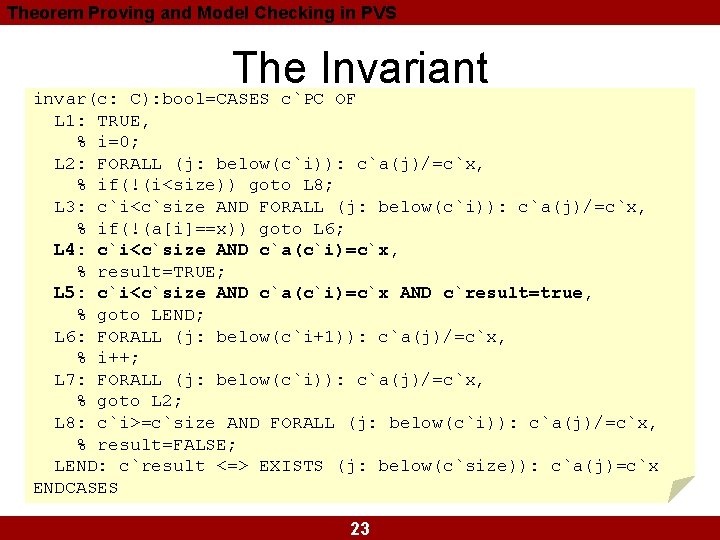
Theorem Proving and Model Checking in PVS The Invariant invar(c: C): bool=CASES c`PC OF L 1: TRUE, % i=0; L 2: FORALL (j: below(c`i)): c`a(j)/=c`x, % if(!(i<size)) goto L 8; L 3: c`i<c`size AND FORALL (j: below(c`i)): c`a(j)/=c`x, % if(!(a[i]==x)) goto L 6; L 4: What here? % result=TRUE; L 5: % goto LEND; L 6: FORALL (j: below(c`i+1)): c`a(j)/=c`x, % i++; L 7: FORALL (j: below(c`i)): c`a(j)/=c`x, % goto L 2; L 8: c`i>=c`size AND FORALL (j: below(c`i)): c`a(j)/=c`x, % result=FALSE; LEND: c`result <=> EXISTS (j: below(c`size)): c`a(j)=c`x ENDCASES 22 A
Theorem Proving and Model Checking in PVS The Invariant invar(c: C): bool=CASES c`PC OF L 1: TRUE, % i=0; L 2: FORALL (j: below(c`i)): c`a(j)/=c`x, % if(!(i<size)) goto L 8; L 3: c`i<c`size AND FORALL (j: below(c`i)): c`a(j)/=c`x, % if(!(a[i]==x)) goto L 6; L 4: c`i<c`size AND c`a(c`i)=c`x, % result=TRUE; L 5: c`i<c`size AND c`a(c`i)=c`x AND c`result=true, % goto LEND; L 6: FORALL (j: below(c`i+1)): c`a(j)/=c`x, % i++; L 7: FORALL (j: below(c`i)): c`a(j)/=c`x, % goto L 2; L 8: c`i>=c`size AND FORALL (j: below(c`i)): c`a(j)/=c`x, % result=FALSE; LEND: c`result <=> EXISTS (j: below(c`size)): c`a(j)=c`x ENDCASES 23
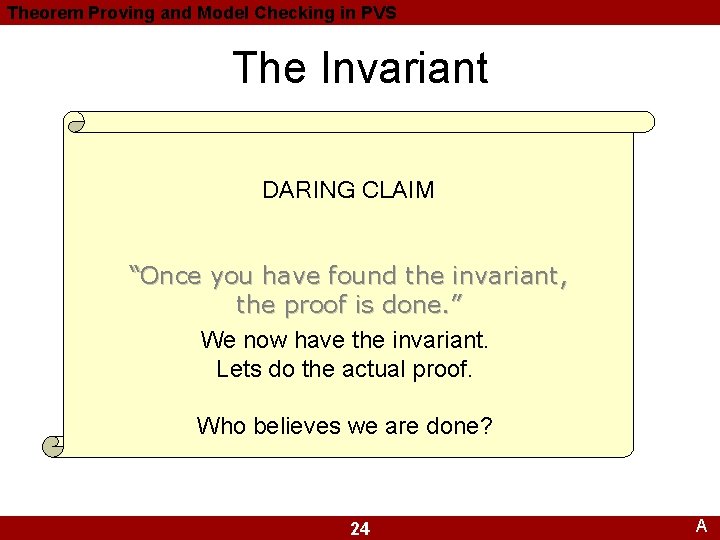
Theorem Proving and Model Checking in PVS The Invariant DARING CLAIM “Once you have found the invariant, the proof is done. ” We now have the invariant. Lets do the actual proof. Who believes we are done? 24 A
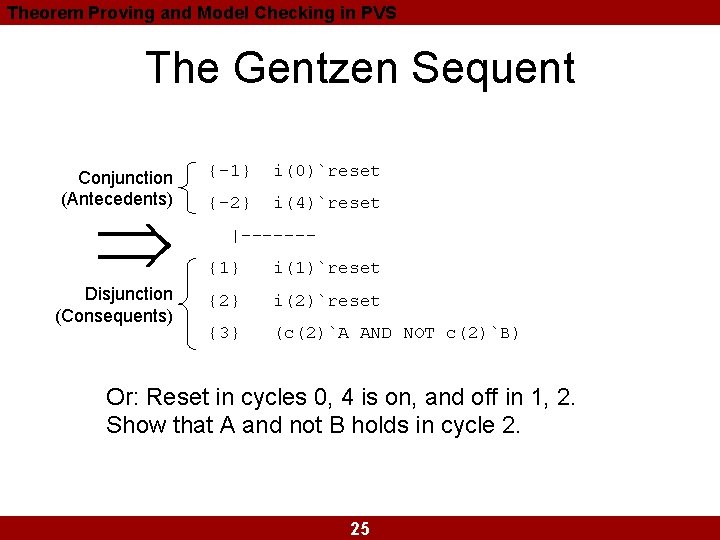
Theorem Proving and Model Checking in PVS The Gentzen Sequent Conjunction (Antecedents) Disjunction (Consequents) {-1} i(0)`reset {-2} i(4)`reset |------{1} i(1)`reset {2} i(2)`reset {3} (c(2)`A AND NOT c(2)`B) Or: Reset in cycles 0, 4 is on, and off in 1, 2. Show that A and not B holds in cycle 2. 25
Theorem Proving and Model Checking in PVS The Magic of (GRIND) • Myth: Grind does it all… • Reality: “. . . frequently used to automatically complete a proof branch…” • Use it when: – Case splitting, skolemization, expansion, and trivial instantiations are left • Does not do induction • Does not apply lemmas 26
Theorem Proving and Model Checking in PVS The Magic of (GRIND) • If it goes wrong… – you can get unprovable subgoals – it might expand recursions forever • How to abort? – Hit Ctrl-C twice, then (restore) • How to make it succeed? – Before running (GRIND), remove unnecessary parts of the sequent using (DELETE fnum). It will prevent that GRIND makes wrong instantiations and expands the wrong definitions. 27
Theorem Proving and Model Checking in PVS NOW LET’S PROVE THE INVARIANT 28
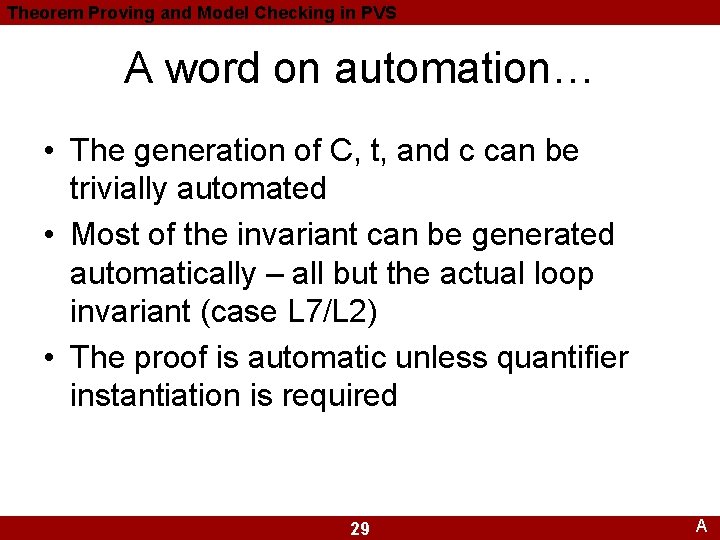
Theorem Proving and Model Checking in PVS A word on automation… • The generation of C, t, and c can be trivially automated • Most of the invariant can be generated automatically – all but the actual loop invariant (case L 7/L 2) • The proof is automatic unless quantifier instantiation is required 29 A
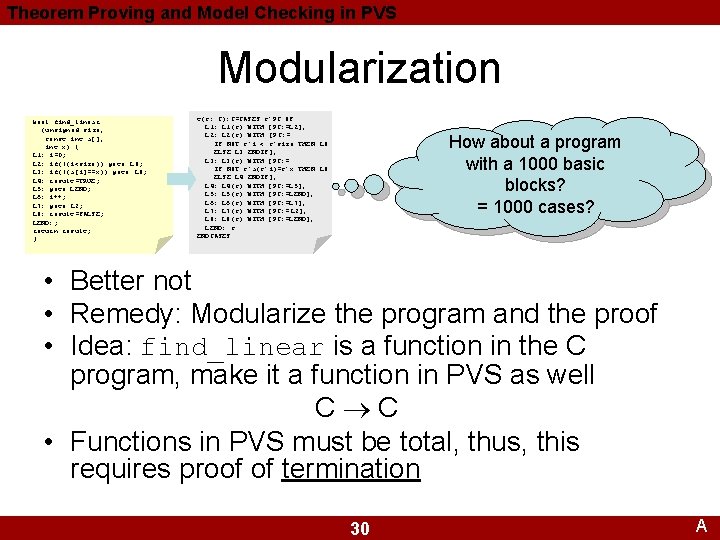
Theorem Proving and Model Checking in PVS Modularization bool find_linear (unsigned size, const int a[], int x) { L 1: i=0; L 2: if(!(i<size)) goto L 8; L 3: if(!(a[i]==x)) goto L 6; L 4: result=TRUE; L 5: goto LEND; L 6: i++; L 7: goto L 2; L 8: result=FALSE; LEND: ; return result; } t(c: C): C=CASES c`PC OF L 1: L 1(c) WITH [PC: =L 2], L 2: L 2(c) WITH [PC: = IF NOT c`i < c`size THEN L 8 ELSE L 3 ENDIF], L 3: L 3(c) WITH [PC: = IF NOT c`a(c`i)=c`x THEN L 6 ELSE L 4 ENDIF], L 4: L 4(c) WITH [PC: =L 5], L 5: L 5(c) WITH [PC: =LEND], L 6: L 6(c) WITH [PC: =L 7], L 7: L 7(c) WITH [PC: = L 2], L 8: L 8(c) WITH [PC: =LEND], LEND: c ENDCASES How about a program with a 1000 basic blocks? = 1000 cases? • Better not • Remedy: Modularize the program and the proof • Idea: find_linear is a function in the C program, make it a function in PVS as well C C • Functions in PVS must be total, thus, this requires proof of termination 30 A
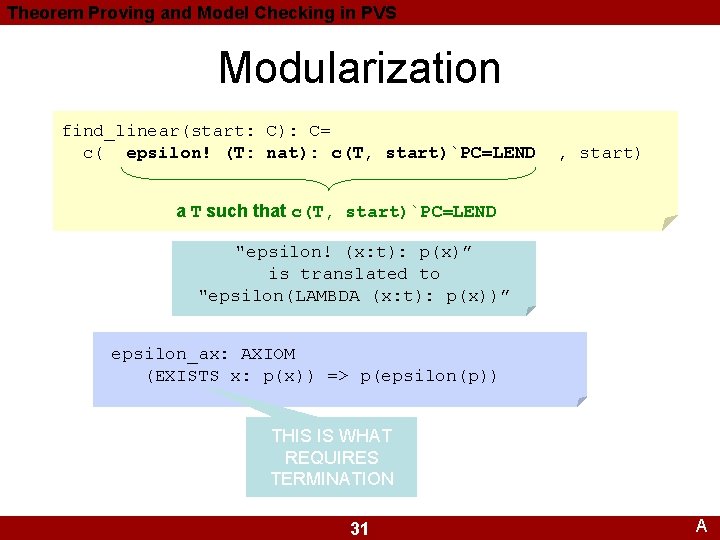
Theorem Proving and Model Checking in PVS Modularization find_linear(start: C): C= c( epsilon! (T: nat): c(T, start)`PC=LEND , start) a T such that c(T, start)`PC=LEND "epsilon! (x: t): p(x)” is translated to "epsilon(LAMBDA (x: t): p(x))” epsilon_ax: AXIOM (EXISTS x: p(x)) => p(epsilon(p)) THIS IS WHAT REQUIRES TERMINATION 31 A
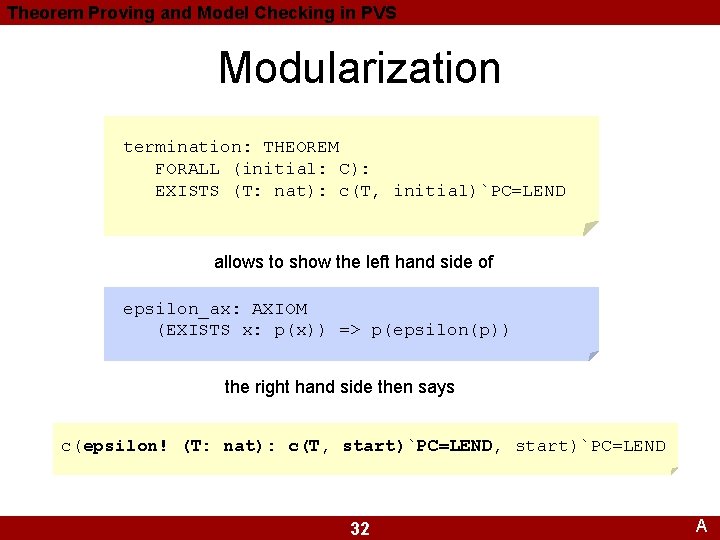
Theorem Proving and Model Checking in PVS Modularization termination: THEOREM FORALL (initial: C): EXISTS (T: nat): c(T, initial)`PC=LEND allows to show the left hand side of epsilon_ax: AXIOM (EXISTS x: p(x)) => p(epsilon(p)) the right hand side then says c(epsilon! (T: nat): c(T, start)`PC=LEND 32 A
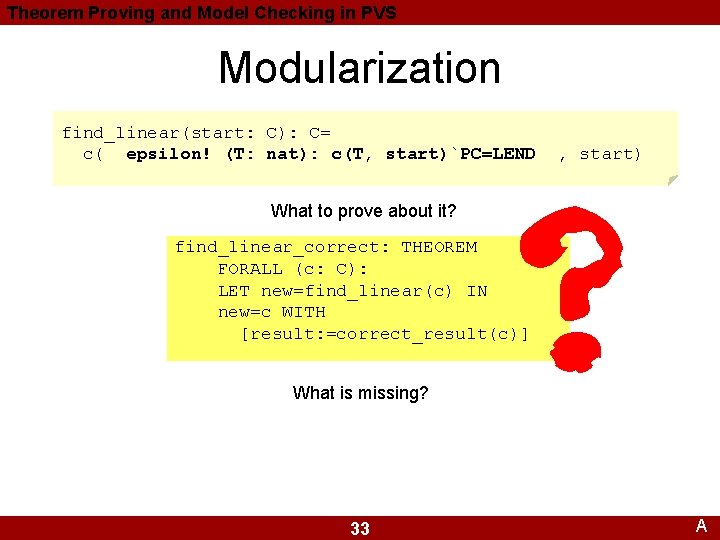
Theorem Proving and Model Checking in PVS Modularization find_linear(start: C): C= c( epsilon! (T: nat): c(T, start)`PC=LEND What to prove about it? , start) ? find_linear_correct: THEOREM FORALL (c: C): LET new=find_linear(c) IN new=c WITH [result: =correct_result(c)] What is missing? 33 A
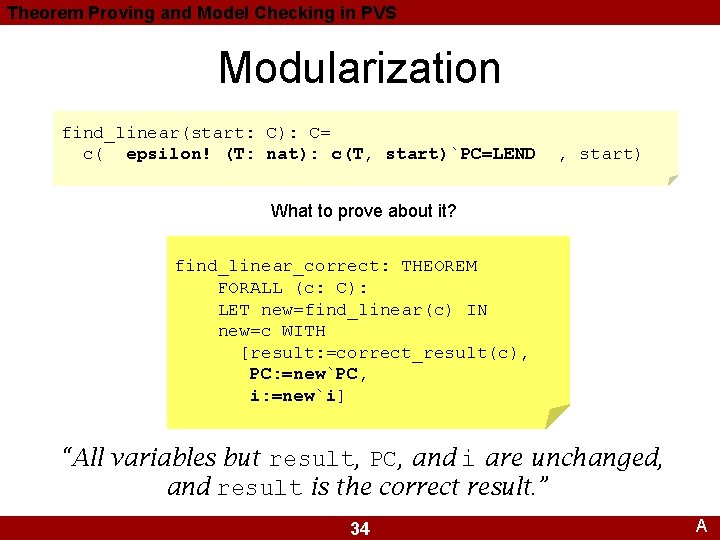
Theorem Proving and Model Checking in PVS Modularization find_linear(start: C): C= c( epsilon! (T: nat): c(T, start)`PC=LEND , start) What to prove about it? find_linear_correct: THEOREM FORALL (c: C): LET new=find_linear(c) IN new=c WITH [result: =correct_result(c), PC: =new`PC, i: =new`i] “All variables but result, PC, and i are unchanged, and result is the correct result. ” 34 A
Theorem Proving and Model Checking in PVS NOW LET’S PROVE THEOREM 35