
Theology in Context 1 Scripture or Tradition Making

- Slides: 29
Theology in Context 1: Scripture or Tradition? Making Christian Identity
Today’s Session n n Set up the context of weeks 7 -12 ‘Theology in Context’ Discuss how we know what Christian identity is Explore the issue of the making of Christian identity Read texts and discuss issues related to being a Christian in the early centuries CE Discuss the role of the development of scripture and tradition in creating the Christian community
Contexts n All theology takes place in context: Its definition (language, philosophy) n Its creation (culture, politics, society) n Its interpretation (theology, power) n Its continuation (external and internal pressures) n Many impulses on context: culture, politics, economics, philosophy, sociology, theology…. n
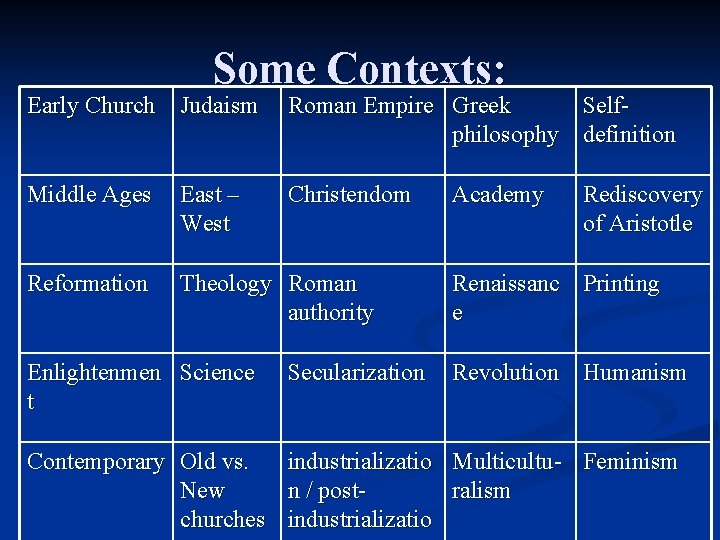
Some Contexts: Early Church Judaism Roman Empire Greek Selfphilosophy definition Middle Ages East – West Christendom Reformation Theology Roman authority Enlightenmen Science t Secularization Academy Rediscovery of Aristotle Renaissanc Printing e Revolution Humanism Contemporary Old vs. industrializatio Multicultu- Feminism New n / postralism churches industrializatio
What does this mean? n What are theological statements/ doctrines: Sui generis religious categories? n Culturally conditioned interpretations? n Beliefs prescribed by tradition? n Malleable beliefs open to fresh definition? n n Is this a question we can/ should answer?
What is a Christian/ Christianity? n How do we know what is meant by the Christian Church? n How do we distinguish Christianity and Judaism? n How do we identify orthodox Christian belief?
The Earliest Christians n (Some) Contexts: The Christian Development from Judaism n Christian apologetics in the Greco-Roman World n Christian self-identity n Internal Christian disputes n
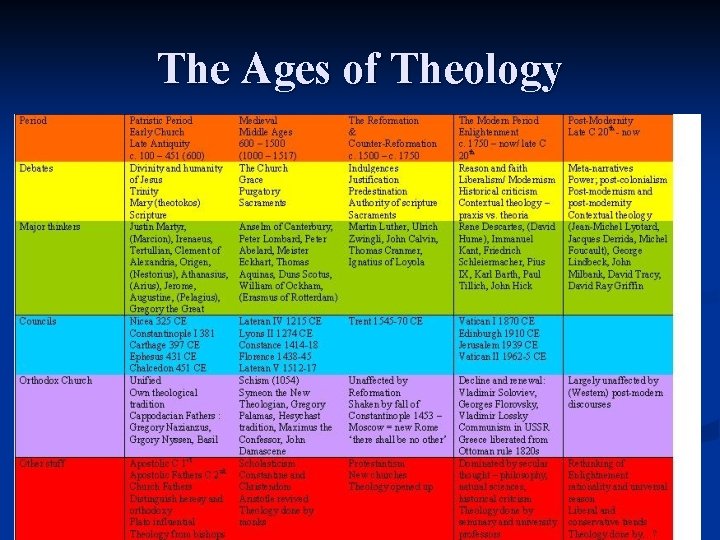
The Ages of Theology
Judaism n From C 1 st into 2 nd ( or later) became separate n n Jesus was a Jew His disciples were Jews n n But: n Mission to Gentiles n n Go to synagogues first An inclusive Judaism? See Jesus as divine/ Messiah/ soteriologically significant Politics: against Jewish revolts n n n These facts were forgotten for around 1800 years! 66 -70 CE revolt: Temple destroyed 132 -135 CE Bar Kochbah Revolt: Jerusalem destroyed Pelikan: n n n C 1 st Christians: Jesus = Messiah = obvious C 2 nd Christians: Jesus = Messiah = embarrassment C 3 rd Christians: Jesus = Messiah = obscure
Apologetics n Define, defend and explain the church to an alien world Christianity misunderstood: see quote 2 n Christianity seen as absurd: see quote 6 n Use (high-brow) Greek philosophy to explain n Seek forms that make it acceptable/ plausible n
Was Jesus God? n In early Church various views: He was the Messiah, but human n He was human, but adopted as God’s Son n He was the Logos – first born of creation, who became human n He was a divine emanation, who appeared on earth in a spiritual body n He was God n He was a spiritual being whose earthly appearance was illusionary n
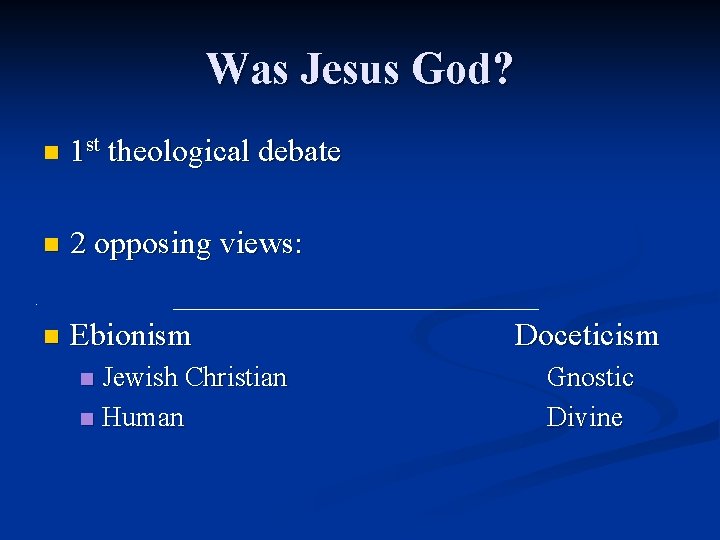
Was Jesus God? n 1 st theological debate n 2 opposing views: n Ebionism Jewish Christian n Human n Doceticism Gnostic Divine
Problems of Terminology n Ways we speak about ‘Gnosticism’: “…Gnosticism appeared very similar to Christianity…. ” n “… Gnostic writers has a tendency to interpret New Testament passages in a manner which dismayed Christian leaders…. ” n n Mc. Grath, Historical Theology, p. 29 n Why is this a problem? Gnosticism had no separate existence from Christianity n It was not a distinct sect, but a way of interpreting Christianity n Orthodox belief is also a way of interpreting Christianity n
Arguments against Gnosticism/ Doceticism See Ignatius of Antioch on Doceticism n See Irenaeus on Gnosticism in Christology n
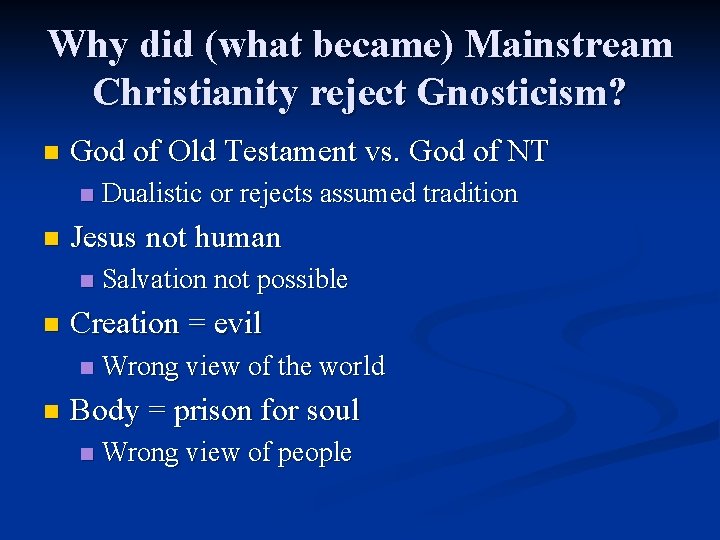
Why did (what became) Mainstream Christianity reject Gnosticism? n God of Old Testament vs. God of NT n n Jesus not human n n Salvation not possible Creation = evil n n Dualistic or rejects assumed tradition Wrong view of the world Body = prison for soul n Wrong view of people
Heresy and Orthodoxy n A new matter of concern n See heresy sheet and the following:
What is heresy 1? n Meaning: n "heresy" (Greek αἵρεσις, hairesis) n to choose = n choice of beliefs or n faction of believers. n Popularized: n Irenaeus Against Heresies (Contra Haereses) n contrasted with orthodoxy n (ortho- "right" + doxa "thinking")
What is heresy 2? n In traditional Christian understanding: n Orthodoxy has always existed n Taught by Apostles n “One Church, One Faith, One Lord” n That believed: everywhere; always; by all n Heresy is deviation from this n Amendments to original faith
What is heresy 3? n However: n Historical research shows: n The early church had a diversity of beliefs n The definition of orthodoxy changed from generation to generation n One generation’s orthodoxy was heresy to the next n Probably no notion of heresy in early church – c. C 150 CE
What is heresy 4? n Another way to view it: n Orthodoxy is the culmination of the church’s attempts to understand Jesus n Heresies are ‘failures’ within this quest (of faith seeking understanding)
What is heresy 5? n Problems: n Who decides/ knows when ‘orthodoxy’ is reached? n How do we identify failure? n Why ‘orthodoxy’ over ‘orthopraxy’? n Is it the question that the most powerful group at the end are right? n Many heretical groups associated with marginalized groups n i. e. Donatists = indigenous North Africans vs. ‘Orthodox’ = Roman settlers
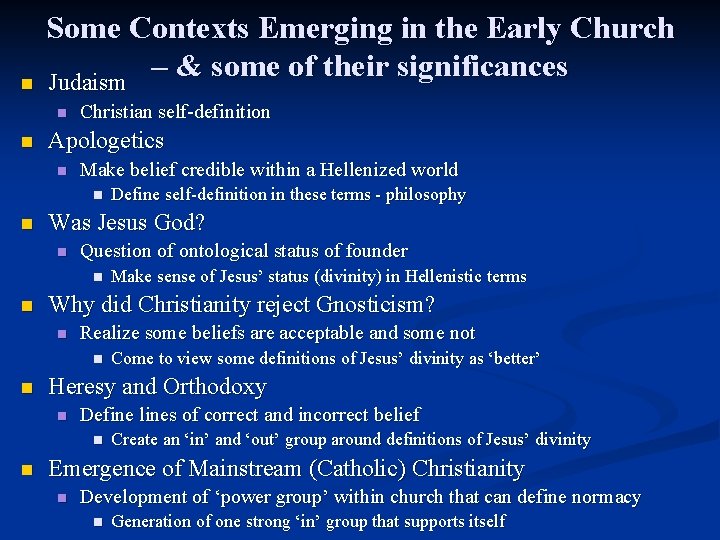
n Some Contexts Emerging in the Early Church – & some of their significances Judaism n n Christian self-definition Apologetics n Make belief credible within a Hellenized world n n Was Jesus God? n Question of ontological status of founder n n Realize some beliefs are acceptable and some not n Come to view some definitions of Jesus’ divinity as ‘better’ Heresy and Orthodoxy n Define lines of correct and incorrect belief n n Make sense of Jesus’ status (divinity) in Hellenistic terms Why did Christianity reject Gnosticism? n n Define self-definition in these terms - philosophy Create an ‘in’ and ‘out’ group around definitions of Jesus’ divinity Emergence of Mainstream (Catholic) Christianity n Development of ‘power group’ within church that can define normacy n Generation of one strong ‘in’ group that supports itself
Seminar n Brief introductions to: Tradition n Scripture n Readings n Discussion n
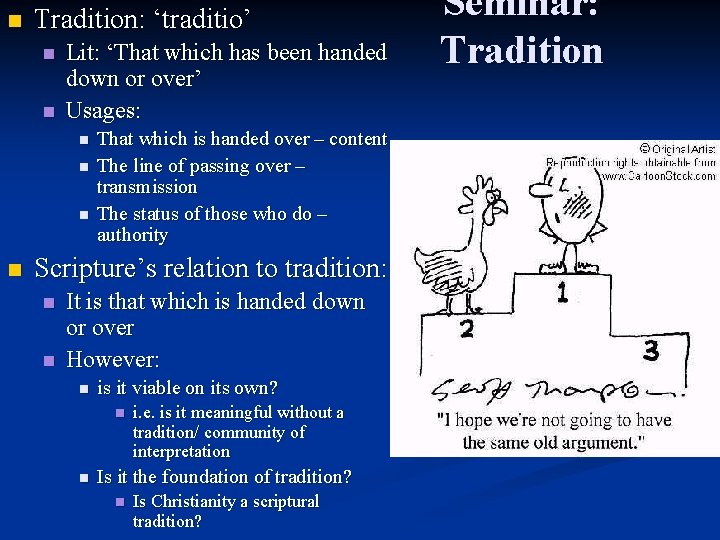
n Tradition: ‘traditio’ n n Lit: ‘That which has been handed down or over’ Usages: n n That which is handed over – content The line of passing over – transmission The status of those who do – authority Scripture’s relation to tradition: n n It is that which is handed down or over However: n is it viable on its own? n n i. e. is it meaningful without a tradition/ community of interpretation Is it the foundation of tradition? n Is Christianity a scriptural tradition? Seminar: Tradition
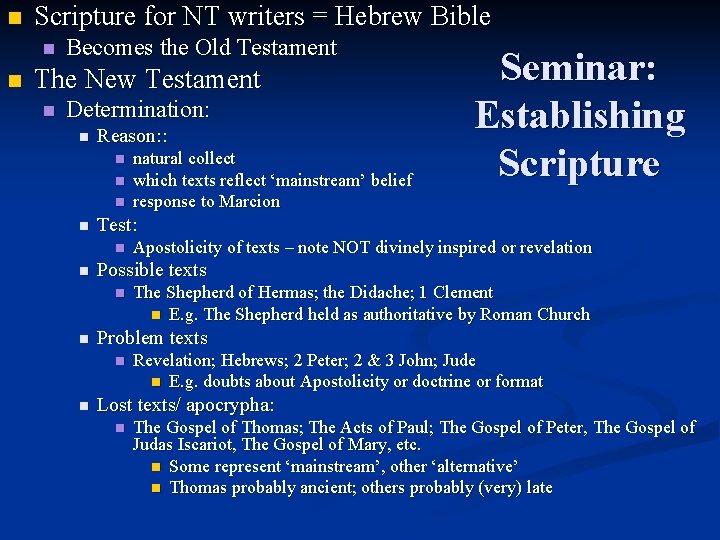
n Scripture for NT writers = Hebrew Bible n n Becomes the Old Testament The New Testament n Determination: n Reason: : n n Test: n n The Shepherd of Hermas; the Didache; 1 Clement n E. g. The Shepherd held as authoritative by Roman Church Problem texts n n Apostolicity of texts – note NOT divinely inspired or revelation Possible texts n n natural collect which texts reflect ‘mainstream’ belief response to Marcion Seminar: Establishing Scripture Revelation; Hebrews; 2 Peter; 2 & 3 John; Jude n E. g. doubts about Apostolicity or doctrine or format Lost texts/ apocrypha: n The Gospel of Thomas; The Acts of Paul; The Gospel of Peter, The Gospel of Judas Iscariot, The Gospel of Mary, etc. n Some represent ‘mainstream’, other ‘alternative’ n Thomas probably ancient; others probably (very) late
Seminar: Readings Irenaeus on the Role of Tradition n Tertullian on Tradition and Apostolic Succession n
Seminar: Living Voice n “living voice” n n Ancient usage, e. g. Galen (c 129 – c 200 CE), Pliny the Younger (c. 63 -113), Seneca (c 4 BCE – 65 CE) = require information first hand, not from books or tradition (approved of) Gnostics refer to “living voice” in this way: n Problems: n How to control – can anyone claim this? n Inspiration – Holy Spirit n ‘mainstream’ part of church veers to tradition
Seminar: Discussion n n Does the Church seem ‘correct’ in its rejection of its Gnostic wing? Is tradition an interpretation of a (given) scripture or is scripture simply the first layer of tradition? n n i. e. is scripture the creation of the tradition, and, if so, what are the implications of this for Christianity today? Does the answer given by Irenaeus and Tertullian seem reasonable? Does a public succession or lineage trump other interpretations? n However, consider, we know the ‘orthodox’ lineage because they won, but Gnostics had massive followings in the early church and had lineages of teachers, with many bishops being Gnostics. Is this an infallible way to ensure
What you may have learnt today? n The importance of context n n All debates take place within a (historical) situation Early Church Contexts n The events which effected the making of Christian identity n The break/ evolution from Judaism n The need to relate to the Greco-Roman world n The Gnosticism Controversy – the fact that, for various reasons, this was considered unacceptable n Heresy and Orthodoxy – Gnosticism made the church think in these terms n Very unusual – most faith traditions stress orthopraxy over orthodoxy n The debates on Scripture and Tradition – the way they were