
THEMIS multispacecraft observations of a 3 D magnetic
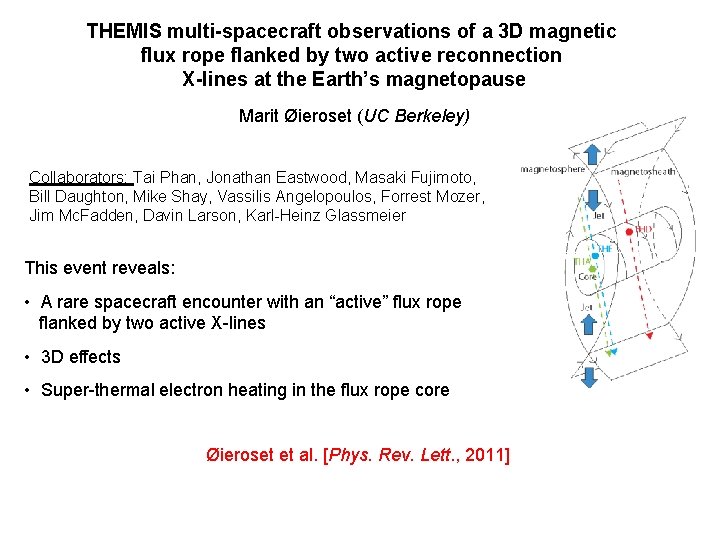
THEMIS multi-spacecraft observations of a 3 D magnetic flux rope flanked by two active reconnection X-lines at the Earth’s magnetopause Marit Øieroset (UC Berkeley) Collaborators: Tai Phan, Jonathan Eastwood, Masaki Fujimoto, Bill Daughton, Mike Shay, Vassilis Angelopoulos, Forrest Mozer, Jim Mc. Fadden, Davin Larson, Karl-Heinz Glassmeier This event reveals: • A rare spacecraft encounter with an “active” flux rope flanked by two active X-lines • 3 D effects • Super-thermal electron heating in the flux rope core Øieroset et al. [Phys. Rev. Lett. , 2011]
Outline 1. Theoretical predictions of reconnection-generated flux ropes: 2 D versus 3 D 2. THEMIS multi-spacecraft observations of an active 3 D flux rope
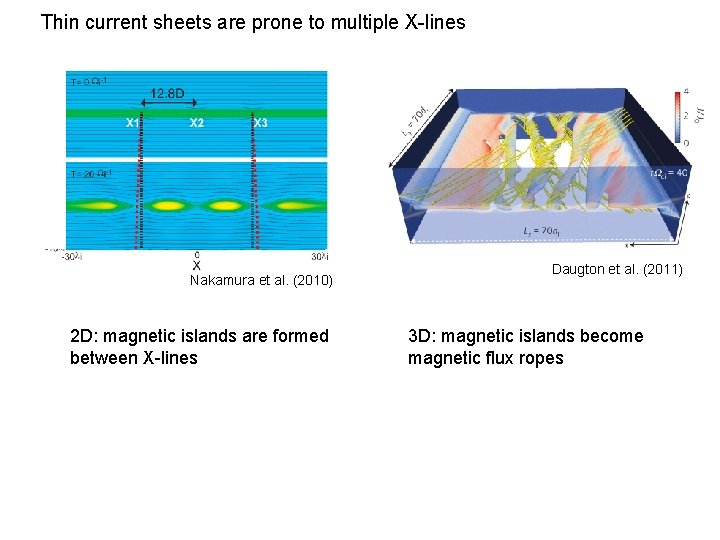
Thin current sheets are prone to multiple X-lines Nakamura et al. (2010) 2 D: magnetic islands are formed between X-lines Daugton et al. (2011) 3 D: magnetic islands become magnetic flux ropes
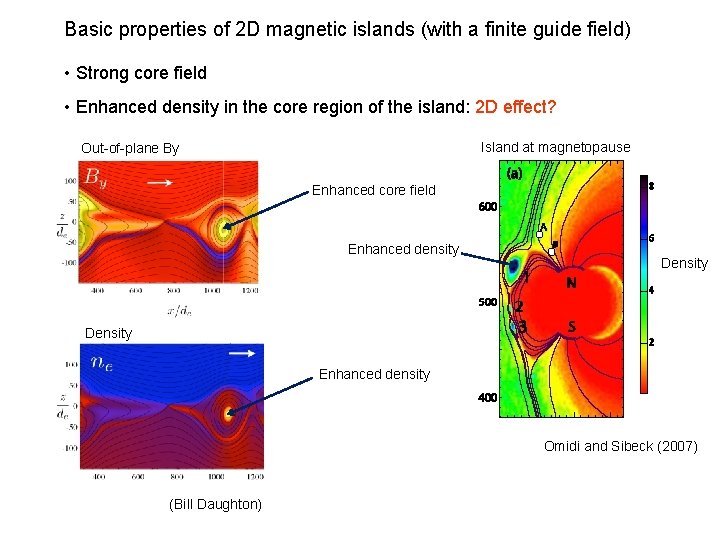
Basic properties of 2 D magnetic islands (with a finite guide field) • Strong core field • Enhanced density in the core region of the island: 2 D effect? Island at magnetopause Out-of-plane By Enhanced core field Enhanced density Density Enhanced density Omidi and Sibeck (2007) (Bill Daughton)
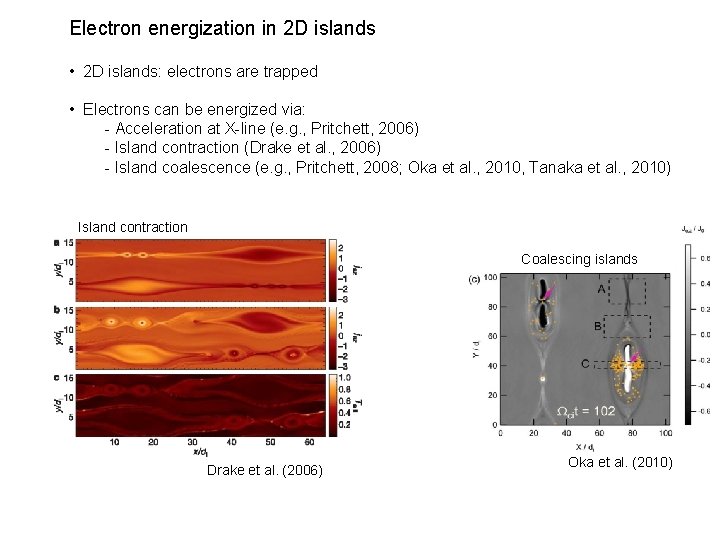
Electron energization in 2 D islands • 2 D islands: electrons are trapped • Electrons can be energized via: - Acceleration at X-line (e. g. , Pritchett, 2006) - Island contraction (Drake et al. , 2006) - Island coalescence (e. g. , Pritchett, 2008; Oka et al. , 2010, Tanaka et al. , 2010) Island contraction Coalescing islands Drake et al. (2006) Oka et al. (2010)
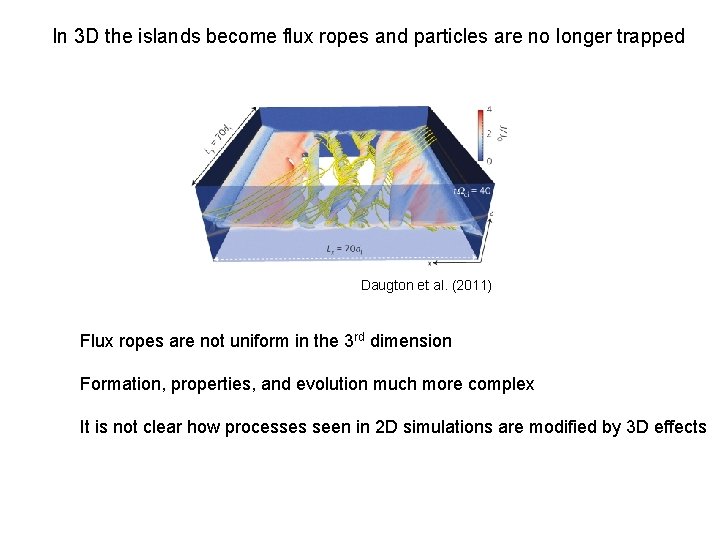
In 3 D the islands become flux ropes and particles are no longer trapped Daugton et al. (2011) Flux ropes are not uniform in the 3 rd dimension Formation, properties, and evolution much more complex It is not clear how processes seen in 2 D simulations are modified by 3 D effects
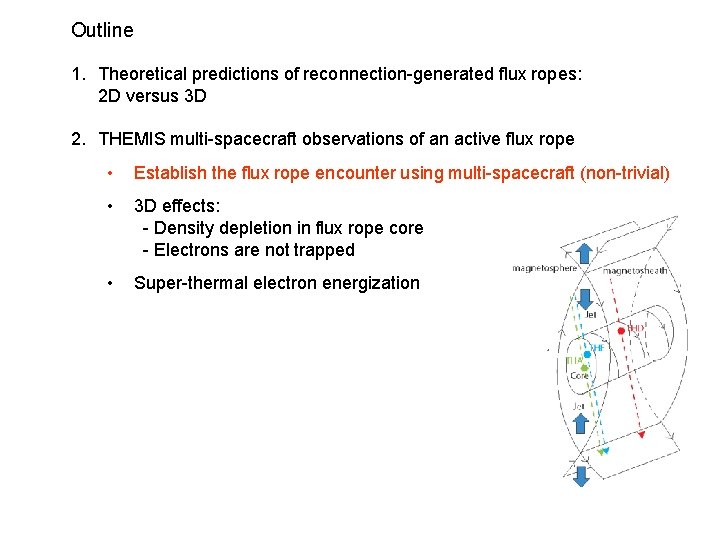
Outline 1. Theoretical predictions of reconnection-generated flux ropes: 2 D versus 3 D 2. THEMIS multi-spacecraft observations of an active flux rope • Establish the flux rope encounter using multi-spacecraft (non-trivial) • 3 D effects: - Density depletion in flux rope core - Electrons are not trapped • Super-thermal electron energization
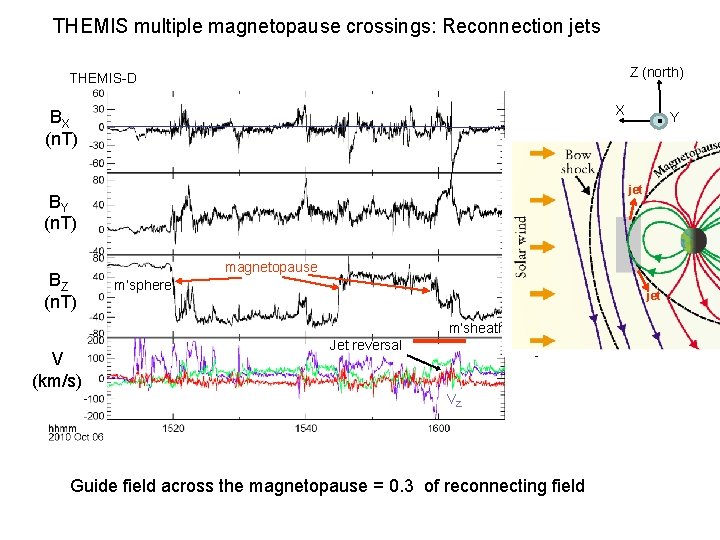
THEMIS multiple magnetopause crossings: Reconnection jets Z (north) THEMIS-D X BX (n. T) jet BY (n. T) BZ (n. T) magnetopause m’sphere jet m’sheath V (km/s) Y Jet reversal VZ Guide field across the magnetopause = 0. 3 of reconnecting field
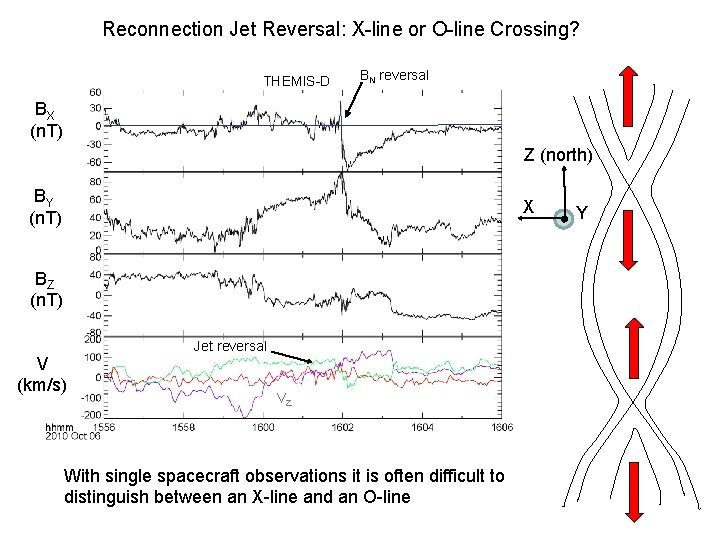
Reconnection Jet Reversal: X-line or O-line Crossing? THEMIS-D BN reversal BX (n. T) Z (north) BY (n. T) X BZ (n. T) V (km/s) Jet reversal VZ With single spacecraft observations it is often difficult to distinguish between an X-line and an O-line Y
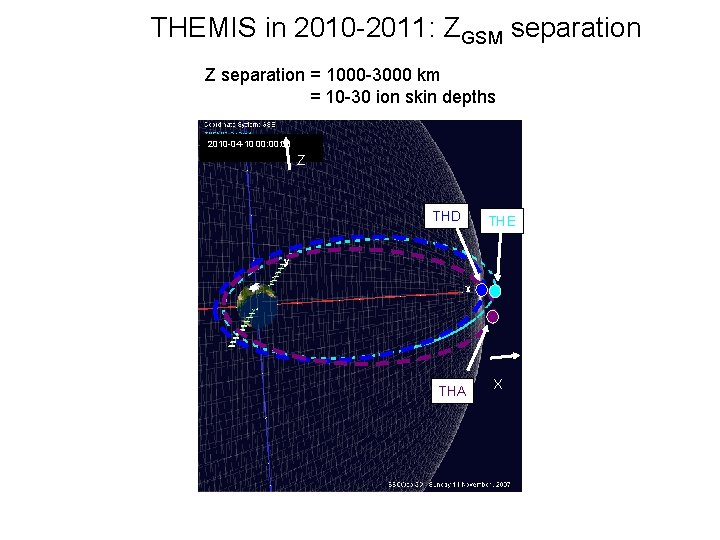
THEMIS in 2010 -2011: ZGSM separation Z separation = 1000 -3000 km = 10 -30 ion skin depths 2010 -04 -10 00: 00 Z THD THA THE X
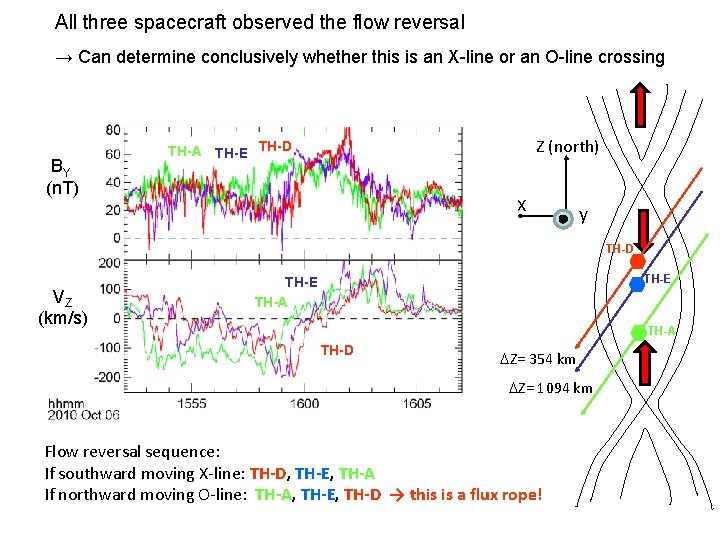
All three spacecraft observed the flow reversal → Can determine conclusively whether this is an X-line or an O-line crossing BY (n. T) Z (north) TH-A TH-E TH-D X y TH-D VZ (km/s) TH-E TH-A TH-D DZ= 354 km DZ= 1094 km Flow reversal sequence: If southward moving X-line: TH-D, TH-E, TH-A If northward moving O-line: TH-A, TH-E, TH-D → this is a flux rope!
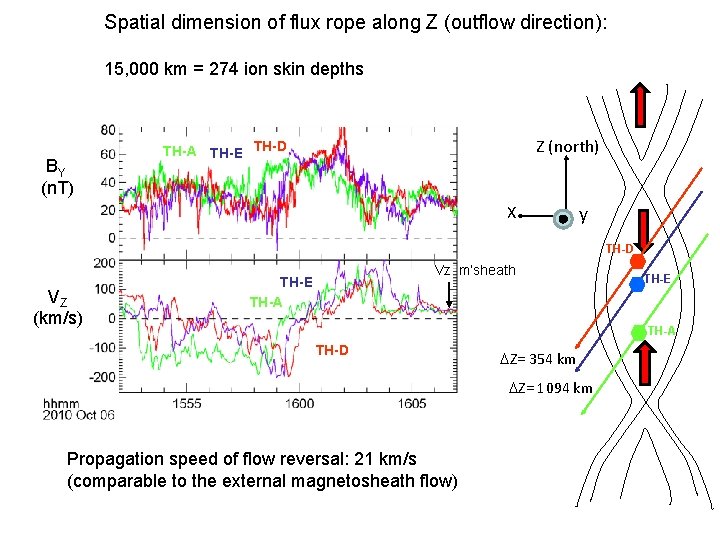
Spatial dimension of flux rope along Z (outflow direction): 15, 000 km = 274 ion skin depths BY (n. T) Z (north) TH-A TH-E TH-D X y TH-D VZ (km/s) Vz m’sheath TH-E TH-A TH-D DZ= 354 km DZ= 1094 km Propagation speed of flow reversal: 21 km/s (comparable to the external magnetosheath flow)
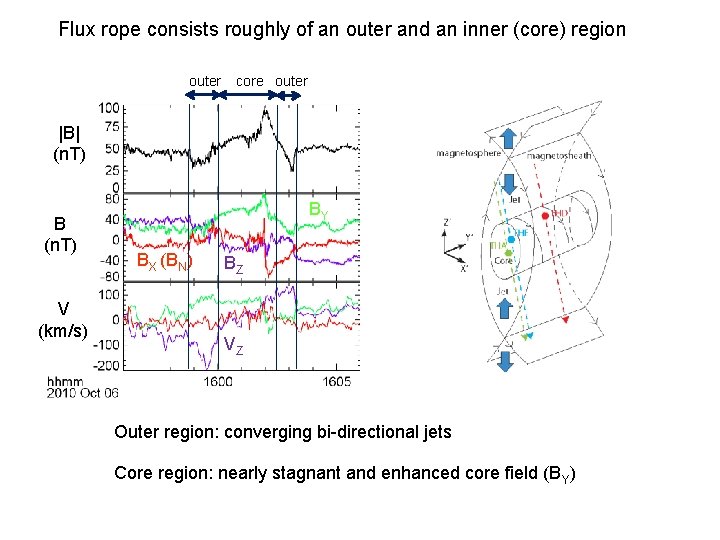
Flux rope consists roughly of an outer and an inner (core) region outer core outer |B| (n. T) B (n. T) V (km/s) BY BX (BN) BZ VZ Outer region: converging bi-directional jets Core region: nearly stagnant and enhanced core field (BY)
Outline 1. Theoretical predictions of reconnection-generated flux ropes: 2 D versus 3 D 2. THEMIS multi-spacecraft observations of an active flux rope • Establish the flux rope encounter using multi-spacecraft (non-trivial) • 3 D effects: - Density depletion in flux rope core - Electrons are not trapped • Super-thermal electron energization
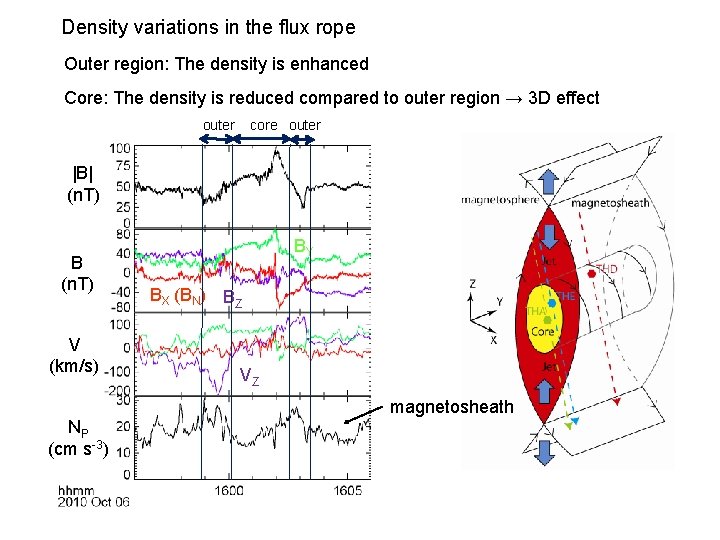
Density variations in the flux rope Outer region: The density is enhanced Core: The density is reduced compared to outer region → 3 D effect outer core outer |B| (n. T) B (n. T) V (km/s) BY BX (BN) BZ VZ magnetosheath NP (cm s-3)
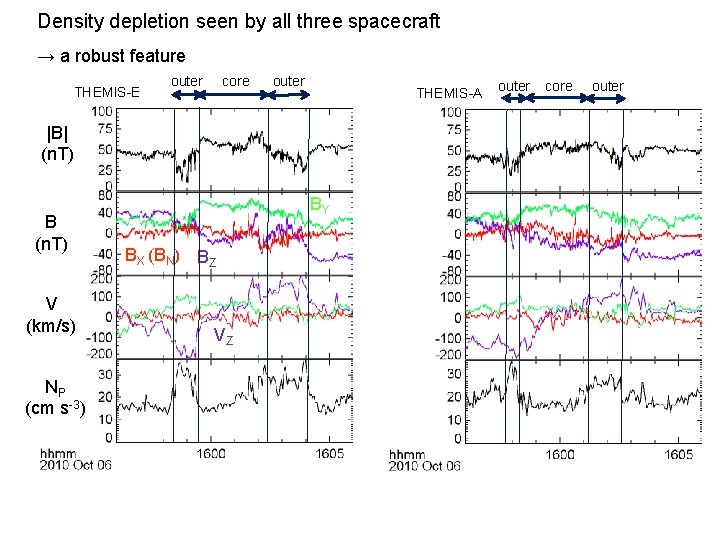
Density depletion seen by all three spacecraft → a robust feature THEMIS-E outer core outer THEMIS-A |B| (n. T) B (n. T) V (km/s) NP (cm s-3) BY BX (BN) BZ VZ outer core outer
Outline 1. Theoretical predictions of reconnection-generated flux ropes: 2 D versus 3 D 2. THEMIS multi-spacecraft observations of an active flux rope • Establish the flux rope encounter using multi-spacecraft (non-trivial) • 3 D effects: - Density depletion in flux rope core - Electrons are not trapped • Super-thermal electron energization
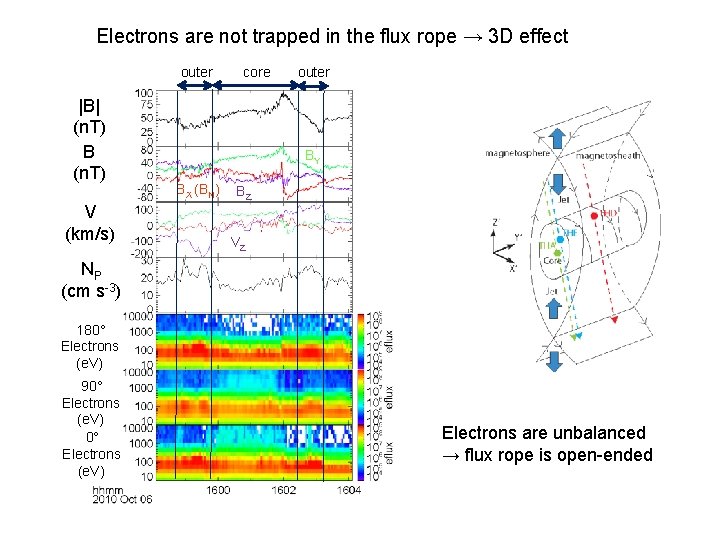
Electrons are not trapped in the flux rope → 3 D effect outer |B| (n. T) B (n. T) V (km/s) core outer BY BX (BN) BZ VZ NP (cm s-3) 180° Electrons (e. V) 90° Electrons (e. V) Electrons are unbalanced → flux rope is open-ended
Outline 1. Theoretical predictions of reconnection-generated flux ropes: 2 D versus 3 D 2. THEMIS multi-spacecraft observations of an active flux rope • Establish the flux rope encounter using multi-spacecraft (non-trivial) • 3 D effects: - Density depletion in flux rope core - Electrons are not trapped • Super-thermal electron energization
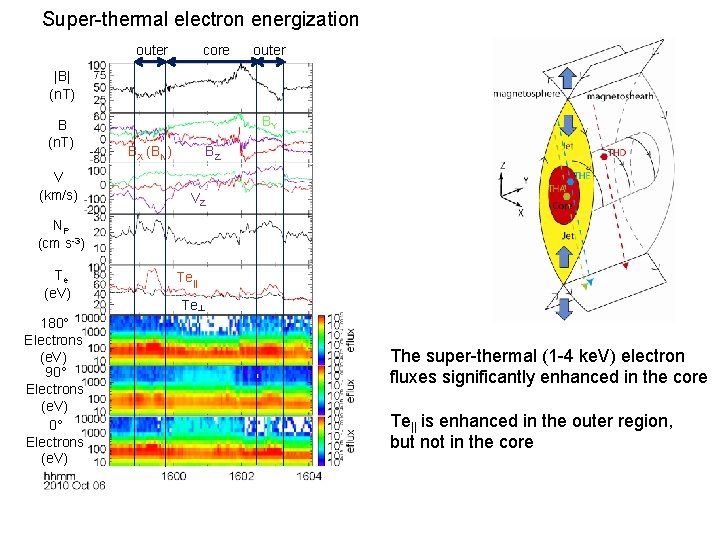
Super-thermal electron energization outer core outer |B| (n. T) B (n. T) V (km/s) BY BX (BN) BZ VZ NP (cm s-3) Te (e. V) 180° Electrons (e. V) 90° Electrons (e. V) Te|| Te┴ The super-thermal (1 -4 ke. V) electron fluxes significantly enhanced in the core Te|| is enhanced in the outer region, but not in the core
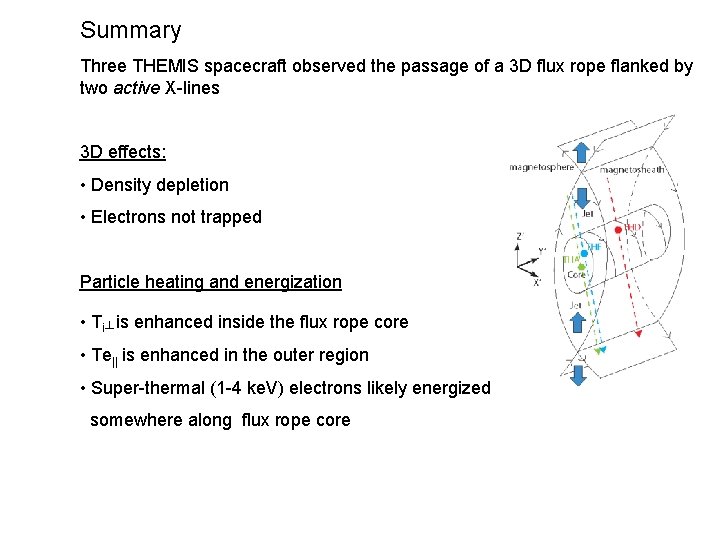
Summary Three THEMIS spacecraft observed the passage of a 3 D flux rope flanked by two active X-lines 3 D effects: • Density depletion • Electrons not trapped Particle heating and energization • Ti┴ is enhanced inside the flux rope core • Te|| is enhanced in the outer region • Super-thermal (1 -4 ke. V) electrons likely energized somewhere along flux rope core
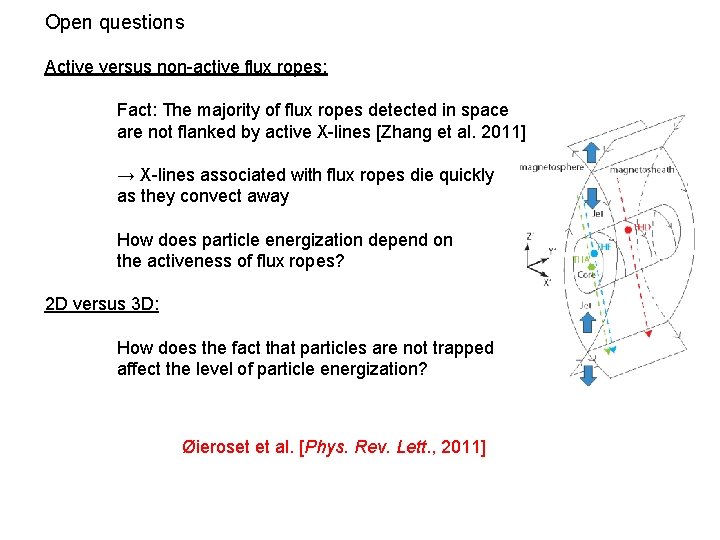
Open questions Active versus non-active flux ropes: Fact: The majority of flux ropes detected in space are not flanked by active X-lines [Zhang et al. 2011] → X-lines associated with flux ropes die quickly as they convect away How does particle energization depend on the activeness of flux ropes? 2 D versus 3 D: How does the fact that particles are not trapped affect the level of particle energization? Øieroset et al. [Phys. Rev. Lett. , 2011]
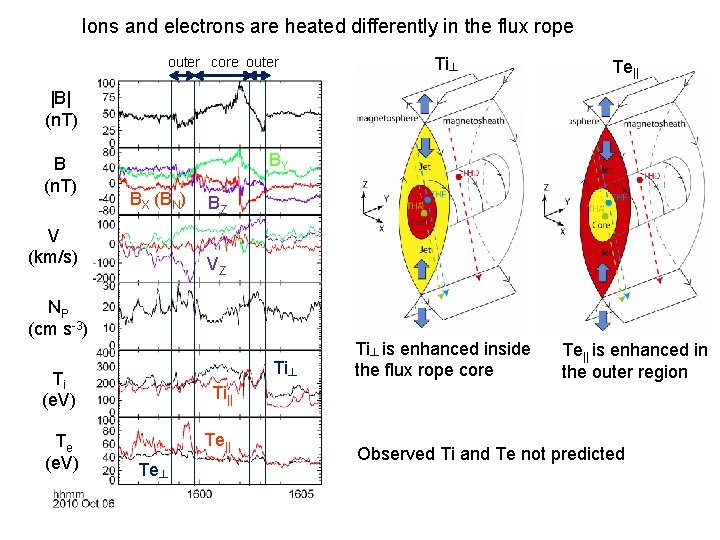
Ions and electrons are heated differently in the flux rope outer core outer Ti┴ Te|| |B| (n. T) BY BX (BN) V (km/s) BZ VZ NP (cm s-3) Ti┴ Ti (e. V) Te (e. V) Ti┴ is enhanced inside the flux rope core Te|| is enhanced in the outer region Ti|| Te┴ Observed Ti and Te not predicted
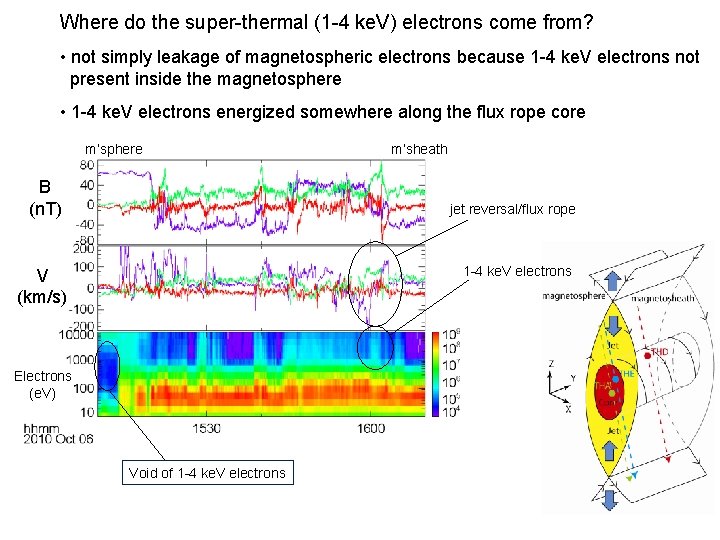
Where do the super-thermal (1 -4 ke. V) electrons come from? • not simply leakage of magnetospheric electrons because 1 -4 ke. V electrons not present inside the magnetosphere • 1 -4 ke. V electrons energized somewhere along the flux rope core m’sphere B (n. T) m’sheath jet reversal/flux rope 1 -4 ke. V electrons V (km/s) Electrons (e. V) Void of 1 -4 ke. V electrons
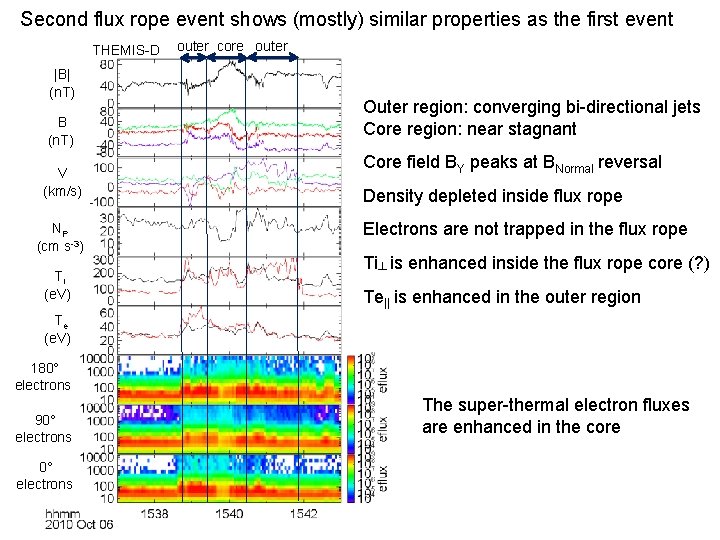
Second flux rope event shows (mostly) similar properties as the first event THEMIS-D |B| (n. T) B (n. T) V (km/s) NP (cm s-3) Ti (e. V) outer core outer Outer region: converging bi-directional jets Core region: near stagnant Core field BY peaks at BNormal reversal Density depleted inside flux rope Electrons are not trapped in the flux rope Ti┴ is enhanced inside the flux rope core (? ) Te|| is enhanced in the outer region Te (e. V) 180° electrons 90° electrons The super-thermal electron fluxes are enhanced in the core
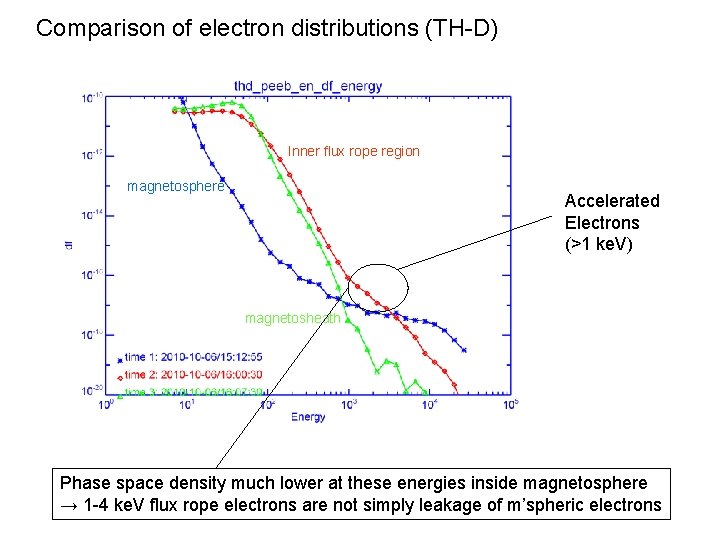
Comparison of electron distributions (TH-D) Inner flux rope region magnetosphere Accelerated Electrons (>1 ke. V) magnetosheath Phase space density much lower at these energies inside magnetosphere → 1 -4 ke. V flux rope electrons are not simply leakage of m’spheric electrons
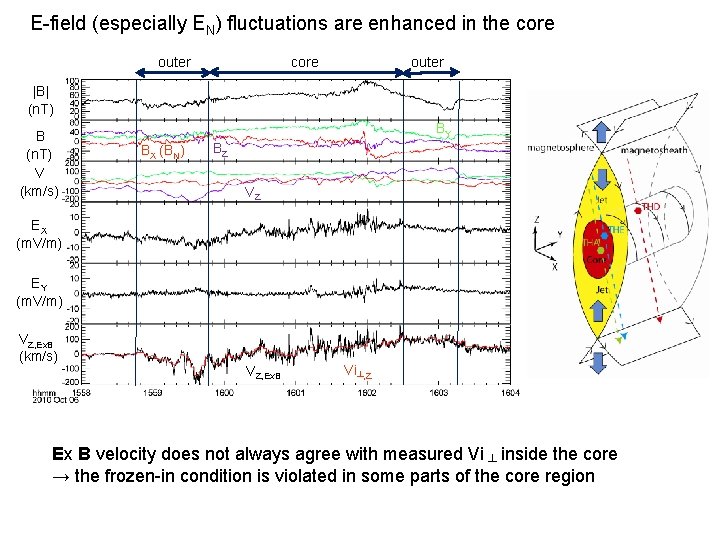
E-field (especially EN) fluctuations are enhanced in the core outer |B| (n. T) B (n. T) V (km/s) BY BX (BN) BZ VZ EX (m. V/m) EY (m. V/m) VZ, Ex. B (km/s) VZ, Ex. B Vi┴, Z Ex B velocity does not always agree with measured Vi ┴ inside the core → the frozen-in condition is violated in some parts of the core region
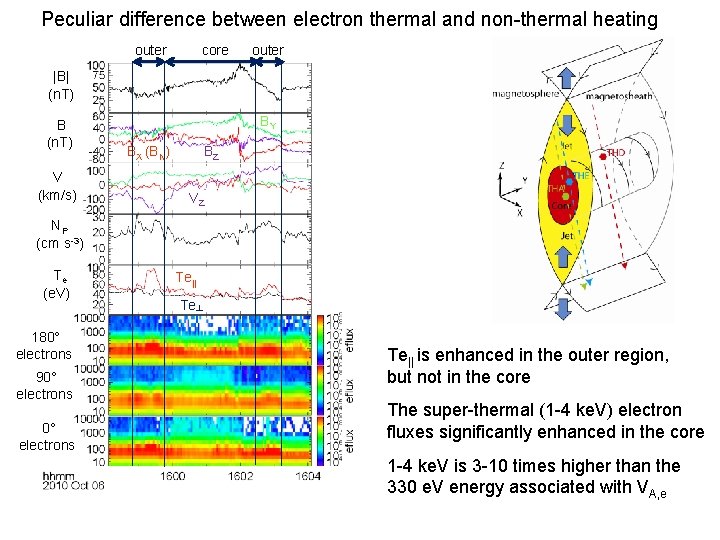
Peculiar difference between electron thermal and non-thermal heating outer core outer |B| (n. T) B (n. T) V (km/s) BY BX (BN) BZ VZ NP (cm s-3) Te (e. V) 180° electrons 90° electrons Te|| Te┴ Te|| is enhanced in the outer region, but not in the core The super-thermal (1 -4 ke. V) electron fluxes significantly enhanced in the core 1 -4 ke. V is 3 -10 times higher than the 330 e. V energy associated with VA, e
- Slides: 29